Wednesday, April 19, 2017

Interview _ Emma Lee

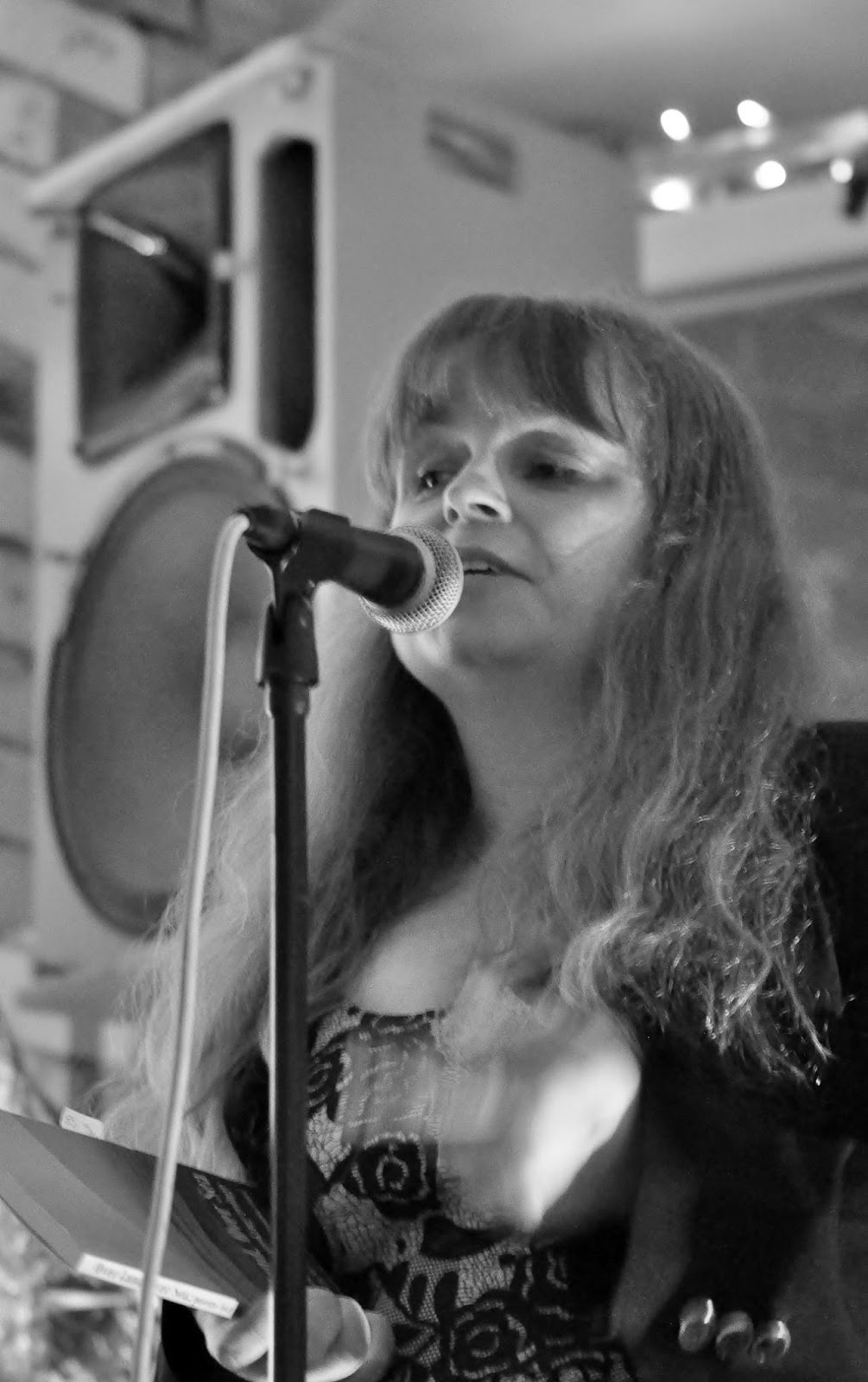
Emma Lee
Emma Lee co-edited Over Land, Over Sea: Poems for those seeking refuge (Five Leaves Publications, 2015) and is one of the coordinators of Journeys in Translation. She also co-edited Welcome to Leicester (Dahlia Publishing, 2016) and has three poetry collections, Ghosts in the Desert (Indigo Dreams Publishing, 2015), Mimicking a Snowdrop (Thynks, 2014) and Yellow Torchlight and the Blues (Original Plus, 2004).

She reviews for The High Window Journal, The Journal, London Grip and Sabotage Reviews and is currently Vice-President of Leicester Writers' Club. Her poems have been published in the UK, USA, Mexico and South Africa, broadcast on radio and she has performed them at venues such as Leicester City Football Club, Leicester's Guildhall and the Poetry Cafe in London.

In this interview Emma Lee talks about her writing and about Journeys in Translation.

How would you describe the writing you are currently doing?

In between poetry reviews and blog articles, there are poems. I'm currently taking part in NaPoWriMo (National Poetry Writing Month, April 2017) where the aim is to draft or make notes towards 30 poems during April, averaging a poem a day. Outside of NaPoWriMo, I'll still be writing poems, blog articles and reviews, going to poetry and spoken word events and Leicester Writers' Club, but without the pressure of averaging a poem a day.

In that, who or what has had the most influence on you?

I usually avoid naming contemporary poets for fear of leaving someone out, but it's fair to say many of them are my Indigo Dreams Publishing stable mates. Other influences include Sylvia Plath, Charlotte Mew, Rosemary Tonks, Maya Angelou, Marcia Douglas, Anna Akhmatova, Elizabeth Bishop, Robert Lowell.

How have your personal experiences influenced the writing?

Not all my poems are semi-autobiographical. I love that poems give me the chance to try and imagine what someone else's experiences feel like and explore how others might tell their stories if they were given a chance.

What has been your most significant achievement as a writer so far?

In terms of being noteworthy, probably co-editing Over Land, Over Sea: Poems for those seeking refuge (Five Leaves Publications, 2015), not only in the interest it generated in readings in Leicester, Nottingham, St Andrews, the Poetry Cafe in London and interviews in The Morning Star and on Iraqi TV, but also in fundraising for refugee charities and subsequent projects such as the Journeys Poems Pop-Up Library, Journeys in Translation and the "Poetry and 'The Jungle'" paper I presented at the Jungle Factory Symposium organised by the University of Leicester in 2017.

On a more personal level, it has to be the publication of my third collection Ghosts in the Desert (IDP, 2015).

How did you get involved with Journeys in Translation?

Ambrose Musiyiwa and I were chatting over coffee about the Journeys Poem Pop-up Library, where we gave out postcards featuring eight poems from Over Land, Over Sea at Leicester Railway Station during the Everybody's Reading Festival, and how we could build on that.

At the time of putting together Over Land, Over Sea we only took poems in English, a language common to all three co-editors, because our priority was to raise funds, however we were aware that the publication being monolingual was a potential issue because it raised barriers to reading and sharing poems about a universal experience. So the idea came about to translate some of the poems into other languages and break down some of those barriers.

We picked the eight poems used in the postcards and added a further five, using local poets so that we could work towards an event where the original poems would be read and displayed alongside readings and displays of some of the translations.

I suspect if I hadn't stopped for that coffee, I'd still be involved somehow.

"[We] were chatting over coffee about the Journeys Poem Pop-up Library, where we gave out postcards featuring eight poems from Over Land, Over Sea at Leicester Railway Station during the Everybody's Reading Festival, and how we could build on that."

Which were the easiest aspects of the work you put or are putting into the project?

Coming up with the design for the posters. We're using the cover image of Over Land, Over Sea and each poster features the original poem alongside one translation.

Where more than one translation in a specific language has been done, these are being featured with the original poem on one poster, where possible. For example, there are three German translations of "The Man Who Ran Through the Tunnel" and these are featured with the original English version on one poster. The idea is not to directly compare the translations, but discuss how the differences occurred and difficulties in translating phrases or idioms which don't have a direct translation into another language.

One of your poems, "Stories from 'The Jungle'" is also being used as part of Journeys in Translation. How did the poem come about?

One frequently asked question is along the lines of: "Why don't refugees apply for asylum in the first European country they arrive in?" or "Why do refugees camped in France want to come to the UK?"

I wanted to explore some answers to that.

Sometimes it's because the refugees already have family here and want to join their family. Sometimes it's because the only European language they speak is English (usually because they were from a former colony and English was and in some cases still is one of the official languages). Sometimes it's a combination of reasons.

"Stories from the Jungle" takes seven stories from newspaper interviews and explores them not only through the question of why try to get to England but also why leave home and country in the first place.

Primarily I was trying to show that refugees are people with stories too. Not only that but they also have the right to tell those stories in their own words and on their own terms. There are a lot of negative connotations attached to the word migrant. But there is also a tendency to imply refugees are victims with no agency. Neither is accurate.

We won't solve the problems that large migrations cause without understanding why they are happening. People don't choose to leave their homeland and embark upon long, perilous journeys unless they have good reason for doing so. In an age of austerity, it's easy to fall into the trap of seeing migration as an economic problem but it's not that simple. I wanted "Stories from 'The Jungle'" to re-humanise de-humanised people.

Emma Lee's poem "Stories from 'The Jungle'" on the pavement at the Leicester Against War / Leicester for Peace vigil. The vigil started in December 2015 and is held at the Clock Tower in Leicester, every Friday,  in solidarity with people everywhere who are bearing the brunt of war as well as those who are seeking refuge.

How has the poem been received?

One of the translators in the Journeys in Translation project commented:
I found that when focusing on the words and stories within the poems I started to really focus on the human aspect of the refugee crisis, which I had not perhaps really appreciated until this point. Suddenly all those news images and statistics took on a more personal meaning. When I read through the experiences of Abdel, Sayid and Ziad in “Stories from ‘The Jungle’” and the lives they left behind, which seemed very normal and comparable to my own, I couldn’t help thinking, "It could have been me!"
So far, which were the most challenging aspects of the work you put into the initiative? 

The most challenging was translating some of the poems myself. I do have a basic understanding of German but hadn't spoken or written in German recently. I started with my own poem because I knew the intention behind the words I'd chosen so wouldn't be so daunted by there not being a direct translation.

I used several online dictionaries (not just Google Translate) so I could be more confident I was picking the right German words for the poem. I also re-translated my German back into English using online dictionaries so I could be sure that the selected German words would be interpreted in the right way. It was very reassuring when others translated the same original poem into German and I could see their approach was very similar to mine, although still with small differences.

I had tried to reproduce the original rhyme scheme (at least by sight) in my translation, but the other translators had gone for a more literal translation without the rhymes.

What would you say is the value of initiatives like Journeys in Translation?

It's great to see the enthusiasm and involvement of both poets and translators.

Translating the poems isn't just about widening the audience for the original poems, it's about breaking down barriers to the poems being read and enabling the stories behind the poems to be shared. It also gives others the opportunity to share their stories and experiences.

Editor's Note:

Journeys in Translation aims to facilitate cross- and inter-cultural conversations around the themes of home, belonging and refuge.

The project encourages people who are bilingual or multilingual to have a go at translating 13 of the 101 poems from Over Land: Over Sea: Poems for those seeking refuge (Five Leaves Publications, 2015) from English into other languages and to share the translations, and reflections on the exercise on blogs, in letters and emails to family and friends, and on social media.

So far, the 13 poems that are being used as part of the project have been translated into languages that include Italian, German, Shona, Spanish, Bengali, British Sign Language, Farsi, Finnish, French, Turkish and Welsh. Currently, over 20 people from all over the world are working on the translations. More translations and more languages are on the way.

In Leicester, Journeys in Translation will culminate in an event that is going to be held on September 30 as part of Everybody's Reading 2017. During the event the original poems and translations will be read, discussed and displayed.

Over Land, Over Sea: Poems for Those Seeking Refuge (Five Leaves Publications, 2015) was edited by Kathleen Bell, Emma Lee and Siobhan Logan and is being sold to raise funds for Doctors Without Borders/ Médecins Sans Frontières (MSF)Leicester City of Sanctuary and the Nottingham and Nottinghamshire Refugee Forum.

Copies of the anthology are available from Five Leaves Bookshop (Nottingham).

More information on how Over Land, Over Sea came about is available here.

Monday, April 17, 2017

Interview _ Antonella Delmestri

Antonella Delmestri was born in Trieste, Italy, where she began her education in Classical Studies before moving to Computer Science. Holder of a PhD in Information and Communication Technologies, she is author or co-author of a number of scientific publications.

In 2004 her first collection of Italian poems, Stanze dove non eri stato mai, was published by Ibiskos. In 2016 her second collection, Il respiro del drago (The breath of the dragon), including an English translation by Anne Lloyd-Williams, was published by Battello Stampatore.

Antonella has also published in Italian a short story “E questo fu solo l’inizio!” and has won various literary awards with her poems. Since 2006, she has lived in the UK, and works at the University of Oxford in medical research.

In this interview, Antonella Delmestri talks about her poetry.

How have your personal experiences influenced your writing?

My personal experiences have entirely influenced my writing, even its very start and existence. I love T. S. Eliot’s definition of poetry:
Poetry is not a turning loose of emotion, but an escape from emotion; it is not the expression of personality, but an escape from personality. But, of course, only those who have personality and emotions know what it means to want to escape from these things.
Which authors influenced you most?

What has most influenced my writing is my classical background, especially Greek and Latin mythology. I am fascinated by the power of this psychologically evocative cultural expression, which remains significant through the ages in representing universal human emotions. Myths, archetypes and metaphors are symbolic ways of conveying deeper truths about ourselves and the world around us.

How would you describe Stanze dove non eri stato mai?

Stanze is a journey through different emotional states represented by the book's sections: "Ombre" (Shades), "Attimi" (Moments), "Sorrisi" (Smiles), "Miraggi" (Mirages) and "Catene" (Chains).

The reader is invited to discover different rooms (stanze in Italian) of a virtual house, which symbolises one's inner self and identity. This is what the book's title refers to (Rooms where you had never been in English), and is a line in one of the poems, "La vergogna" (Shame). The fact that Stanza has an additional meaning in poetry makes the title more evocative.

How did the collection come about?

I started writing poetry when I was in my early 30s and it was a complete surprise to me. One day I woke up and I just had to write.

Initially, everything I produced was in rhyme, and the rhymes were ready to come out effortlessly. It was an unsettling experience, because I was not used to it and I did not understand where it came from. Probably to give it some direction, I got into the habit of writing in the morning and editing the result later in the day. This activity of dreamy writing and file-editing went on for a few years undisturbed and solitary.

One day I heard of a publisher, Ibiskos, running a competition for poetry collections, and I began to consider sharing my writing with the outside world. I started selecting the poems that I thought might be suitable, and grouped them into sections. My collection was shortlisted in the competition and Ibiskos offered to publish it.

Antonella Delmestri's first poetry collection Stanze dove non eri stato mai was published in 2004 by Ibiskos Editrice. 
What were the easiest aspects of the work that went into the collection? And which where the most challenging?

The creation of the poems themselves was the easiest part of the work. But my writing is very deep, and I am always worried that it could be too intense for people to enjoy. I found it challenging to choose what to include in a collection, as I had to overcome this concern and try to focus on the quality of the poems instead. I asked a few trusted friends for their opinion and comments before reaching a final decision.

I received good feedback for the book. People seemed to connect with and relate to the poems, which was encouraging. Of course, the market for poetry is so small that it is difficult to have good distribution and advertising if you are not an established author, but I expected this difficulty.

In what way is your second collection similar to Stanze dove non eri stato mai? And, conversely, what sets Il respiro del drago apart from your first collection?

There are several similarities between the two collections. In both books, the poems are accessible, short, deep and sharp. Another similarity is the virtual journey offered to the reader through very different emotional atmospheres.

However, although the first collection accompanies the traveller through rooms of a symbolic house where the sequence of the passage is irrelevant, in The breath of the dragon, the exploration of human emotions follows a specific course with a higher degree of awareness. "Sparks", "Flames", "Embers" and "Smoke" track sequential stages of fire, as in a process of completion. This reflects a deeper and more mature understanding of emotions and their mechanisms.


Antonella Delmestri's second poetry collection, Il respiro del drago / The breath of the dragon (Battello Stampatore, 2016) is bilingual and includes Anne Lloyd-Williams' English translation of the poems. 

How did the bilingual edition of Il respiro del drago come about?

Il respiro del drago has been nearly ready for some time and, after several years of being overwhelmed at work, I felt I was ready to allocate again more attention and energy to my writing. When the draft was ready, I sent it to Battello Stampatore, a small publisher in Trieste who might have been interested. When I met the owner, he suggested producing an Italian/English edition, considering that English could give the poems more visibility.

One of my good friends in Oxford, Anne Lloyd-Williams, who has an interest in poetry and is an Italian speaker, was happy to collaborate on this project. The experience was fascinating for me, and it made me even more aware of the cultural differences between Italy and the UK, which are reflected in their languages' capabilities and richness.

Interestingly, after having read the English translation of Il respiro del drago, an American poet, David Olsen, expressed his interest in translating the poems of my previous book, Stanze, and we are now collaborating.

How would you describe the nature of your involvement with Journeys in Translation?

A friend of mine, who works at the Refugee Studies Centre of Oxford University, knowing my interest in poetry and humanitarian initiatives, forwarded an email regarding Journeys in Translation, which was seeking translators.

I was delighted to hear about the initiative, and to be able to contribute to an important project that will raise awareness on such a serious and current topic. Our society has become far too blind and deaf to our fellow human beings’ painful destinies. We, authors, should use our skills to help them.

I have translated into Italian nine of the 13 poems - those with which I felt confident, and which had not been previously translated into my mother tongue. Moreover, I am organizing a poetry reading in Oxford for late May for The breath of the dragon, and I am very excited about having different readers giving their voices to four of the poems from Journeys in Translation.

Which were the easiest aspects of the work you put into the initiative?

This has been my first experience of translating poetry into Italian. The easiest aspect was to get into the poems, as they were very meaningful and powerful.

What I found complicated sometimes was, how to be faithful to the original poem, while giving a poetic structure to the translation. After writing the first draft, I reviewed it several times while trying to keep an open mind, and finally I sent it to a friend for his opinion and suggestions.

"but one country" also had the extra challenge of having an earth shape, which is so visually expressive.

Antonella Delmestri's translation, into Italian of Rod Duncan's "but one country", one of the 13 poems from Over Land, Over Sea: Poems for those seeking refuge (Five Leaves Publications, 2015) that are being used as part of Journeys in Translation.


Editor's Note:

Journeys in Translation aims to facilitate cross- and inter-cultural conversations around the themes of home, belonging and refuge.

The project encourages people who are bilingual or multilingual to have a go at translating 13 of the 101 poems from Over Land: Over Sea: Poems for those seeking refuge (Five Leaves Publications, 2015) from English into other languages and to share the translations, and reflections on the exercise on blogs, in letters and emails to family and friends, and on social media.

So far, the 13 poems that are being used as part of the project have been translated into languages that include Italian, German, Shona, Spanish, Bengali, British Sign Language, Farsi, Finnish, French, Turkish and Welsh. Currently, over 20 people from all over the world are working on the translations. More translations and more languages are on the way.

In Leicester, Journeys in Translation will culminate in an event that is going to be held on September 30 as part of Everybody's Reading 2017. During the event the original poems and translations will be read, discussed and displayed.

Over Land, Over Sea: Poems for Those Seeking Refuge (Five Leaves Publications, 2015) was edited by Kathleen Bell, Emma Lee and Siobhan Logan and is being sold to raise funds for Doctors Without Borders/ Médecins Sans Frontières (MSF)Leicester City of Sanctuary and the Nottingham and Nottinghamshire Refugee Forum.

Copies of the anthology are available from Five Leaves Bookshop (Nottingham).

More information on how Over Land, Over Sea came about is available here.