Showing posts with label literature. Show all posts

Thursday, August 15, 2019

Interview _ Marija Todorova

Marija Todorova has worked for international organizations that include the United Nations Development Programme (UNDP), the United Nations High Commissioner for Refugees (UNHCR), the Department for International Development (DFID), and the Organization for Security and Co-operation in Europe (OSCE).

She is currently a Postdoctoral Fellow at The Hong Kong Polytechnic University. Her research interests include interpreters in mediation, intercultural education, and visual representation in translation.

Todorova is an Executive Council member of International Association for Translation and Intercultural Studies (IATIS). She holds a PhD in Translation Studies from the Hong Kong Baptist University, and a PhD in Peace and Development Studies from University Ss. Cyril and Methodius Skopje.

In this interview, Maria Todorova talks about translation, peacebuilding and Journeys in Translation:

What would you say is the role of translation or translation studies in peacebuilding?

For me, language is maybe one of the most important aspects of both peacebuilding and development. In the current state of the world when we are witnessing increasing numbers of refugee crises around the globe, the need for language professionals who work alongside humanitarian personnel is greater than ever.

My interest in this topic started with my employment with the United Nations High Commissioner for Refugees (UNHCR) during the Kosovo conflict in 1999 and the ensuing refugee crisis in Macedonia in 2001 as well as the repatriation process in Kosovo. I was interpreting for the refugees at the Macedonia-Kosovo border as well as in various refugee camps throughout Macedonia, and for the internally displaced people and minorities in Kosovo. This was a truly life-changing experience for me.

I have done a lot of research to explore some of the aspects that make interpreting in conflict different and specific.

My personal experience provides me with a lot of insight, and I also conducted interviews with people who were working as interpreters in both the Kosovo refugee crises and the European refugee crises. Although employed primarily for their linguistic skills, field staff working in situations of emergency often decide to adopt a role similar to that of a mediator, and giving voice to the vulnerable. In doing this they undertake tasks beyond the scope of the work of a language broker and more of a peacebuilder.

Can you tell us more about the book chapter, "Interpreting conflict: Memories of an interpreter"?

Interpreters have been traditionally seen as invisible. Even when their presence is mentioned by historians, interpreters working in conflict zones are rarely referred to by name or given space to share their stories and comment. However, if we listen to their accounts we may be able to learn a lot about how they feel and how they perform their tasks.

The chapter you mention was published in Transfiction: Research into the realities of translation fiction (John Benjamins Publishing Company, 2014), edited by Klaus Kaindl, Karlheinz Spitzl. The chapter makes an attempt to make some sense of the life of a Serbian interpreter in a Kosovo US Army base by examining the main character of Tanja Jankovic’s semi-autobiographical work of fiction, The Girl from Bondsteel. The novel is an account of how an interpreter copes with the difficult situation of being “in between”. This ‘in-betweenness’, however, does not mean being in a place which is neutral or objective, in between cultures. For Diana, the main character in the novel, this means constantly making decisions and taking sides based on her own ideologies and loyalties which are connected with specific cultural spaces, and not with the ‘in-between’.

And, with Zoran Poposki, you co-authored "Public memory in post-conflict Skopje: Civic art as resistance to narratives of ethnicity and disintegration". Can you tell us more about that chapter as well?

The violent conflicts in the countries emerging out of former Yugoslavia may be a thing of the past but the ethnic and nationalistic tensions underlying them remain part of the daily life in the new independent states. This article looks at how art in public space is used to promote or resist the legacy and ideology of ethnic division, disintegration and conflict.

The article, in Post-Conflict Performance, Film and Visual Arts: Cities of Memory (Palgrave Macmillan, 2016), edited by Des O'Rawe and Mark Phelan, explores tactics of creative resistance to the official public narrative of ethnicity, history and disintegration, focusing on the work of a few Macedonian new media artists who seek to resist the government-led transformation of Skopje’s public space into a place of division and spectacular power. One of these artists, Zoran Poposki has produced several projects focusing his art on transforming the public space from a place of exclusion into a place of inclusion and representation of the multifaceted nature of Skopje’s citizens.

In the article, we also focus on the difference between public art proper (artworks in public space commissioned by governmental or corporate entities that ultimately reproduce existing mechanisms and relations of power as well as a culture that glorifies violence); and civic art (artworks in the public sphere, largely immaterial in form and created through broad participatory processes that are representative of various counter-publics and help create a culture of peace).

You are also the author of "Hong Kong Diversity in Anglophone Children’s Fiction". Tell us more.

A few years ago, my family and I moved to Hong Kong. Moving to a new country for us meant being able to learn a new culture, experience it in our own unique way, and adding that layer to our existing (multi)cultural experiences.

It also meant implanting a bit of ourselves in the diverse and cosmopolitan culture of Hong Kong.

We do this by embracing the local literary and art scene. Hong Kong offers a unique possibility to do this due to its production of local books in the English language.

I was particularly drawn to children’s literature because of its potential to transform and change deeply rooted stereotypes.

My study, "Hong Kong Diversity in Anglophone Children’s Fiction" (in Cultural Conflict in Hong Kong: Angles on a Coherent Imaginary (Palgrave Macmillan, 2018), edited by Jason S. Polley, Vinton W.K. Poon and Lian-Hee Wee), approaches fiction books for children as framing and representation sites that contest or promote stereotypes. Books should assist children in building their identities and thus encourage children to accept differences and reject discrimination. They should serve to open young readers’ horizons to other cultures and ways of life, thereby helping them to overcome fears that stem from ignorance.

The written word has a great potential to convey to children information about social diversity. One of the goals of effective use of children’s literature is to familiarize and celebrate cultural difference, to develop interaction, experience, understanding, and respect for people from different cultures. Both Anglophone children’s books and the Anglophone authors from Hong Kong speak to the diversity in Hong Kong, but migrant and ethnic minority experiences are still less likely to become the center of Anglophone children books published and distributed in Hong Kong.

How did you get involved with Journeys in Translation?

Translation is not only my profession; it is something I take great pleasure in. In addition to my work as an award-winning professional translator of numerous literary works primarily catering to a particular market, serving as a volunteer translator gives me the opportunity to participate in the socio-cultural processes by promoting the voices of the marginalized periphery.

For several years, I have served as a volunteer translator for the International Children’s Digital Library, translating children’s picture books in Macedonian. It all started with the translation of the picture book, Ciconia, Ciconia by the Croatian author, Andrea Petrlik Huseinović, about a white stork who is forced to leave its home destroyed by war.

In Hong Kong, I have served as a co-translator for the Hong Kong Poetry Festival, introducing Macedonian, Bosnian and Serbian poetry to Hong Kong readers. On the other hand, literature produced in and about Hong Kong is often overlooked by foreign translators and critics, rarely getting the attention it deserves as part of the world literary scene. Thus, my translation students at the Hong Kong Baptist University and I curated a website that introduces new contemporary prose and poetry from Hong Kong authors to English readers.

Hong Kong is also home of a significant migrant and refugee community. Recently, I was invited as guest speaker at a literary sharing on the issue of belonging and hospitality. Here I shared some of the poetry from Journey in Translation and the poems were received with great interest.

Marija Todorova's translation, into Macedonian, of Emma Lee’s “Stories from 'The Jungle'”, Over Land, Over Sea: Poems for those seeking refuge (Five Leaves Publications, 2015) p.85. 

Which were the most challenging aspects of the work you put into the initiative?

Translating poetry is not an easy task. Poetry contains a multi-layered and complex language, condensed with images and feelings, very different from any other literary genre. Translating poetry means that one has to interpret all the potential meanings embedded in these features. For some poems this meant retaining the poetic form as well. Whether or not this is at all possible when translating poetry from one language to another is a big question. Finding the right words to make the same impact in a new language can be very challenging.

Which were the most enjoyable aspects of the work?

Translating poetry is a very rewarding task. By translating the poetry in the Journeys in Translation project into Macedonian language I hope to contribute to the internationalization of the narratives of refugees and their plight. With this translation I hope to confront and change the misperceptions and stereotypes of the ‘other’ as enemy, along with providing positive models for acceptance and integration. This acceptance of cultural diversity as a positive thing and not as an obstacle helps promote models of coexistence and the expansion of identity.

As Macedonia has been affected by several refugee crises over the years, these poems will find resonance with the readers affected by the cultural conflict still present in the country.

Translating into Macedonian does not only represent sharing different voices and perspectives with the Macedonian readers. For me, it also means preserving the Macedonian language.

What would you say is the value of initiatives like Journeys in Translation?

Culture has been seen as an integral part of conflict, being both the cause of and channel for direct violence and its justification, as art can also be used to perpetuate cultural violence. Johan Galtung defines ‘cultural violence’ as referring to aspects of culture such as religion, language, art, empirical science and formal science, all of which justify direct and structural violence.

Art has an important role to play in the symbolic continuation or challenging of that culture of violence. Art, in all forms, is used as resistance to narratives of hate. The artist is a citizen, too, who reacts to social problems in the city just like everyone else.

By being an oppositional aesthetic practice, art of the activist or socially engaged type can offer powerful resistance to the state’s power structures, becoming civic art, the type of ‘art that promotes and creates civic values, invites and fosters citizen participation in public affairs’, all of which are essential to the functioning of democracy as a discursive space. In this process, culture is perceived as vital to social transformation, conflict mediation and resolution.

Editor's Note:

Journeys in Translation aims to facilitate cross- and inter-cultural conversations around the themes of home, belonging and refuge.

The project encourages people who are bilingual or multilingual to have a go at translating 13 of the 101 poems from Over Land: Over Sea: Poems for those seeking refuge (Five Leaves Publications, 2015) from English into other languages and to share the translations, and reflections on the exercise through blogs, letters, emails to family and friends, and on social media.

So far, the 13 poems that are being used as part of the project have been translated into languages that include Italian, German, Shona, Spanish, Bengali, British Sign Language, Farsi, Finnish, French, Turkish and Welsh. 

Over Land, Over Sea was edited by Kathleen Bell, Emma Lee and Siobhan Logan and is being sold to raise funds for Doctors Without Borders/ Médecins Sans Frontières (MSF), Leicester City of Sanctuary and the Nottingham and Nottinghamshire Refugee Forum.

Copies of the anthology are available from Five Leaves Bookshop (Nottingham).

More information on how Over Land, Over Sea came about is available here.

Wednesday, July 24, 2019

Interview _ Deborah Tyler-Bennett

Deborah Tyler-Bennett is a poet and fiction writer with eight volumes of poems and three volumes of short linked stories to her credit. She is currently working on her first novel, Livin' in a Great Big Way. Her new volume, Ken Dodd Takes a Holiday, will be out from King's England in 2019.

Her poems have also been featured in anthologies that include Bollocks to Brexit: an Anthology of Poems and Short Fiction (CivicLeicester, 2019), Leicester 2084 AD: New Poems about The City (CivicLeicester, 2018) and Welcome to Leicester (Dahlia Publishing, 2016).

In an earlier interview, Deborah talked about her concerns as a writer, and some of the influences she draws on.

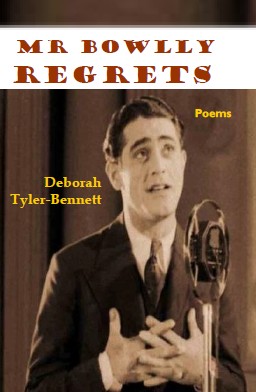
In this new interview, Deborah talks about her latest book, Mr Bowlly Regrets, and about poetry and politics:

Do you write every day?

I do write everyday: on trains; in cafés; in bars; at home; in other settings. I try and give myself a timetable between teaching Adult Ed creative writing, workshops, and performances, and the writing itself. I think the important thing is to do it. If the session is me writing alone, I split my day between the writing and reading aloud what I’ve done so far. I end when I feel the writing’s becoming stale and I need a break. I think knowing when to stop’s an art like anything else.

How many books have you written so far?

I have just finished the manuscript of my ninth poetry collection and am working on my first novel. I’ve also written three books of linked short fictions set in the world of variety. Also, I’ve had published a poetry pilot for schools and three creative writing textbooks and packs. I was fortunate enough to co-author the Victoria and Albert Museum’s creative writing web package with Gillian Spraggs. See below for details:

Volumes and Chapbooks: Poetry

Forthcoming 2019: Ken Dodd Takes a Holiday (King’s England).

Mr Bowlly Regrets (King’s England, 2017)

Napoleon Solo Biscuits (King’s England, 2015)

Volume Using Record Office Collection, Leicester:

Friendship’s Scrapbook (University of Leicester, 2015, reprinted and re-issued as two volumes in 2017, with extracts being published by the University’s Centre for New Writing in Women’s Writing in the Midlands 1750-1850, 2016). Two of the poems were later displayed on the front of Leicester University’s David Wilson Library and in the new Digital Resource Centre, for International Women's Day, 2018. ‘A Walk with Susanna Watts’ from the collection also appeared in Welcome to Leicester (Dahlia Publishing, 2016). Two Responses to the poems, plus a poem based on images of child migrants appeared in Leicester 2084 AD (CivicLeicester, 2018).

Kinda Keats (Shoestring, 2013): Inspired by Residency at Keats House, Hampstead.

Revudeville (King’s England, 2011): Featured many poems inspired by adult and school museum workshops.

Mytton … Dyer … Sweet Billy Gibson (Nine Arches, 2011). Three portraits in verse.

Pavilion (Smokestack, 2010). Poems set in Brighton and featuring images of Dandies.

Clark Gable in Mansfield (King’s England, 2003)

Selected Poems:

Take Five (Shoestring, 2003); The Staring Owl: An Anthology of Poems by the Poets of the King’s England Press (King’s England, 2017)

Special Museum Volume:

Ballad of Epping and Other Poems (Leicestershire Open Museum Pilot, 2007-2008)

Three linked books of short stories set in the 1940s/ 1950s/ 1960s world of variety:

Turned Out Nice Again (King’s England, 2013),

Mice That Roared (King’s England, 2015),

Brand New Beat (King’s England, 2017).

Museum and Education Volumes:

Words and Things: Writing Creatively from Objects and Art (with Mark Goodwin et al, Leicestershire County Council, 2008).

Speaking Words: Writing for Reading Aloud (Crystal Clear, 2005),

Poetry, Prose, and Playfulness for Teachers and Learners (with Mark Goodwin, Leicestershire County Council, 2004).

Museum Packs:

Leicestershire and Nottingham museums (includes Art and Education packs for Leicester’s Open Museum).

Special Commission, Victoria and Albert Museum:

Co-authored creative writing adult education web-package for the Victoria and Albert Museum with Gillian Spraggs, which included two of my poems on objects, these have since been used for summer schools at Wake Forest University, NC, USA and elsewhere.

See also Wellcome Collection work at the British Society for the History of Science (BSHS).

What is your latest book about?

It’s called Mr Bowlly Regrets, is a book of poems, and came out from King’s England Press in 2017. It has many poems about growing up, memory, and change, some on performers, including Britain’s Bing Crosby, the wonderful Al Bowlly. It also contains a sequence on the First World War, which came from a series of Lottery Funded workshops done for Diseworth and other Leicestershire villages. Those poems often contain images of real soldiers from the villages’ war memorials.

I’ve also just completed a further volume of poems for King’s England, Ken Dodd Takes a Holiday which is due out later in 2019. The poems are mainly about theatre and imagery from the lives of Music Hall and Variety performers – of which an elegy for Ken Dodd (to my mind the last of the Victorian inspired performers) is key to the rest of the poems.

On top of these, I’m working on my first novel, Livin’ in a Great Big Way, for the same publisher. This tells the story of Dad, Rosa, and their daughter, Spring, who live on Velia Street, Sutton-in-Ashfield. When the novel opens it’s 1946. Spring’s beloved Aunt, Reena, is dying, and her husband, Nev, is just back from service in Italy. The family have kept things buttoned-up throughout the war, but as Reena fades, secrets and confessions begin spilling out. Also, Dad has visions of moving up in the world, while Rosa’s happy where she is. This is not to mention Grandad Stocks who lives with Mrs Close, much to the family’s shame, Mrs Jim, next door neighbor and Velia Street’s beating heart, and Butcher Mr Cole and his odd wife – whose dreadful crime will come to haunt them all.

How long did it take you to write the book? 

My forthcoming book of poems has taken me a couple of years but, interestingly-enough, some of the poems are earlier ones I had in magazines and have since re-written. The poems in Mr Bowlly, likewise, took a couple of years to write, and King’s England published it in 2017. The novel was begun on the way back from the Callander Poetry Weekend in Scotland, in 2017. At first, I thought it was a short story, but it got longer and longer. So, in the end I had to admit it was a novel and carry on!

How did you chose a publisher for the book? Why this publisher? What advantages and/or disadvantages has this presented? How are you dealing with these?

Over the years I’ve had many publishers including Shoestring Press, Smokestack, University of Leicester Press, Leicester County Council Press, Nine Arches Press, and others. But the majority-of my stories and poems have been published by King’s England Press, Huddersfield, under direction of Steve Rudd. When they accepted my first volume of poems, Clark Gable in Mansfield in 2003, they published mainly historic and children’s books. Over years their poetry and fiction lists have grown, and I’ve come to trust Steve’s judgement as an editor. He’s allowed me a lot of consultation on how the volumes look, and how my poetry and prose is presented. He’s also allowed me to experiment and been honest over what did and didn’t work. So, I’ve enjoyed working with him and continue to do so.

Which aspects of the work you put into the book did you find most difficult? Why do you think this was so? How did you deal with these difficulties?

I think with most of my books of poems I deal with memory and characters a lot. I want the poems to be true to the ‘voices’ of various narratives and narrators. So, I think about who sees, who speaks, and period detail as I work. In Mr Bowlly, I wanted the title poem to bring Al Bowlly’s life, the fact he’s such a great performer and yet didn’t get his fair dues from history (he died in 1941 during the blitz, is buried in a communal grave, and has a blue plaque but no statue), and his wonderful singing voice to life. In performance I sing bits of the poem. If someone comes away from reading the volume to watch a clip of him on YouTube, I’ll be happy.

Which aspects of the work did you enjoy most? Why is this?

I enjoyed playing with poetic form in Mr Bowlly – there are sonnets, monologues in rhyming couplets, shaped poems, a poem to the rhythm Longfellow uses in ‘Hiawatha’, unrhymed couplets, and poems chiefly in dialogue. I love playing with form and have previously used sestinas and villanelles, which I go back to in my forthcoming book. Form really tests you, makes you think, and alters the poetic ‘voice.’ I review many poetry books and always feel a bit cheated when a poet doesn’t stretch themselves via form. Lots of unrhymed ‘free verse’ (like many poems I find the term doesn’t really describe what a verse with structures you come up with is) can feel much the same to me. So, I like testing the limits of a poem, and form helps me do this.

What sets the book apart from other things you’ve written?

Although most books represent developments and, hopefully, advancements in style and technique, I think Mr Bowlly differed in that I wanted the sections of the book to be read in tandem, but also stand alone.

I also think I dealt with the subject matter of the First World War in a more sequential way. Those poems were important to me as they dealt with histories of real soldiers that I came across during my workshops and I really wanted to get things right. I also realised that I used the poems to memorialise people who may not have got much of a memorial in death, a technique I began with an earlier poem about my Great Grandad’s son – ‘James William Gibson’ (in Mytton …Dyer …Sweet Billy Gibson) – who died in infancy and was buried below the cemetery wall. The soldiers I came across and used in poems for this newer volume often came from Institutions like the Industrial Schools, so, their next of kin might be their last employer.

In what way is it similar-to the others?

I think I’ve looked at similar histories and voices throughout my poetic career – maybe I’m fascinated with the ‘little things’ in history (both familial and wider) which, as my friend Ray Gosling once remarked, might be more important than the big things.

What will your next book be about?

As this will be the novel, I’d say about family life, of the triumphs and tragedies of human beings being able to live and work together. I realised, also, that the book has a lot of images of craft, (sewing, making, cooking etc.) that may go un-sung as a talent because people separate if from art. I collect vintage items from the 1940s, and often go to 1940s events, loving the music, endurance, and style of the period. Talking to historians and re-enactors (there are some splendid displays on the Home Front, from wedding dresses to the contents of a larder) has made me aware that making something from nothing is a skill to celebrate and venerate – yet often it’s passed-over in favour of the more showy-and-expensive object.

I have begun collecting brooches made by women (started when Mum gave me a brooch made by my Great Aunt from fuse wire, a belt buckle, and buttons shaped like flowers) and marvel at the artistry they create from things you would throw away. I wanted the novel to celebrate craft as someone’s art, their talent, and love – hence Reena in the book is a wonderful seamstress, and Mrs Jim comments at what she might have achieved with money behind her.

What would you say has been your most significant achievement as a writer?

I think, like most writers it’s carrying on writing. Not many people get to do what they love every day, and I think that’s something to be celebrated and, also, marveled at. Obviously, getting published is significant, as it gives your voice an audience, and I hope never to take this for granted. I’ve also been very lucky in the places I’ve worked and read in from the Wellcome Trust, Brighton Pavilion, and Keats House in Hampstead (where I did a residency), to small art galleries, schools and colleges – I wouldn’t have guessed, early on, that I’d work for any of them.

You have a poem featured in Bollocks to Brexit: An Anthology of Poems and Short Fiction. How did the poem come about?

I was tremendously pleased to be asked to be in the book and another poem on Brexit, ‘Ennui’, appears in my new collection. As a writer and someone who has always considered themselves a European, the divisions occasioned by Brexit have made me tremendously sad. I think that the poem, which I wrote especially for the volume, gave me an opportunity to highlight these divisions as they seem to me.

I hope the poem gives you a whistle-stop tour of what I observed after the vote, and how I consider it is the young who will suffer loss of opportunities, from which European Citizens such as myself benefited, from this most disastrous decision. When you feel that your voice is not being heard above shouting – poetry can give you your voice back.

Why is it important for poets to speak up on social, political and related matters?

Poetry has always spoken out on such matters! From Shelley to Blake, Suffragette poets to John Cooper Clarke, poets speak for themselves but also often for the excluded, and those finding themselves ‘voiceless.’

I think it’s worth considering that people sometimes remember lines from a poem giving protest, such as poems by Sassoon, Owen, and Graves from the First World War and those lines come to represent certain times in history perhaps more poignantly than anything else.

What do anthologies like Bollocks to Brexit add to poetry and public discourse?

In a time of shouting, it’s important to hear something more measured, and in a time when phrases such as ‘will of the people’ are being bandied about, it’s a good thing to remember that not all ‘people’ are being represented. You can read a poem over-and-over again, and think about it, come back to it. I always thought Barrack Obama sounded a better statesman than most, because I felt he’d considered his words with care.

Poetry considers its words with care.

Seamus Heaney talked of the right words in their proper places. I think public discourse, at present, is lacking in thoughtful, measured words. Perhaps it’s up to poetry to fill-in the gap.

Friday, July 19, 2019

Interview _ Deborah Tyler-Bennett

Deborah Tyler-Bennett’s forthcoming volume, Ken Dodd Takes a Holiday, is out from King’s England Press in 2019, and her first novel, Livin’ In a Great Big Way is in preparation for the same publisher. She also has two recent volumes from the same publisher – Mr Bowlly Regrets – Poems, and Brand New Beat: Linked Short Fictions Set in the 1960s (both 2017).

She’s had seven collections of poetry published, some previous volumes being Napoleon Solo Biscuits (King’s England, 2015), poems based on growing up in the 1960s and ‘70s, and Kinda Keats (Shoestring, 2013), work deriving from a residency at Keats House, Hampstead.

Her first collection of linked, 1940s set, short stories, Turned Out Nice Again came out from King’s England in 2013, and a sequel, set in the 1950s, Mice that Roared was published in 2015, Brand New Beat, set in the 1960s, represents the final part of the trilogy.

In 2016, The Coffee House Anthology from Charnwood Arts marked the final volume of Coffee House magazine, which she edited for twenty-five issues over fifteen years (this was featured on the Poetry Society’s poetic map of England).

Translations and publications of her poems have appeared in Spain, Ireland, The US, Scotland, Austria, and Romania, where they were broadcast on Radio Bucharest. She’s also read in Belgium.

Deborah regularly reviews poetry and has written books and education packs on creative writing.

Recent poems have appeared in the anthologies Double Bill (Red Squirrel, 2014), Maps and Legends (Nine Arches, 2013), Strike Up the Band: Poems for John Lucas at Eighty (Plas Gwyn Books, 2017), and the Max Miller Society journal, who recently published the elegy for Ken Dodd that forms the title poem in her new book. New poems appear in Leicester 2084 AD (CivicLeicester, 2018).

She regularly performs her work and has appeared at many venues in Brighton, London, the East Midlands and nationally. She occasionally teams up with music hall expert Ann Featherstone to perform variety stories from her first two collections. She also does many workshops for adult and school groups, teaches writing classes for the WEA, and hosts workshops for national galleries and museums.

In 2018 one of her poems was displayed on the side of Leicester University Library, and one at its new digital resource centre, for International Women’s Day.

With Gillian Spraggs, she co-authored the Victoria and Albert Museum’s creative writing web pages. She’s also currently working on a new poetic sequence, The Ladies of Harris’s List set in the eighteenth-century, and a series of music hall poems with Andy Jackson.

In this interview, Deborah Tyler-Bennett talks about her writing:

When did you start writing?

I’ve been writing things down for as long as I can remember being able to write and recall composing poems and bits of stories from the age of about eight. I don’t think I started taking the writing seriously until I was in my early twenties. Then you realise you’re starting to have drawers and notebooks full of stuff and you need to do something creative with it. I don’t think I felt I’d earned being called a ‘writer’ until I’d had a significant amount of work published.

How did you decide you wanted to be a published writer?

I think the above realisation (that you have lots of work and unless someone else gets to read it, it’s a little pointless, and also you have no feedback on what others think of it) drives you to send work out. Personally, I began sending poems to little magazines and competitions. I felt that if I had a body of published work behind me, and people responded to it, then maybe I could send work away for consideration as a collection.

The more I had published in little magazines, the more I felt I was becoming part of a poetic community and, also, most crucially, the more I learned. Editors sending advice and encouragement was invaluable to me. I also considered the range of where I sent to – I had quite a few things published in Ireland and found the magazines there an aesthetic delight. To achieve publication takes a thick skin and the old cliché about all writers getting used to rejections is true – but these make the publications you do get, sweeter.

How would you describe the writing you are doing?

I think my writing has changed a lot over the years. At-the-moment, I’ve just finished my ninth volume of poetry and am working on new poems. I’m also writing my first novel. This comes after three volumes of linked short stories. It’s always hard to describe your own work but I think I’ve become fascinated by the lives of so-called ‘ordinary’ people – and have come to believe that no one has an ‘ordinary life.’

I think writing is a great way of conveying past and present – and have noticed two things, recently, in commentaries on my work. Firstly, people comment on my use of Nottinghamshire dialect, as if it’s something unusual to use. Secondly, people often think I’ve invented elements that come from my own background and family history. I feel as if we’re living at a cultural time where, if we’re not careful, and despite the success of writers like Sally Wainwright and Andrew Graves on the script writing and poetry scenes, we’ll be going back to the idea of the arts as a preserve of the privileged and socially connected.

I realise what’s not unusual for me, seems unusual to some, and that there are many assumptions made about writing from ‘ordinary’ life.

I’m also using a lot of images and characters from music hall in my poetry (my new book’s titled Ken Dodd Takes a Holiday) as I do think that this reflects a type of history that often gets ignored, sidelined, or damned with the loaded phrase ‘popular culture.’

I’ve also started to take my painting more seriously and exhibit work and suspect that the colours and textures I use in visual art creep into my poems and stories.

Who is your target audience?

This question is interesting. When I started, I don’t think I thought in terms of a ‘target audience.’ Most poets I know are just glad to get an audience. But I do think over time I’ve become aware that with poetry in particular - I want my work to be accessible to the widest possible audience. I don’t really want someone to leave a reading of mine saying: “I didn’t get it.” Or “I think that was aimed at a poetry or literary-critical group.”

The same is also true of fiction. I like it when an audience laughs, holds its breath, or even joins-in. Maybe that’s the music hall influence again. I like it even more when someone approaches me after a reading to say that they didn’t think poetry was for them, but they enjoyed what I did and would go to a reading again. I try my stories out on local audiences, or reading them aloud at home, and hope that anyone who wanted to read something could do so without fear of being either talked at, down to, or addressed in a jargon clearly meant for a specific crowd.

In the writing you are doing, which authors influenced you most?

Like most writers, I love so many authors (both classic and contemporary) that it’s hard to narrow it down. I think the biggest influence on my poetry and storytelling has been the Orkney writer George Mackay Brown. He wrote novels, stories, poems, a column for his local paper, libretti, dramas and work for festivals. He could catch how people spoke, vibrant imagery of time and place and was fascinated by blurring boundaries between chronological periods. And his images are so vital, instead of saying someone was hungover he describes them as having a mouth ‘full of ashes’, lipstick imprinting a man’s cheek becomes ‘red birds’ – magic!

There are so many contemporary poets I admire, and I like those such as Emma Lee and Andrew Graves who are always experimenting and pushing the boundaries of what they do. Simon Armitage, Mark Goodwin, and John Hegley make me question how I write and what I can learn from people experimenting with language. Carol Leeming makes me think of how I perform and how I can do more, as do Ian Macmillan, Benjamin Zephaniah, and others. John Cooper Clarke, obviously, has an unmatchable status as performer and writer, I’ve always loved watching, hearing and reading him. I think it was Mark E. Smith of The Fall who said he didn’t wholly trust people who didn’t like John Cooper Clarke, and I think that’s sound (oh, that, and Elvis, too).

In prose, I’m still a huge fan of Dickens, as I think he tells such memorable stories full of such vibrant oddities. I did a PhD thesis on Djuna Barnes, and still find her work extraordinary. One book that I’ve found my most re-read is an anthology by John Sampson called The Wind on the Heath, about gypsies and published in the nineteen twenties. The stories and poems in it sing.

Likewise, I write a lot of ghost stories and am a huge fan of the form, loving E. Nesbit, Mary E. Braddon, Dickens, M.R. James, Ian Blake, and Susan Hill. Stars all. I think ghost stories are hard but worth it and reading around the genre helps you know your way around the structures of it. I swap ghost stories with Scottish writer, Ian Blake, and we enjoy a correspondence over the genre.

Sally Evans who edited Poetry Scotland has been a huge influence on my work, reading techniques, and has inspired me as a poet. Her poems do so much within economic lines and lingering images and I’ve never met anyone so welcoming and generous to her fellow poets. For years she and Ian King ran the Callander Poetry Weekend and it was a joy to attend and perform at that.

Lastly, I love European writing, and have always considered myself blessed as a writer to be part of Europe. The culture which includes writers as diverse as Balzac, Marco Vici, Hugo and Colette is an ever self-enriching one, and we have been fortunate indeed to be part of that.

How have your own personal experiences influenced your writing?

I think even if your telling of a certain story doesn’t seem connected to your own life experience, that experience will be embedded in this somewhere. Sometimes stories come directly from my family history, places travelled or lived in, or people met. Other stories might seem removed from the above, but actually- have elements of my experience in them.

Occasionally I write from a current event, and it’s true that living in ‘interesting times’ (a polite way of saying that you turn the news on every night wondering what on earth could have happened today) these ‘event’ based poems grow in number. Over the past year I’ve written poems as responses to the disaster of Brexit and about how lack of empathy leads people to disregard what’s happening to fellow human beings in front of their noses.

Even a poem based in the nineteenth century (‘The Boy Acrobat’s Villanelle’ published in Leicester 2084 AD) ended with an image of twenty-first century child migrants, children whose Dickensian plight can only be ignored via a spectacular lack of empathy.

What are your main concerns as a writer? 

Like most writers, I want to tell a story (whether in poetry or prose) well, and make the reader feel that the read was worth it. I also like putting people and places before the reader that come from my own growing-up, family stories, and local legends. I became aware in my late teens that my Grandma’s language, her bit of Nottinghamshire, and the world she grew up in, was vanishing. Like George Mackay Brown’s Orkney, I wanted to get some of it down before it went all together.

When I was writing my three volumes of stories set in variety, I had a desire to make the reader’s emotional response to the short fictions similar to those they’d get in a theatre – a story might bring a lump to your throat one minute and make you laugh in the next.

As with all such techniques and concerns, writers just have-to keep going, and I know whatever I’ve planned the story might well have other ideas. During the variety stories, an old lady, Grandwem (a cross between my Grandma and Great Aunt, plus some others) was going to be a minor character. She had other ideas and became the mainstay of all three books, the glue holding the family together.

In my current novel, the plan I’d made crashed and burned as a minor character did something awful as I wrote, and I had to go back and revise the whole first part of the book! Like painting, I love the unknown element that creeps in when you write, making me think of the old blues adage: ‘Make God laugh, tell him all your plans.”

What are the biggest challenges that you face? And, how do you deal with them?

I think for writers, challenges can be divided into practical working challenges, and aesthetic challenges.

The second category includes the obvious thing of being true to your ‘voice’ and the stories and poetic narratives you want to tell. In other words, it’s easy to become distracted from your purpose, think there are more fashionable things you could be writing, or forget why you wanted to tell a certain story in the first place. I’ve found it very useful to stop from time-to-time and ask: ‘why did you want to write this?’ I also find Robert Graves idea of ‘the reader over your shoulder’ very useful. Imagine someone looking at your work ‘over your shoulder’ – ask ‘what will they get out of it?’ If the answer is ‘not enough’ then that’s the time for a re-write or re-vision.

The first category I mentioned - the practical working challenge - may cover several bases. How much money do you need to earn to keep writing? Where does funding come from? How much time a week do you spend actually-writing? Is this time enough?

Due to current events, arts funding is going to become tighter, outreach for writers lessening as they are excluded from European opportunities, and I foresee writers who flourish will be previously established, have to work many more hours to stay afloat, or have private incomes and connections.

Reading information from literary bodies already indicates as much. I hope I’m wrong, and that writers beginning as I did from ordinary schools and backgrounds will have opportunities similar to mine. But I think most writers from state schools will struggle more, and that all writers will face challenges we couldn’t have seen prior to 2017. The challenge is (to mis-quote a US President) to do it because it is hard, to do it because it is there – to do it because that’s what you do. And (to misquote a US boxing legend) if you do what you love, strive to be the best at it you can be.

Wednesday, December 13, 2017

Leicester and Leicestershire look at how to raise profile of literature and literary scene

Individuals and groups that have an interest in the literary activity that takes place in Leicester and Leicestershire are meeting to look at what can be done to raise the profile of the scene locally, nationally and internationally.

The meeting is free and open to all and is taking place at the Bishop Street Methodist Church, 10a Bishop Street, on 13 December 2017, in Leicester, from 6.30pm till 9.30pm.

Speaking at the event are:

Henderson Mullin, Chief Executive Officer, Writing East Midlands (WEM)
James Urquhart, Relationship Manager for Literature in the Midlands, Arts Council England
Cllr Sarah Russell, Deputy City Mayor with responsibilities for Children, Young People's Services, Leicester City Council
Farhana Shaikh, Dahlia Publishing / Leicester Writes Short Story Prize / The Asian Writer
Matthew Pegg, Mantle Arts / Mantle Lane Press
Emma Lee, President, Leicester Writers Club; and
Bobba Cass, Pinggg...k!

The event is being hosted by the Leicester Writers' Showcase, and will be chaired by Attenborough Arts Centre director, Michaela Butter MBE.

The speakers will give the view they have of the literary scene in Leicester and Leicestershire and what they think can or ought to be done to raise the profile of the scene. They will also take part in a discussion and Question and Answer session with those present.

In addition to the presentations, there will be a display of books by local writers as well.

Leicester Librarian Matthew Vaughan says, "The Leicester Writers’ Showcase started in January 2017 and hosts a literary event once a month at the Central Library on Bishop Street.

"The Showcase aims to create space for conversations between readers, writers, spoken word artists, publishers, booksellers, and venues.

"The event we are hosting at the Bishop Street Methodist Church is part of the conversation people in the city and county need to have about the literary activity that takes place here and what can be done to increase its visibility."

Events that have been held as part of the Leicester Writers’ Showcase include launch-style events; readings, talks, and Q&A sessions; as well as, the Leicester and Leicestershire Writers’ Fair that was held during Everybody’s Reading 2017 and which is going to become a regular feature of the literary scene in Leicester.

Other Showcase plans include a Local Writers' Corner featuring books by local writers and which will be hosted by the Leicester Central Library.

About the speakers

Bobba Cass is a gay grey poet born in Seattle, Washington, USA but living in Leicester / Leicestershire since 1973. He organises a monthly poetry event, Pinggg…K! which celebrates the metrosexuality of verse. He is a member of Peoples Arts Collective. He is currently working on a series of fables for children, from Gramps with Love.

Bobba Cass will read from poetry and fables that draw on his life on three continents and on his experiences as an events organiser and grandad.

Emma Lee is President of Leicester Writers' Club. Her most recent poetry collection is Ghosts in the Desert (IDP, 2015). She co-edited Over Land, Over Sea: poems for those seeking refuge (Five Leaves, 2015) and Welcome to Leicester (Dahlia Publishing, 2016). Emma Lee blogs at http://emmalee1.wordpress.com. She reviews for The High Window Journal, The Journal, London Grip and Sabotage Reviews and has been shortlisted for the Best Reviewer Saboteur Award.

Emma will share insights from the Leicester Writers' Club which meets every Thursday at Phoenix Square in the heart of Leicester's Cultural Quarter. The Club is for professional and semi-professional writers and includes novelists, poets, short story writers, non-fiction writers, children's writers and scriptwriters. Members are both widely published and award-winners. The Club provides constructive criticism on work in progress, visiting industry speakers, social events, advanced masterclasses and a writers' retreat.

Farhana Shaikh is a writer and publisher born in Leicester. She edits The Asian Writer, an online magazine championing Asian literature and runs the small press, Dahlia Publishing which publishes regional and diverse writing. Farhana hosts the popular Writers Meet Up Leicester as well as Leicester Writes Festival of New Writing. In 2017, she won Travelex & Penguin’s The Next Great Travel Writer competition and is currently part of Curve’s Cultural Leadership programme.

Drawing on her experience as a writer, editor, publisher and events organiser, Farhana will give the view she has of the literary scene in Leicester and the region and suggest what can be done to raise the profile of the scene.

Matthew Pegg is Director of Mantle Arts, a participatory arts organisation based in Coalville, Leicestershire. He is also a published writer, playwright and graphic designer. Matthew will share insights from Mantle which, since 2015, has been running Red Lighthouse, a creative writing programme focused on publishing, development opportunities for Midlands writers and community projects.

Mantle also runs a writer development programme for authors interested in writing for children and young adults which includes the Wolves and Apples biannual conference on writing for children and a series of master classes on aspects of writing for the young. The next one of which is in March 2018.

In addition to that, Mantle Arts runs community projects that include playwriting projects in schools, song writing in care homes and a community audio drama about William Wordsworth’s time living in Leicestershire. Mantle Lane Press, Mantle’s publishing arm, issues a series of small books by Midlands writers, fiction anthologies and factual and historical books with a Midlands connection.

Cllr Sarah Russell is Deputy City Mayor with responsibilities for Children, Young People's Services, Leicester City Council. She has been a Councillor for 10 years and part of the City’s Executive team for the last 8 years. Throughout that time, Cllr Russell has been a passionate supporter of the Libraries Service and has taken every opportunity to promote books and reading. Despite no longer having responsibility for Library Services, Cllr Russell has continued to be the Reading Champion for the City Council and seeks to work with schools, young people and communities to promote reading (and writing) for pleasure as well as for formal means.

Henderson Mullin is Chief Executive Officer of Writing East Midlands which delivers writing-based projects and skills development opportunities across the region. Before setting up WEM in 2008, he ran Index on Censorship, a campaigning publisher which supports of freedom of expression. Henderson has worked in the arts sector for over 20 years and has sat on the Boards of several organisations including Writers and Scholars International, Free Word Centre, Human Rights House Foundation Oslo, Open Word FM, New Arts Exchange, FLUPP Literature Festival (Rio), Nottingham Literature Festival, and Nottingham UNESCO City of Literature, and the mighty Loughborough Foxes Women and Girls Football Club.

Henderson will be talking about what is happening on a regional and strategic level elsewhere and how WEM might support a process of developing the profile of Leicester’s writing and writers going forward.

James Urquhart is the Relationship Manager for Literature in the Midlands for Arts Council England. After 15 years as a freelance literary critic, regularly published in a range of UK broadsheets, James joined Arts Council England in 2010. His role as Relationship Manager includes offering development and funding advice and monitoring Arts Council England investments in literature projects and organisations.

James will give the view he has of the Leicester/shire literary scene and future possibilities. He will also talk about the Arts Council’s funding programme, Grants for Arts and Culture (formerly known as Grants for the Arts), which is open to writers, artists and organisations.

About the Chair

Michaela Butter MBE has over 30 years of experience working in the arts as a curator, promoter and funder. Currently Director of Attenborough Arts Centre, the University of Leicester's arts centre, she is responsible for developing an inclusive approach to a growing public programme of performing and visual arts, with a strong emphasis on supporting emerging talent, creative learning and community engagement. She also plays a growing role in wider cultural policy at the University of Leicester and beyond.

*See also:

1. Leicester & Leicestershire: City and County of Literature, Eventbrite listing
2. Grassroutes: Contemporary Leicestershire Writing, University of Leicester
3. Cultural Exchanges Festival, De Montfort University Leicester (DMU)
4. Ross Bradshaw, "States of Independence", 17 March 2012 (Video)

Wednesday, July 6, 2016

[Interview_2] C. Y. Gopinath


C. Y. Gopinath has worked as a journalist, a film director, and a community development worker.

His books include Travels with the Fish (Harper Collins, 1999) and the novel, Book of Answers.

In this email interview, C. Y. Gopinath talks about his new book, Hoyt’s War.

What is your latest book about?

I just finished writing Hoyt’s War. The story is set in USA 2020, after four years of a very Trump-like President called Barry Codbag have made America the most ridiculed and reviled nation on the planet. It’s strange that my main ‘villain’ was every bit as irrational, maverick, and a dangerous loose cannon as Donald Trump.

Campaigning now for four more years in the Oval Office, Codbag needs new and more diabolical distractions to confuse the electorate.

Along comes an ordinary retiring American, Daniel Hoyt, a man who just would rather be left alone in peace. Hoyt knows he’s in trouble when he inherits an ancient but locked book said to contain answers to all of America’s problems.

And Codbag wants it. He knows this book will help him get re-elected.

Hoyt, wanting no part of this, sells the book to a dollar store. But the shop owner quickly realizes what the book could mean, and re-invents himself as a clergyman, claiming that through this book God speaks straight to him. It’s a matter of time before he is working directly with the President.

The President and the pastor make a lethal pair. For every preposterous law Codbag wants to enact, the pastor makes up ‘divine’ evidence that it comes from God’s words in the book. And a gullible nation laps it up.

Codbag wants to turn America into a monarchy with himself as King, in the name of minimum government.

Decriminalize rape.

Legalize cheating in examinations.

Impose a tax on sex.

Create a special Grey Area for people who think too clearly.

Ban the past and future tense.

Now Daniel Hoyt hates a fight; he’s no hero. But against his wishes, he gets dragged closer and closer to a confrontation with Codbag. The government wants the key to the book, and only Hoyt can get it. Suddenly he is the White House’s crosshairs.

Hoyt’s War is the story of an ordinary American who reluctantly takes on the most powerful man on the planet, in a hard-hitting, riotous and all too plausible satire of a dystopian America.

Is it true that Donald Trump was the inspiration for the character of President Barry Codbag?

Codbag undeniably talks, thinks and feels like Trump. But the truth is that I began writing this book in 2012 and finished it in early 2015, long before Trump was even a feature on the election map. So it’s a moot point whether Trump inspired Codbag — or whether Trump could pick up a few more crazy ideas from him.

The rather audacious promotional campaign I am launching actually is based on a series of ‘news stories’ from a certain fictional newspaper called Washington Psst, in which Trump is seen waving a copy of Hoyt’s War and saying it should be banned. It feels completely appropriate to take full advantage of someone as amoral, unethical, unprincipled and self-serving as Trump.

What sets the book apart from other things you've written?

Imagine a story set in the culture and society of one country — being re-written and re-imagined in the socio-political setting of a completely different country. I would go out on a limb and say Hoyt’s War might be the first book in literary history to do that.

In 2011, HarperCollins India published my first novel, The Book of Answers, a sharp political satire along Orwellian lines, set in India. The novel got shortlisted for the 2012 Commonwealth Book Prize, though its sales in India were in the hundreds. My literary agent at that time, Nathan Bransford of Curtis Brown Limited, mentioned once that the Indian cultural setting made the story harder to sell in the US.

This troubled me — the story was quintessentially about the madness of the extreme right ideologies that are dragging the world towards chaos. India and America had comparable madness. In 2013 I decided to completely re-write the story as an American political thriller. Patros Patranobis, the reluctant protagonist, became Daniel Hoyt. Prime Minister Ishwar Prasad, heading a parliamentary democracy, became Barry Codbag, leading a federal union called the United States of America.

Mumbai became the Tribeca district of New York. The royal palaces of Kerala morphed into the cotton plantations of Shongaloo, Louisiana, and Kerala itself became the Everglades. Miami and the circus town of Gibsonton.

The story could not stay the same either, I soon discovered. America was heading into its own elections, and the extreme right white-supremacist Christian evangelical environment needed serious tweaks in the story itself. Most importantly, I had to master the different dialects and idioms of the parts of America that featured in my story.

Best of all, a certain Mr Donald Trump landed with a crash-boom-bang on the election scene, bringing his own blustering, aggressive brand of unreasonable madness with him — and suddenly my President Codbag began to feel like the right villain at the right time. Codbag was already Trump, no two ways about it.

Which aspects of the work you put into the book did you find most difficult?

Writing intimately about neighborhoods and cities that I had neither seen nor lived in was one of the challenges in writing Hoyt’s War.

The Book of Answers dealt with my country, India, and descriptions were textured and detailed because I had experienced them. To get the same level of familiar detail about American settings, I spent weeks and weeks in Google Street View. It is astonishing how much of the world you can now see in continuous street-level view thanks to Google’s mapping software. Once I had a sense of what a street or neighborhood looked like, my imagination added texture and other details.

I have now walked the streets of Tribeca, down to the metro stations; the sea fronting villas of Little Neck Bay, and where East River widens to become Long Island Sound; I have trolled the evening streets of Miami looking for a bar; and sweated in the humid marshes of the Everglades. Dr Basin’s clinic in New York is authentically sited near a waterfront that bustles with streetwalking sex workers in the evening.

I also had to research local government institutions, hierarchies, ranks, so that my details about police, precincts, and officialdom rang true.

What did you enjoy most?

I most enjoyed tweaking the story politically to align it better to the frightening lunacy of modern-day Trumpian politics in the USA.

India and the USA share frightening similarities in their right wing establishments, but in the USA at the moment, a particularly virulent form is in full expression.

For example, in the years since I began work on Hoyt’s War, rape has been a major issue in India — and the whole world saw how easily the Indian male patriarchy condoned and excused it. But curiously, the US extreme right does not view women’s bodies all that differently from an orthodox Hindu fundamentalist. I have heard ignorant Republicans speaking of how the woman’s body “shuts down” pregnancy after a rape; and the number of insane and nearly barbaric laws to pressure women away from choosing abortion.

In Hoyt’s War, I decided to go out on a limb and have the President decriminalize rape in the USA, partly to protect himself when his connection to a real-life rape in the Oval Office surfaces. Of course, he does this in a very Trump-like way, by referring to some spurious ‘evidence’ that rape makes women stronger in spirit, and better managers of men.

This is probably the most controversial part of the story. A reading club in New York with whom I had a Skype meeting went literally speechless when they heard this detail of the plot. You just don't satirize rape, it’s too serious, they said. Yet the reality of how men discuss women’s bodies in America and India and pass legislation to control it — is shocking, preposterous — and far worse that any satire I could conjure up. I can easily hear Trump say that there’s nothing wrong with rape, that it’s one of life’s trials that makes a woman stronger. I can see him producing some victim of rape at a town hall and saying, Isn't she fantastic? Can you even tell she was once raped?

Another pleasurable part of the writing was the stylistics. When I was young, one of my pleasures used to be in trying to imitate the writing styles of authors I loved — P G Wodehouse; Vladimir Nabokov; Gerald Durrell; Adam Hall. It’s a kind of literary muscle-flexing that actually builds skill.

In transposing Hoyt’s War to the USA, I had to change the way I used English. My voice, which had been the sometimes stiff English of a literate Indian, had to became the easy, slangy and colorful English of the American continent. Except that not all Americans speak and use English the same way. A black American from New Orleans would speak it differently from a Puerto Rican in New York.

One of the joys of writing Hoyt’s War was getting the voice right. I learned a lot, I crafted a lot, and I edited a lot. The narrative, in becoming American, also became tighter.

How did you choose a publisher for the book?

The novel has been published by Amazon’s CreateSpace. I have been doing all the things writers are supposed to do these days — send queries to agents, wait for weeks and weeks and weeks, try not to be too depressed by the inevitable ‘compassionate’ rejection letter. But the days of being at a publisher’s mercy are over. Amazon is actually an empowering option. I know I have a great and timely story, and I see no reason to wait and wait till the American elections are over. So, yes, Hoyt’s War has been available through Amazon since mid- April 2016.

Why Amazon CreateSpace? What advantages and disadvantages has this presented?

In the past, I have been wary of Amazon. I released The Book of Answers on Smashwords and on the Apple Bookstore as an e-book, since HarperCollins only had publishing rights for India. I was put off by Amazon’s requirement that anyone publishing with them had to forgo all other channels. That makes them a monopoly — and I instinctively rebel against those. But the traditional publishing route is slow, completely depressing, and based on randomness and lucky strikes. I am still looking for a publisher, but my story is linked to a fast changing political reality and I want to be out there right now. So I am on Amazon — and I’m seeing that it is a huge and viable option — and could actually play a role in helping me get noticed by a publisher.

What will your next book be about?

I have two books in progress right, one non-fiction, called Letters to a son @ McGill, and one fiction, titled Balman the Matruist.

Letters started as something I wrote to my son who started undergraduate studies in McGill University in August last year, traveling from Bangkok (where we live as expatriate Indians) to Montréal, two oceans away. With his consent, I posted a few of the letters on medium.com, and later on the International McGill Parents Facebook Page.

The response was emotional and heartfelt — and the idea for a book of such letters, called Letters to a son @ McGill grew out of that. One post, on loneliness on the campus, quickly went viral, garnering 22K views. I reposted on the McGill parents Facebook page, and began receiving replies from parents as far afield as California and India. Comments included —
Thank you for sharing your Letters to a son at McGill. They each touch me in a deep and spiritual way. Please continue to be as generous in sharing your (and your son's) experiences. (Fred Cohen)

Thank you. It brought tears to my eyes. (Andree Vezina)

Thank you! This is SO timely given all that is going on in the world, and certainly recently in Quebec and across Canada. Our daughter carries a Canadian passport but has only lived in Canada since beginning her studies at McGill- your writing is touching and relevant to all of us - thank you! (Michelle Rath)
I began working on the book in earnest when I realized that there are so many conversations waiting to happen between fathers my age and their millennial sons and daughters. These kids will live their lives in a world engulfed by crisis. Old rules will not apply. Snowballing technology change, violent politics, climate change, natural disasters and wars will define their world. What can I tell my children to prepare them for this world?

I coined the word maltruist for my next novel, Balman the Maltruist, to signify ‘great harm caused by someone trying to do great good’. The story is set among the Luo tribe of Kenya — where Obama’s father came from, incidentally — and tells of the interaction between an American missionary with dollars, and the Luos of Western Province, and the crafty, charming and amoral Indian who plays the intermediary between the two, translating each for the other, and inserting his own conservative Hindu values and hang-ups into the translation.

The story is written in two voices, the Indian’s, and in every alternate chapter, a young Luo man called King. Through these two we see a culture through two very different eyes. To understand them and their daily hardships, I lived for a month among them, in a hut in a village with no water or electricity, eventually returning to Bangkok with the disease so many Luos die of, malaria.

I will not say more, lest I spoil the story for you.

What would you say has been your most significant achievement as a writer?

Certainly the exercise of recrafting an existing story in a dramatically different cultural setting and voice, as I have done in Hoyt’s War, is certainly an achievement that gives me a great deal of pleasure when I think about it.

I suspect that when I finish Balman the Maltruist, I will get similar joy from having told a story in two gentlemen’s voices, one Indian and one Luo, in alternating chapters.

How many books have you written so far?

My four books so far are:

  • Travels with the Fish (HarperCollins India, 1998): A freewheeling and tongue-in-cheek of my globetrotting adventures through places from Chicago to Jerusalem, Turkey to Thailand, and Kerala to Bali; 
  • The Book of Answers (HarperCollins India, 2011): An Orwellian satire of a man who inherits a book of answers to India’s problem but doesn’t want to make the world a better place — and the Machiavellian prime minister who uses the closed book to plunge his country into pandemonium, anarchy and chaos, just so he may win an election; 
  • Hoyt’s War (Createspace, 2016): One ordinary American’s war to get America back from a lunatic, Trump-like President who has made America the most reviled and ridiculed nation on the planet; and 
  • Lonely Planet Guide to Thailand for Indians (Lonely Planet, 2012): A custom made Lonely Planet guide to Thailand for the growing numbers of Indians coming here to vacation.

Thursday, February 14, 2013

Interview _ Ellie Stevenson

Ellie Stevenson was born in Oxford and brought up in Australia. She is a member of the Careers Writers' Association and the Alliance of Independent Authors.

She writes feature articles and short stories.

Her first novel, Ship of Haunts: the other Titanic story (Rosegate Publications, 2012), which is available as an e-book and as a paperback, has been described as "engaging and lively ... a real page-turner" and as "thoroughly enjoyable".

In this interview, Ellie Stevenson talks about her concerns as a writer:

When did you start writing?

When I was 10.

I spent part of my childhood in Australia, and I would lie in bed and listen to the sounds of the Australian bush, and think about what I could do with my life. My first published work was a poem published in an Australian state newspaper. Then came a hiatus, quite a long one, but fortunately, that’s over now.

How would you describe your writing?

Fairly eclectic.

Primarily I’m focused on writing more novels but I also write stories, articles and poetry. The poetry's more of a leisure thing, but I like to think it informs my work!

I always wanted to write books, but life and a need for cold, hard cash got in the way. When I finally took my ambition seriously, I started with articles, as a way getting some hands-on experience. But I always planned to be a novelist – I just wasn’t sure if I had the stamina.

Who is your target audience?

Anyone who wants to read my work!

No, seriously, I write for people who love mysteries and a sense of something other-worldly. I love to read ghost stories and books that take us across time and space. Maybe some time travel, or something that haunts or has a bit of a twist.

I write the stories I want to read.

I like novels which speak to the reader, are emotionally strong. And those that challenge the reader’s concepts, while still maintaining a page-turning story. Lyrical language is also important. I love to read books by Maggie O’Farrell and Douglas Kennedy.

Have your own personal experiences influenced your writing in any way?

My novel is a ghost story about Titanic, child migration and living a life under the sea. I’m an historian by nature and I love the past. Three of my family were child migrants and I’ve been heavily influenced by the time I spent living in Australia, an amazing country. I’ve always been passionate about Titanic. As for the ghosts, I can’t really say...

What are your main concerns as a writer?

Making my work the best it can be and improving its rhythm and the way it flows. Having integrity in my stories. Making people wonder if what we know isn’t all there is. Reaching readers.

What are the biggest challenges that you face?

Marketing my work. In order to be read, readers need to know you exist. I enjoy promoting my novel and articles but it takes a lot of time, which means less time to write. It’s a constant trade off, especially if you’re an independent author. Every day I do a little bit more.

Do you write every day?

At the moment I’m focused on promoting the novel. But when I’m writing, yes, every day, in allocated time slots until I have to do something else. I stop at that point, or when I come to a natural break. The initial writing isn’t that hard, the real work comes with the plot corrections, improvements to language, and the many revisions. I’m naturally self-critical and my work is never good enough. It’s not a happy trait for a writer to have!

How many books have you written so far?

One so far, Ship of Haunts, although a collection of short stories will be coming out in late September.

How long did it take you to write the novel?

Far too long. The next one will be quicker.

Where and when was it published?

Initially, as an ebook on Amazon (Rosegate Publications). It was published in April 2012, to coincide with the 100-year anniversary of Titanic’s sinking. Print copies are also available, via Amazon.com, or via me if you live in the UK.

How did you choose a publisher for the book?

Because it took so long to write, and I had to meet the April deadline, an ebook was the obvious choice, with printed copies following later. That’s the beauty of independent publishing: the author has control of the book. It’s also the downside – you have to do all the work yourself. Commissioning a cover, getting it proofed, getting it out there. I’d do it again, but it’s a steep learning curve.

Which were the most difficult aspects of the work that went into Ship of Haunts?


The book was organic, it developed as I wrote it. And then of course, it needed reworking. I spent much of my time rewriting the novel. Again and again. Next time round, I’m planning the book before I write it!

What did you enjoy most?

Creation of the story, thinking of the plotlines, doing the research. The creative side is why I write. Editing and rewrites are hard work, especially when you’re several drafts in.

What sets Ship of Haunts apart from other things you've written?

It’s my first novel, so in that sense it’s totally different. And Titanic, of course, is quite unique. And the novel encompasses reincarnation, which is a little bit out there (in the West, anyway).

In what way is it similar to the others?

The broader themes are fairly similar to the stories I’ve written: mysteries and loss and a sense of something unexpected, perhaps paranormal. The odd twist or a bit of a chill...

What will your next book be about?

A lost place and a man who... (well that would be telling)

What would you say has been your most significant achievement as a writer?

Having the book in my hands, and seeing it as something outside myself. I wasn’t sure I could ever do this. And now, of course, I’m going to do more...

Related articles:

Friday, January 25, 2013

[Interview] Harry Whitehead

by Nick Edgeworth, The Grassroutes Project*

Harry Whitehead is a novelist, a short story writer and a creative writing lecturer at the University of Leicester. Before that, he worked in the film and TV production industry.

His novel, The Cannibal Spirit (Hamish Hamilton, 2012) is set among the First Peoples of Canada at the turn of the twentieth century, and has been described as "“Unflinching and rigorously unsentimental ... a thought-provoking and impressive read.”

His short stories have appeared in magazines and anthologies that include London Lies (Arachne Press, 2012), The Storyteller Magazine and Whimperbang.

In this interview, Harry Whitehead talks about the concerns that inform his work as a novelist and a creative writing lecturer:

To start off, thanks very much for agreeing to be interviewed.

Pleasure.

My first question is: where did the creative writing process begin for you? When and why did you start?

Well, I used to win the prizes at primary school at creative writing exercises and competitions, and I think that started it for me. And I always wrote. I never took it seriously I don't think – but I guess everyone who writes stories sort of does take it seriously, don't they?

I did an undergraduate degree in Anthropology when I was 24 – I had been in the Far East for many years – and I read a story whilst I was there: an anthropological story that stuck with me. I won't explain it immediately because it might go back to a question you ask me later, but that story just played in my mind and I ended up doing a Masters degree in Anthropology to follow the story, and then it wouldn't go away, and I did a Creative Writing MA as well, and got sidetracked and wrote a load of other stuff before I eventually came back and wrote that. So I've always written, and enjoyed storytelling from the earliest days, and I got serious about it in my thirties.

Anthropology is a big part of your début novel The Cannibal Spirit. Do you think you're the sort of writer who looks very widely for ideas in interdisciplinary fields?

Yeah, for sure.

Before I joined this department [UoL's School of English] I had an O Level in English Literature so I haven't come from a focused reading past, in the way that English Literature trains you, at all. I come from a much broader space and have read much more multifariously, shall we say. But living abroad for so many years and then studying Anthropology has made me look all over the place for stories.

My book has been reviewed well and badly, and when it's been reviewed badly it's often in terms of its cultural authenticity and arguments about that. I was treading on some pretty delicate ground writing about First Nations people in Canada and people either loved me or hated me for it. Which is all right – that's fine by me.

What was it that attracted you to that setting at that point in time?

Well, I was 25 and I'd just broken my back, and I read this story, actually in a piece by Claude Lévi-Strauss, one of the founders of structuralism – so a pretty unlikely spot to originate. I read this story about a nineteenth-century north-west coast shaman who wanted to become a shaman in order to expose the lies and trickery of shamanism. And he learns all these acts of prestidigitation and fraudulence as he saw them, and then a local chieftain has a dream that only he can save his sick grandson. So very reluctantly the guy performs the ritual, and lo and behold the child is cured.

So, this guy, whose name is Quesalid in the story – Quesalid's dilemma fascinated me. It was about belief; it was about the placebo effect; it was about what healing means; it was about rationality – all these kind of things. And it was that story that just wouldn't go away. So I decided when I did my Masters in Anthropology that I wanted to find out who this shaman actually was. And what I learnt about who he actually was was that he was half white, half Native Canadian; he was an anthropologist's assistant as well as a shaman and a chieftain; he was tried for cannibalism in 1900 – and there I had a great story of a man who exists between worlds, as we all do to one extent or another. How do we fight those conflicts that we have inside ourselves?

So it was that that really kind of stuck for me. And it was 18 years, really, from when I first read that story to when I was published.

Was it quite research-intensive?

Yeah, it was. I wrote a draft of the novel in nine months, so in a flash really. My wife, who you just heard texting me, I had just met and I was doing this Ph.D. and I was trying to write this novel, and I'd been researching for 10 years. Just about everything: into the life and the history of the region, the history of the Canadian First People. And I was sat in the British Library surrounded by books piled high. I'd just met her and I was sitting there going, [mock-sobbing] “I can't write my novel! I can't do it – I don't know what to do!”

And she said, “All these books: send them all back,” like that.

And as soon as I threw them all away and started to make it up, it flowed and came out in a burst. But without all those years of them filling me up and then stepping away and being free to just create, one would not have allowed the other, if that makes sense.

Did you find it difficult to arrive at what you felt was an authentic voice for George Hunt [the shaman], or was it more of a difficult labour to get something that sounded right?

This question has been debated since by people. There have been some critical responses to his voice, and some people loved it, others have hated it. There's about 40 years of his letters – of this anthropologist's – that still exist, but they're very tentative and very polite and rather obsequious, and actually not as interesting as the character I was reading about. They always used to put me off.

And then I read this story by Edward Curtis, this famous American photographer who worked with George Hunt, who said that Hunt was prone to murderous rages: he would lose his mind and come stomping down the beach to kill you sometimes, and he was this terrifying huge man. And as soon as that happened he came alive as a person to me - someone I could use and construct. And then I made up his voice.

There are bits of his speech from his letters; there are bits and pieces from the slang of the time; from other people's writings; and it kind of evolved as I wrote. The first draft I wrote in the third person actually, and it was only the second draft that I turned it into the first person. His voice started to come into being. But it was born of all those bits and pieces, and also the flora and fauna of the place and how I imagined the experience of being a hard old bastard of a man, like he was, who lived in these worlds; it would've made him gruff but articulate, if you like.

You mentioned a minute ago writing in the British Library. How do you think living and working in Leicester has altered your approach to writing, if it has at all?

Well, it means I don't have access to the British Library. [Laughs.] That's a pain, because I loved the silence amid the chaos of the city. My own office up here is not quite the same. But the book I'm writing at the moment is thematically a book about psychogeography, and it's set now, in the present. And it's set in the kind of edgelands: there are many different marchlands, edgelands; the urban countryside; the margins of the town, if you like, of the city; those bits inbetween. Everywhere that's inbetween; the forgotten bits around the back of new retail parks and the nowhere scrublands between one building and another. It's all about that.

Of course, Leicester is packed full of that sort of decaying, half-forgotten, inbetween places, so I've been sniffing out the underbelly a bit, walking along the canals and things like that. So it's been quite useful to me actually here. I mean, I'm a Londoner: I was born in Dean Street, above the Pizza Express, in 1967, so it's been tough moving away from what I know in the city, but actually as well it's been quite liberating because the subject of my novel fits the surroundings at the moment.

Would you like to say anything more about your new work?

Yeah, sure.

Well, it's called Nowhere. It's premise is, it's the story of a location scout in the film business who's set the brief to find Nowhere by a film director. And in the middle of nowhere he meets this lady anthropologist who has been diagnosed as having had a nervous breakdown, but actually hasn't at all – she's just seen through how everything is. And they have this furious love affair whilst searching for Nowhere along the edgelands of society, if you like.

It's all set in a very short period of time: a few days of their affair and this guy's location scout. So there you go: I've told you all about it now.

You recently organised this year's Annual Creative Writing Lecture with Laura Esquivel, the hugely popular Mexican writer. As an author yourself, what do you feel you gain with this dialogue, if you like, with authors from completely different cultures?

My remit in having this lecture take place each year is that Creative Writing as a taught subject here in the academy, the enormously popular subject that it is, grew up in the 1880s in Harvard and other American academic institutions and was born from English Studies, and has as its craft tools critical ways in which we approach literature in English Studies. So, it's somewhat blind to itself, given what its supposed universality is.

So, what I am hoping to gain from these kind of dialogues – we had Ben Okri last year, who is based in the U.K., but has a very broad kind of take on what literature is, and then Laura Esquivel, who I thought was fascinating actually in how revolutionary she saw creativity – I mean, real Latin American stuff – what a revolutionary take she had on it. She said we have to get away from telling the same stories, and when we are looking at archetypes, look in a quantum-mechanical way at the mirror of an archetype, the opposite, the negative charge, the opposite character to the character you're writing and see if that's more interesting. That was really something important and new that she had to say. It was all about what I'm trying to do in making a Creative Writing lecture bring people in from outside the Anglophone tradition. So I felt, even though she went off in all kinds of directions, and I think a few people went, “What is she on about?”, I thought it was great, you know. I thought she was really doing something different to what any British writer would've done if they'd been invited to give this lecture.

What do you think? Do you agree?

I would agree: it was not what I was expecting at all, but I found it a really interesting, a really original take on it.

Yeah it was. She was as mad as fish, bless her, but also fantastic! I got to spend a couple of days with her and talking to her, she was so wonderful and engaged, and she really does absolutely believe in what she was talking about. And flipping things upside-down; inverting them, turning them round; you know, not repeating ourselves and how that's actually an answer to the social condition of supermodernity, of the modern condition, a passive consumerism. And how the creative process of writing stories can actively become part of that.

It's not something we talk about in Creative Writing classes in the Anglophone tradition. We just talk about point of view and doing this and doing that. We don't – I don't as a teacher – I've not been taught to say to you guys, “Let's use this to tell some story that really is about something else.” To really plunder the depths. I'm hesitant to do that: classes I'm teaching tend to be introductory classes and I don't want to scare people off, but then after watching Laura Esquivel a bit of me thinks that actually, yeah, maybe I should be scaring people off and engaging the people who want to be engaged.

You know what I mean? What do you think about that? Interesting to throw that at you, since you're one of my students.

I think the classes so far have been valuable and I think I would've felt a bit out of my depth. But then it's interesting to think – I was about to call them the “basic tools” of creative writing, but is that an objective thing, or is that something ingrained in how we think about it in the Anglophone tradition?

I started on about it a little bit in the class on Monday. With Jamaica Kincaid, everything is kind of like what I've been explaining – until it ain't. But when it still works, it still works.

And Alain Robbe-Grillet's take on the nouveau roman – I don't know if you guys have come across him or not - but he says, “I'm not interested in character or plot, point of view, structure, any of this kind of thing. I'm interested in tone, colour, suggestion,” - all those completely different things.

For someone who comes along to these events, or the Grassroutes exhibition and thinks, “That looks fun – I want to do that”... what advice would you give to an absolute beginner who wants to write?

Be wary of your own ambitions. Be absolutely honest that you're not fooling yourself by your ambitions.

Isak Dinesen said something that I have pasted up in my office. She said, “I write a little every day, without hope, without despair.” And that's it.

I mean, Laura Esquivel says, “What should a writer do? Write.”

If you're an absolute beginner you think, “Oh I'd like to be doing that.”

“Why aren't you?” is an important question. What is it that you want? Because there is a degree – not so much in universities, and I haven't found it so much in reality in my students as I thought I might – but there's a degree of a culture of narcissism at writing schools.

In a secular age, how do we answer our extinction after 4,000 weeks of life? By showing the world how authentic, deep and meaningful we are by writing a Great Novel.

Like Nick Cave says, “We call upon the author to explain.”

My advice for a starting writer is have a good look at what it is you want to do. Don't fantasise it too much too soon.

Don't become a writer before you write.

Yeah, that's exactly right. Don't seek to become a writer: seek to write. And then ask yourself what it is you write: what is your purpose? Why? Do it without hope or despair. [Laughs.] Because God knows it's a long process!

I got lucky. I did an MA from 2004 to 2005 and I got my first novel published in 2011: six years, I mean, that's remarkable. I'm not bigging myself up, I'm just saying it's remarkably fortunate how quick that happened. Also, I'd been writing since I was eight and I've always written stories, hundreds of short stories that are rubbish.

So, it's a long old grind and you've got to enjoy the process.

I met this guy when I was on this book tour in Canada who did a survey of 1,500 novelists, and he asked them how old they were when their first novel was published, and the mean age was 42, which is a real surprise I think.

Thanks very much.

A pleasure.

*Nick Edgeworth is a volunteer at Grassroutes: Contemporary Leicestershire Writing, a project that aims to promote Leicestershire's diverse literary culture.

Related books:

,,

Related articles:

#