Saturday, June 5, 2010

[Interview] Thomas D'Arcy O'Donnell

Canadian script writer, Thomas D'Arcy O'Donnell is the author of Diamond Walker, a blog novel about an 18-year-old shaman baseball player.

The novel's protagonist, Jimmy Walker, is a provocative anti-hero who brings a fresh and disturbing capability to America’s Game. He is a cutting-edge warrior and a throwback to old-school modes and values who swims with killer whales and seems to project grace and brightness wherever he goes.

In this interview, Thomas O'Donnell talks about his writing:

When did you start writing?

Diamond Walker started off (in my head) as an idea for a film.

I had the idea that if I could create a 'property' or story based in Vancouver, British Columbia, I could come back some day and, instead of working for someone else as a waiter or bartender, I could go to the places that amazed me and the work I did would be making the film that was in my head.

Through a strange turn of events, year later, I decided to write the story as a novel, after a synopsis for the film disappeared during the Pitch This competition at the Toronto International Film Festival.

All conspiracy theories aside (who took the synopsis and why?), I also realized it would be a very expensive film to make, so why not create it as a novel?

How would you describe your writing?

The stories, Diamond Walker, particularly, tend to be action or adventure with an ecological basis.

Nature and the environment are always in play and the principal characters are either for or against nature and the environment. The 'good guys' are highly in tune with nature, the 'bad guys' are completely oblivious and/or destructive regarding nature.

Who is your target audience?

I write for a very broad general audience ... all ages.

I like the idea of people reading about good ideas, good actions and characters (exemplars) who have the right ideas and values and know how to go about life with actions that reflect this accordingly.

On the converse side, I really don't see the value in slasher or mangle horror titillation, i.e. Bad (Fear) triumphs over Good. Though I see it has been a very successful theme for many writers.

So, in a way, I could say I write to present 'positive' alternatives to 'negative' stories.

Which authors influenced you most?

I've read thousands of books.

It's very hard to single out influence but I'll admit it's inevitable.

I've read every John D. MacDonald book, including the Travis McGee series; every Louis L'Amour book (westerns); the True History of The Kelly Gang (Peter Carey) blew me away and made me realize that prose or literary form did not have to conform to my perceptions just as the original Huckleberry Finn by Mark Twain should have taught me.

The Horse Whisperer (Nicholas Evans) certainly inspired me and I hope my 1st book touches similar themes of man/creature/environment.

How have your personal experiences influenced your writing?

Nat Bailey is known as the grandfather of baseball, in Western Canada. While staying in his home (I had worked with his grandson in Banff, Alberta), he told me of his youth and selling peanuts and popcorn during semi pro baseball games. At his suggestion, I visited the stadium named after him, stood on the infield grass one morning and the idea (for Diamond Walker) poured into me as I looked up at an eagle riding an updraft overhead.

It was a magical morning.

The baseball diamond was like a jewel of green, set in an urban environment and Nat's words and storytelling from the night before were floating with the eagle ... yet in my head as well.

What are your main concerns as a writer?

Getting the ideas out of my head, filtered through my clumsy fingers, onto paper (or text file) and then refining or resolving those primal ideas into prose or literary form and being satisfied, is really the challenge.

My only concerns as a writer are satisfying myself ... and that means there should be ideas of merit ... and if there's going to be conflict, crisis or resolution, my lead characters should be exemplars. They should define 'Winners'.

I can't in any way control what a reader of my work thinks ... though I hope they enjoy reading it. I hope they find values they can embrace ... or that make them feel good.

Do you write everyday?

I can only write when it comes to me. It either flows or it doesn't.

I don't see it as writer's block, I see it as a gift that comes to me, often via happenstance or intermittently.

At the same time, I do believe there's a laziness, mixed with self-doubt, to my writing. It's that smidgen of belief and creativity that keeps the small flame alive ... and so ... I write.

How many books have you written so far?

Diamond Walker is my only completed novel and its unpublished.

Keep in mind, that Diamond Walker came into my head ... before there was an 'internet' and I wrote on sheets of paper, then in spiral notebooks, or on napkins in bars or restaurants ... then as text files, eventually even as emailed memos to myself.

I sent queries and sample chapters to publishers, agents etc ... and finally decided to put the entire novel online as a blog novel ... It's kind of apropos actually, since it was written in fits and starts ... intermittently ... over the years.

I think my talent lies in writing. It certainly does not lie in effective contact with literary agents or publishers, though I've tried mightily, to pour effective effort into that Catch 22 endeavor.

Without complaint I can truly say, that an unpublished author in Canada faces an extreme uphill climb and I've constantly tried to reach outside of Canada for representation or interest. Others have succeeded and I'll always keep trying.

I'm self published ... I migrated the book to Wordpress as a blog novel. It's now driven mainly by serendipity, though I utilize its presence on the web via continued queries to the literary or publishing world and of course alternatives such as Conversations with Writers.

Which aspects of the work you put into the book did you find most difficult?

I remember one day when I was writing Diamond Walker and I was creating dialogue and the thoughts of a 45-year-old woman. I was almost overcome with doubt, thinking, 'Who am I to create the thinking process of a woman ?'

The same thing occurred one day when I was writing a treatment for a children's TV program and I was writing dialogue for a 6-year-old girl, but it was more of a feeling inside me of, 'Where the heck is this coming from?'

What will your next book be about?

My next book will likely be a sequel focusing on Hunter Walker (Jimmy 'Diamond' Walker's father).

I like the idea of a hunter, tracker Navajo, based in British Columbia who tracks missing or abducted people in wild or urban environments, and can deal with adverse weather, environments or dangerous adversaries.

What would you say has been your most significant achievement as a writer?

Getting Diamond Walker finished. Uploading it to the web, as a blog novel was a huge milestone for me. But, as I mentioned earlier, satisfaction comes from feeling I've met, or come close to what I believe are necessary levels of creativity, competence and merit.

I wrote a poem, in support of a documentary project I'm developing, and I'd never undertaken a long poem before. Seeing that poem online within my research/development blog for Ann Harvey really made me feel good. Kind of that creatively exhausted satisfaction and, I guess, I should say that the whole process of trying to breath life into a documentary about a historical event, i.e. the attempt to write eloquently about an amazing story that actually happened, but is little known, is a pretty special challenge and opportunity.

Possibly related books:

,,

Related articles:

Thursday, June 3, 2010

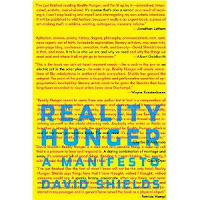
[Book Review] David Shields' Reality Hunger

A True Manifesto or Literati Hype?
By Jessica Cortez*

Essayist David Shields' latest book, Reality Hunger: A Manifesto was released earlier this year to both critical approval and a measured amount of hype.

Of course, Shields' book endeavored to fulfill a lofty goal — to identify the course of literature's future.

Shields is even so bold as to trace the path of Art's future as a whole. And what better way to go about accomplishing this than to self-proclaim the little volume a “manifesto”?

Shields begins his network of interrelated theories in an interesting way:
Every artistic movement from the beginning of time is an attempt to figure out a way to smuggle more of what the artist thinks is reality into the work of art.
He concludes his first chapter, “Overture,” in a similarly grandiose manner, which typifies the rest of the book, by proclaiming,
An artistic movement, albeit organic and as-yet-unstated one, is forming. What are its key components? A deliberate unartiness: 'raw' material, seemingly unprocessed, unfiltered, uncensored, and unprofessional ... Randomness, openness to accident and serendipity, spontaneity; artistic risk, emotional urgency and necessity, reader/viewer participation ...

And on and on.

What is most fascinating about Shields' book is not simply its content, but its form.

The book is essentially a compendium of quotes, varying in length, from the short aphorism to a solid grouping of paragraphs, interspersed with the author's own musings.

The real zinger is that Shields does not cite the quotes' authors in footnotes. He does so only in endnotes, so that there is no way that the reader knows who said what unless she flips to the back of the book.

And the breadth of the cited authors is dizzying: Picasso, Roland Barthes, and John Mellancamp to name a few. Even an excerpt from Scooter Libby's legal brief is presented.

So what is the thrust of Shields' proclamations? What is his point?

In a perfect fusion of manic style and engaging content, Shields essentially prophesies a conflation of fiction and nonfiction, to the point that the two (apparently false) categorizations will be indistinguishable.

Sound too lofty? A little ridiculous?

To a certain extent, yes.

But there are two things that lead me to believe Shields' book stakes some sort of valid claim on the truth.

For one, I see Shields' basic premise everywhere — in Pedro Gonzales-Rubio's recent, fairly groundbreaking film Alamar; in the blogosphere; in virtual reality worlds like Second Life; and, even in the as-of-now dubious art form of karaoke (something Shields' book discusses at length).

Secondly, Shields' knowledge of the Western literary canon is solid. He doesn't take his feet off the ground in this respect. He pays tribute to our literary predecessors by demonstrating what they have had to show us about their own respective time periods, and, moreover, what the more enduring works can teach us about the future of the novel.

In an age where it seems as though people are reading less and less, Shields' little book is certainly revolutionary. Or at the very least, it's a breath of fresh air.

*Jessica Cortez writes on the topics of online degree programs. She welcomes your email comments.

Possibly related books:

,,

Related articles:

Tuesday, June 1, 2010

[Interview] Henry McGrath

Henry McGrath studied oriental medicine for nine years, obtaining diplomas in shiatsu, acupuncture and herbal medicine.

He is currently the Acupuncture Course Director and Academic Director for the College of Naturopathic Medicine and has undertaken clinical placements in the Herbal Medicine Oncology Departments of several Chinese hospitals in Nanjing and Beijing.

Henry is an Orthodox Christian and is interested in the links between religion and medicine. He currently runs his own private practice and works at Penny Brohn Cancer Care.

He lives in Bristol, UK.

His books include The Traditional Chinese Medicine Workbook (College of Naturopathic Medicine, 2007) and Traditional Chinese Medicine Approaches to Cancer: Harmony in the Face of the Tiger (Singing Dragon, 2009).

Why did you first become interested in Traditional Chinese Medicine?

I’ve been interested in Eastern culture ever since childhood. I started yoga when I was about 18, then martial arts, and soon became interested in Eastern philosophy. I started studying shiatsu, Japanese pressure point massage, when I was about 26, and this led on to acupuncture and Chinese herbs.

How can Traditional Chinese Medicine complement the approach to cancer in the West?

Western medicine focuses on the illness, whereas Chinese medicine focuses on the person.

The West looks at the detail, the Chinese look at the “big picture”.

Western medicine tends to see human person as a machine, whereas Chinese medicine sees the human as an integrated entity of body and spirit, intimately related to his surroundings. Disease is always a reflection of an imbalance of the whole organism, and even of the whole of creation.

In your new book Traditional Chinese Medicine Approaches to Cancer, you talk about qi and how strong qi can protect us from illness. How can we improve the strength of our qi?

Good quality food. Exercise. Fresh air. Cultivating harmony with those around us and with the planet. Most important of all, spiritual development. In Chinese medicine spirit influences qi.

What changes can we make in our diets to enhance our health?

Perhaps surprisingly, I would say the most important thing is not to become obsessive about food. Relish your food, enjoy every mouthful. Eat lots of organic food, without being fussy about it. Eat a little of everything. Give thanks for food, say grace whenever you eat. Fast sometimes, but in a spiritual context, rather than purely for health reasons. For example, in our Orthodox Christian tradition we abstain from animal products during Lent, and on Wednesdays and Fridays. This transforms one’s relationship with food.

What can Traditional Chinese Medicine hope to teach doctors in the West about person-centred care?

A lot of GPs I speak to recognise that it is very important to build a relationship with patients: I would encourage them in this.

It is one of the tragedies of the NHS that many doctors' surgeries are moving to a team system, whereby the individual relationship between a patient and a certain doctor is lost. Patients like to feel that someone knows them properly.

People seem aware of the depersonalising effects of Western medicine, but nobody seems to be doing anything about it. With something like cancer, the GP could be the person who takes care of the patient through the whole confusing process, at present there is often nobody who does this.

I think it is very positive to see medical students learn something about complementary medicine: I recently had two trainee doctors spend a day with me in my clinic and receive a treatment as part of their training. They were both very inspired and said they saw the human in a very different way. Perhaps more doctors could visit us and talk to our patients about their experience of complementary medicine.

(c) Jessica Kingsley Publishers, 2010

This article was first published in the
Singing Dragon Newsletter in September 2009

Possibly related books:

,,

Related articles:

Saturday, May 29, 2010

[Interview] Bettina Wyngaard

South African novelist, Bettina Wyngaard made her debut as an author with the publication of Troos vir die gebrokenes (Umuzi, 2009) - a novel about three generations of Afrikaans-speaking black women, dealing with issues like domestic violence, alcohol abuse, and crime.

The novel was subsequently shortlisted for the Jan Rabie Rapport Prize, which is awarded to a debut or early work characterised by fresh and innovative Afrikaans prose.

In this interview, Bettina Wyngaard talks about her writing:

What made you decide you wanted to be a published writer?

I’m not even sure that it was a decision, as much as an urge, a compulsion, if you will, to return to writing.

I write mostly in Afrikaans, but have never really felt comfortable with the Afrikaans literature that is available out there. I felt it did not really reflect my reality, with the result that I read mostly English.

Eventually, I realised that instead of complaining and bemoaning the lack of fiction reflecting my reality, I could be the voice telling those unheard and untold stories. So, I identified a story and a milieu that I could identify with, and that isn’t really portrayed in literature, and started writing.

There is very little fiction written in the sometimes very informal Afrikaans used in Troos vir die gebrokenes, addressing the issues that affect “real” people.

The language in most Afrikaans books is often stilted and formal, so that it leaves the reader uncomfortable, as if something is missing. I found it difficult to relate to those characters.

Why do you think the literature is like that?

At a guess, I would say it is because no one has been prepared to risk doing things differently.

There have always been Afrikaans writers who challenged the status quo and addressed social issues, but the vast majority preferred writing romantic fiction, for which, of course, there probably is a far greater market.

It could also be that the memory of past censorship has made writers more wary of taking risks in their writing.

How would you describe your own writing?

Social commentary, but packaged to appeal to a popular audience.

I shine a spotlight on relevant social issues affecting women in the hopes that I will get readers to think differently about these issues.

I don’t believe that all writers everywhere should only write about social issues. There is a definite place for fantasy and escapist fiction. Having said that, however, social commentary holds up a mirror to society, daring the reader to change their thinking and/or behaviour. I believe this to be a vitally important function of writing.

Who is your target audience?

Afrikaans-speaking adults with a social conscience.

What motivated you to start writing for this audience?

I believe that there is not enough fiction in Afrikaans that address social concerns, and that there is always need for that sort of writing.

Which, would you say, are some of the most pressing issues affecting South Africa today?

Crime, especially corruption and gender based violence, poverty, the ongoing AIDS crisis ...

We, as South Africans, have this tendency to believe that government should fix everything that is wrong, and that we are absolved from doing anything. We need to change that mindset - it is all our responsibility to ensure that our society is held morally accountable.

If we all work together, we can make a difference.

Which authors influenced you most?

I have mostly been influenced by social commentators such as Maya Angelou, Toni Morrison and Alice Walker, as well as the natural philosopher, H. D. Thoreau. They write about issues I’m passionate about, using words as a means of exposing injustice, but doing so in compelling, beautiful prose.

Have your own personal experiences influenced your writing in any way?

I’m not sure that any writer can divorce their writing from their life experiences. Certainly, in my own case, I have found that my writing only ring true if I write about things I know about, or can convincingly imagine.

In order to convince the reader to suspend their disbelief, the writer must be able to authoratively paint a picture of the events, the characters and the world those characters inhabit.

It’s important that my writing is authentic and accurate. As a result, I do quite a lot of research before I start writing. I’ll often interview people, familiarise myself with the environment I’m writing about, and ask loads of questions

What are the biggest challenges that you face?

Finding time to write. I generally set time aside over weekends to do some writing.

When I have a publishing deadline, I’ll write everyday. Otherwise, I write over weekends, but only when I have something to say, or am trying to explore an idea.

Writing is meant to be fun, and trying to force it, takes the joy out of creating characters and the world they inhabit.

When you do write, how does each session start? How do you proceed? How do you know when to stop?

I try not to do any reading for a few days before I start writing - to clear my mind of all clutter. When I write, I only listen to classical music, so no songs with words to interfere with my thinking. I choose the music to go with the mood I want to create in the piece I’m writing.

I always have an outline of what I want to write, even though the actual writing often meanders far away from the outline!

I stop when I lose focus and concentration, or when the plot starts losing interest to me. If I’m not spellbound, neither will the reader be.

How many books have you written so far?

One, an Afrikaans book called Troos vir die gebrokenes, published by Umuzi, an imprint of Random House in July 2009.

Troos vir die gebrokenes is about three generations of Afrikaans speaking black women, dealing with various social issues, such as domestic violence, alcohol abuse, crime, the effect it has on them and how they overcome. It is a story of hope, of the human spirit overcoming affliction.

Given that Afrikaans is a language which a generation or more of black women will have resisted, at one time or the other, is this tension between the language and the people who are using it reflected at all in the novel?

No, I deliberately did not take any stance on the language. The characters deal with issues, like poverty, like gender-based violence, that are far more pressing for them. Adding issues around language would have taken the focus away from the main message, which deals with hope and empowerment of women.

How long did it take you to write it?

From conceptualising to finalisation, about nine months

How did you chose a publisher for the book?

Random House has a reputation as a publisher of excellent material, and I wanted to work with them. It never even occurred to me to send my manuscript elsewhere.

What advantages and/or disadvantages has this presented?

Working with a group of dedicated people who really set the bar high, forces me to constantly evaluate the quality of my own writing. Having an ego, or being possessive of one’s work, is not even an option!

How do you deal with this?

Write, rewrite, and rewrite again until I’m happy with the result.

Which aspects of the work that you put into the book did you find most difficult?

Writing about serious issues without striking a depressive note.

The challenge for me was to put my characters in extremely dark situations, but to have them retain a hopeful outlook.

It is a very delicate balance to maintain in life, and trying to use words to portray it without making your audience feel manipulated, is tricky.

I find that taking a step or two back from the work, and really looking at it critically, helps. Also, getting constant feedback from others.

Which aspects of the work did you enjoy most?

The whole creative process.

Contrary to common perception, writing is a collaborative process, and having a team of talented people co-creating with me, is probably the ultimate buzz - seeing my baby raised by a village, in a manner of speaking!

What sets Troos vir die gebrokenes apart from the other things you've written?

Troos is my first work of fiction, everything else has been factual

It is similar to other things I've written because it has a strong emphasis on gender issues, although it is approached from a different perspective to the more academic writings that I’ve done.

What will your next book be about?

Corrective rape, so it’s again about a gender issue.

I’d rather not divulge more than that - I find the story evolves almost without my input, so the plot I work on now, may no longer be applicable a week from now.

What would you say has been your most significant achievement as a writer?

As a debut writer, I’d have to say getting my first book published by the first publisher I submitted it to!

When did you start writing?

I’ve always written, even as far back as primary school. In fact, my first published piece appeared in our school newsletter in my Grade 8 year. I stopped writing for number of years during tertiary education, and when I started working.

Possibly related books:

,,

Related articles:

Sunday, May 23, 2010

[Interview] Magdalena Ball

In earlier interviews, poet, storyteller and literary activist, Magdalena Ball talked about the factors that made her start writing, her concerns as a writer and about her debut novel, Sleep Before Evening.

Since then she has gone on to publish She Wore Emerald Then, a poetry chapbook written in collaboration with Carolyn Howard-Johnson. The chapbook was a finalist in the USA Book News 2009 NBBA Best Book Awards.

She Wore Emerald Then was followed by Repulsion Thrust (Bewrite Books, 2009), a full length, solo poetry collection whcih tackles subjects like quantum physics, astronomy, time travel, ecological destruction, and technological singularity, all viewed through the lens of the human condition.

Below, Magdalena Ball talks about the work she is currently doing:

How would you describe Repulsion Thrust?

My latest book is Repulsion Thrust, which is out from Bewrite Books. It's a poetry book which is in three sections. The first has an overall theme of "The Black Dog" (as in Churchill's - eg depression and pain), the second is environmentally and technologically/futuristically focused, and the third is an almost lighthearted (for me!) synthesis of the first two -- a kind of answer to the clash of the first two notions.

As always with my work, there's a fair amount of influence from the 'sciences', from quantum physics to psychology, geology, evolution, and astronomy.

I chose Bewrite Books because they published my novel, Sleep Before Evening, and I knew that they also published poetry, and above all, that they would provide a thorough editing process for me, which is what I wanted. I also knew it would be easier than going to a new publisher as I already had a positive relationship in place with them and a reasonable understanding of the process, although poetry was quite different to prose, and there was much still for me to learn.

Which were the most difficult aspects of the work you put into Repulsion Thrust?

Finding a neat structural framework for the poetry I had been writing was a little bit tricky. Also with poetry, there's always work involved in ensuring that you remove anything that is absolutely unnecessary to what you want to say. Every word has to work, or you dilute the effectiveness of the poetry.

With the framework, that was simply a left brain exercise. Sit down and think about the overall focus of the work and work out how a structure could support what I wanted to say.

In terms of the editing process, again, having someone else involved was very helpful. I had one superb reader (my mother -- say what you will -- she's a great editor), who went through every poem with me once I was done. I read them to her outloud, and she would ask questions or point things out. Often just the process of reading outloud showed me what didn't work and what did.

My Bewrite editor (Sam Smith) was also very good at spotting what worked well and where I was overly wordy (an issue I need to work on!), or obscure. We even removed a few poems he didn't feel were strong and replaced them with others. I even did a last minute edit after the final proofread.

What did you enjoy most?

To be honest, I really love writing poetry. It's a medium I find most natural, and the fact that you can complete an exercise in one relatively contained burst, and then have something to submit, makes it very satisfying.

I found that I was (and continue to) "allow" myself some poetry time at the end of a hard slog or difficult bit of writing as a kind of reward. The combination of short term (completion/submission) gratification, with knowing I was working on a longer term objective (a full book), was very pleasurable.

To be honest, it's kind of hard to stop myself and get back to a daily fiction schedule, which doesn't have that instant component.

I will though.

My next novel is over halfway done, so it has a kind of imperitive of its own.

What sets Repulsion Thrust apart from other things you have written?

This is my first full length poetry book (the others have been much shorter chapbooks), so it's a big thing for me. It's much more intense and inclusive.

I was able to have that chapter structure and to cover a much wider terrain. I'm very excited about it!

In what way is it similar to the others?

When I finished Quark Soup, I said I would leave science alone for a bit, but found myself even more drawn to it. Not only the language, although I do tend to find words like "catalysis" and "emulsification" very attractive (not sure why!), but there is, to me, something so breathtaking about looking at the world around us from a scientific perspective. There is so much that is beautiful to explore. The fundamental structure of a snowflake or rock formations are just startling. An aurora or solar wind is an amazing thing. The quantum world itself is so full of interesting absurdities that breakdown reality in ways that are seem out of sync with day to day relativity, but when you think about dreams, emotions, or perceptions, there are alignments which aren't absurd at all. So I play with those things in most of my work.

What will your next book be about?

Black Cow is the story of Graeme Archer, a well respected Chief Executive Officer of a large multinational corporation. When his health problems worsen, and his busy family life starts to disintegrate, he has to rethink the way he lives.

The story tracks the family as they move from a ritzy suburb to a small Tasmanian farm, and the challenges they encounter as they attempt to change their lives from super consumers to super conservers. It's a little funny (my funny, which is still reasonably black at times ...)

Do you have a target audience?

I'm sure I'd sell more books with a more specific target audience.

I embrace all readers and hope that my work, even the poetry, is clear and simple enough to appeal to all levels.

That said, my work probably will appeal more to a literary fiction, poetry loving reader who likes their work to resonate for a while, rather than to someone who likes fast paced, action thriller style work. That's what my son tells me, and I'm sure he knows best.

How would you describe your writing?

I'm one of those jacks of all trades who tends to write across genres.

I have been doing a lot of poetry recently, and my work seems to be very science oriented at the moment, though that can change, and tends to apply more to my poetry than my fiction and certainly more to poetry than to nonfiction, which can be on any topic from literary criticism to parenting.

No matter what I'm writing, it's always metaphor rich, with a certain amount of depth, and probably more run-on sentences than I should have. That's my natural tendency. Even my academic writing is metaphor rich, much to the horror of various supervisors that I've had over the years!

Which influences do you draw on as a writer?

So many authors have influenced or inspired me, that it's difficult to pinpoint specific influences. I could start from my earliest reading experiences, including such authors as Maurice Sendak (Where the Wild Things Are, Little Bear, In the Night Kitchen) and Dr Seuss (The Lorax still brings a lump to my throat. On Beyond Zebra still excites me) through to authors that inspire me now, from literary writers like Umberto Eco, James Joyce, Margaret Atwood, Peter Carey, Salman Rushdie, to Auden, Plath, Porter, Judith Bevridge to the incredible science writers like Hawkings and Dawkins. I'm sure I've left out some major influence, and could probably list names for many paragraphs.

And, like most writers, I also draw on my personal experiences in almost everything I write. I'm something of a magpie, so will pick at just about everything I've got - personal obversations, sensory experiences, overheard conversations, a story someone told me, the song my son is struggling to learn on the piano. If I burn myself on the stove, the pain will be in a story or poem before the sting goes.

As a writer, I always try to get at the core of something. To try and get at something meaningful and deep at the heart of our experiences. That goes for whether I'm writing fiction, comedy, nonfiction or poetry. It isn't always easy, but it helps to have good readers, who can test whether what you've said translates into what you mean for a reader. I have several excellent readers who I show final drafts to, and they don't hesitate to tell me when I'm not making sense or when I've written something trite.

Do you write everyday?

I do write everyday. It isn't always a lot, but I'll always schedule in some time for writing in my daily plan.

I would love to have a regular place and time, but with the juggling I do, I have to take whatever moments I get, so I'll usually just open something up in the morning that I'm planning to work on and whenever and wherever I get a chance I'll work on it.

If I'm writing a poem, I'll usually keep going until the whole thing is done (first pass - often there are several iterations later). That's the same for any short piece of work - flash fiction or a short nonfiction piece. For longer work like a story or a novel, I'll usually keep going until, through some kind of instinct, I feel I've had enough and it's time to stop (or I have to go pick up the kids from school or meet some other impending deadline).

It's probably the same for nearly every 21st Century person but time is my biggest challenge. Finding enough of it to do all the things I want to do.

I'm reasonally well organised and do tend to plan each day fairly well, listing key objectives to lead to the bigger objectives, but there's always a limit to just how much you can get through in a day, and in addition to my writing, I'm also parent to three young(ish - getting older all the time :-) children, have a reasonably big day job, have just started another Master's degree, have two websites to manage and a new book to promote, so time is always a challenge. I deal with it as best as I can, through planning and prioritising - standard time management processes, but I also sometimes have to ease off my goals and accept my limitations. My children won't be young forever, so they always have to take priority.

How many books have you written so far?

I've listed the books I've written below. I've collaborated on and participated in quite a few more anthologies and collections (say around six), but these are the key ones:
  • Repulsion Thrust, Bewrite Books, 2009, ISBN: 978-1-904492-96-2 - this is my just released full length poetry collection. Repulsion Thrust tackles big subjects not often the fodder of poetry: quantum physics, astronomy, time travel, ecological destruction, and technological singularity, all viewed through the lens of the human condition.
  • She Wore Emerald Then, 2008, 978-1438263793, (poetry chapbook - collaboration with Carolyn Howard-Johnson), finalist in the USA Book News 2009 NBBA Best Book Awards. She Wore Emerald Then and Cherished Pulse are part of an ongoing "Celebration" series of chapbooks designed to replace greeting cards.
  • Sleep Before Evening, BeWrite Books, 2007 , ISBN-13: 978-1904492962 – 2008 Indie Book Awards Regional Fiction Finalist - this is a novel set in NYC that follows the adventures of 17 year old, Marianne as she discovers the healing power of music through an almost deadly journey into the deepest recesses of her own mind.
  • Quark Soup, Picaro Press, 2006 , ISBN 1-920957-23-5, ( Poetry Chapbook) - Quark Soup contains twenty eight poems which muse on topics like what it means to be human, love, loss, fear, longing, and transcendence. Avoiding cliché and the mundane, the poetry in this collection is accessible to the common reader, with a powerful intellectual edge and playful wit. As all good poetry should, this work uses sound, sense, and strong imagery to deal with everyday topics like depression, birth, growing old, love and death, all moving towards a large universal picture. As the title suggests, there is a strong astrophysical theme running through the poems.
  • The Art of Assessment: How to Review Anything, Mountain Mist Productions, 2003 , ISBN 1-920913-10-6, ( Nonfiction) , The Art of Assessment is a complete guide to the review process, from how to write good reviews, how to use interviews to add depth to your reviews, obtaining review copies, marketing your reviews, and plenty of examples and references to help you become a working reviewer.
  • Cherished Pulse, 2006 , re-released in 2009 as a print book, ISBN 978-1449546052 ( Poetry Chapbook - collaboration with Carolyn Howard-Johnson) , Cherished Pulse contains twenty poems which look at love from a wise, mature, sensitive perspective. Never sentimental (forget Hallmark), the poems explore love in its many guises -- cherish, longing, sensuality, and that sacred place between desire and consumation.

Possibly related books:

,,

Related articles:

Saturday, May 15, 2010

[Book Review] Mailer and Gibran's alternative Gospels

In 2007, when I was browsing through the shelves at the Dudley Library, looking and hoping I’d find one or two titles by Dambudzo Marechera, I came across The Gospel According to the Son.

The title was like a magnet.

Many years earlier, while browsing through the shelves of a bookstore in Harare, Zimbabwe I’d stumbled upon Kahlil Gibran’s Jesus, the Son of Man and I’d been completely taken in by the idea of a novel about Jesus Christ. I’d found Gibran’s book so engaging that it’s now top on the list of books I keep reading and re-reading. Norman Mailer’s Gospel According to the Son is also joining that list.

The two books are similar to each other. They are both based on the Gospels. They both take a familiar story and they re-imagine and re-tell it. They both present an imaginative account of the life and work of Jesus Christ and explore the effect that Jesus had on the lives, hearts and minds of the people he lived and worked among. The story in both books is presented in the first person by a person who was close to the action. And, to me, the spirit that informs and pervades both books feels so authentic that each of the books reads like an alternative Gospel.

The main difference between the two books is that Jesus, the Son of Man was first published in 1928 while The Gospel According to the Son came out in 1998. Also, while The Gospel According to the Son has one narrator, Jesus, the Son of Man is told from multiple perspectives. It is told from the individual point of view of a variety of characters who’d known, lived with, met or heard about Jesus Christ. Most of the characters whose voices we hear in this book are also mentioned or implied in the Gospels. These characters include Anna, the mother of Mary; Mary Magdalen; Caiaphas, the High Priest; Joseph of Arimathaea and Simon, the Cyrene. Jesus, the Son of Man gives these and other characters more time and space than they were given in the Gospels and allows each of them to tell what they saw, heard, thought and felt about Jesus in their own words.

In The Gospel According to the Son, Norman Mailer does more-or-less the same thing. While in the Gospels which appear in the Bible, we hear about the life and work of Jesus from people who heard about him from his disciples, in The Gospel According to the Son, Mailer allows Jesus to tell his own story in ‘his own words’.

Mailer allows us to imagine how Jesus Christ might have told the story of his own life. He allows us to imagine Christ as a man like any other man and to see some the inner conflict Christ must have felt and experienced and how he resolved or failed to resolve this conflict. Mailer allows us to imagine what Christ might have thought and felt about key stages or events in his life, among them: his birth; his apprenticeship as a carpenter; his relationship with his mother and immediate family; his relationship with his disciples; his relationship with God; his relationship with religious leaders of the time; his death; his resurrection and the wars that have been fought in his name.

Both Jesus, the Son of Man and The Gospel According to the Son are written in language that is accessible and easy to read. They contain nuggets of observations on life and spirituality that encourage the reader to think about life, religion and his/her relationship with others and with God. The books also have the effect of making the reader want to go back and re-familiarize himself/herself with the Gospels and the account they present of the life and work of Jesus Christ.

Possibly related books:

,,

Related articles:

Wednesday, April 28, 2010

[Interview] He Jinghan

He Jinghan is the author of Bagua Quan Foundation Training (Jessica Kingsley Publishers, 2009) and Bagua Daoyin: A Unique Branch of Daoist Learning, A Secret Skill of the Palace (Singing Dragon, 2008).

A fifth generation practitioner of the BaguaQuan lineage, he was introduced to Master Gong BaoZhai at the age of 23 and began to specialise in Bagua.

He Jinghan is now dedicated to the cultivation and promotion of the Bagua Daoyin.

When did you first become interested in Bagua Quan?

I was interested in the teachings of Gong Bao Zhai, my teacher, before I began to learn the art of Bagua Quan.

I started practicing Bagua Quan because I found it had more depth in comparison to the other Chinese martial arts that I had previously spent some years learning, like Taiji Quan or Xinyi Quan.

As I started to understand the philosophy and theory of Bagua Quan through physical practice, I began to experience the real depth of it. It is since then, that I have been interested in Bagua Quan.

What are the main benefits of practicing Bagua Quan?

There are many different ways that you can benefit from Bagua Quan. The different stages of Bagua Quan, each have there own different benefits.

Firstly, you experience physical and mental improvement, secondly you begin to grow in self-confidence; however the most powerful benefit is the understanding that is gained of the "cause” and “result”. The results tend to be physically visible, and understanding the roots of the cause for this visual difference is truly the greatest benefit.

What would be your advice to anybody considering starting to practice Bagua Quan?

I would recommend that you read my book in order to understand what Bagua Quan is and whether it is for you.

Set your goal and start from the very beginning. The foundation practices won't seem too difficult. However, it is very important to practice with awareness of yourself, your capabilities and ensuring that you don’t think about fighting from the beginning.

Make sure that you feel right and comfortable in every practice. Move to the second practice only once you completely understand and feel comfortable with the first practice.

Have faith that the result will come naturally if the cause is right.

What or who most inspires you?

I was and still am inspired by many Who's and Whats.

We are inspired only if we have a “subject” and a “question” in mind. To me, it is Bagua Quan, that is both a subject and a question on body and mind improvement. The key to this lies in what my Sifu once told me: “ask why about everything, find the roots and understand the connections.”

Therefore, I could be inspired by a phrase in a book, a child’s posture, a mistake made by myself or somebody else, a creature from nature or even an advertisement on TV ...

What was the last book you read?

I read many different kinds of book. I usually read different books in one period of time.

I have just finished reading the speeches of Mr. Nan Hwai-Jin, a Daoist book on Chan Tong Qi and also his speech about a Buddhist book Jing Gong Jin. I was reading these whilst I also finished reading the beginning of heaven and earth a book about Mr. Hu Lan-Chen, a debatable character in the last hundred years in China.

(c) Jessica Kingsley Publishers, 2010

This article was first published in the Singing Dragon Newsletter in June 2009

Possibly related books:

,,

Related articles:

Saturday, April 24, 2010

[Interview] Alma Kroeker

In this interview, Alma Kroeker talks about her blog novel, In the Absence of White Rabbits:

When did you start writing?

I would say that I started writing as a child, but this particular work began about four years ago. I was lucky enough to have a day-job that allowed me to work on the novel.

I didn’t want to be overly poetic with the writing which is why I decided to make half the novel dialogue.

Publication was simply a means to having the story out there, for anyone who might be interested.

Who is your target audience?

I worked in a hospital and was witness to some of the issues and people, surrounding the field of psychiatry.

I wanted to write something that would incorporate both sides, doctor and patient, of the experience of being mentally ill. As such, the novel is probably of most interest to those people, though others have also enjoyed it.

How have your personal experiences influenced your writing?

I think we’ve all, at times, on a spectrum of intensity, felt the pressures of life and looked for ways to escape or alleviate that stress.

What are your main concerns as a writer?

That there is something helpful in my novel and that no one will be able to access that information.

Do you write everyday?

I tend to write at least a little bit each day. It depends on how inspired I am.

There are also times where I feel pressed by the characters to tell their story and I will write for hours.

How many novels have you written so far?

Just the one – In the Absence of White Rabbits (2009).

The novel examines a woman’s deteriorating psychosis and her relationship with her doctor.

Why did you decide to release the novel as a blog?

The process of obtaining a publisher is difficult for any new writer.

It was most important to me that the novel be made available to the public. A blog is a forum where people can easily, and without cost, access the novel as well as contribute criticism. However, getting the site recognised is a difficult process (html formatting can also drive me crazy).

It is my hope that the novel's first year online will see a dramatic increase in readers.

Which were the most difficult aspects of the work you put into the novel?

The main character experiences a great deal of turmoil; I found it difficult to write for lengthy periods of time while being submersed in her world.

Which aspects of the work did you enjoy most?

The end. I wrote the last sentence and thought I was done when out of nowhere another sentence was put down which completely changed the tone of the story.

What would you say has been your most significant achievement as a writer?

I wrote a story and people read it.

Possibly related books:

,,

Related articles:

Wednesday, April 21, 2010

[Interview] Ged Sumner

Ged Sumner is a practising craniosacral therapist and Chi Kung teacher.

He has also studied shiatsu, healing and attachment based psychoanalytical psychotherapy.

He is Director of the College of Elemental Chi Kung.

His new book You Are How You Move: Experiential Chi Kung has just been published by Singing Dragon.

How and when did you first become interested in Chi Kung?

When I was 25 I went to a class by a Chinese Chi Kung master in London and was completely blown away.

The movements were like nothing I had seen before and the energy was remarkable. I could instantly see it was an amazing mix of exercise, meditation, and subtle energy.

Since then I have been studying with different people, learning more about it, practicing and teaching it.

What is experiential Chi Kung?

The art of deepening into chi is to become skilled at being body and chi aware.

You have got to experience what's within the movement forms so that you deepen into a body sensation and a chi field state. You feel chi, you don't think it or have an idea of it.

What will people gain from using the Chi Kung methods described in your book and what kind of people will benefit from them?

Everyone will benefit.

Regular practice if only for a short time will bring greater vitality, more suppleness in the body and greater stamina and mental focus. When you practice them a lot you can overcome illness, transform your mind and your whole approach to life and become much more attuned to your life's purpose and the subtle forces and movements within nature.

What or who most inspires you?

People who are using their energy, skills and resources to make a difference in the world today by creating greater awareness of the need to live a life in attunement to our environment.

What do you enjoy doing in your spare time (other than Chi Kung)?

I like driving my tractor around my land. I like taking my kids to the beach. I like cooking.

(c) Jessica Kingsley Publishers, 2010

This interview was first published in the Singing Dragon Newsletter in May 2009

Possibly related books:

,,

Related articles:

Monday, April 19, 2010

[Interview] Richard Wink

Richard Wink's poetry has been published in magazines that include Ditch, Underground Voices and Aesthetica Magazine.

He has also published a number of chapbooks, among them, The Magnificent Guffaw (Erbacce Press); Apple Road (Trainwreck Press); All Along the Wensum (Kendra Steiner Editions); Delirium is a Disease of the Night (Shadow Archer Press) and Devils and Daylight (New Polish Beat).

Dead End Road (Bewrite Books, 2009) is his first full length poetry collection.

In this interview Richard Wink talks about his writing:

When did you start writing?

I started writing poetry after finding out that I had been gifted the happy knack of putting together some snappy metaphors alongside sparse, blunt prose.

Overtime I graduated from bedroom notepad scribbles to actually getting my work published in various magazines and periodicals. This took a great deal of perseverance and patience, as paper cuts bled into rejection letters and grovelling around on my hands and knees led to grazes and bruises that blunted the ego.

I guess I never set out to get published; it took a great deal of courage to actually put my neck on the chopping block and send my words out into the open. But once you get that first acceptance and you see your poem in print – it becomes a drug, you soon get addicted and eventually you end up with all kinds of hopes, dreams and delusions.

Such flighty ideas led me to put together my debut full length collection, Dead End Road. Getting the book published was merely a case of chancing my arm, getting some interest from a publisher and then working with a fine editor who cut away the fat and produced a lean, succulent composition.

Having said that I have grafted, working my way up the small press grapevine, putting out chapbooks through indie presses and publishers, honing my craft over time. Getting Dead End Road published didn’t just happen, I had to put the hard yards in.

How would you describe your writing?

My poems are a mixture of what I see and what I imagine, a crude oily blur of fact and fiction, an exaggeration of reality.

I’m attempting to mould together many different influences - blend kitchen sink drama with surrealism, and then add two teaspoons of existentialism.

Who is your target audience?

Anyone can read my words; I’m not aiming for an intellectual minority. I endeavour to make my writing as accessible as I can.

Surely it is common sense for a writer to want as many people to read his words as possible?

Which writers influenced you most?

Carol Ann Duffy ignited the passion, Charles Bukowski made me realize anyone can do this and Allen Ginsberg explicitly taught me how to sprinkle the sugar.

Do your personal experiences influence your writing in any way?

Most certainly, as I mentioned before I write about the everyday, I believe there is a lot of mileage in the mundane. Any writer would be foolish to ignore what they directly experience.

In my working life, I’ve encountered the good, the bad and the ugly in an assortment of weird and wonderful jobs, I aim to capture the unique characters like butterflies, and pin them down on paper.

What are your main concerns as a writer?

I think every writer faces self doubt. That little voice in the back of your head that politely asks what the hell you are doing?

I find it best to flip that little voice off, and plough on into the light. So basically what I’m saying is that I am fearful of the legitimacy of my words, yet fearless when it comes to getting them out there into the open.

What are the biggest challenges that you face?

The challenge is to get people to read Dead End Road.

I mean there is are a lot of obstacles to overcome, both from the bloated corpses of the past, the dead poets, and those poets who are currently hot stuff - alive and kicking with the backing of the bigger publishing houses.

I’m dealing as best as I can, but I’ll be honest and say that I find the promotional work hard going. Let’s face it; I would make a terrible car salesman.

Do you write everyday?

I’m working (real work, not writing!) long hours at the moment so time is very much at a premium.

Honestly, I write when I can, forcing the muse through the fatigue and mental tiredness.

Each session starts with a cup of tea, I scribble in the notepad, and ideas form from the ether. Then I make the first draft, the second ties it all together and the third normally is finely polished.

Right now I’m working on a novel, so the process is a lot stricter and tightly regimented; sessions need to yield a minimum of 1,000 words.

How many books have you written so far?

A number of chapbooks and one full length collection of poetry, all released between 2005 and now.

It started when after getting in a few magazines and anthologies I approached a small press in the States that put together a chapbook called The Beehives, then I approached another that helped me with Stress, both are pretty shocking in terms of quality and thankfully no longer in print. However the experience got me thinking more about assembling a body of work rather than an odd gaggle of poems.

Then I went on a glory run and released The Magnificent Guffaw through Erbacce Press, Apple Road via Trainwreck Press, All Along the Wensum through Kendra Steiner Editions and Delirium is a Disease of the Night with Shadow Archer Press. Apart from a little chapbook I released with A J Kaufmann’s imprint New Polish Beat titled Devils and Daylight all of the other chapbooks have led up to my debut full length collection Dead End Road; the training miles before my marathon, if you will.

How would you describe Dead End Road?

I’ve described it as Revolutionary Road meets Desperate Housewives; a series of snapshot poems that look at different characters and personalities along a fictional road.

It took me a couple of months to write, because I really got into a good groove, the words were flowing effortlessly.

The book is published by BeWrite Books. I picked BeWrite because they have a roster of talented writers that I respect, and also because I wanted to work with a publisher that is forward thinking, and ambitious.

What advantages and/or disadvantages your association with BeWrite Books presented?

Speaking open and honestly I found that the editing process was superb. I worked closely with Sam Smith, an experienced writer who helped shape the collection into something substantial and coherent.

I was certainly impressed with the quality of the paperback version of the book, it looks superb.

The disadvantages have mostly been promo related, when you work with independent publishing houses it is up to you the writer to seek out reviews, this can be tricky with every Tom, Dick and Harriet also attempting to plug their books. You really do have to knock on the door of every reviewer and hope they will give your book a read, and hope you get a favourable review.

What will your next book deal with?

The novel, tentatively titled Tears and Spittle will be about a man who loses his identity and embarks on a Candide-esque misadventure across the dirty South (of England).

What would you say has been your most significant achievement as a writer?

Writing Dead End Road which I believe would be a wonderful stocking filler gift. What with Christmas around the corner. It makes sense for you to pick up a copy!

Possibly related books:

,,

Related articles:

Saturday, April 17, 2010

[Interview] Marita van Aswegen

South African author, Marita van Aswegen writes poetry, short stories and novels for both children, young adults as well as adult readers.

Her work has been published Afrikaans, Sesotho and English.

Her books include Dance Thispo, dance (Kwela, 1997); Gavin’s Game (Masterskill Publishers, 2009) and Phapo’s Gift (Knowledge Thirst, 2010).

In this interview, Marita van Aswegen talks about her writing:

When did you start writing?

I wrote my first story when in 1964 when I was fifteen. I sent it to a magazine ... but it was rejected.

It was a love story and I sent it to Sarie. That was the favorite magazine of the sixties.

I was a teenager and my mind was filled with roses and moonshine and the perfect love.

What would you say motivated you to start writing?

As long as I can remember, I always wanted to write a book.

During the years when my children were small, I wrote essays and poems because essays are short and you can complete one in an hour or so. ( Small children do not give you a lot of time to write.) The essays were on subjects like: "Going to the hairdresser" (humorous essay); "We got electricity!"; "The day I put a cheque on the car’s roof and forget about it", etc.

The poems were for small children (through my children’s eyes) and also poems that expressed my own personal feelings. The latter I kept for myself.

Two of the poems for children were published thirty years later in Die nuwe verseboek by Riana Scheepers!

I just had to write things down, I felt happy when I did that.

After all my children went to boarding school, I started to write on a more regular basis.

My first book was published in 1997. I had sent the story to several publishers and got it back six times. But I did not give up. The book was in Afrikaans, but Kwela Publishers also translated it in English and Sesotho. The book was for adults who did not go to school when they were children and they got literacy classes as adults.

The book is about a young postman who has to deliver a letter to an old man who was waiting for a letter from his grandchild. The old man was attacked by a robber and the postman saved his life.

It was easy to write and did not take me long. I kept on resubmitting it because I believed it was a good story. Yes, Kwela translated it into Afrikaans and Sotho too. The book was beautiful, but unfortunately only the Afrikaans and English sold. The Sotho did not sell at all.

How would you describe your writing?

I have been writing for different markets.

The first book was for ABET readers.

After that I wrote Roer jou riete Pampas, a youth book in Afrikaans. It was translated in Sesotho.

I wrote several short stories for teenagers that were included in different books.

I wrote a teenage novel and several stories for the Kroonsteen series.

I also wrote more literary short stories.

How much influence have your personal experiences had on your writing?

I love writing for children age nine to twelve.

Because I work with children from the rural communities who grew up in difficult circumstances, I like to write about them. They have so much courage, they inspire me.

Being a social worker had influenced my writing in the sense that I became more aware of social issues like alcohol abuse, verbal abuse, poverty, etc. Real life had influenced me more than any book ever would.

Which authors have influenced you most?

I appreciate the work of Jacqueline Wilson, the British writer. Her stories soften the disappointments of real life.

It gives hope.

I like that.

What are your main concerns as a writer?

My main concern as a writer is the fact that children in South Africa rather spend time outside than reading books. Whenever I meet with children, I try and motivate them to read.

In the rural area where I stay, most of the parents of children are illiterate. Therefore there is no reading culture in the homes. Children have to walk long distances to farm schools. These children speak Sotho in their homes and then they have to learn English and Afrikaans in school. Reading is for them a nightmare because their mother tongue is neglected in schools.

Farm children do not have the facilities that bigger schools have. There are no libraries, no reading groups, no one who can open the world of reading to them. They should be helped to love their mother tongue and reading in their mother tongue. Writers in their mother tongue should visit schools and motivate children to be proud of their own language.

What are the biggest challenges that you face?

The biggest challenge for me is to write every day. I discipline myself to do that. Even when I do not feel like writing, I go and sit in front of the computer and write something. After a while the ideas just flow. I write till I feel I have completed the specific idea that I am busy with.

I enjoy writing for children the most. But it is not always easy. As a writer you realize that you have an impact on children’s minds and for me this is a great responsibility.

I write mostly in Afrikaans, this is my mother tongue. I love Afrikaans because I grew up with it. I can express myself in one word. The last ten years I also started to speak English quite often, because my children are overseas and I visit them every year. I started to translate my Afrikaans children’s stories into English. I enjoy it.

What would you say Phapo's Gift is about?

My latest book, Phapo’s Gift is about the ten-year-old Phapo who is clever, pretty and happy. But she has a big burden to carry: her father, who she loves very much, is dying from Aids.

All around her, her school friends are getting boyfriends and girlfriends, but Phapo wants nothing more than to make mud cakes under her favourite tree and dream of beautiful dolls.

When the boys start to look at her, her Grandma tells her a very special secret: Phapo has a precious, perfect fruit inside her. She alone has the power to treasure or to destroy that fruit.

It took me about three months to write the story. It will be published during 2010 by Knowledge Thirst.

How did you find a publisher for the book?

I received an email from SCBWI where Knowledge Thirst was asking for stories.

I sent in my story and they accepted.

Since they let me know they want to publish the story, I have been working with professional, punctual people all the way. I enjoy working with them. I enjoyed writing the story, first in Afrikaans and then in English.

I feel the story has something to say for children and might help them to understand the preciousness of sex. What makes this book different is the fact that the publisher kept me informed all the time and I could see how the book was progressing. This was excellent.

What will your next book be on?

My next book is already finished. It is about an orphan in a centre for abused and neglected children.

Every book is an achievement for me.

Possibly related books:

,,

Related articles:

Monday, April 12, 2010

[Interview] Michael Acton

Michael W. Acton is Founder and Senior Instructor of the Wu Shi Taiji Quan and Qi Gong Association UK.

He has been training for over 30 years and is the sole representative of Dr Li Li-Qun, a fourth generation Wu Style Taiji Quan master and a leading Qi Gong master.

His new book entitled Eternal Spring: Taijiquan, Qi Gong, and the Cultivation of Health, Happiness and Longevity has just been published.

When did you first become interested in Taijiquan and Qi Gong?

When I was young I was fascinated by Indian Yoga and so I began to practice meditation when I was eleven. I was without a teacher then and pretty much in the dark. There were no yoga teachers anywhere near my home town in the early sixties and I certainly had not heard of Taiji quan or Qi Gong then. I have always been drawn to yogic practices.

I was also interested in all things Chinese and especially Chinese painting and its Daoist roots. I was already a good candidate for Qi Gong and Taiji though still knew little to nothing about it.

My first introduction to Qi Gong was a small book of Daoist Yogic practies and I also found a book by the American dancer Sophia Delza who had studied the Big Slow Form of Wu Style Taiji Quan with Ma Yueh Liang when she had lived in Shanghai. I think that was in the 1940's. The illustrations in the book were hopeless to learn anything from and although I got the first few moves I got no further. It was not until many years later, after university, that I found a teacher of Taiji Quan.

I am not sure when I first saw Taiji even. There were only a few teachers in London at the time. I was however lucky enough to meet a young Chinese Malaysian who was starting a small group. When I saw him practice the form I was deeply impressed with the beauty and natural elegance and sense of integrated power. I started to learn the Wu Style form, Tui Shou and some Qi Gong from him. As fate would have it, it was the same form which Sophia Delza had studied and whose book I had struggled with back in my school days.

It was many years later (1992) in Shanghai that I would eventually find my true teacher; 16 or so years after my first Wu style teacher had returned to Malasia. During that time I had kept up my practice though not always systematically and even learned other forms and worked with and met other teachers. Only one, however, really impressed me. He was an old Chinese artist from Shanghai who had left China for London. His Traditional Yang Style, Hsing Yi and Ba Gua were quite remarkable and inspirational. When he stopped teaching and moved to Australia I realised that I would have to go to China to get what I wanted.

What do you think is the particular relevance of Taijiquan and Qi Gong for a Western audience?

Their relevance to the Western audience must surely be the remarkable ability of Taiji and Qi Gong to bring about good health, self healing and restore a sense of vitality and mental clarity. It also bring us back into contact with our true nature and the natural environment and the conditions of life.

Western Science will no doubt eventually explain much of what Qi Gong is and what it can do. But we don't have to wait for explanations, we can cultivate the experience now. We can rediscover our innate ability to restore and heal ourselves and rest in mental dimensions that will always remain beyond science. In a world where we are sensorially overloaded and so many of our experiences are tailored, limiting and manipulative, we can discover an internal freedom and strength and a sense of real liberation and empowerment and perhaps even spirituality. The methods for this were cultivated thousands of years ago. It has taken a long time for the West to notice them.

What would be your advice for anyone in taking up either Taijiquan and Qi Gong?

Find a good teacher and a good and mutually supportive group and don't get caught up in the politics of who does what and which form is best.

Always avoid conceit and arrogance in a teacher and never submit anything for the promise of 'secret knowledge'. Just do it with no aim other than giving yourself up to the experience.

It may take a long time to feel you are getting somewhere so persevere and do not look at the end goal. The key to the achievement of Taiji and Qi Gong are firstly perseverance, then slowness, precision, lightness and correct awareness. I rate correct awareness very highly since, without it, form often remains only beautiful movement and the deeper levels of achievement will remain a mystery.

There are often long periods when you do not seem to achieve much but progress often occurs when you least expect it. Suddenly you may discover that your level of practice is deepening and your ability to maintain a steady and undistracted awareness is maturing. Always return to the experience, perseverance is more important than talent and never give up.

The extraordinary lies hidden within the ordinary.

What or who most inspires you?

I think it must be the people in China who rise early and go to the park to practice their Taiji or Qi Gong. In a way they have transcended the discipline of practice because for them it is as ordinary as eating rice; just an everyday activity. One feels good, the other tastes good and both are important for a long and healthy life.

My teacher Dr Li Li Qun is one of them and he has been practicing since childhood. He is now in his 80's and still cycles to the park each morning. Such an inspiration. His belief that Taiji and Qi Gong is for everybody is also inspiring.

Finally, I should say that I am inspired also by the humility of such people and their deep connection to an ancient and remarkable tradition and belief.

What do you enjoy doing in your spare time (other than Taijiquan and Qi Gong)?

I make no distinction between spare time and Taiji and especially Qi Gong time which I try to practice continuously from morning to night.

I am also an artist and so I am often thinking about paintings.

I spend a lot of time with my wife and daughter and the rest goes on working to make a living. My first Taiji teacher said that making money must come first, then the family (since without money the family would not be secure) and finally the practice of Taiji Quan. It is a good rule of thumb in our modern world though I'm afraid I have done it the wrong way around.

(c) Jessica Kingsley Publishers, 2010

This interview was first published in the Singing Dragon Newsletter in April 2009

Possibly related books:

,,

Related article:

The benefits of bodymindcore work, Conversations with Writers, April 2, 2010