Friday, July 8, 2011

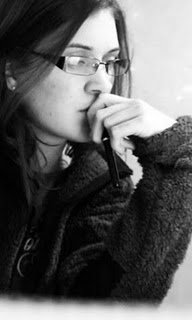
[Interview] Jen Bee

Jen Bee studied Creative Writing at a university in Wales.

On her personal blog, she describes herself as a "recovering student, future tea shop owner, practising telepathy by staring at blank pages."

She is the author of Sally Carter, a blog novel that follows the life and adventures of Sally Carter and Detective Hood.

In this interview, Jen Bee talks about her writing:*

When did you start writing?

Thursday 20th February, 1994 at 3:09pm ... No, I've been making up stories as long as I can remember, though only a few made it onto paper at first. It was just something I did, that and reading.

As I grew older the stories I read grew longer and so did those I thought up, which I then started to write down.

What made you want to get your stories published?

I wanted to write books like those I read, long before I understood what publishing meant. This is probably a good thing or I may have become too overwhelmed to go on. Now it's too late, I love writing, wherever it takes me.

I'm still going about reaching that end, working towards finishing stories, and next year, my final year of studying creative writing at uni, my modules will include E-publishing and Writing & Publishing 2.

I write and submit short stories to competitions and magazines and online. My current project is a blog-story, which I start posting from the June 1, 2010. It'll be updated fortnightly with short fiction, mostly, and some interviews, news stories, recipes, etc. too.

How would you describe your writing?

In general terms, the blog-story is a fantasy-detective series, hopefully quirky, humorous, and fun. As is my other stuff.

My aim is for it to be enjoyed predominantly by young adults, but also to be accessible to younger readers (my sister, 12) as well as older.

Which authors influenced you most?

Tolkien. Exactly how is a bit fuzzy, but I love The Lord of the Rings - to read, not write.

More recent influences include Neil Gaiman and Jasper Fforde, because they seem to just go ahead and write what they want without worrying about being too wacky, as I used to.

Have your own personal experiences influenced your writing in any way?

I dread to imagine ... I'm sure my mum will spot something.

What are your main concerns as a writer?

Currently, finishing uni. One thing at a time.

So far I've learned it can be a scary world out there for writers, so I hope to learn as much as I can before wandering into it.

Do you write everyday?

Yep. Notes, e-mails, Tweets ... Writing is writing and you never know where you may bump into an idea.

I do story writing too, mostly for assignments at the moment, and soon I'll have my blog story to keep up with.

I keep no schedule. If something needs finishing, I do nothing else until it's done, not even Doctor Who. When I'm not writing, I'm thinking of things to write, characters, ideas, stuff to change. Usually not on purpose.

How many books have you written so far?

Nothing finished yet. The aforementioned assignments take priority for another year.

My current project, which I'm publishing online in a blog, follows a Detective (Hood) on a slightly magical island, and a writer (Sally) who sometimes assists him. I'll be writing it as I go or else I'll never get started.

There have been no great difficulties so far. However, while this project kicked off a couple of years ago, it is really only now beginning.

Which aspects of the work you are putting into the project do you enjoy most?

Unexpected ideas. Writing. Happy feedback, because it's always good to have anything you've done appreciated.

What sets the work apart from other things you've written?

The style is similar to another project, which follows two adventurers trying to make a living, but the Hood and Sally stories are on a much smaller scale and, come to think of it, probably a bit darker too.

Also, I have a bunch of other ideas, similarish action-adventure-fantasy-comedy, different characters/worlds/etc.

Started a romance once, for an assignment, an adventure-romance, interesting experience, may look at it again one day.

What would you say has been your most significant achievement as a writer?

I'll get back to you.

*This article is based on an email interview with Jen Bee which took place in May 2010

Related articles:

Saturday, July 2, 2011

[Interview] Wilf Morgan

Wilf Morgan lives in Nottingham in the United Kingdom.

His books include a novella, That Time in Honduras (Eighty8Tales Press, 2009) as well as the novels, The Assassin’s Wedding (Eighty8Tales Press, 2008); The Cotton Keeper (Eighty8Tales Press, 2007) and Lost Angels (Eighty8Tales Press, 2006).

He is also the author of Dead Heroes, a free online serial that he publishes through the Eighty8Tales website.

In this interview, Wilf Morgan talks about his writing:

When did you start writing?

Although I can’t remember when I actually started writing, I do remember some of my first stories being Star Wars tales featuring the figures and toys I owned at the time ...! There was one about Han Solo and Luke Skywalker flying the Millenium Falcon to the end of the universe where the stars stopped or something. And another about Luke and Darth Vader crashing on a deserted planet and being stuck together (I think Darth had actually hit his head and gotten amnesia so forgetting he was the baddie). Random stuff like that! So, yeah, pretty young, I think is the answer ...!

I decided from a very young age that I wanted to become a published writer – but the problem with that is you go through years thinking it’s really easy. All you have to do is write a full-length book. So I did this, expanding on a story I’d done in class called "The Year 2200". It was very long and written on various different types and styles of paper (this was the early 80’s – no home word processing yet!). And it was also a total Star Wars clone! (no pun intended). By the time I finished it, I was 10 or 11 – and I realised it was nowhere near good enough to be published. So I 'archived' it (in the attic) and started again on something else.

A few twists and turns aside, I’ve pretty much gone through that entire cycle several times until I got to what I consider my first 'proper' book in my mid-20s – Lost Angels. Unable to get it published (through the long and difficult 'sending to Literary Agents' process), I printed it myself (initially via Lulu.com) and sold it myself. I did the same with The Cotton Keeper, That Time in Honduras and my most recent printed work The Assassin’s Wedding.

This all ended up becoming a full-fledged self-publishing venture called Eighty8Tales Press behind which I put most of my ‘publishing’ efforts. I would still like to be published by a big publishing house but I’m happy doing self-pub for the time being. (It’s fun doing my own covers!)

How would you describe the writing you are doing?

My current work Dead Heroes is generally described as a thriller. But it has some extra-genre dimension to it that makes it harder to classify if you’re wanting to be more accurate.

Because I initially was a big sci-fi fan, all I wanted to write was science-fiction. I soon found that this limited the number of agents who I could send work to and so I expanded into crime (the genre, not the activity!) and general thrillers. So Lost Angels and The Assassin’s Wedding are in the same boat as Dead Heroes – they’re all thrillers ‘but’…

Dead Heroes is basically a modern-day Robin Hood story. Being from Nottingham, I’ve always wanted to do a Robin Hood story but since there are, like, a thousand of these (and mostly quite similar), I had to wait until I had a really good idea in order to make it worth doing – and, hopefully, unique.

Without giving away too much of the plot, it basically deals with Robin Hood and The Sheriff of Nottingham landing on modern-day Nottingham and continuing their centuries-long battle against each other. Ultimately, Nottingham – and perhaps the rest of the country – find themselves both prize and casualty in this war. On the one hand, it’s just this personal battle between these two individuals, whereas on the other hand, the battle contains concepts and ideals that affect everyone on the planet.

I try hard to balance the high concepts with some good old fashioned action (car chases and gun battles being the currency of choice!).

Who is your target audience?

I’m not entirely sure who my target audience is with any of my stuff – another obstacle to selling myself to literary agents!

Dead Heroes – like my other works – are simply meant as stories to be enjoyed by anyone who likes to get lost in a good yarn. I like to include some kind of concept or question to spice up the proceedings (in Dead Heroes that includes things like: what is the true nature of freedom, how much freedom would you be willing to sacrifice for less crime, etc). And I also like action and drama.

So, I suppose, anyone who likes thinking about some interesting ideas that might touch on their lives but also get swept into a good tale at the same time – that’s my target audience!

Which authors influenced you most?

I have very little influence from any authors – that’s not to say I don’t like any. I get inspired by certain people’s approach but not necessarily their style.

How have your personal experiences influenced your writing?

Only as mentioned previously – I originally moved away from sci-fi out of what I saw as necessity for improving my chances of finding a literary agent. In the end, this proved a fortuitous move as it opened the path to this more ‘genreless’ type of story I like to tell. Now, although this has probably actually harmed my saleability, it has made me tell more interesting stories, I believe.

But with the advent of affordable self-publishing, this is fine as it still gives me the ability to get my stuff out there.

What are the biggest challenges that you face?

The main challenges for me are simply forcing myself to write something every day. With all the other demands on my time – looking after kids, housework, day job – it’s all too easy to flop down in front of the TV at the end of the day and switch my brain off!

Related to that, I’d say forcing myself to write when what comes out is rubbish! You always want your stuff to be perfect and sometimes it’s just total trash. But if you force yourself through and keep churning out the trash, you can go back to it and make it better later. If you stop and produce nothing, you’ve just got the same problem facing you next time! Always a million times easier to write rubbish and brush it up than to write nothing and just get stuck.

Do you write everyday?

Dead Heroes has been good for me because it’s a weekly serial – so I’ve had to get into the habit of writing most days. Sessions are pretty much "power through, go back and re-write and enhance". It’s the same as when I’m writing a full novel except the cycles are extremely compressed with much less procrastinating!

A writing session usually ends when I have to go to bed!

How many books have you written so far?

I’ve written four books so far, not including Dead Heroes. They’re all under the Eighty8Tales banner. They are;
  • That Time in Honduras (2009) – A novella and prequel to The Assassin’s Wedding. It’s part action thriller, part love story and leads the reader right up to the start of The Assassin’s Wedding novel. It’s a story of love and revenge. Also, some pigs.
  • The Assassin’s Wedding (2008) – A darkly humourous thriller about an assassin, Mike Shepard, who – against his own rules – falls in love and proposes. The story tells of the week leading to the wedding as Mike wrestles with whether he should come clean to his fiancĂ©e about his vocation. The week is made harder by missing persons, another assassin and a private eye with a penchant for flavoured vodka. Sometimes, Mike reflects, it’s all you can do to survive the happiest day of your life.
  • The Cotton Keeper (2007) – A novella set in Sierra Leone in 1999 – the last days of the civil war. Femi is a young chimpanzee who is tired of hunting for food to feed his starving tribe. He embarks on a mission to find the mythical Cotton Keeper in the hope she will use her great wisdom to lead him to a place where he can live in well-fed and selfish isolation. Things never go so easy, though, as Femi comes into contact with the dreaded ‘Big-Walkers’ and their baffling conflict…
  • Lost Angels (2006) – This is a dark and gritty crime thriller set in a fictional town called Lost Angels. Daniel, looking for somewhere to escape the hell his life had become, finds the off-the-map town. It’s run by a violent mix of criminals and politicians. Daniel rises through the ranks in a self-appointed mission to save the town from the corruption that oppresses its inhabitants – all the while ignoring the corruption in his own soul that led him to Lost Angels in the first place…
What is your latest book about?

Dead Heroes is a fixed-length serial updating weekly. It tells the story of Robin Hood and the Sheriff of Nottingham arriving in modern-day Nottingham. They continue their centuries-long battle, each fighting to save us from the apparent tyranny of the other. It’s a battle of law and order versus freedom. Unfortunately, it appears that the very people each side hopes to save are also the ones they are willing to roll over in their quest for victory.

Which aspects of the work you put into the book did you find most difficult?

Probably the most difficult obstacle in writing this book is simply the fact that it’s about Robin Hood – this is a topic that has been done to death and back. How on earth do you find an original angle?

I’m a firm believer that there’s always a way to achieve any particular creative angle, you just have to procrastinate long enough to come up with it! In the end, I think I have done just that but only reactions and comments from readers will tell me if I was right.

Without giving too much away, I tried to look at ways the original Robin Hood ideas could be extrapolated through the filter of modern-day concerns. In the end, the clash between freedom (Robin Hood’s eternal calling card) and controlled law and order (and extrapolation of much of The Sheriff’s traditional antics) seemed to offer a good deal of drama as well as topical relevance. Exactly what freedoms are we willing to give up in order to live in a safe, crime-free society?

What sets the book apart from other things you've written?

This is the first time I’ve used characters and situations that I have not made up. It’s almost like writing fan-fiction except I’ve tried to take the originals and build new issues on top of the existing ones in order to give it its edge. But the fact I’ve had pre-existing concepts to start with makes things very different and a lot of fun!

What will your next book be about?

I haven’t decided yet – I have a few ideas.

I might do a short story collection.

I’m keen to write another story set in Sierra Leone as that is where my family is from. It certainly won’t be examining the violence and misery of the civil war, though. I touched on that with the Cotton Keeper but there are also many more brilliant books on this topic than I could ever write. But setting something fun and entertaining in Sierra Leone might be something a little more interesting and new.

What would you say has been your most significant achievement as a writer?

Writing four books!

Actually, I’d say producing some significant piece of work every year since 2006. It certainly keeps me busy and it always helps people take you seriously as a ‘new’ writer if they see you’ve actually got a body of work behind you.

Related articles:

Monday, June 27, 2011

[Interview] Chris Taylor

Chris Taylor is registered manager of a residential home and a company trainer. He works with young people with attachment difficulties and delivers training on the subject to foster carers, social workers and residential childcare workers.

He is the author of A Practical Guide to Caring for Children and Teenagers with Attachment Difficulties (Jessica Kingsley Publishers, 2010).

In this interview, Chris Taylor talks about his work:

How did you first become involved in working with children and young people with attachment difficulties?

I had a 15-year career in industry and, having worked through two recessions, I was feeling a bit jaded with commerce. A broken hip from a cycling accident gave me time to think about my future. My own children were young teenagers, and I believed I had something to offer adolescents, and that I would be motivated and rewarded.

I found a job as a 'house a parent' (it's 20 years ago, language was different) in a therapeutic community. I don't think I really knew what I was getting into. The model of working was psychodynamic, but attachment wasn't the dominant paradigm. Many of the children in the community had been severely neglected or abused. They were often traumatized and struggling to find an internal representation of safety. All this was then acted out in desperate and often self-defeating attempts to resolve their insecure past.

I'd read [John] Bowlby's work in the late 60s and I, as I began to explore ways of understanding the troubled and vulnerable children in the community, I began to think more deeply about how their attachment pattern was deeply intertwined in their difficulties and their presenting behaviors: their developmental pathway.

How does understanding attachment help childcare and social workers?

I think we have to caution against suggesting that an individual's attachment is a catch-all for their current condition.

Development is a pathway, and each individual is where they are because of a huge and complex array of innate and environmental factors acting on each other. However, that basic biological drive to be close to the primary caregiver for safety, comfort and reassurance is a powerful mechanism in an individual's early development. Although initially the attachment relationship is a descriptor of the dyadic relationship between child and caregiver, as the child becomes older, the pattern of attachment becomes increasingly an aspect of their individual functioning.

Our attachment history affects us all, and children who have had sub-optimal early care are likely to be anxiously attached and to carry this anxiety as a self-fulfilling prophecy into other relationships, developing behavioral coping mechanisms that may make them difficult to care for. If the caregiver is also frightening, the child cannot organize their coping strategy in a coherent way. Such a child presents a huge challenge to be adequately cared for.

Understanding attachment allows professionals charged with this task to unpack the child's adjustment and work out ways of responding to the child that answers their attachment need and switches of the child's self-defeating behaviors. Understanding caregivers' attachment history can give us insight into the kind of support they may need to adequate parent a trouble child.

Would you be able to tell us about your work in a therapeutic unit?

For the last 10 years, I have managed a four-bedded therapeutic unit. In that time, every child who has been resident has had some degree of attachment difficulty. The children (or young people) may access individual psychotherapy, but, helpful though that can be, therapeutic means something more than that.

The model is one of supporting and enabling development whilst challenging maladaptive coping mechanisms. We promote a holistic, planned environment that provides a secure base for the child to explore their past and current relationships in the here and now. Working as a symbolic attachment figure, the staff team provides the sensitive attunement to enable the child to begin to use information from both emotions and cognition in a flexible way, to gather a coherent understanding of their attachment history and gradually possess 'earned security'.

We also think about the staff's needs from an attachment perspective. The children we care for challenge the secure representations of their caregivers; support needs to be matched to the internal pressure exerted on the caregiver by the child's coping mechanisms. Adult attachment models provide a powerful framework for doing this.

What developments have been made in the area since you first started working with children with attachment difficulties, and what is your hope for the future?

Many foster-carers, residential workers and social workers are now hugely interested in attachment theory, which has become one of the foremost paradigms in child development. It is now more common to see at least an attempt to think about the child's current experiences in the light of their attachment pattern.

I think some fostering agencies have gone a long way in thinking about both the foster child's and the carers' attachment styles when trying to make placements. I also now see more placement decisions in residential care where the child's attachment needs are mentioned, but there still seems to be little serious thought about what to do with this. What this means is that there is often a description but little idea what may help, perhaps a vague idea that something therapeutic is required.

I'd hope that in the future we may continue to develop holistic, psycho-social models for promoting recovery; children develop anxious attachments in their first relationships, recovery takes place in supportive and enabling relationships and social environments.

I also hope that the resources careful and effective work requires are forthcoming; social area budgets are going to be under pressure, but these children deserve a chance to have useful and fulfilling lives.

What are you currently reading in your spare time?

I like to have two or three books on the go for spare time reading, and often my leisure interest reading rubs up against my work.

I'm currently reading Bedlam: London and its mad (Catherine Arnold). As well as unraveling historical social constructions of madness, it's an engaging social history from mediaeval to recent times.

I'm also reading Jarheads (Anthony Swofford), the author's account of living through the fear and boredom of the first Gulf War, and Opening Skinner's Box: great psychology experiments of the twentieth century (Lauren Slater). The experiments are familiar, but Ms Slater writes about them in a way that makes you think you were part of them.

(c) Jessica Kingsley Publishers 2011

This article was first published in the Jessica Kingsley Publishers Social Work Newsletter in January 2010

Related articles:

Friday, June 24, 2011

[Interview] Pam Inder

Leicester-based writer and former museum curator and university lecturer, Pam Inder is the co-author of seven books.

The books, which she wrote with Marion Aldis, include:  
In this interview, Pam Inder talks about her writing:

How did you decide you wanted to be a writer?

I didn’t really have much choice about writing – I worked as a museum curator and writing catalogues, articles in journals etc was very much part of the job! However, the sort of writing I now do came about rather differently.

Back in the early 1990s, I did an MA in English Local History and became friendly with one of my fellow mature students, Marion Aldis, who was very interested in 19th century diaries. Some months after we finished the course – by which time I was working at Staffordshire University in Stoke-on-Trent – I helped a colleague with a local history project she was doing with a group of students which involved them in looking at original documents.

One of the sets of documents they were given to work on was a collection of diaries (in Keele University Special Collections Library). The students hated them – they were quite difficult to read – so I spent quite a lot of time helping them with that part of the project and realised that the collection was actually enormously interesting – and no-one else was studying it. I contacted my friend – and we embarked on what became a 12-year project tracing the history of these North Staffordshire diarists. Fortunately for us they were an eccentric, quarrelsome bunch so their lives made interesting reading ...(I can talk about this at length!)

Fairly soon we realised that the material was worth publishing and set about looking for a publisher. We wrote to a number of national publishers – none of whom were interested – then we heard about a publisher (now retired) in Leek and he published five books for us based on the diaries.

How would you describe the writing you are doing?

We write ‘popular history’ – for people who are interested in the same sort of things that interest us – the everyday lives of ordinary people, especially women, in the 19th century.

We both read a lot of history but I’m not sure there are many direct influences on our work. In some of our books – notably Finding Susanna, we incorporate quite a lot of the story of our research projects and our personal stories. Research is a form of detective work and the way we uncover information can sometimes be quite quirky.

We also have a lot of fun – we are both married women, not as young as we’d like to be, and going off on research trips together is very enjoyable, very different from the lives we lead as wives and mothers.

What are your main concerns as writers?

I suppose our main concern is, first of all, to do our research properly. What we write is always as factually historically correct as we can make it. The second concern is to try to make our subjects come alive – without relying too heavily on our imaginations. And the third is to write in a lively, approachable style. So much modern history is written in jargon.

Writing as a pair does help – we are quite critical of each other.

Do you write everyday?

I, personally, don’t have any particular process for writing. I’m busy – I write when I have the time, while dinner is cooking, while the kitchen floor is drying – whatever. I certainly don’t write every day.

How many books have you written so far?
  • The 1844 Diary of John William Sneyd: Muskets and Mining (Churnet Valley Books of Leek, 1996) 144pp. Transcript of the diary with an introduction and a lot of illustrations.
  • John Sneyd’s Diary 1815-1871: Thirty Pieces of Silver (Churnet Valley Books of Leek, 1998) 264pp. Edited transcripts of some of his 50+ diaries with chapters describing the major events of his life. He was a clergyman who lost the family fortune in ill-advised mining speculations, had a fellow clergyman imprisoned for slander, quarrelled irrevocably with his eldest son. He was a charismatic, able, but deeply flawed man.
  • Finding Susanna: the Story of Mrs Susanna Ingleby, nĂ©e Sneyd 1831-91 (Churnet Valley Books of Leek, 2002), 379pp. A biography based on her diaries. The most colourful event of her life was that she married in 1860 to an abusive husband and left him after a mere six weeks. Thereafter she was a social pariah and ended up as housekeeper to her widowed brother (the one who was estranged from their father) bringing up his only child, her nephew, who grew into an extremely strange and eccentric adult. She was, however, the only member of the family who was remotely capable of managing money, and she spent her time bailing out impecunious relatives – including her youngest brother who was a clergyman who impregnated a teenage aidservant and was the subject of a Consistory Court hearing.
  • Susanna’s Cookery Book: A Culinary Adventure in Staffordshire (Churnet Valley Books of Leek, 2003) 128pp. A collection of Susanna Ingleby’s recipes together with comments from local people (some of them her descendants) who tried the recipes out for us.
  • Finding Ralphy (Churnet Valley Books of Leek, 2005), 288pp. The biography of Susanna’s nephew. He had a private museum, was a self-styled Knight of the Round Table, became Chief Druid for Staffordshire, conducted eccentric religious ceremonies in his private chapel, was a competent artist and a truly appalling poet – and totally eccentric.
  • Staffordshire Women: Nine Forgotten Histories (History Press, 2010), 126pp. Very much the same sort of thing as I’ve described for Norfolk Women. Subjects included a pottery paintress, an heiress who endowed a school, a nail mistress, a housekeeper in a stately home and a factory owner.
  • Our 7th book, Nine 19th Century Norfolk Women (title not yet decided) goes to press at the end of next month. To be published by Poppyland in 2011
How would you describe your latest book?

The current book is about 19th century Norfolk women and it takes the form of nine single-chapter biographies of ordinary women who led successful lives within the parameters of their social class. None of them are in any way famous – we aim to shine a spotlight on the lives of ordinary people. One was a governess who went to the Ukraine, one was a lighthouse keeper, one a fishmonger, one the matron of a lunatic asylum, one a farmer, one emigrated to Canada – and so on.

How long did it take you to write the book?

Its always hard to say how long something takes. The research for each chapter probably takes about a month – or it would if you could work at it consecutively – but that’s not how research pans out.

We got the commission for this book in October and it goes to the publisher at the end of July – but we’d already done some of the work in another context. So you could say it took 10 months – or three years – or twenty years if you include learning how to do what we do!

How did you choose a publisher for the book?

Poppyland, our publisher specialises in books on Norfolk which is why we chose him – but in the real world publishers do the choosing, not authors. The only disadvantage so far is that he is based in Cromer which is rather a long way away – time will tell what other (if any) disadvantages present themselves when he actually gets the mss!

What were the most difficult aspects of the work that went into the book?

There are always all sorts of difficulties – for this particular book we have had to discard several of our subjects either because someone else was working on them or because their descendants didn’t like us writing about them, for example.

My biggest difficulty probably this time was finding illustration of a particular small town in the Ukraine – you’d be amazed how difficult that was.

You deal with problems as they crop up - they are all different so there’s no simple answer.

What would you say has been your greatest achievement as a writer?

Single biggest achievement? Well, I suppose getting fairly esoteric material published at all was quite clever – let alone having (so far) had three separate publishers.

Most of the people we studied with write and do research – few of them have published.

Related articles:

Saturday, June 18, 2011

[Interview] Max Gladstone

Max Gladstone lives, works, and writes in Cambridge, MA. He is the author of several novels which include Three Parts Dead, which is currently out on submission.

His short stories have been featured in magazines that include Space Westerns and On The Premises as well as in the anthology, The Book of Exodi (Eposic, 2009).

He also administers the blog Two Guys, Three Hundred Poems, where he publishes and comments on translations of the anthology of Tang poetry known as the 300 Tang Poems.

In this interview, Max Gladstone talked about his writing:

When did you start writing?

I began writing before I actually knew how to put letters together -- just a bunch of scratches filling my parents' old notebooks, one line at a time -- but if you mean writing stories, it started with a very simple vampire story typed out on an old suitcase Remington in my closet at the age of five or six.

From there, it was a short skip and a jump to wanting to be a published writer: I realized as soon as I started reading books that were worth remarking upon that I wanted to respond to the ladies and gentleman I had read, and the best way to do that was to write books of my own.

How would you describe the writing you are doing?

In terms of genre, I write mostly in what John Crowley would call the genres of romance: science fiction and fantasy, with a bit of mystery thrown in.

I'm concerned about the degree to which American fantasy fiction concerns itself with the same issues as English fantasy fiction. It seems to me that we should be trying to do something different, and I've been trying to reach towards that.

I've spent the last year or two reading a lot of American fiction and trying to develop the voice in my writing. It's a very strange exercise, something like practicing Taiji Quan, where you have to be very conscious of the words you're writing and what they mean.

Who is your target audience?

I try to write for all intelligent people who like awesome stories.

Roger Zelazny has been an immense influence since I was a child, and a lot of my initial sense of the poetry in speculative fiction comes from him.

I also loved LeGuin's Earthsea books; her dragons are some of the best realized creatures (monsters? beasts? people?) in fantasy.

John Crowley's Little, Big has also molded the way I see fiction, though I didn't discover that particular masterpiece until college.

Recently, I've found non-genre authors the most moving and influential: Mikhail Bulgakov, Salman Rushdie, and Toni Morrison on the slightly slipstream side, and [William] Faulkner and John Steinbeck on the more traditional side.

East of Eden and Absalom, Absalom are particularly amazing, though in different ways.

How have your personal experiences influenced your writing?

Every writer is shaped by his personal experience, whether he admits it or not. I try to avoid directly copying events from my life into fiction, but my experiences in Asia (I lived in China, traveled in Mongolia, Cambodia, Thailand and Japan), and my travels in Europe and out west in the United States as a child gave me a wealth of experiences that are endlessly valuable in my work.

Bits of truth about life in China, and about the history of suffering there, show up from time to time in my work that's not set anywhere near China, for example. Certainly my sense of the pleasures and occasional torments of village life come from my experiences in China, and my students' discussions.

What are your main concerns as a writer?

My main concern, honestly, is that it's quite difficult to make a living as a writer, and that in the context of a full-time job I won't find time enough to get serious work done. So far I've tried to fight that with a rigorous writing schedule, and had some success.

My biggest challenges arise when the obligations of life get in the way of doing real, capital-W work, without being a huge loser to my family and friends. As far as challenges go, these are pretty simple, I guess.

I once met a farmer in rural China who made 100 kuai a month (about $12.50) from his crop; I said that seemed a very small amount and he said it was fine, that he made a lot less during the Cultural Revolution. He's been through challenges far greater than any I've faced in this life, and there are still tons of people in the world worse off than him.

Do you write everyday?

I write every day, though I don't have a set habit. I have an extremely portable word processor (an AlphaSmart Neo, if you're interested), that I carry with me while I'm writing, and if I have a few minutes I sit down and slam out a few sentences, a paragraph, a thousand words. The one-track mind is a great help to me there.

I've written several novels, one of which I'm submitting to agents as I write this; none of these have been published, though I have published a handful of short stories in small presses and magazines in the last two years: one short story of espionage and assassination, one about a group of Martian rebels, one about a dream-space-Viking invasion of Miami, and one about the travails of a Chinese doctor who discovers the secret to re-animating the dead (some of the time), all of which are linked off my website.

This year I'll be collaborating with Alana Abbott on a serial novel about fairy politics, gladiatorial combat, and political rebellion called Blood and Tumult, which should start appearing in fall on Baeg Tobar.

What is your latest book about?

My latest book is a sort of legal procedural with necromancers; it took me the better part of six months to write, and is currently in the submission stage of its life.

Which aspects of the work you put into the book did you find most difficult?

The query letter and plot synopsis were the most difficult parts of the writing process, though I did finally get the hang of them.

Essentially, you have to distill the book you've written to a few sentences. The problem is, if you could represent adequately your book in those few sentences you wouldn't have written a book, you'd have written flash fiction. So then you think about it as an exercise in marketing and flash fiction, and it's (mostly) okay. Of course, the success of that method remains to be seen -- fingers crossed!

Which aspects of the work did you enjoy most?

I enjoy writing the most. Putting one word in front of the other is great, especially when you feel that they're good words.

Revising is second-best. It's like whittling, only you're whittling your own child. Maybe it's more fun than that sounds.

What sets the book apart from other things you've written?

Each of my books (and each of my pieces of short fiction, for that matter) have come out of different inspirations, and have been written in states of obsession with different topics. While writing this one, I spent a lot of time thinking about neural networks, religion, evolution, and finance, for example; previous books have been more concerned with Go, or with Genghis Khan.

I hope readers would say that all my books have interesting, well-defined characters, and a driving plot that consists of many wheels within wheels.

What will your next book be about?

The next project is going to be Blood and Tumult, an exciting project that I'm collaborating upon with Alana Abbott. I'm looking forward to collaborating with someone so experienced on such an interesting property as Baeg Tobar.

What would you say has been your most significant achievement as a writer?

So far, I'd say my most significant achievement as a writer has been persisting. Writers write, finish what they start, revise endlessly, and move on to the next project. That way (I hope!) the best story is always the next one.

Related articles:

Saturday, June 11, 2011

[Transcript] Grassroutes: Contemporary Leicestershire Writing


Corinne Fowler is a lecturer in the School of English at the University of Leicester. Her work includes Chasing Tales: Travel Writing, Journalism and the History of Ideas about Afghanistan (Editions Rodopi B.V, 2007); Travel Writing and Ethics: Theory and Practice (Routledge, forthcoming) and Postcolonial Manchester: the literary response (Manchester University Press, forthcoming). In this video, she talks about Grassroutes: Contemporary Leicestershire Writing, an Arts Council funded project which, among other things, aims to promote transcultural Leicester writing:

The reason I devised this project was because I found, in my research, that books written by London-based writers, especially if they've got a strong transcultural element, tend to enjoy much wider readerships than those written by ... than those that are transcultural novels and plays and so on, in the regions.

What I wanted to do was to try and promote public awareness of the kind of scope and diversity and range of writing that had been produced in Leicestershire since 1980. The reason I picked that as the start date was because a lot of money then came through to councils to promote this kind of writing and publishing activity. A lot of this material has been produced by independent, alternative publishers which don't have commercial imperatives and which care about quality fiction in a devance sense. And what I mean by 'devance sense' is that I want to give a sense of the range of writing across Britain. At the moment, I think, our view of what's being produced is a bit distorted and London-centric. So, this project is aimed at combating that. And it's also ... it has several outputs which I think are really exciting.

There's going to be an open-access database, which I'm calling an e-catalogue, of all the titles I can find that have been produced since 1980 and there'll be an exhibition about writing in Leicestershire. Again, this will be at the David Wilson Library at the University of Leicester but also in the central and reference library in Leicester.

There'll be a literary blog, which will enable people to give feedback, so that I can receive responses to my writing about the material I am uncovering. And there'll be a £1,000 writing commission which some people might want to apply for and an online, edited, writers' gallery which will give 50 author pages and showcase the writing of quality writers in Leicestershire who are at work today.

I did a study, and in many ways, this study inspired me to apply for funding to support Leicestershire writers whose work is transcultural in some way. What I did was, I compared compared Zadie Smith's White Teeth to a novel which had been produced in Moss Side in Manchester. The novel came out in the same month as Zadie Smith's White Teeth. It's called Forever and Ever Amen, by an author called Joe Pemberton. Both of them received excellent critical reviews. They were reviewed in the national media but Zadie Smith had an international following and Forever and Ever Amen soon fell by the wayside in terms of readership.

What I really wanted to examine was why they had two, such different trajectories and what was the cause of that. And, part of it, I found, was because there's a history of slightly negative reception of northern writing and of regional writing, in general ... which is the idea that anything that's not written in the cosmopolitan centre of London must, by definition, be rather parochial and of only local interest.

The other complication with Joe Pemberton's novel was that it was a working-class novel by a black writer based in the North and I found that these elements, all put together, were too much for the marketing brains of the corporate publishing world in London to take on board even though, I felt, in terms of quality, the two novels were comparable.

It gave me a sense of how so much good writing is falling by the wayside and that this is a kind of injustice which is driven by fairly commercial agendas on the part of publishers which are understandable, on one hand, but highly problematic and unjust, on another.

I have several partners that are involved in this project and the aim of these partners is to try and improve the local, national and international reach and exposure of this writing. I have a list here because it is quite difficult to remember them all.

There are 10 partner organisations: Word! at the Y; we've got the Asian Writer, which has got a big international following; Charnwood Arts; the Centre for Transcultural Writing and Research at Lancaster University; Embrace Arts at Leicester University; Leicester Libraries are onboard; the Literature Network; Mainstream Partnership; Short Fuse Fiction; and, an organisation called Writing East Midlands which mentors a lot of writers in the region. And these people will all come together as part of the steering group.

More information about the project is available on the Grassroutes: Contemporary Leicester Writing microsite.

Wednesday, May 25, 2011

[Interview] Rhidian Hughes

Dr Rhidian Hughes has worked in applied health care as well as social care research and has an active interest comparative policy, methodology and ethics.

He has lectured widely and has spoken at a number of national and international conferences. In addition to that, he is a visiting senior lecturer at Guy's, King's and St Thomas' School of Medicine. In addition to that, he is also a visiting senior researcher at Institute of Gerontology, King's College London.

Books he has authored, co-authored or edited include:
In this interview, Dr Rhidian Hughes talks about the work he is doing:

How did you first become interested in the field of gerontology and restraint in particular?

Before going to work in palliative care I read for my Doctorate in social policy. The main focus of my work at that time was on finding ways to improve end-of-life care for older people.

I then went to work for the Commission for Social Care Inspection during its existence between 2004 and 2009. The focus of my work changed as it required me to take a whole system look at how care is planned and commissioned as well as how it is delivered and experienced by people using services. Many of my studies included a focus on older people, including people with dementia and complex needs.

We were charged to follow up on a Government Health Committee report on the neglect and abuse of older people and a specific recommendation which asked the Commission to publish its findings on restraint. Preparing this report for the Commission sparked my interest in the use of restraint and this edited volume.

Your new book, Rights Risks and Restraint-Free Care of Older People takes an international look at the topic across a range of health and care services. What do you think are the main differences between the UK and other countries in Europe or North America in relation to restraint?

Thanks to some early pioneers, the United States was the first country to take a long hard look at the use of restraint and to develop a number of innovative restraint reduction and eradication approaches. Many of the principles underpinning these approaches remain current today.

Progress in other countries has followed, although at a different pace. Arguably the UK has lagged behind other countries in the attention afforded to this topic and the lack of domestic research has been criticised, a point made in the book. What is positive, however, is that the UK is beginning to take seriously the need to develop our evidence base on the abuse and neglect of older people, and important studies are underway.

What do you think are the main challenges facing those working with older people?

We all need to be challenging any use of restraint. It is a practice that merely contains issues at particular points in time. Restraint does nothing to address the underlying causes of people’s behaviour.

The book underlines the importance of taking a person-centred approach to enable the perspectives and needs of older people to be addressed, so that the precursors to behaviour that give rise to the use of restraint are identified and acted upon early enough.

To achieve this vision requires the right complement of well trained staff, good leaders and services that put people at the centre of their care.

Getting these basics right will enable us to make some important inroads to improving older people’s experiences of care.

What are you reading at the moment?

True Tales of American Life edited by Paul Auster -- a fascinating collection of short stories all revolving around anecdotes that were written by listeners to a radio show in the States.

I am also dipping into Pennine Way because, one evening in the pub, I committed to walk it.

(c) Jessica Kingsley Publishers 2011

This article was first published in the Jessica Kingsley Publishers Social Work Newsletter in December 2009

Possibly related articles

Saturday, May 14, 2011

[Interview_1] Julius Sai Mutyambizi-Dewa

Julius Sai Mutyambizi-Dewa is a Zimbabwean poet, songwriter, novelist and playwright. Currently, he lives in Derby, in the United Kingdom.

His books include the anthology, Preaching to Priests (Timeless Avatar, 2007) and essay collection, Candid Narratives (I-Proclaim, ____).

He was among the first members of the Budding Writers Association of Zimbabwe.

In this interview, Julius Sai Mutyambizi-Dewa talks about his writing:

When did you start writing?

That’s a very difficult question ... in Grade 3 I acted in a school play as "The Narrator" and as we went into Grade 4, I remember my teachers were amazed at my long “compositions” but they were not bored.

In 1988, when I had completed the Zimbabwe Junior Certificate, I wrote my first full Shona novel titled, Shamisai. Unfortunately this was not published. Even at that time, I was writing short stories in both Shona and English. And I was brave enough to enter the competition for Zimbabwe’s then new National Anthem, needless to say I lost.

In 1990, I was among the first members of the Budding Writers Association of Zimbabwe. I knew what I wanted. I was a poet, songwriter, novelist, playwright and essayist ... a complete artist. I have acted on stage and written plays. I am also a recorded musician although I never really got the time to promote my first and (so far) only music album because I had to go into exile.

How have your plays been received?

In 1990, I formed a community-based theatre group, Maphupho Theatre Group while I was waiting for my Ordinary Level results. That group was the first serious vehicle for my original work, my plays and we toured in schools around Chitungwiza, Seke Rural and in Mashonaland East Province.

We also performed in night clubs at Murehwa Centre. Problem was when my O-level results came out, I had to continue in full-time education and that slowed things a bit. But I continued to act on a part-time basis and managed to have a lucrative contract performing for the Swedes. I continued to write plays which we performed at various venues.

My childhood friend, Last Chiangwa [Tambaoga of “The Blair That I Know" fame] kept things going by maintaining Maphupho as a full-time group and continued to perform in schools. When he finally decided to concentrate more on music, my brother Tendai and nephew John Jusa kept the group going. We then managed to get contracts to perform in civic and voter education for ZimRights and Zimbabwe Election Support Network.

So, although I was not published, my work was being acted on stage. Meanwhile, I was trying very hard to get published but that was an uphill struggle even though I had become a member of a writers’ organisation, the Budding Writers’ Association of Zimbabwe. In terms of getting published, my breakthrough came when I was in the United Kingdom and I got a contract from Timeless Avatar who published my anthology: Preaching to Priests.

How would you describe your writing?

I am an all-rounder. I am both a writer of fiction and non-fiction but overall my writing focuses on social commentary. I write for the adult niche. And when I am writing fiction, I write for people who love adventure. Sometimes I take topical issues such as the environment and try to paint a picture of the consequences of failure in that regard through moving drama. This has always been my audience and I have always tried to speak to them even with my first novel, Shamisai.

As a writer, which authors influenced you most?

I am reluctant to say I am not that widely read and this is controversial coming from a writer. I am not the perfect writer who did literature at school, no I never did that. I don’t know anything by Shakespeare or any of these famous guys. My experience, especially when I am composing something, is that reading or listening to other compositions will take away my originality. But I will be honest that I have read Lord Jeffrey Archer and Chenjerai Hove among a few people and they really impressed me.

My personal experiences have influenced me more than anything else. At the same time, there is also a lot of invention and innovation in what I write. Some of the things that I write about happened to me or people I know but a lot of it is pure fiction, pure imagination, to be precise.

What are your main concerns as a writer?

Getting published has been a problem for me. This is a disincentive. When you have a family and your first book fails that makes it difficult to convince your family about the prospects of any future work. And at the same time, you also need to look after yourself.

It is not easy to make the breakthrough and make money as a writer. You therefore must have another way of sustaining you and your family while writing. Striking the balance is difficult. You need to carry the family with you. During the time you are writing, you could be using time that should have been given to your wife and children and that can be really taxing.

The best way to deal with challenges is to believe in yourself and try and explain the difficulties you face to your loved ones. If they understand that it’s a gamble, then you may find them joining the queue to ask what they need to do to make your writing a success.

People have different views on everything. I have a friend who thought that I made £100,000 each time I appeared on television. Similarly, many other people think I make money each time a newspaper publishes my article or quotes me or when I am interviewed. When I tell them I don’t, they ask me why I do those things then.

Do you write everyday?

I write almost daily. What I write varies. It might be a newspaper article on a topical issue. It might be a new song .... so far I have written more than 600 Shona, Ndebele and Kalanga songs. It might be a new poem, a play or part of a novel.

I write when I am in the mood to. I don’t force myself to write and I don’t want anyone to tell me to respond to such and such article. I find that very difficult.

How many books have you written so far?

Preaching to Priests, which is an anthology published by Timeless Avatar; Candid Narratives, collected essays published by I-Proclaim. I also have a completed manuscript, “Two Faces one Woman” and some two novels that are still work in progress.

Candid Narratives is a collection of essays. The problem has been on distribution and I am in the process of negotiating with my publishers so as to broaden the horizon in terms of marketing.

What sets the book apart from the other things you've written?

It is not fiction. It is a collection of essays on topical, political issues and is, therefore, different from everything I have written or I shall ever write.

What will your next book be about?

My next book is already there. It is fiction but it is fiction with an eye for facts.

Wednesday, April 20, 2011

[Interview] Dylan Birtolo

Dylan Birtolo is the author of two novels, The Shadow Chaser (Inkwater Press, 2004) and The Bringer of War (Lulu, 2008).

He is also the co-author of Colonial Gothic, a role-playing game and has short stories that have been published in places that include the anthology of short stories, Ransom (Athor Productions, 2008)); the multi-media epic fantasy setting,  Baeg Tobar; and the e-zine, The Edge of Propinquity.

In this interview, Dylan Birtolo talks about his writing:

When did you start writing?

I started writing back when I was in third grade and we had to write out our stories in cursive writing on paper with the one inch margins drawn on them. I actually still have the very first story that I ever wrote. It was required to be one page long and tell a story, mine was 17 pages. At this point, I knew that I wanted to be a storyteller and share stories with people.

Ever since then, I have always been telling stories in many formats - writing, orally making up stories on the fly, running tabletop role-playing games. It didn't matter to me how I was telling the story, as long as these stories were getting out there.

I think it was high school when I decided that I wanted to be a published writer. This had absolutely nothing to do with wanting to make it a vocation, but solely was based on the fact that I knew I could share my stories with more people if I wrote them down in books. Plus, I just thought it would be wonderful to hold a book in my hands with my name on the cover.

Over the next several years, I tried a couple of ideas for a book, deciding to go right for that rather than try to get some short fiction published first. It wasn't until I was two years out of college that I stumbled upon my first idea for a novel that would turn into a full-fledged book. I shopped it around and tried to find both an agent and a publisher who might be willing to bite on it. It was a few years after that when I found a small publishing press that was willing to publish my first novel. From there, once it was done, I started trying to figure out how to market it and going to cons to meet other writers, editors, and publishers. The irony is, now I am getting into short fiction more after I published two books, rather than the other way around which is more standard.

How would you describe your writing?

Is frenetic an acceptable answer? Seriously though, I am writing a lot of short fiction currently and some game fiction. Everything that I write is fantasy based, and usually has a bit of a darker tone to it than most sword and sorcery fantasy.

I also write a fair amount of urban fantasy where I take the modern world and throw a twist into it that changes it significantly. I have submitted several short pieces for consideration into multiple, different anthologies at this time and am waiting to hear back about whether or not my stories are accepted.

I recently completed a contract for the game called Colonial Gothic. This was a cooperative effort between myself and another writer where we wrote letters from one character in the game world to another.

Most recently, I have been working with the creators of Baeg Tobar to create some short fiction that highlights pieces of their world that ties into their graphic novel, The Torn God.

Who is your target audience?

Honestly, my true target audience consists of my Beta readers and myself.

I try to create stories that I know that I would enjoy reading. I find that my writing is much more exciting if I am excited about creating it. Other than that, I do have a handful of friends that are my beta readers - a collection of about 10 people who read just about everything that I consider sending out. I like hearing their feedback and knowing that they enjoy the stories that come out of my head. This has expanded to the point that I now write for people who have read my current books and stories and want to read more.

Going to the same conventions year after year enables me to see the same friends and fans each year. I love to have new things to share with people who enjoy what I create and hunger for more. I have never actually written a story for a specific audience in terms of a certain age bracket or type of person.

In the writing you are doing, which authors influenced you most?

The strongest influences on my writing always go back to C. S. Lewis and J. R. R. Tolkien.

Specifically, the books the influenced me the most were The Chronicles of Narnia, The Lord of the Rings series, and The Hobbit. These books influenced me the most because of the fact that these are the ones that I grew up on.

The story in my family is that the first book I ever read was actually The Lion, The Witch, and the Wardrobe. Of course I wasn't actually reading the book - I just had requested my mother to read it to me so often that I knew the first chapter or so by heart and would "read along". It still makes for a good story. But, these are the books that I have read the most. No matter which fantasy authors I read, every few years, I come back to read these series.

There are several authors I have read since then that I have enjoyed and think are wonderful, but those two definitely form my core influence.

I will say that the two authors that have had the most influence on my style, versus my content, would be Stephen King and Alan Lightman.

Stephen King's book On Writing is the best book I have ever read to improve my craft. With Alan Lightman, I was incredibly lucky to have him as a creative writing instructor. Not only did he improve my writing quality, but I also owe him for keeping me interested in writing. I can honestly say that if I didn't take his class, I would probably not be a published writer at this point in my career.

How have your personal experiences influenced your writing?

Personal experiences are key to writing, and I am no exception. I am a firm believer that you can only write what you know. Once you have experienced things, it gives you a very different perspective and enables you to write about it in a way that makes it more believable and put in details that you might otherwise miss.

I always try to incorporate my experiences into my writing, and at the same time, seek out experiences that fit with the type of stories that I write. That's why I picked up martial arts and horseback riding at first. I stay with them because I love them, but I wanted to know what it was like so that I could bring that to light in my writing. And let me tell you, it is very different to talk abstractly about wearing armor and getting on a horse and actually doing it. I think that having this knowledge and experience enables me to put in a lot more minor details and make my stories more believable. Hopefully this makes them more entertaining as well.

What are your main concerns as a writer?

My biggest concern as a writer is whether or not the story that I am writing is going to be both enjoyable and clear to read. If I am not writing something that is fun to read, then there is not much point in putting the time to put fingers to keys.

The biggest problem that I have with this is my internal editor - where I will rewrite the same sentence multiple times trying to get it just right. The biggest way that I deal with this is I learn not to listen to the editor - to pound out that first draft and stay excited about it. I find that if I just keep writing my first draft, my energy and excitement stays up, which usually keeps the story moving along at a steady and enjoyable pace. I can always do the editing after the entire first draft is complete.

What are the biggest challenges that you face?

The biggest challenge is getting my writing out there.

Personally, I do not have problems with the writing, and while I don't enjoy the editing, I think I do a decent job at it. Even if I don't, I do have a couple of friends who are good at editing and are more than willing to read through my material.

However, getting my writing out there is a problem that has no simple solution. With short fiction, I need to find someone willing to buy a story. With books, even if you have the best book in the world, it doesn't do any good if no one knows about it.

I deal with the problem in two different ways depending on whether we are talking about short fiction or novels, because they really are two different beasts.

With short fiction, I find that getting the fiction accepted in a reputable market is the hardest part. True, you can publish it on your own website for free, but then you are left with the problem of getting people to your website and convincing them to spend the time to read your material. If they do not know you and you don't have a reputation, I feel like the odds of this are significantly small. Instead, what I choose to do is write short pieces for markets that already have a fan base. This can be something like monthly e-zine like The Edge of Propinquity, the graphic novel and surrounding stories of Baeg Tobar, or inclusion in a short story anthology. I find that all of these are ways to get your writing noticed by even more people. In these cases, you can be pretty sure that you will have more than just your effort going into the promotion of the writing. This communal marketing helps immensely.

For books, it is much harder because in these cases, usually you are doing all of the marketing yourself. Granted, you may have some support from your publisher, but I have been told that is unlikely. I have not been published by a large publishing house, so I do not know if it is different in that case. With a small house publisher or independently publishing, you will definitely have to do all of the marketing yourself. I am not sure what the solution to this is, but I can say the different things that I try: having a website, maintaining a blog, having a mailing list, going to conventions, posting in forums, and getting more short fiction out there which hopefully leads people to your novels. This marketing plan is still a work in progress.

Do you write everyday?

I do write every day, but I do not write fiction every day. I have another job that pays the bills and that is being a technical writer.

Even though it is a different style of writing, it has improved my craft significantly. It has taught me how to tighten up my writing, express my ideas more clearly, and be less repetitive. If I was not a technical writer for my day job, I know my writing skills would not be even close to where they currently are.

With my fiction writing, it is a very different beast. Because of my schedule, I am not able to get fiction writing done on a regular basis from Monday to Thursday. However, there are times when the desire to write a story is so strong that I need to make the time to write.

When I have decided it is time to write I have my rituals. I turn off all distractions, because otherwise I can't keep the writing flowing. It is too easy to get distracted and lose a train of thought, which is devastating especially in the middle of an action scene. Then I get myself a beverage, what it is varies based on the time of day. It can even just be a glass of water, but I need something there to sip on when I am gathering my thoughts. The last step is the music. What music I play depends on the story or scene that I am writing. I find that my music and the tone of my writing often go hand in hand. Regardless, I do have a preference for music that either has no words, or that I know the words so well I don't think about them. Otherwise, I might start listening to the words of the music, which makes me unable to write.

How many books have you written so far?

I have written two novels so far. The first is called The Shadow Chaser and was published in 2004 by Inkwater Press. It is an urban fantasy novel that tells the story of a world where people have the ability to shift between their human form and an animal form at will. A young man named Darien is thrust into this world because he is a shifter even though he doesn't know it. He is stuck between two warring factions who are both trying to recruit him because even among the shifters, he has a unique ability that makes him potentially more dangerous.

My second novel is The Bringer of War and it was published in 2008 by Lulu. Yes, I self published my second novel because I made the decision that it was more important to make the book available to my fans than to try to publish it traditionally. This novel is a stand-alone sequel to The Shadow Chaser and delves deeper into the conflict between the two warring factions of Shifters. It tells the story of what Darien does once he has access to his powers, and how another player gets involved - one who has the same abilities as Darien.

What advantages or disadvantages has self-publishing your second novel presented?

The Bringer of War was self-published through Lulu. This was a decision that I spent a lot of time debating about. I tried to get it traditionally published, but I was pressured for time. I very much wanted to make sure that it was available at GenCon 2008 so that it would be available to my fans who had enjoyed the first book and kept coming to my table for two years to see if I had anything new. It got to the point where I knew that the only way it would be available by then would be to self-publish, so I opted to go that route.

However, going with a self-publish book takes a lot more work if you want it to be of the same quality as a traditionally published novel. I spent a lot of time and effort into getting artwork for the cover, laying out the book, line editing the book, etc. I also called in a lot of favors and did put a fair amount of money into the process as well in terms of paying artists and editors for their work. The traditional rule is that money should always flow to the writer, but I decided to violate that rule in this case because I was self-publishing and wanted a quality product. In the end, I believe I succeeded, but it was far from simple.

I can honestly say that I would not self-publish again. The amount of work that it takes to finalize a quality product is simply not worth it. By the time that my novel was available, I had lost my enthusiasm for it and was not excited to market it and get it out there like I had been with the first novel. This is perfectly understandable because your excitement and energy will only go so far, but it is not a good way to handle the release of your book. You should be excited about it and do everything you can to make it available and known. No one else will market it for you, and honestly, no one else should because no one is going to as excited as you are about your book.

Which aspects of the work you put into The Bringer of War did you find most difficult?

I think that the marketing aspect is the most difficult. I think this is because there is no clear idea of what works and what doesn't. The problem with marketing is that you can put a lot of time and effort into it (and possibly money too), and have no good way to measure the effect it might have.

There are a lot of things that you can try that have no effect whatsoever. So it becomes a question of how you will market yourself and how you will determine what is worthwhile. You only have so much time - where will you devote it? I have a feeling that marketing also is susceptible to the law of diminishing returns.

The best way that I deal with these aspects is I do the marketing aspects that I enjoy doing. I enjoy going to conventions and meeting other writers and editors. I enjoy talking with potential readers and past readers to see what they liked and didn't. I like updating my blog and sharing details and writing thoughts with anyone who reads it. I enjoy sending out emails to the mailing list because it reminds me that I have people who enjoy what I create and seeing the stories that I come up with. I don't know if this is enough, but that is the wonderful thing about marketing - no one knows what works. There is no single solution that works for everyone.

Which aspects of the work you put into the novel did you enjoy most?

I love the creation of the first draft. This is by far my favorite part.

Everyone writes differently, and what works for me will not work for another writer. But, when I am writing, at least with a novel, I often don't know what is going to happen. Yes, I have the big-picture events planned out for consistency, but the minor details are as much of a surprise to me on my first writing as they are when someone is reading it for the first time. Because of this, I think it is very exciting to create the first draft to see what happens. It is like reading a story that you are enjoying, watching the characters come to life and start to take charge of the story. Eventually it gets to a point in the story where I don't feel like I am writing any more and I am just documenting what happens. That is when it gets really exciting.

What sets The Bringer of War apart from the other things you've written?

This book has a lot more action and a lot more intensity in terms of outright violence than my previous works. There are many scenes where people are being brutally attacked by different animals. I won't say that I went into excessive or even vivid detail, but there are some details in there that will and have make some readers a little uncomfortable.

While my stories have always been a little bit darker, this was the first time that I showed the darkness as clearly as I did.

All of my stories have a tendency to move pretty quickly because of the fact that I know I write action well. The best scenes in any of my writing, according to my readers, are my fight scenes. I seem to have a talent for writing combat in a way that flows quickly and is easy to follow while keeping the excitement up. So, I tend to put a fair amount of action in all of my stories and try to keep it moving at a steady clip. My first draft actually needed a couple of extra scenes added because as one of my beta readers said - "You need to slow it down once in a while, otherwise when the person gets to the end they feel like they ran a marathon."

What will your next book be about?

I'm not sure since I am currently focusing on my short fiction. However, I am toying with the idea of another urban fantasy novel, but set in a different world than the one of my previous two novels.

I have a short story published in The Edge of Propinquity that talks about a young man, a martial arts practitioner, who learns that oni - Japanese demons - actually exist and masquerade as humans. The only weapons that can harm them are traditionally-made Japanese swords. Over the course of that short story, he becomes an oni hunter. I am thinking that my next novel will expand on this short story - several years after the events of the short.

What would you say has been your most significant achievement as a writer?

My most significant achievement is getting my first book published. I am still new enough to writing that sometimes I can hardly believe that I actually have a novel out there with my name on it - let alone two! It still feels like a big deal and is something that I am very excited about. I love sharing it with people and hearing what they have to say.

I have taken many steps over the years that I am really proud about, but finishing that first novel and getting it published is definitely the biggest step I ever took. I can still remember what it felt like to open that box the first time and pull out a copy of the book. I will never forget that feeling.