Thursday, April 20, 2017

Interview _ Lydia Towsey

Lydia Towsey is a poet and a performer. Her previous commissions include: Freedom Showcase (Literature Network); Spoken Word All Stars Tour (Poet in the City); Beyond Words, U.K. tour of South African poets (Apples and Snakes); and, Three the Hard Way UK tour, alongside Jean ‘Binta' Breeze and Alison Dunne in 2014 and Jean Binta Breeze and Shruti Chauhan in 2015.

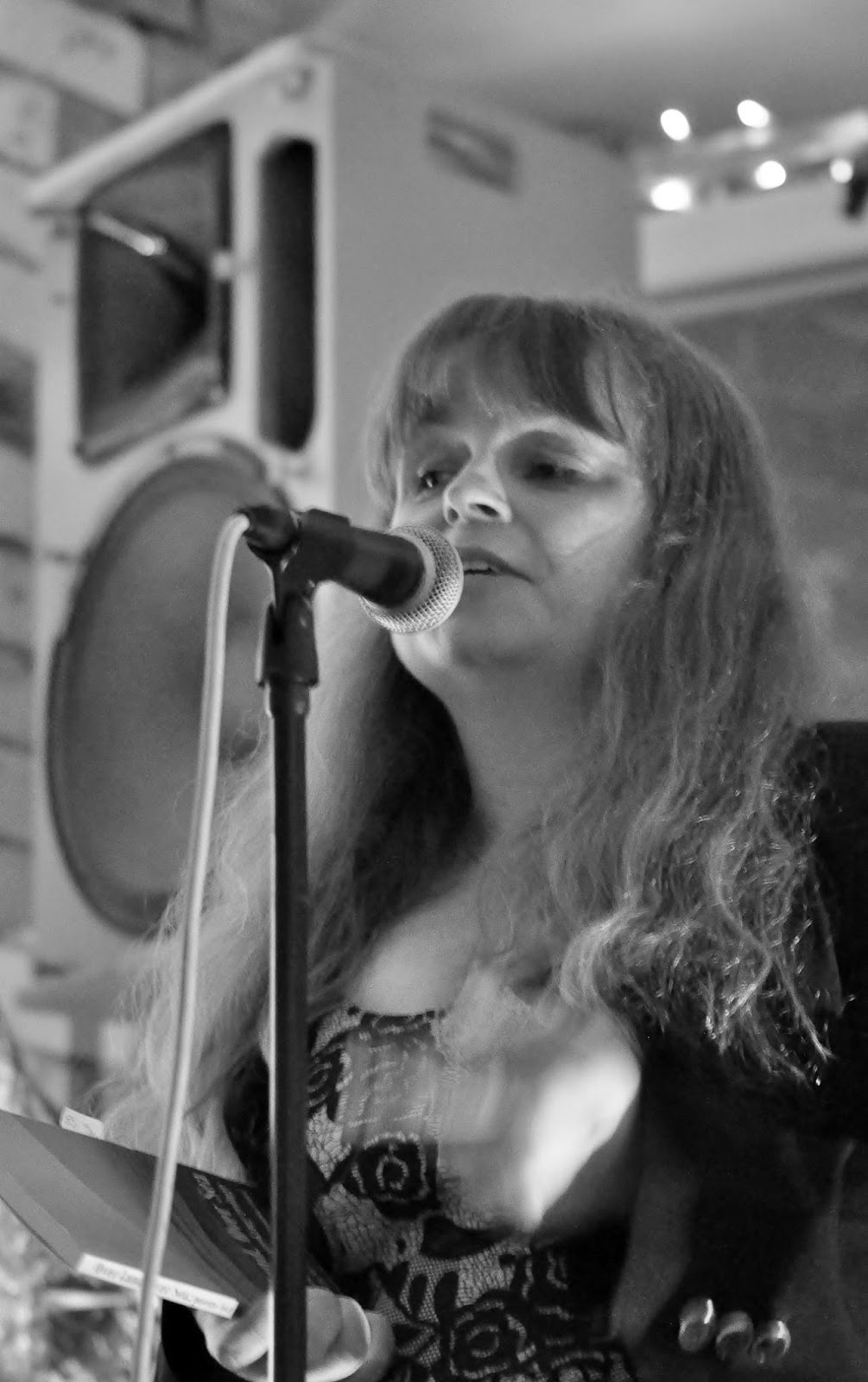
Poet, Performer and Spoken Word Artist, Lydia Towsey.
A Decibel commissioned artist, in 2008 Lydia Towsey was one of 50 international artists in residence at Stratford Theatre Royal.

Previously shortlisted for the Bridport Poetry Prize, she has spoken and performed everywhere ... from London’s 100 Club, Roundhouse and the House of Lords, to ... Plymouth University’s Zombie Symposium.

Her work has been featured in publications that include the magazines: The London Magazine, Hearing Voices and Magma Magazine; and the anthologies, Hallelujah for 50ft Women (Raving Beauties, Bloodaxe, 2016), Over Land, Over Sea: Poems for those seeking refuge (Five Leaves Publications, 2015), Welcome to Leicester (Dahlia Publishing, 2016) and within Candlestick Press’ 10 Poems about ... series.

Lydia is currently UK touring the stage show of her collection, The Venus Papers (Burning Eye Books, 2015) produced by Renaissance One, supported by Arts Council England.

In addition to her practice as a poet/performer, Lydia works as a producer, specialising in literature, health, women and excluded communities and works as part-time Arts in Health Coordinator for Leicestershire Partnership NHS Trust. She plays the ukulele, keeps a cat and is the chair/co-ordinator and rotational compere of WORD! - the longest running spoken word night in the Midlands, nominated as ‘Best Regular Spoken Word Night’ in the 2017, national Saboteur Awards.

In this interview, Lydia Towsey talks about the work she is doing.

How would you describe your writing?

My creative writing focuses on poetry and developing work for the page and performance.

I'm particularly interested in narratives surrounding gender, politics, woman and culture - from popular culture to counter culture and the other… to ethnicity and notions of national identity. I enjoy using humour, satire, wordplay, the fantastical and both visual and performance based techniques and approaches to explore these areas.

Who or what has had the most influence on you as a writer?

Who - undoubtedly, Jean Binta Breeze - who I was lucky enough to meet at an early point in my writing career and fall truly, madly, deeply in friendship and fan-girldom with. I was in my mid-20s and experiencing challenging personal circumstances. Jean taught me to look outside of myself and combine the personal with the public. I think of poems of hers like “Ordinary Mawning” pegging out the washing, while America bombs the middle east… now, with new resonance, of course.

Who, also - Scott Bridgwood, my life partner, figurative painter and key creative collaborator. Our work frequently crosses over, and has done so most recently in The Venus Papers. In this, I’ve developed my research in collaboration with Scott, drawing on his knowledge of figurative art and incorporating my work as a life model (within our relationship) to write around these and other experiences/areas of knowledge. He’s always the first person to hear a new poem and the closest thing to a Witch Doctor I’ve found.

Another big influence - around 10 years ago undertaking and completing an MA in Creative Writing at Nottingham Trent University, specialising in poetry and screenwriting. In doing so I was able to develop formal craft, technique and writing processes, which I’ve drawn and built on ever since.

How have your personal experiences influenced your writing?

I began training as a visual artist, initially undertaking a Degree in Critical Fine Art Practice at Brighton University. Though ultimately not a path I pursued, I think I take quite a visual approach to my writing, from the arrangement of text, to style and content. In the case of The Venus Papers, the writing has been at least in part ekphrastic, directly responding to a painting.

Writing about Venus, I’ve also drawn on other backgrounds, specifically the past experience of anorexia, from my late teens through to my early 20s - with this naturally making me interested in such issues as mental health, body image, the media and cultural/societal pressures to conform.

Writing about Venus - as ‘everywoman’ but also ultimate traveller, I’ve also been motivated by my cultural background. Like many people in the UK, I come from a family of immigrants, on my father’s side mostly Hungarian Jewish, though my Great Great Grandfather was Mexican, his wife American - and there are people from/of other places and cultures too, my mother's Welsh. At the same time I'm English and a descendent of the British Empire and therefore implicated in a story of colonialism and post-colonialism. Given all that, a lot of my writing is interested in this question of cultural and national identity, its historical resonance and unfolding contemporary narratives - including Brexit and the current European refugee crisis.

I often write about my own experiences, so everything from being a being a zombie fan (long story), becoming a mother, working part-time for the NHS and keeping a cat - have made it into my work.

I'm currently working on a new collection exploring Englishness and so far, featuring all of the above. Later this year I'll be poet in residence for Literary Leicester and Arriva Buses - thinking about my dad's former occupation as a bus driver, so again working with personal material, but linking it to a broader context.

Lydia Towsey's The Venus Papers (Burning Eye Books, 2015) takes, as it's starting point, Botticelli's 15th Century painting, 'Birth of Venus' where Venus is depicted arriving on a shell at a Cypriot beach, and goes on to imagine Venus transported to the 21st century.

What would you say has been your most significant achievement as a writer so far?

Developing and touring my first full length collection, The Venus Papers, published by Burning Eyes Books (September 2015) and funded by Arts Council England. I first began writing Venus material, six or seven years ago, so the body of work has had a long gestation period and evolved a lot to take in many influences, personal writing breakthroughs, ideas and experiences. Seeing all that come to fruition has been enormously satisfying.

As a whole, The Venus Papers is about how we look - at ourselves, each other and the world - and how others influence the way we do so … from marketing and the media, to representations of women, the (fe)male gaze and the political machine.

The title sequence takes Botticelli’s infamous 15th century painting, "Birth of Venus", depicting Venus, Roman Goddess of love and beauty arriving on a Cypriot beach. It then relocates her to a UK beach in the 21st century and asks what might happen if she were to arrive here, now. So, there are poems like “Venus Walks into a Bar” … “Venus gets a job as a Glamour Model” … “Venus in Primark” … “Venus at Customs” and so on …

Botticelli’s Venus was the first recorded example of a female nude painted and exhibited life size and in many ways the medieval blueprint for every cover girl to come. Against this background and through the eyes and perspective of someone arriving as an outsider, naked and vulnerable, both show and book engage with society, politics, culture and identity ... re-framing familiar contemporary situations to try and look anew.

The tour is produced by Renaissance One and continuing until the end of 2017, with our next dates taking in Wiseword Festival, Canterbury; The Royal Albert Hall and JW3, London; Lancaster Literature Festival, and more.

WORD! - the poetry and spoken word night you chair and compere with fellow committee members, Tim Sayers, Pam Thompson and Richard Byrt - has just been shortlisted in the 2017 Saboteur Awards as the UKs "Best Regular Spoken Word Night".

Tell us about WORD!, its place within the local literature scene and how you feel about the nomination.

WORD! is the longest running spoken word night in the Midlands - est. circa 2001 by Apples & Snakes, and delivered independently by a voluntary committee/organisation since 2008. The night is formed of an open mic, plus booked act(s) and takes place at The Y Theatre, Leicester on the first Tuesday of every month, compered by members of the committee, Pam Thompson, Tim Sayers, Richard Byrt and I.

We take a diverse approach and programme across gender, age, cultural background and style.

Over the last year we’ve presented powerful local voices like Toby Campion, Shruti Chauhan and John Gallas, alongside artists from outside the city - including Mark Pajak, Malika Booker, Jean Binta Breeze MBE and Rosie Garland.

We’ve also programmed exciting local collectives - from a Writing East Midlands literature project, with refugee writers at City of Sanctuary - to a showcase from Project LALU, a group of female ukulele players, writing bilingually and committed to cultural cohesion and wellbeing.

Our open mic is generally busy and attracts both established and emerging voices from near and far. We aim to create a democratic and safe space, where a range of voices can play together, from the acclaimed, to the emerging and/or previously voiceless.

For many years the only spoken word night in Leicester, in more recent years it’s been exciting and energising to see the emergence of many other local literature projects - from our sister nights, Pinnng…K! (particularly open to LGBTQ+ audiences) and Moonshine Wordjam (led by WORD! and Bootleg Jazz and particularly focused on women and diverse artists) - to a range of other initiatives, connected and unconnected to us. In all cases, our work now also involves the voluntary distribution of a regular newsletter, praising, promoting and further supporting such other activity.

WORD! is the longest running spoken word night in the Midlands and has been shortlisted in the 2017 Saboteur Awards as the UKs "Best Regular Spoken Word Night".

What effect would winning the Sabotage Review “Best Regular Spoken Word Event” have on WORD!?

Winning the accolade of ‘Best Regular Spoken Word Event’ in the UK, would of course be a dream. It would really help in our current endeavour to secure public funding - and in doing so substantially grow our work and make it possible for us to reach even more people. If nothing else, being nominated has greatly impressed our cats/mothers/significant others - and provoked us to Instagram!

We find ourselves on a brilliantly inspiring shortlist - so can only hope to follow in our football team’s footsteps, be fearless and ‘do a Leicester’.

If we win, we’ll ask Gary Lineker to present the next WORD! … in his boxer shorts.

If people would like to, they can vote for us, and across other categories, here. Voting closes at midnight on April 30th.

How did you get involved with Journeys in Translation?

I was working on “Three the Hard Way - Part Two” - a show with Jean Binta Breeze and Shruti Chauhan, touring the UK in 2015 and exploring women, our three generations and continents of origin.

In the light of the ongoing and distressing European refugee crisis, we set ourselves and audiences the question “Who’s your neighbour?” - reflecting on such themes as multicultural Britain, globalisation, inter-dependence and migration. In a country built on both transatlantic slavery – and the free movement of Europeans into the New World – how should we define our responsibilities, where should we draw our borders and who should be entitled to what? We invited people from across the country to respond with poems, uploading recordings or links to text, via twitter.

At the same time and in response to the same situation, the call-out came via CivicLeicester for Poems for People, an anthology designed and planned to gather poems and micro-fictions in solidarity with the refugees - then (and still) receiving so little welcome in Europe and specifically of course, the UK.

Jean, Shruti and I were keen to share the call-out alongside our own, raise awareness and contribute to challenging the hostile political and media discourse growing up around the subject.

In addition to sharing the call, we invited project instigator, Ambrose Musiyiwa and co-editor, Kathleen Bell, to share their own poems in solidarity and speak about the book at our first tour date, Upstairs at the Western, in Leicester.

I went on to submit and have two poems placed in Over Land, Over Sea: Poems for those seeking refuge (Five Leaves Publications, 2015) the anthology that came out of the initiative, and have been keenly following the Journeys in Translation stage of the initiative's genesis.

As part of Journeys in Translation, my piece, "Come In" has been translated into six languages so far and I’ve seen it chalked onto the pavements of Leicester as part of one of CivicLeicester’s many activist happenings. I feel very proud to be connected to the project and grateful for its existence.

Lydia Towsey's "Come In" is one of the 13 poems from Over Land, Over Sea: Poems for those seeking refuge (Five Leaves Publications, 2015) that are being translated into other languages as part of Journeys in Translation. So far, the poem has been translated into six languages.

Which were the easiest aspects of the work you put into the project?

Unusually for me, I found it relatively easy to write the poems. I wrote both of those featured in Over Land, Over Sea, around the time our government announced it would shelter only 4,000 of the most severely affected refugees - a minuscule number comparative to need, resources at our disposal and offers made by fellow European countries. My feelings were so strong and the issues so specific that I was able to work quickly.

Post Brexit, the rise of racist attacks, and our government’s new announcement, that it will now take only 350 child refugees - the hardest thing is to not give in to despair and feel powerless. I deal with such fears by continuing to write and speak positively around the subject, donate what I can to charities supporting refugees, engage with activism and exercise my voting rights to effect the change I want to see.

Lydia Towsey's poem, "Come In", on the pavement at the Leicester Against War / Leicester for Peace vigil that, since December 2015, is held every Friday at the Clock Tower in Leicester in solidarity with people from everywhere who are bearing the brunt of war and those who are seeking refuge.

What would you say is the value of initiatives like Journeys in Translation?

Journeys in Translation is exciting and dynamic as both a political and an artistic endeavour. The poems and micro-fictions are in response to migration, a politically resonant and urgent subject - but then the words and poems are themselves migrating across language borders, and then migrating between stage and page - then onto the internet, pavements, placards and beyond. The project has great value in its reach, artistry, innovation and activism.

In translating poems over multiple languages and involving even more people, as translators and audience (in conventional and unconventional settings) it has the ambition and power to bring people together and unite diverse groups and communities - something that is of evident value and importance, and particularly so now.

Editor's Note:

Journeys in Translation aims to facilitate cross- and inter-cultural conversations around the themes of home, belonging and refuge.

The project encourages people who are bilingual or multilingual to have a go at translating 13 of the 101 poems from Over Land: Over Sea: Poems for those seeking refuge (Five Leaves Publications, 2015) from English into other languages and to share the translations, and reflections on the exercise on blogs, in letters and emails to family and friends, and on social media.

So far, the 13 poems that are being used as part of the project have been translated into languages that include Italian, German, Shona, Spanish, Bengali, British Sign Language, Farsi, Finnish, French, Turkish and Welsh. Currently, over 20 people from all over the world are working on the translations. More translations and more languages are on the way.

In Leicester, Journeys in Translation will culminate in an event that is going to be held on September 30 as part of Everybody's Reading 2017. During the event the original poems and translations will be read, discussed and displayed.

Over Land, Over Sea: Poems for Those Seeking Refuge (Five Leaves Publications, 2015) was edited by Kathleen Bell, Emma Lee and Siobhan Logan and is being sold to raise funds for Doctors Without Borders/ Médecins Sans Frontières (MSF)Leicester City of Sanctuary and the Nottingham and Nottinghamshire Refugee Forum.

Copies of the anthology are available from Five Leaves Bookshop (Nottingham).

More information on how Over Land, Over Sea came about is available here.
Wednesday, April 19, 2017

Interview _ Emma Lee

Emma Lee
Emma Lee co-edited Over Land, Over Sea: Poems for those seeking refuge (Five Leaves Publications, 2015) and is one of the coordinators of Journeys in Translation. She also co-edited Welcome to Leicester (Dahlia Publishing, 2016) and has three poetry collections, Ghosts in the Desert (Indigo Dreams Publishing, 2015), Mimicking a Snowdrop (Thynks, 2014) and Yellow Torchlight and the Blues (Original Plus, 2004).

She reviews for The High Window Journal, The Journal, London Grip and Sabotage Reviews and is currently Vice-President of Leicester Writers' Club. Her poems have been published in the UK, USA, Mexico and South Africa, broadcast on radio and she has performed them at venues such as Leicester City Football Club, Leicester's Guildhall and the Poetry Cafe in London.

In this interview Emma Lee talks about her writing and about Journeys in Translation.

How would you describe the writing you are currently doing?

In between poetry reviews and blog articles, there are poems. I'm currently taking part in NaPoWriMo (National Poetry Writing Month, April 2017) where the aim is to draft or make notes towards 30 poems during April, averaging a poem a day. Outside of NaPoWriMo, I'll still be writing poems, blog articles and reviews, going to poetry and spoken word events and Leicester Writers' Club, but without the pressure of averaging a poem a day.

In that, who or what has had the most influence on you?

I usually avoid naming contemporary poets for fear of leaving someone out, but it's fair to say many of them are my Indigo Dreams Publishing stable mates. Other influences include Sylvia Plath, Charlotte Mew, Rosemary Tonks, Maya Angelou, Marcia Douglas, Anna Akhmatova, Elizabeth Bishop, Robert Lowell.

How have your personal experiences influenced the writing?

Not all my poems are semi-autobiographical. I love that poems give me the chance to try and imagine what someone else's experiences feel like and explore how others might tell their stories if they were given a chance.

What has been your most significant achievement as a writer so far?

In terms of being noteworthy, probably co-editing Over Land, Over Sea: Poems for those seeking refuge (Five Leaves Publications, 2015), not only in the interest it generated in readings in Leicester, Nottingham, St Andrews, the Poetry Cafe in London and interviews in The Morning Star and on Iraqi TV, but also in fundraising for refugee charities and subsequent projects such as the Journeys Poems Pop-Up Library, Journeys in Translation and the "Poetry and 'The Jungle'" paper I presented at the Jungle Factory Symposium organised by the University of Leicester in 2017.

On a more personal level, it has to be the publication of my third collection Ghosts in the Desert (IDP, 2015).

How did you get involved with Journeys in Translation?

Ambrose Musiyiwa and I were chatting over coffee about the Journeys Poem Pop-up Library, where we gave out postcards featuring eight poems from Over Land, Over Sea at Leicester Railway Station during the Everybody's Reading Festival, and how we could build on that.

At the time of putting together Over Land, Over Sea we only took poems in English, a language common to all three co-editors, because our priority was to raise funds, however we were aware that the publication being monolingual was a potential issue because it raised barriers to reading and sharing poems about a universal experience. So the idea came about to translate some of the poems into other languages and break down some of those barriers.

We picked the eight poems used in the postcards and added a further five, using local poets so that we could work towards an event where the original poems would be read and displayed alongside readings and displays of some of the translations.

I suspect if I hadn't stopped for that coffee, I'd still be involved somehow.

"[We] were chatting over coffee about the Journeys Poem Pop-up Library, where we gave out postcards featuring eight poems from Over Land, Over Sea at Leicester Railway Station during the Everybody's Reading Festival, and how we could build on that."

Which were the easiest aspects of the work you put or are putting into the project?

Coming up with the design for the posters. We're using the cover image of Over Land, Over Sea and each poster features the original poem alongside one translation.

Where more than one translation in a specific language has been done, these are being featured with the original poem on one poster, where possible. For example, there are three German translations of "The Man Who Ran Through the Tunnel" and these are featured with the original English version on one poster. The idea is not to directly compare the translations, but discuss how the differences occurred and difficulties in translating phrases or idioms which don't have a direct translation into another language.

One of your poems, "Stories from 'The Jungle'" is also being used as part of Journeys in Translation. How did the poem come about?

One frequently asked question is along the lines of: "Why don't refugees apply for asylum in the first European country they arrive in?" or "Why do refugees camped in France want to come to the UK?"

I wanted to explore some answers to that.

Sometimes it's because the refugees already have family here and want to join their family. Sometimes it's because the only European language they speak is English (usually because they were from a former colony and English was and in some cases still is one of the official languages). Sometimes it's a combination of reasons.

"Stories from the Jungle" takes seven stories from newspaper interviews and explores them not only through the question of why try to get to England but also why leave home and country in the first place.

Primarily I was trying to show that refugees are people with stories too. Not only that but they also have the right to tell those stories in their own words and on their own terms. There are a lot of negative connotations attached to the word migrant. But there is also a tendency to imply refugees are victims with no agency. Neither is accurate.

We won't solve the problems that large migrations cause without understanding why they are happening. People don't choose to leave their homeland and embark upon long, perilous journeys unless they have good reason for doing so. In an age of austerity, it's easy to fall into the trap of seeing migration as an economic problem but it's not that simple. I wanted "Stories from 'The Jungle'" to re-humanise de-humanised people.

Emma Lee's poem "Stories from 'The Jungle'" on the pavement at the Leicester Against War / Leicester for Peace vigil. The vigil started in December 2015 and is held at the Clock Tower in Leicester, every Friday,  in solidarity with people everywhere who are bearing the brunt of war as well as those who are seeking refuge.

How has the poem been received?

One of the translators in the Journeys in Translation project commented:
I found that when focusing on the words and stories within the poems I started to really focus on the human aspect of the refugee crisis, which I had not perhaps really appreciated until this point. Suddenly all those news images and statistics took on a more personal meaning. When I read through the experiences of Abdel, Sayid and Ziad in “Stories from ‘The Jungle’” and the lives they left behind, which seemed very normal and comparable to my own, I couldn’t help thinking, "It could have been me!"
So far, which were the most challenging aspects of the work you put into the initiative? 

The most challenging was translating some of the poems myself. I do have a basic understanding of German but hadn't spoken or written in German recently. I started with my own poem because I knew the intention behind the words I'd chosen so wouldn't be so daunted by there not being a direct translation.

I used several online dictionaries (not just Google Translate) so I could be more confident I was picking the right German words for the poem. I also re-translated my German back into English using online dictionaries so I could be sure that the selected German words would be interpreted in the right way. It was very reassuring when others translated the same original poem into German and I could see their approach was very similar to mine, although still with small differences.

I had tried to reproduce the original rhyme scheme (at least by sight) in my translation, but the other translators had gone for a more literal translation without the rhymes.

What would you say is the value of initiatives like Journeys in Translation?

It's great to see the enthusiasm and involvement of both poets and translators.

Translating the poems isn't just about widening the audience for the original poems, it's about breaking down barriers to the poems being read and enabling the stories behind the poems to be shared. It also gives others the opportunity to share their stories and experiences.

Editor's Note:

Journeys in Translation aims to facilitate cross- and inter-cultural conversations around the themes of home, belonging and refuge.

The project encourages people who are bilingual or multilingual to have a go at translating 13 of the 101 poems from Over Land: Over Sea: Poems for those seeking refuge (Five Leaves Publications, 2015) from English into other languages and to share the translations, and reflections on the exercise on blogs, in letters and emails to family and friends, and on social media.

So far, the 13 poems that are being used as part of the project have been translated into languages that include Italian, German, Shona, Spanish, Bengali, British Sign Language, Farsi, Finnish, French, Turkish and Welsh. Currently, over 20 people from all over the world are working on the translations. More translations and more languages are on the way.

In Leicester, Journeys in Translation will culminate in an event that is going to be held on September 30 as part of Everybody's Reading 2017. During the event the original poems and translations will be read, discussed and displayed.

Over Land, Over Sea: Poems for Those Seeking Refuge (Five Leaves Publications, 2015) was edited by Kathleen Bell, Emma Lee and Siobhan Logan and is being sold to raise funds for Doctors Without Borders/ Médecins Sans Frontières (MSF)Leicester City of Sanctuary and the Nottingham and Nottinghamshire Refugee Forum.

Copies of the anthology are available from Five Leaves Bookshop (Nottingham).

More information on how Over Land, Over Sea came about is available here.

Monday, April 17, 2017

Interview _ Antonella Delmestri

Antonella Delmestri was born in Trieste, Italy, where she began her education in Classical Studies before moving to Computer Science. Holder of a PhD in Information and Communication Technologies, she is author or co-author of a number of scientific publications.

In 2004 her first collection of Italian poems, Stanze dove non eri stato mai, was published by Ibiskos. In 2016 her second collection, Il respiro del drago (The breath of the dragon), including an English translation by Anne Lloyd-Williams, was published by Battello Stampatore.

Antonella has also published in Italian a short story “E questo fu solo l’inizio!” and has won various literary awards with her poems. Since 2006, she has lived in the UK, and works at the University of Oxford in medical research.

In this interview, Antonella Delmestri talks about her poetry.

How have your personal experiences influenced your writing?

My personal experiences have entirely influenced my writing, even its very start and existence. I love T. S. Eliot’s definition of poetry:
Poetry is not a turning loose of emotion, but an escape from emotion; it is not the expression of personality, but an escape from personality. But, of course, only those who have personality and emotions know what it means to want to escape from these things.
Which authors influenced you most?

What has most influenced my writing is my classical background, especially Greek and Latin mythology. I am fascinated by the power of this psychologically evocative cultural expression, which remains significant through the ages in representing universal human emotions. Myths, archetypes and metaphors are symbolic ways of conveying deeper truths about ourselves and the world around us.

How would you describe Stanze dove non eri stato mai?

Stanze is a journey through different emotional states represented by the book's sections: "Ombre" (Shades), "Attimi" (Moments), "Sorrisi" (Smiles), "Miraggi" (Mirages) and "Catene" (Chains).

The reader is invited to discover different rooms (stanze in Italian) of a virtual house, which symbolises one's inner self and identity. This is what the book's title refers to (Rooms where you had never been in English), and is a line in one of the poems, "La vergogna" (Shame). The fact that Stanza has an additional meaning in poetry makes the title more evocative.

How did the collection come about?

I started writing poetry when I was in my early 30s and it was a complete surprise to me. One day I woke up and I just had to write.

Initially, everything I produced was in rhyme, and the rhymes were ready to come out effortlessly. It was an unsettling experience, because I was not used to it and I did not understand where it came from. Probably to give it some direction, I got into the habit of writing in the morning and editing the result later in the day. This activity of dreamy writing and file-editing went on for a few years undisturbed and solitary.

One day I heard of a publisher, Ibiskos, running a competition for poetry collections, and I began to consider sharing my writing with the outside world. I started selecting the poems that I thought might be suitable, and grouped them into sections. My collection was shortlisted in the competition and Ibiskos offered to publish it.

Antonella Delmestri's first poetry collection Stanze dove non eri stato mai was published in 2004 by Ibiskos Editrice. 
What were the easiest aspects of the work that went into the collection? And which where the most challenging?

The creation of the poems themselves was the easiest part of the work. But my writing is very deep, and I am always worried that it could be too intense for people to enjoy. I found it challenging to choose what to include in a collection, as I had to overcome this concern and try to focus on the quality of the poems instead. I asked a few trusted friends for their opinion and comments before reaching a final decision.

I received good feedback for the book. People seemed to connect with and relate to the poems, which was encouraging. Of course, the market for poetry is so small that it is difficult to have good distribution and advertising if you are not an established author, but I expected this difficulty.

In what way is your second collection similar to Stanze dove non eri stato mai? And, conversely, what sets Il respiro del drago apart from your first collection?

There are several similarities between the two collections. In both books, the poems are accessible, short, deep and sharp. Another similarity is the virtual journey offered to the reader through very different emotional atmospheres.

However, although the first collection accompanies the traveller through rooms of a symbolic house where the sequence of the passage is irrelevant, in The breath of the dragon, the exploration of human emotions follows a specific course with a higher degree of awareness. "Sparks", "Flames", "Embers" and "Smoke" track sequential stages of fire, as in a process of completion. This reflects a deeper and more mature understanding of emotions and their mechanisms.


Antonella Delmestri's second poetry collection, Il respiro del drago / The breath of the dragon (Battello Stampatore, 2016) is bilingual and includes Anne Lloyd-Williams' English translation of the poems. 

How did the bilingual edition of Il respiro del drago come about?

Il respiro del drago has been nearly ready for some time and, after several years of being overwhelmed at work, I felt I was ready to allocate again more attention and energy to my writing. When the draft was ready, I sent it to Battello Stampatore, a small publisher in Trieste who might have been interested. When I met the owner, he suggested producing an Italian/English edition, considering that English could give the poems more visibility.

One of my good friends in Oxford, Anne Lloyd-Williams, who has an interest in poetry and is an Italian speaker, was happy to collaborate on this project. The experience was fascinating for me, and it made me even more aware of the cultural differences between Italy and the UK, which are reflected in their languages' capabilities and richness.

Interestingly, after having read the English translation of Il respiro del drago, an American poet, David Olsen, expressed his interest in translating the poems of my previous book, Stanze, and we are now collaborating.

How would you describe the nature of your involvement with Journeys in Translation?

A friend of mine, who works at the Refugee Studies Centre of Oxford University, knowing my interest in poetry and humanitarian initiatives, forwarded an email regarding Journeys in Translation, which was seeking translators.

I was delighted to hear about the initiative, and to be able to contribute to an important project that will raise awareness on such a serious and current topic. Our society has become far too blind and deaf to our fellow human beings’ painful destinies. We, authors, should use our skills to help them.

I have translated into Italian nine of the 13 poems - those with which I felt confident, and which had not been previously translated into my mother tongue. Moreover, I am organizing a poetry reading in Oxford for late May for The breath of the dragon, and I am very excited about having different readers giving their voices to four of the poems from Journeys in Translation.

Which were the easiest aspects of the work you put into the initiative?

This has been my first experience of translating poetry into Italian. The easiest aspect was to get into the poems, as they were very meaningful and powerful.

What I found complicated sometimes was, how to be faithful to the original poem, while giving a poetic structure to the translation. After writing the first draft, I reviewed it several times while trying to keep an open mind, and finally I sent it to a friend for his opinion and suggestions.

"but one country" also had the extra challenge of having an earth shape, which is so visually expressive.

Antonella Delmestri's translation, into Italian of Rod Duncan's "but one country", one of the 13 poems from Over Land, Over Sea: Poems for those seeking refuge (Five Leaves Publications, 2015) that are being used as part of Journeys in Translation.


Editor's Note:

Journeys in Translation aims to facilitate cross- and inter-cultural conversations around the themes of home, belonging and refuge.

The project encourages people who are bilingual or multilingual to have a go at translating 13 of the 101 poems from Over Land: Over Sea: Poems for those seeking refuge (Five Leaves Publications, 2015) from English into other languages and to share the translations, and reflections on the exercise on blogs, in letters and emails to family and friends, and on social media.

So far, the 13 poems that are being used as part of the project have been translated into languages that include Italian, German, Shona, Spanish, Bengali, British Sign Language, Farsi, Finnish, French, Turkish and Welsh. Currently, over 20 people from all over the world are working on the translations. More translations and more languages are on the way.

In Leicester, Journeys in Translation will culminate in an event that is going to be held on September 30 as part of Everybody's Reading 2017. During the event the original poems and translations will be read, discussed and displayed.

Over Land, Over Sea: Poems for Those Seeking Refuge (Five Leaves Publications, 2015) was edited by Kathleen Bell, Emma Lee and Siobhan Logan and is being sold to raise funds for Doctors Without Borders/ Médecins Sans Frontières (MSF)Leicester City of Sanctuary and the Nottingham and Nottinghamshire Refugee Forum.

Copies of the anthology are available from Five Leaves Bookshop (Nottingham).

More information on how Over Land, Over Sea came about is available here.

Friday, April 14, 2017

Interview _ Irena Ioannou

Irena Ioannou’s poetry has appeared or is forthcoming in The Wild Word, S/tick, Literary Mama, Eyedrum Periodically and Shipwrights. She writes from Crete, Greece where she lives with her husband and four children.

In this interview, Irena Ioannou talks about her writing, translation and poetry.

When did you start writing?

My first efforts were in Greek and were meant for my eyes only, too many years ago to be able to pin it down. Then I stumbled upon some creating writing courses at Malmo University, or they stumbled upon me, I can’t tell for sure.

My first poems were published online in 2013 and ever since I’ve been taking my writing one step forward, the past months more steadily and decisively so.

How would you describe the writing you are doing?

I write narrative, confessional poetry, more often than not with a feminist-political bent. Lately, I’ve been experimenting with the flash fiction and the short story form. Writing constantly offers new opportunities to learn and evolve, or sometimes you find that a medium cannot deliver the intended meaning adequately. But poetry is the guide to everything else: it taught me to pay attention to every single word, which is a big step into writing.

Who or what has had the most influence on you as a writer?

I am Greek and I have attended Greek school which means that I’ve studied the Classics. Having also studied English Literature though, a new window opened when I came across contemporary female poets.

I chose to do my Bachelor Thesis on Carol Ann Duffy’s The World’s Wife, and, well, nobody can remain unaffected by that. Questions about the truth of representation and the reinvention of history still haunt my writing.

In general, I am drawn to poems with a strong voice. Poets like Sharon Olds and Adrienne Rich — and others less known who use poetry to bare their soul — are my soft spot.

How have your personal experiences influenced your writing?

Your experiences make you who you are, and your writing reflects it. I’ve been influenced by two countries: Sweden, where I was born, and Greece, where I’ve grown up.

Studies have also the habit of messing with your head, and at times I enroll in foreign language courses trying to decode the way of thinking behind them. And of course, my job in the Greek Fire Brigade offers new angles of interpreting the human condition.

What has been your most significant achievement as a writer so far?

I consider my best achievement that I continue writing while working and being a mother of four.

I cannot single any of my pieces out as they all carry a piece of me in their words. But of course I value the magazines that treat my work with respect, like The Wild Word did with my poem "It’s Only Human Nature" and my personal essay "On Country And Shared Blood", and the Mortar Magazine did with my short story "St. George".

The publishing world is still a puzzle to me, though every time a total stranger chooses my work among hundreds I call it a small miracle, and marvel at the way poetry unites us all.

How did you get involved with Journeys in Translation?

I answered to an open call for volunteer translators posted in my university’s online writing community.

I have translated eight of the poems into Greek, and I am working on the rest. So far, it’s been a very rewarding experience. I can’t help but admire such initiatives; we’re all so caught up in our lives that we don’t even allow sidelong glances to anything that doesn't directly concern us.

Which were the easiest aspects of the work you put into the project?

It’s natural to identify more with certain poems than with others, which make their reading and translation an easier task. It’s like reading a poem and thinking, "Yeah, I've been there." I could refer here to Kathleen Bell’s "Waiting". That peeking out through the window felt quite intimate.

Irena Ioannou's translation, into Greek of Kathleen Bell's "Waiting", one of the 13 poems from Over Land, Over Sea: Poems for those seeking refuge (Five Leaves Publications, 2015) that are being used as part of Journeys in Translation, a project that aims to facilitate cross- and inter-cultural conversations on the themes of home, belonging and refuge.  

Which were the most challenging?

Words come in different hues and there is always the fear that, as a translator, you’ll assign a meaning to a word not intended by its first creator. I treated some of the poets as witnesses, as though offering them a medium to share their experiences and I would hate to alter these experiences in any way, as in assigning to emotionally charged words lesser meaning. But in the end, poetry is deeply felt and you just put on the paper what your heart dictates.

What would you say is the value of initiatives like Journeys in Translation?

The value of such an initiative is that it is not another product of MFA graduates, neatly arranged words in projected structures — at least that’s not the way I viewed it. I felt some of the poems literally singing to me, I could see the rhythm of escaping behind them, this sense of people caught in midair. I don’t know what else can touch us anymore, but poetry — our eyes have long been trained to stop seeing.

Editor's Note:

Journeys in Translation aims to facilitate cross- and inter-cultural conversations around the themes of home, belonging and refuge.

The project encourages people who are bilingual or multilingual to have a go at translating 13 of the 101 poems from Over Land: Over Sea: Poems for those seeking refuge (Five Leaves Publications, 2015) from English into other languages and to share the translations, and reflections on the exercise on blogs, in letters and emails to family and friends, and on social media.

So far, the 13 poems that are being used as part of the project have been translated into languages that include Italian, German, Shona, Spanish, Bengali, British Sign Language, Farsi, Finnish, French, Turkish and Welsh. Currently, over 20 people from all over the world are working on the translations. More translations and more languages are on the way.

In Leicester, Journeys in Translation will culminate in an event that is going to be held on September 30 as part of Everybody's Reading 2017. During the event the original poems and translations will be read, discussed and displayed.

Over Land, Over Sea: Poems for Those Seeking Refuge (Five Leaves Publications, 2015) was edited by Kathleen Bell, Emma Lee and Siobhan Logan and is being sold to raise funds for Doctors Without Borders/ Médecins Sans Frontières (MSF)Leicester City of Sanctuary and the Nottingham and Nottinghamshire Refugee Forum.

Copies of the anthology are available from Five Leaves Bookshop (Nottingham).

More information on how Over Land, Over Sea came about is available here.

Wednesday, March 8, 2017

Interview _ Laura Chalar

Laura Chalar was born in 1976 in Uruguay, where she trained as a lawyer. She is the author of six books, most recently Midnight at the Law Firm (Coal City Press, 2015), a chapbook of poetry, and Líber Andacalles (Topito Ediciones, 2016), a Spanish-language short story for children.

She has also published numerous translations from and into Spanish, including Touching the Light of Day: Six Uruguayan Poets (Veliz Books, 2016) and Uruguayan poetry dossiers in Modern Poetry in Translation and other literary journals. The recipient of various literary awards as well as a Pushcart Prize nominee, she is currently at work on several simultaneous projects. Laura is married and has a daughter.

In this interview, Laura Chalar talks about her writing.

When did you start writing?

I started writing when I was very small, copying the printed letters I found in books and newspapers. I can’t remember a time when I didn’t write. My father was very proud of a story about a ‘caterpillar woman’, which I must have written when I was about four. Both my parents were readers --- fine examples of that type of cultured, literary-minded lawyer which is now sadly in danger of extinction. We never had much money when I was growing up, but there were always plenty of books around the house.

How would you describe the writing you are doing?

I am a poet and short-story writer who also wants to become a novelist! Recently, I’ve also started writing for children. And then, of course, I also translate. These different genres often hinge around subjects I keep returning to --- memory, childhood, ‘normal’ people living normal lives, usually in places I happen to know or have lived in.

In the writing you are doing, which authors influenced you most and in what way? Why do you think they’ve had this kind of influence?

I wouldn’t know about influence, but there are many writers whose work I admire and which are a quality standard I always try to keep within sight, even if I can’t match it. I’m always discovering poets whose work I love, many of them English!

Among Uruguayan writers, who are perhaps less familiar to English-language readers but definitely worth getting to know, I would mention Julio Herrera y Reissig, Líber Falco, Juan Carlos Onetti, Marosa di Giorgio, Carlos Martínez Moreno, Horacio Quiroga and Juana de Ibarbourou from the ‘classics’ ranks.

Laura Chalar's books include Touching the Light of Day (Veliz Books, 2016) and Líber Andacalles (Topito Ediciones, 2016).

How have your personal experiences influenced the writing you are doing?

My personal experiences are always there, lurking behind the scenes. That is not to say, of course, that my writing is always ‘confessional’ --- I will draw on stories I have heard, the visual arts, places I have never been to --- but there is always something of myself, of my tastes and inclinations, in what I write. I suppose it’s the same with most writers --- your life seeps into your writing, sometimes in ways you can’t recognize.

What are you working on at present?

I am preparing a Spanish-language book of prose poems (or poem-like stories, depending on your view) for the press. It will be published in Uruguay by Irrupciones, a local publisher, perhaps in May.

This year, I also plan to finish a book about reading to (and with) my daughter, and edit the short stories and other writings of my father, who died last year (some of these can be read in the latest issue of Coal City Review, an American literary journal, in my translation).

I’m also looking for a publisher for my translations of the Brontë sisters’ poems, illustrated by a wonderful Uruguayan artist. There are also a couple of translation projects around, involving English-language poets whose work I enjoy ...

And I’m probably still forgetting something.

How do you balance the demands of the various aspects of the work you are doing?

The greatest demands come from motherhood and my work as a lawyer, which is how I make my living. These are both wonderful and challenging but, as you may imagine, take up most of my time! Any free time I find for writing goes to whatever is currently the most ‘urgent’ project, always trying to fit in things that come up and which can be finished relatively quickly.

For you, what connects Law, poetry and literary translation?

Words and ideas ... a passion for them, their possibilities, the worlds they uncover. I suppose I could just as accurately say that in my view they are connected by a deep interest (and involvement) in human lives and human minds.

What would you say is the value of an initiative like Journeys in Translation?

I think if you can make people understand and know about the refugee experience, then tolerance and compassion (both greatly needed in today’s world) will be fostered and enhanced. And you might make people gain a greater appreciation of poetry along the way, which would be an added bonus.

What have been the most interesting aspects of the work you’ve done so far with the initiative?

So far I have only translated a couple of poems, ‘What’s in a Name’ (which offers, in an almost incantatory manner, the names of different people who are suffering, and through naming them brings them closer to us and gives them a voice) and ‘Dislocation’, a very spare poem about disconnectedness and alienation.

The most exciting thing about doing so was the possibility of being a part of a project that will hopefully help people and change lives for the better, hackneyed as these words may seem. Uruguay and Argentina, the countries I divide my time between, are both currently peaceful in the sense that there are no dictatorships, wars or displacement issues (though there is a very concerning streak of totalitarianism alive and kicking in both); for most of us here, having to leave your life, family and possessions behind and start anew, seeking protection in a foreign country, is an ordeal we can’t even begin to imagine. Our ancestors did it when they sailed for this part of the world, usually driven by poverty, two or more generations back --- but it isn’t really a part of our everyday experience. And I don’t want geographical distance and a different life path to prevent me from empathizing with and helping, if I can, those who are going through such misery and misfortune in current times. I want to be a part of the change for the better, part of the good in their lives, and literature seems like the most obvious channel, as writing is what I do best.

Laura Chalar's translations of some of the poems from Over Land, Over Sea: Poems for those seeking refuge (Five Leaves Publications, 2015) that are being used as part of Journeys in Translation, a project that aims to facilitate cross- and inter-cultural conversation on the themes of home, belonging and refuge.

What has been the most challenging? And, how have you dealt or how are you dealing with these challenges?

I always try to deal with translation challenges with creativity and craftsmanship. I think a translation is successful when it can be read as a poem in its own right.

Editor's Note:

Journeys in Translation aims to facilitate cross- and inter-cultural conversations around the themes of home, belonging and refuge.

The project encourages people who are bilingual or multilingual to have a go at translating 13 of the 101 poems from Over Land: Over Sea: Poems for those seeking refuge (Five Leaves Publications, 2015) from English into other languages and to share the translations, and reflections on the exercise on blogs, in letters and emails to family and friends, and on social media.

So far, the 13 poems that are being used as part of the project have been translated into languages that include Italian, German, Shona, Spanish, Bengali, British Sign Language, Farsi, Finnish, French, Turkish and Welsh. Currently, over 20 people from all over the world are working on the translations. More translations and more languages are on the way.

In Leicester, Journeys in Translation will culminate in an event that is going to be held on September 30 as part of Everybody's Reading 2017. During the event the original poems and translations will be read, discussed and displayed.

Over Land, Over Sea: Poems for Those Seeking Refuge (Five Leaves Publications, 2015) was edited by Kathleen Bell, Emma Lee and Siobhan Logan and is being sold to raise funds for Doctors Without Borders/ Médecins Sans Frontières (MSF), Leicester City of Sanctuary and the Nottingham and Nottinghamshire Refugee Forum.

Copies of the anthology are available from Five Leaves Bookshop (Nottingham).

More information on how Over Land, Over Sea came about is available here.

Wednesday, July 6, 2016

[Interview_2] C. Y. Gopinath


C. Y. Gopinath has worked as a journalist, a film director, and a community development worker.

His books include Travels with the Fish (Harper Collins, 1999) and the novel, Book of Answers.

In this email interview, C. Y. Gopinath talks about his new book, Hoyt’s War.

What is your latest book about?

I just finished writing Hoyt’s War. The story is set in USA 2020, after four years of a very Trump-like President called Barry Codbag have made America the most ridiculed and reviled nation on the planet. It’s strange that my main ‘villain’ was every bit as irrational, maverick, and a dangerous loose cannon as Donald Trump.

Campaigning now for four more years in the Oval Office, Codbag needs new and more diabolical distractions to confuse the electorate.

Along comes an ordinary retiring American, Daniel Hoyt, a man who just would rather be left alone in peace. Hoyt knows he’s in trouble when he inherits an ancient but locked book said to contain answers to all of America’s problems.

And Codbag wants it. He knows this book will help him get re-elected.

Hoyt, wanting no part of this, sells the book to a dollar store. But the shop owner quickly realizes what the book could mean, and re-invents himself as a clergyman, claiming that through this book God speaks straight to him. It’s a matter of time before he is working directly with the President.

The President and the pastor make a lethal pair. For every preposterous law Codbag wants to enact, the pastor makes up ‘divine’ evidence that it comes from God’s words in the book. And a gullible nation laps it up.

Codbag wants to turn America into a monarchy with himself as King, in the name of minimum government.

Decriminalize rape.

Legalize cheating in examinations.

Impose a tax on sex.

Create a special Grey Area for people who think too clearly.

Ban the past and future tense.

Now Daniel Hoyt hates a fight; he’s no hero. But against his wishes, he gets dragged closer and closer to a confrontation with Codbag. The government wants the key to the book, and only Hoyt can get it. Suddenly he is the White House’s crosshairs.

Hoyt’s War is the story of an ordinary American who reluctantly takes on the most powerful man on the planet, in a hard-hitting, riotous and all too plausible satire of a dystopian America.

Is it true that Donald Trump was the inspiration for the character of President Barry Codbag?

Codbag undeniably talks, thinks and feels like Trump. But the truth is that I began writing this book in 2012 and finished it in early 2015, long before Trump was even a feature on the election map. So it’s a moot point whether Trump inspired Codbag — or whether Trump could pick up a few more crazy ideas from him.

The rather audacious promotional campaign I am launching actually is based on a series of ‘news stories’ from a certain fictional newspaper called Washington Psst, in which Trump is seen waving a copy of Hoyt’s War and saying it should be banned. It feels completely appropriate to take full advantage of someone as amoral, unethical, unprincipled and self-serving as Trump.

What sets the book apart from other things you've written?

Imagine a story set in the culture and society of one country — being re-written and re-imagined in the socio-political setting of a completely different country. I would go out on a limb and say Hoyt’s War might be the first book in literary history to do that.

In 2011, HarperCollins India published my first novel, The Book of Answers, a sharp political satire along Orwellian lines, set in India. The novel got shortlisted for the 2012 Commonwealth Book Prize, though its sales in India were in the hundreds. My literary agent at that time, Nathan Bransford of Curtis Brown Limited, mentioned once that the Indian cultural setting made the story harder to sell in the US.

This troubled me — the story was quintessentially about the madness of the extreme right ideologies that are dragging the world towards chaos. India and America had comparable madness. In 2013 I decided to completely re-write the story as an American political thriller. Patros Patranobis, the reluctant protagonist, became Daniel Hoyt. Prime Minister Ishwar Prasad, heading a parliamentary democracy, became Barry Codbag, leading a federal union called the United States of America.

Mumbai became the Tribeca district of New York. The royal palaces of Kerala morphed into the cotton plantations of Shongaloo, Louisiana, and Kerala itself became the Everglades. Miami and the circus town of Gibsonton.

The story could not stay the same either, I soon discovered. America was heading into its own elections, and the extreme right white-supremacist Christian evangelical environment needed serious tweaks in the story itself. Most importantly, I had to master the different dialects and idioms of the parts of America that featured in my story.

Best of all, a certain Mr Donald Trump landed with a crash-boom-bang on the election scene, bringing his own blustering, aggressive brand of unreasonable madness with him — and suddenly my President Codbag began to feel like the right villain at the right time. Codbag was already Trump, no two ways about it.

Which aspects of the work you put into the book did you find most difficult?

Writing intimately about neighborhoods and cities that I had neither seen nor lived in was one of the challenges in writing Hoyt’s War.

The Book of Answers dealt with my country, India, and descriptions were textured and detailed because I had experienced them. To get the same level of familiar detail about American settings, I spent weeks and weeks in Google Street View. It is astonishing how much of the world you can now see in continuous street-level view thanks to Google’s mapping software. Once I had a sense of what a street or neighborhood looked like, my imagination added texture and other details.

I have now walked the streets of Tribeca, down to the metro stations; the sea fronting villas of Little Neck Bay, and where East River widens to become Long Island Sound; I have trolled the evening streets of Miami looking for a bar; and sweated in the humid marshes of the Everglades. Dr Basin’s clinic in New York is authentically sited near a waterfront that bustles with streetwalking sex workers in the evening.

I also had to research local government institutions, hierarchies, ranks, so that my details about police, precincts, and officialdom rang true.

What did you enjoy most?

I most enjoyed tweaking the story politically to align it better to the frightening lunacy of modern-day Trumpian politics in the USA.

India and the USA share frightening similarities in their right wing establishments, but in the USA at the moment, a particularly virulent form is in full expression.

For example, in the years since I began work on Hoyt’s War, rape has been a major issue in India — and the whole world saw how easily the Indian male patriarchy condoned and excused it. But curiously, the US extreme right does not view women’s bodies all that differently from an orthodox Hindu fundamentalist. I have heard ignorant Republicans speaking of how the woman’s body “shuts down” pregnancy after a rape; and the number of insane and nearly barbaric laws to pressure women away from choosing abortion.

In Hoyt’s War, I decided to go out on a limb and have the President decriminalize rape in the USA, partly to protect himself when his connection to a real-life rape in the Oval Office surfaces. Of course, he does this in a very Trump-like way, by referring to some spurious ‘evidence’ that rape makes women stronger in spirit, and better managers of men.

This is probably the most controversial part of the story. A reading club in New York with whom I had a Skype meeting went literally speechless when they heard this detail of the plot. You just don't satirize rape, it’s too serious, they said. Yet the reality of how men discuss women’s bodies in America and India and pass legislation to control it — is shocking, preposterous — and far worse that any satire I could conjure up. I can easily hear Trump say that there’s nothing wrong with rape, that it’s one of life’s trials that makes a woman stronger. I can see him producing some victim of rape at a town hall and saying, Isn't she fantastic? Can you even tell she was once raped?

Another pleasurable part of the writing was the stylistics. When I was young, one of my pleasures used to be in trying to imitate the writing styles of authors I loved — P G Wodehouse; Vladimir Nabokov; Gerald Durrell; Adam Hall. It’s a kind of literary muscle-flexing that actually builds skill.

In transposing Hoyt’s War to the USA, I had to change the way I used English. My voice, which had been the sometimes stiff English of a literate Indian, had to became the easy, slangy and colorful English of the American continent. Except that not all Americans speak and use English the same way. A black American from New Orleans would speak it differently from a Puerto Rican in New York.

One of the joys of writing Hoyt’s War was getting the voice right. I learned a lot, I crafted a lot, and I edited a lot. The narrative, in becoming American, also became tighter.

How did you choose a publisher for the book?

The novel has been published by Amazon’s CreateSpace. I have been doing all the things writers are supposed to do these days — send queries to agents, wait for weeks and weeks and weeks, try not to be too depressed by the inevitable ‘compassionate’ rejection letter. But the days of being at a publisher’s mercy are over. Amazon is actually an empowering option. I know I have a great and timely story, and I see no reason to wait and wait till the American elections are over. So, yes, Hoyt’s War has been available through Amazon since mid- April 2016.

Why Amazon CreateSpace? What advantages and disadvantages has this presented?

In the past, I have been wary of Amazon. I released The Book of Answers on Smashwords and on the Apple Bookstore as an e-book, since HarperCollins only had publishing rights for India. I was put off by Amazon’s requirement that anyone publishing with them had to forgo all other channels. That makes them a monopoly — and I instinctively rebel against those. But the traditional publishing route is slow, completely depressing, and based on randomness and lucky strikes. I am still looking for a publisher, but my story is linked to a fast changing political reality and I want to be out there right now. So I am on Amazon — and I’m seeing that it is a huge and viable option — and could actually play a role in helping me get noticed by a publisher.

What will your next book be about?

I have two books in progress right, one non-fiction, called Letters to a son @ McGill, and one fiction, titled Balman the Matruist.

Letters started as something I wrote to my son who started undergraduate studies in McGill University in August last year, traveling from Bangkok (where we live as expatriate Indians) to Montréal, two oceans away. With his consent, I posted a few of the letters on medium.com, and later on the International McGill Parents Facebook Page.

The response was emotional and heartfelt — and the idea for a book of such letters, called Letters to a son @ McGill grew out of that. One post, on loneliness on the campus, quickly went viral, garnering 22K views. I reposted on the McGill parents Facebook page, and began receiving replies from parents as far afield as California and India. Comments included —
Thank you for sharing your Letters to a son at McGill. They each touch me in a deep and spiritual way. Please continue to be as generous in sharing your (and your son's) experiences. (Fred Cohen)

Thank you. It brought tears to my eyes. (Andree Vezina)

Thank you! This is SO timely given all that is going on in the world, and certainly recently in Quebec and across Canada. Our daughter carries a Canadian passport but has only lived in Canada since beginning her studies at McGill- your writing is touching and relevant to all of us - thank you! (Michelle Rath)
I began working on the book in earnest when I realized that there are so many conversations waiting to happen between fathers my age and their millennial sons and daughters. These kids will live their lives in a world engulfed by crisis. Old rules will not apply. Snowballing technology change, violent politics, climate change, natural disasters and wars will define their world. What can I tell my children to prepare them for this world?

I coined the word maltruist for my next novel, Balman the Maltruist, to signify ‘great harm caused by someone trying to do great good’. The story is set among the Luo tribe of Kenya — where Obama’s father came from, incidentally — and tells of the interaction between an American missionary with dollars, and the Luos of Western Province, and the crafty, charming and amoral Indian who plays the intermediary between the two, translating each for the other, and inserting his own conservative Hindu values and hang-ups into the translation.

The story is written in two voices, the Indian’s, and in every alternate chapter, a young Luo man called King. Through these two we see a culture through two very different eyes. To understand them and their daily hardships, I lived for a month among them, in a hut in a village with no water or electricity, eventually returning to Bangkok with the disease so many Luos die of, malaria.

I will not say more, lest I spoil the story for you.

What would you say has been your most significant achievement as a writer?

Certainly the exercise of recrafting an existing story in a dramatically different cultural setting and voice, as I have done in Hoyt’s War, is certainly an achievement that gives me a great deal of pleasure when I think about it.

I suspect that when I finish Balman the Maltruist, I will get similar joy from having told a story in two gentlemen’s voices, one Indian and one Luo, in alternating chapters.

How many books have you written so far?

My four books so far are:

  • Travels with the Fish (HarperCollins India, 1998): A freewheeling and tongue-in-cheek of my globetrotting adventures through places from Chicago to Jerusalem, Turkey to Thailand, and Kerala to Bali; 
  • The Book of Answers (HarperCollins India, 2011): An Orwellian satire of a man who inherits a book of answers to India’s problem but doesn’t want to make the world a better place — and the Machiavellian prime minister who uses the closed book to plunge his country into pandemonium, anarchy and chaos, just so he may win an election; 
  • Hoyt’s War (Createspace, 2016): One ordinary American’s war to get America back from a lunatic, Trump-like President who has made America the most reviled and ridiculed nation on the planet; and 
  • Lonely Planet Guide to Thailand for Indians (Lonely Planet, 2012): A custom made Lonely Planet guide to Thailand for the growing numbers of Indians coming here to vacation.

Thursday, February 14, 2013

Interview _ Ellie Stevenson

Ellie Stevenson was born in Oxford and brought up in Australia. She is a member of the Careers Writers' Association and the Alliance of Independent Authors.

She writes feature articles and short stories.

Her first novel, Ship of Haunts: the other Titanic story (Rosegate Publications, 2012), which is available as an e-book and as a paperback, has been described as "engaging and lively ... a real page-turner" and as "thoroughly enjoyable".

In this interview, Ellie Stevenson talks about her concerns as a writer:

When did you start writing?

When I was 10.

I spent part of my childhood in Australia, and I would lie in bed and listen to the sounds of the Australian bush, and think about what I could do with my life. My first published work was a poem published in an Australian state newspaper. Then came a hiatus, quite a long one, but fortunately, that’s over now.

How would you describe your writing?

Fairly eclectic.

Primarily I’m focused on writing more novels but I also write stories, articles and poetry. The poetry's more of a leisure thing, but I like to think it informs my work!

I always wanted to write books, but life and a need for cold, hard cash got in the way. When I finally took my ambition seriously, I started with articles, as a way getting some hands-on experience. But I always planned to be a novelist – I just wasn’t sure if I had the stamina.

Who is your target audience?

Anyone who wants to read my work!

No, seriously, I write for people who love mysteries and a sense of something other-worldly. I love to read ghost stories and books that take us across time and space. Maybe some time travel, or something that haunts or has a bit of a twist.

I write the stories I want to read.

I like novels which speak to the reader, are emotionally strong. And those that challenge the reader’s concepts, while still maintaining a page-turning story. Lyrical language is also important. I love to read books by Maggie O’Farrell and Douglas Kennedy.

Have your own personal experiences influenced your writing in any way?

My novel is a ghost story about Titanic, child migration and living a life under the sea. I’m an historian by nature and I love the past. Three of my family were child migrants and I’ve been heavily influenced by the time I spent living in Australia, an amazing country. I’ve always been passionate about Titanic. As for the ghosts, I can’t really say...

What are your main concerns as a writer?

Making my work the best it can be and improving its rhythm and the way it flows. Having integrity in my stories. Making people wonder if what we know isn’t all there is. Reaching readers.

What are the biggest challenges that you face?

Marketing my work. In order to be read, readers need to know you exist. I enjoy promoting my novel and articles but it takes a lot of time, which means less time to write. It’s a constant trade off, especially if you’re an independent author. Every day I do a little bit more.

Do you write every day?

At the moment I’m focused on promoting the novel. But when I’m writing, yes, every day, in allocated time slots until I have to do something else. I stop at that point, or when I come to a natural break. The initial writing isn’t that hard, the real work comes with the plot corrections, improvements to language, and the many revisions. I’m naturally self-critical and my work is never good enough. It’s not a happy trait for a writer to have!

How many books have you written so far?

One so far, Ship of Haunts, although a collection of short stories will be coming out in late September.

How long did it take you to write the novel?

Far too long. The next one will be quicker.

Where and when was it published?

Initially, as an ebook on Amazon (Rosegate Publications). It was published in April 2012, to coincide with the 100-year anniversary of Titanic’s sinking. Print copies are also available, via Amazon.com, or via me if you live in the UK.

How did you choose a publisher for the book?

Because it took so long to write, and I had to meet the April deadline, an ebook was the obvious choice, with printed copies following later. That’s the beauty of independent publishing: the author has control of the book. It’s also the downside – you have to do all the work yourself. Commissioning a cover, getting it proofed, getting it out there. I’d do it again, but it’s a steep learning curve.

Which were the most difficult aspects of the work that went into Ship of Haunts?


The book was organic, it developed as I wrote it. And then of course, it needed reworking. I spent much of my time rewriting the novel. Again and again. Next time round, I’m planning the book before I write it!

What did you enjoy most?

Creation of the story, thinking of the plotlines, doing the research. The creative side is why I write. Editing and rewrites are hard work, especially when you’re several drafts in.

What sets Ship of Haunts apart from other things you've written?

It’s my first novel, so in that sense it’s totally different. And Titanic, of course, is quite unique. And the novel encompasses reincarnation, which is a little bit out there (in the West, anyway).

In what way is it similar to the others?

The broader themes are fairly similar to the stories I’ve written: mysteries and loss and a sense of something unexpected, perhaps paranormal. The odd twist or a bit of a chill...

What will your next book be about?

A lost place and a man who... (well that would be telling)

What would you say has been your most significant achievement as a writer?

Having the book in my hands, and seeing it as something outside myself. I wasn’t sure I could ever do this. And now, of course, I’m going to do more...

Related articles: