Saturday, June 17, 2017

Journeys in Translation — an International Translation Day and Everybody's Reading 2017 celebration

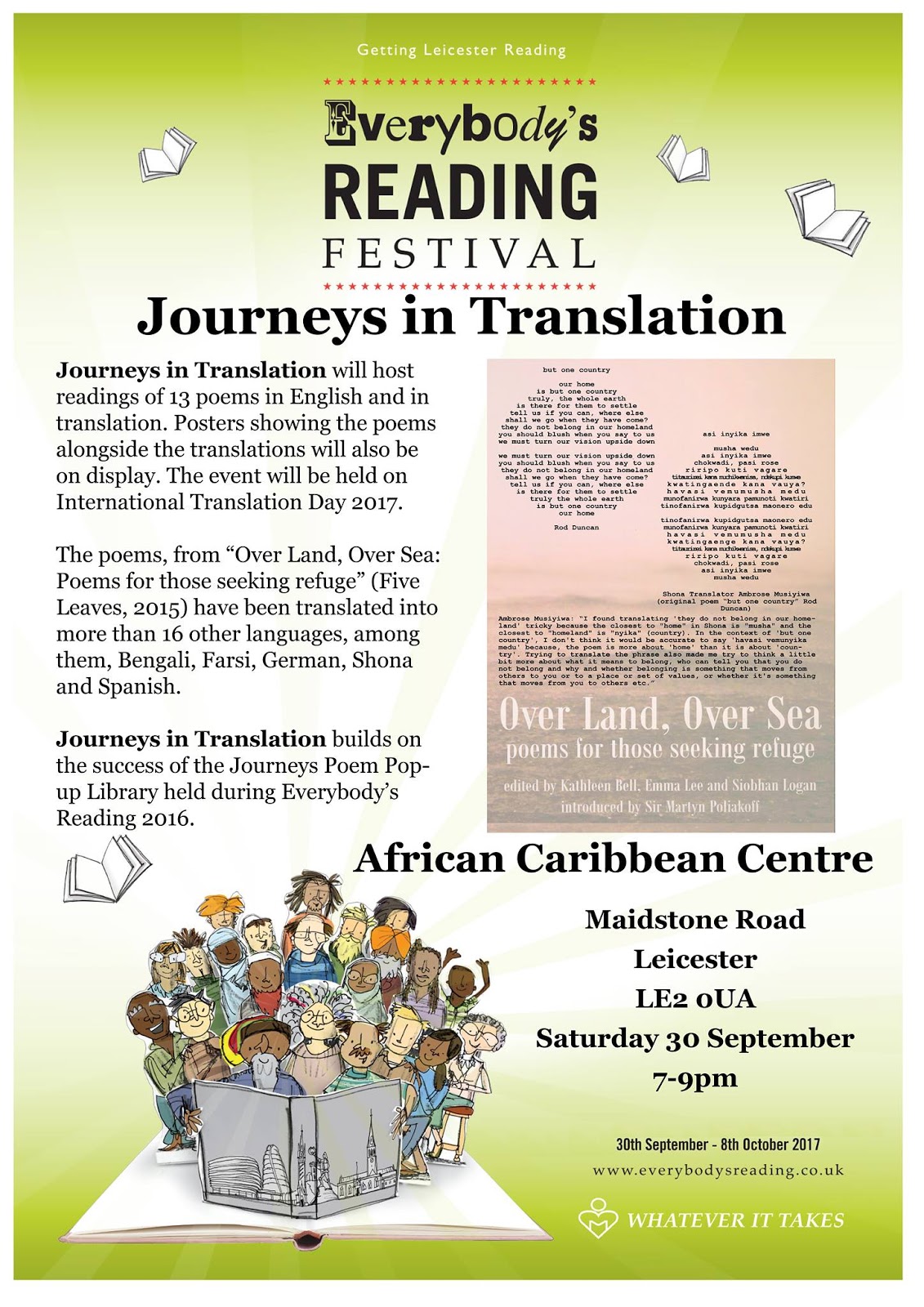
As part of events to mark International Translation Day 2017 and as part of Everybody's Reading, Journeys in Translation will be hosting an event at which 13 poems will be read in English and in translation.

Posters showing the poems alongside the translations will also be on display.

The event will be held at the African Caribbean Centre on International Translation Day which, this year, falls on Saturday, September 30.

The poems, from Over Land, Over Sea: Poems for those seeking refuge (Five Leaves Publications, 2015) have been translated into more than 16 other languages, among them, Arabic, Bengali, Chinese, Farsi, German, Hindi, Italian, Shona and Spanish.

The event is free and open to all.

If you cannot make it to the September 30 event in Leicester, you could:

  1. translate or encourage others to translate as many of the 13 poems as possible,
  2. share the translations and reflections on the translations through blogs, in letters and emails to family and friends and on social media, and/or
  3. organise a related event in your locality at which the 13 poems and translations will be read and discussed and let us know how the event goes.
Over Land, Over Sea: Poems for those seeking refuge was edited by Kathleen Bell, Emma Lee and Siobhan Logan. The anthology is being sold to raise funds for Doctors Without Borders/ Médecins Sans Frontières (MSF), Leicester City of Sanctuary and the Nottingham and Nottinghamshire Refugee Forum.

Copies of the anthology are available from Five Leaves Bookshop (Nottingham).

*See also:

[1] How Over Land, Over Sea came about
[2] Interviews with Journeys in Translation poets and translators
[3] The 13 Journeys in Translation poems:

[a] "but one country", Rod Duncan (Over Land, Over Sea: Poems for those seeking refuge, Five Leaves Publications, 2015) p.123
[b] "Children of War", Malka Al-Haddad (p.119)
[c] "Come In", Lydia Towsey (p.16)
[d] "Framed", Marilyn Ricci (p.114)
[e] "Song for Guests", Carol Leeming (p.92)
[f] "Stories from 'The Jungle'", Emma Lee (p.85)
[g] "The Humans are Coming", Siobhan Logan (p.79)
[h] "The Man Who Ran Through the Tunnel", Ambrose Musiyiwa (p.1)
[i] "Through the Lens", Liz Byfield (p.121)
[j] "Waiting", Kathy Bell (p.62)
[k] "What's in a Name", Penny Jones (p.5)
[l] "Yalla", Trevor Wright (p.94)
[m] "Dislocation", Pam Thompson (p.120)

Sunday, May 21, 2017

Interview _ Grant Denkinson

Grant Denkinson is an Open Access and Research Data Advisor at the University of Leicester's David Wilson Library. He is also a qualified psychotherapist and is one of the contributors to Purple Prose (Thorntree Press LLC, 2016), a new book about bisexuality in Britain.

In this interview, Denkinson talks about writing, sexuality and Purple Prose:

How would you describe Purple Prose?

Purple Prose presents different forms of writing about various aspects of being bisexual, such as being a bi person of faith and so on. Each chapter curates a number of personal experiences, collected thoughts and even tentative advice, together with quotes, cartoons and poems.

The chapter I co-curated with Juliet Kemp covers bisexuality and non-monogamy. The bi community I've been part of has been talking about how you can be bi and happily monogamous, non-monogamous in various ways, or not in relationships at all. Relationships of all kinds we could think of are spoken about in Purple Prose.

We make no argument for one shape of relationship being better than another, just that different ways to love and relate might work better for different people.

How did the book come about?

Kate Harrad decided a book about bisexuality in UK should exist and then made it happen and edited contributions from the UK bisexual community into Purple Prose.

While there has been an active bi movement in UK for many decades, there has not been a UK book by and about bisexuals since Sue George's Women and Bisexuality from 1993.

There have been some excellent academic works and some books from US. However, the UK is a significantly different context and we wanted something for everyone that speaks to personal experience rather than as part of the academic debates.

What are some of the other ways in which Purple Prose is significant?

I'd like this book to be part of making the whole world a better place since bi people are everywhere. We'll only be a small part, but we can play a part.

More specifically, there are a lot of people who, over their lives, have loved, fancied or had some form of sex with several people where those people were not all of the same gender. Many people in UK have had such thoughts or experiences. It seems important to me that there is at least one book out there that says people in this situation are not alone, which acts like a conversational prompt, which mentions aspects of the joys or stresses that they might have, and which comes from a place similar to home rather than from thousands of miles away.

I've met few bisexual people compared to how many there probably are.

Purple Prose is significant because a book can be a private experience. You don't need to be out to anyone to read a book. Books are portable and can be sent and read anywhere. Books last and are preserved in libraries and on bookshelves and can be quoted from and loaned to friends.

Also, many people know others who may be bi and who perhaps they want to understand better without needing to ask intrusive questions or treating one person's experiences as the same as many people's experiences. To gain this understanding, they can read autobiographical journals on-line and articles and news. They can listen to partners, friends and acquaintances. They can pick out films or listen to interviews on the radio or find a podcast. All these things are important but none of them offer the experience that comes from a good book on the subject.

How long did it take to the book together?

The process from conception to launch was a couple of years. Many of the writers met at events and we mainly collaborated online.

A number of UK publishers considered bisexuality too niche a subject despite recent surveys which show that around half of young people do not identify as gay or straight.

It was important to us to have the book properly produced to high quality while keeping the price aimed for the mass market. We therefore crowdfunded to cover the costs of producing the first print run of Purple Prose with Thorntree Press, a small publisher in U.S., who took the chance to expand from their speciality of books about non-monogamy.

Crowdfunding also showed us that there was a reasonably broad interest in the book.

It is wonderful to see the final version, a tangible thing that didn't exist before and can now be out there in the world to fare as it may.

I think we have a good book ... a book that is part of efforts to raise awareness around the complexity and diversity of human sexuality and which lets many voices shine and which does not reduce people to soundbites and simplistic characters.


Purple Prose 
(Thorntree Press LLC, 2016) was written for and by bisexuals in the UK.

Described as, "the first of its kind", Purple Prose: Bisexuality in Britain features interviews, essays, poems and commentary on topics that include definitions of bisexuality, intersections of bisexuality with other identities, stereotypes and biphobia, being bisexual at work, teenage bisexuality, bisexuality through the years, the media's approach to bisexual celebrities, and fictional bisexual characters. 


Which were the most difficult aspects of the work you put into the book?

The bi community I know has been good at accepting and talking about various aspects of complicated, diverse and sometimes fluid human sexuality including how gender or disability intersect with lives, what options for relationship shapes we might consider, and the emotional and physical feelings related to various bodily practices related to BDSM.

We are also catching up on dealing with other parts of bi lives that include race, ethnicity and class.

Making sure we adequately gave voice to those we don't hear from enough because of racism and the like was a challenge. We never wanted to be tokenistic.

Word-of-mouth and the friend-to-friend networks we enjoy can lead us to mainly speak to people like we are personally, in similar positions in society. We wanted a broader approach.

Also, we're all pretty much volunteers on this. We have the whole rest of our lives to live and some of our community are constantly or often having to struggle more in life because of how they are disabled or because they are dealing with the consequences of prejudice.

What are some of the things from your personal experience that influence your writing?

I've been out as bisexual for about half my life and feel most at home as part of the UK and international bi communities. There I feel I can just be myself rather than feel the need to downplay any part of myself or need to keep explaining the basics of my attraction to some people who don't all share the same gender. I've tended to a high level of frustrated energy towards social progress and this has led to me community organising and volunteering often around sex, sexuality and relationships.

I was born in Nottingham in 1971 and have moved around England with work or study as well was living as a kid in Los Angeles because my parents wanted to try the place out.

I've lived in Leicester about a dozen years and love the mix of people and how much of a beacon we can be to show how positive multicultural living can be. I like how much is going on within 15 minutes bicycle ride from my house and that I will meet good people and friends at pretty much anything I go to.

I have never worked out what I want to do when I grow up. I'm into science and techie things and work these days for University of Leicester in the David Wilson Library promoting and supporting open scholarship. I'm also a qualified psychotherapist and support students at De Montfort University and in private practice.

What are your main concerns as a writer? And, how do you deal with these concerns?

In the back of my mind I'm aware of some of the violent backlash or relationship damage that can follow being out and out so publicly. However, I'm in a privileged position with good people around me and I hope any negative reaction I do get will be a sign of possible change and progress and will help others in the future.

I don't think of myself as a writer but cannot deny that I write. There are better crafters of words, better thinkers, people with more experience and knowledge and many other more marginalised voices trying to be heard.

I can amplify and signpost to other writers. I can encourage others to express themselves as they wish and try to lower barriers. I can keep expressing myself despite my inner critics so others may be emboldened to do the same.

If I write and others are inspired to write something better then I have helped offer a step and a goad. Perhaps some people will read and have happier lives or help others to do so. If the only response someone has is critical, that is OK, too ... It shows they are thinking around the the subject.

When did you start writing?

I mainly wrote for myself rather than for others until there were things I wanted to say to a geographically distributed community.

There used to be a magazine in the UK bi community called BiFrost which stopped publication in 1995, just when I was meeting the annual national get-together for bisexuals, friends and allies called BiCon.

Many people wanted a newsletter so Bi Community News was formed and I edited it for a while and still write there.

I've also contributed as a chapter writer or interviewee to a few books and pieces of research work. I wrote a chapter, "SM and Sexual Freedom: A Life History", as an activist, for Safe, Sane and Consensual: Contemporary Perspectives in Sadomasochism by Darren Langdridge and Meg Barker published by Palgrave Macmillan in 2007.

I am currently sharing the findings of a project I conducted recently which collates experiences of bisexual people using emotional support or mental health services and which I hope will lead to better training and professional practice.

And although I am not committing to writing more for books right now, I note that there hasn't been a recent UK book on non-monogamies. I also write snippets and scene settings for fiction as my brain keeps coming up with such narratives and I wonder what would happen if I put them down together on some pages.

Do you write everyday?

I tend to write in bursts of enthusiasm.

I'd like to be better at getting into a writing mood quickly and getting some words down in pockets of dead time throughout the day and be more tolerant of interruptions.

In the writing you are doing, which authors influenced you most?

Writing about sexuality I have much appreciated a number of writers of more ephemeral forms on-line and in zines over the years as well as books such as Pat Califia's Speaking Sex to Power, John Preston's My Life as a Pornographer and Carol Queen's Real Life Nude Girl. These take an unapologetic, brave and clear look at how things could and should be in a better world.

I've also loved bits of recent history including No Bath But Plenty of Bubbles by Lisa Power from the oral history of the Gay Liberation Front; veteran of the campaign for homosexual equality, the late Antony Grey's writings; and Pressing Matters by Christine Burns about the successful Press for Change work around transgender issues.

I can mention books around bisexuality but there are rather a lot of them and an annotated bibliography might be more appropriate!

I feel lucky to have met a number of contemporary bi writers as well as having read their words.

I tend to read speculative fiction, occasionally utopian writers like Iain M. Banks or Ursula K. LeGuin, and dystopian, urban / technical, universe building authors.

I value books above other media and so approach writing for one with care.

Much of my thinking comes from both my own life and the many bi lives I have intersected with. I take the anger, the fear and the hope and joy and try to approach them all as true parts of our stories.
I have felt very open and am operating from a reasonably integrated "me" and am closely connected and moved by some wonderful people when writing.

I am also aware of writing with some horrible experiences in mind because they should not have happened or because people can do better.

And I have spoken to enough people in comic shops and bars to remember that concepts that might have been polished or kicked around in niche communities probably make no sense to the rest of the world ... because of that, I try to be as clear as possible when I write or speak.
Thursday, May 18, 2017

Leicester Libraries to host Poetry Translation Workshops during the 2017 Festival of Learning

Do you live in Leicester or Leicestershire? Can you speak more than one language? Or, are you learning another language? These free, poetry translation workshops taking place in libraries, from May 23 to May 27, are for you.


Journeys in Translation and the Leicester Library Service are holding a series of poetry translation workshops as part of the 2017 Festival of Learning.

The workshops are open to all and will suit anyone who is bilingual, multilingual or who is learning another language.

They offer participants the chance to read, discuss and look at how 13 poems from the anthology, Over Land, Over Sea: Poems for those seeking refuge (Five Leaves Publications, 2015) might be translated from English into other languages in an informal, relaxed and supportive atmosphere.

No prior translation experience is required.

The workshops will be held on:


The workshops will be delivered by Journeys in Translation coordinator, Ambrose Musiyiwa who is also the co-editor of Welcome to Leicester (Dahlia Publishing, 2016), a poetry anthology that explores what Leicester means to people who know the city well.

Ambrose Musiyiwa says:
Estimates suggest over 40% of the people in Leicester are either bilingual or multilingual. Other estimates suggest more than 100 languages are spoken in Leicester every day. 
Through translating poems, the workshops are an opportunity to celebrate the multiplicity of languages in Leicester and the richness they bring.
It will also be interesting to see what happens when a poem migrates from one language to another.
Journeys in Translation encourages people who are bilingual or multilingual or who are learning another language to have a go at translating 13 poems from Over Land, Over Sea from English into other languages and to share their translations and reflections on the exercise on blogs, in letters and emails to family and friends, on social media and at poetry and spoken word events.

The 13 poems have, so far, been translated into at least one of 17 languages that include Arabic, Bengali, British Sign Language, Chinese, Farsi, Turkish and Welsh. All 13 poems have been translated into Italian, 10 into Spanish, and 10 into German.


Journeys in Translation will culminate in an event that is going to be held on September 30 as part of Everybody's Reading 2017.

During the event the original poems and translations are going to be read and discussed. Posters showing the original poems and translations will also be on display.

Over Land, Over Sea: Poems for those seeking refuge was edited by Kathleen Bell, Emma Lee and Siobhan Logan and is being sold to raise funds for Doctors Without Borders/ Médecins Sans Frontières (MSF), Leicester City of Sanctuary and the Nottingham and Nottinghamshire Refugee Forum.

Development Librarian, Matthew Vaughan says
We were really excited to be offered these workshops as part of our Festival of Learning programme of events.

The workshops are highly relevant to both libraries and multicultural Leicester. They will appeal to anyone who speaks more than one language or who is learning another language and are not to be missed."
Notes:

[1] For more information on Journeys in Translation, contact Ambrose Musiyiwa, Email: amusiyiwa@googlemail.com

[2] The translation workshops are free and open to all. Booking advised. Participants can book a place by calling the libraries the workshops are being held at.

[3] Copies of the 13 poems will be available at the respective libraries on the respective days. Anyone interested can also join the Journeys in Translation Facebook group where the 13 poems are available for download.

[4] The Festival of Learning runs from 22 - 27 May and features a variety of events, workshops and information and learning sessions across a number of libraries and community centres.

Saturday, May 13, 2017

Interview _ Kathleen Bell

Kathleen Bell is a lecturer in English and Creative Writing at De Montfort University.

Her poems, micro-fiction and short stories have been published in magazines and journals that include PN Review, New Walk and Under the Radar and in anthologies that include Welcome to Leicester (Dahlia Publishing, 2016); Over Land, Over Sea: Poems for those seeking refuge (Five Leaves Publications, 2015) which she co-edited with Emma Lee and Siobhan Logan; and A Speaking Silence (Indigo Dreams Publishing, 2013).

Her poem, "Testament: in an Embankment Garden" won the Nottingham Poetry Society’s 2016 Open Competition which was judged by award-winning poet Liz Berry, and her poetry chapbook, at the memory exchange (Oystercatcher, 2014) was shortlisted for the Saboteur awards.

In this interview, Kathleen Bell talks about poetry, micro-fiction and Journeys in Translation.

How would you describe the writing that you do?

I can’t remember a time when I didn't write so I suppose that writing is a way in which I need to respond to the world around me and to interact with it.

I write both poetry and prose fiction and sometimes the border between the two is pretty blurred. For instance, I’m not sure whether "Waiting", in the anthology, Over Land, Over Sea, is poetry or micro-fiction, and the same is true of another piece, "In The Tunnel" which was published as a poem in the Eyewear pamphlet, Refugees Welcome. I've never cared too much for borders so the definition doesn't trouble me much.

Apart from that, I do a huge range of writing.

In poetry, I like working in strict form when it suits the subject but I’m also happy to work in a more allusive and fragmentary way – I like to have a repertoire of methods. And, as well as short stories, I've written two unpublished novels which are still in need of yet another edit. I think novels are more different from short stories than short stories are from poetry, so that’s another kind of writing ... And then there are reviews, academic essays, Facebook statuses (and rants), tweets and other odd forays …

Who has had the most influence on you as a writer?

I assume by this question you mean other writers. As a reader I’m pretty omnivorous and I’m still learning – I hope I never stop.

I wrote my PhD thesis on Auden so of course he influenced me, as did the Greek poet Cavafy, and various Latin and Ancient Greek authors including Sappho whose surviving fragments do so much in so few words. I had a phase in my teens of being influenced by the satires of Alexander Pope.

Another day I might come up with a different list – and I’m carefully avoiding mention of any living writers. There are also many I admire who don’t influence me as a writer because I know that they do something that is very different from the ways in which I write. At most, I might observe a useful technique in a single poem and find it helps me years later.

Kathleen Bell's poems have been featured in anthologies that include Over Land, Over Sea: Poems for those seeking refuge (Five Leaves Publications, 2015) and Welcome to Leicester (Dahlia Publishing, 2016).

How have your personal experiences influenced your writing?

I grew up assuming that writing was a natural and normal way to respond to the world.

My parents encouraged me and my brother to enjoy all kinds of reading and cultural experiences, without the sense of hierarchies that middle- and upper-class people impose. So, we went to the theatre (in the gods, as we called the gallery benches) to see everything from Shakespeare to musicals and read all sorts of things from the popular magazine Tit-Bits to Plato and Borges. This isn't what people expect of working-class families in council estates but it’s what my family was like. I still remember Mum coming home with a Penguin of Borges’ Labyrinths and telling us that we must read it because it was amazing, and my brother and I, both in our teens, loved it. We also shared an enthusiasm for the volume called The Last Days of Socrates and I was very excited when later, at about 17, I found I could struggle through the beginning of Socrates’ speech in his defence in Ancient Greek. So, that kind of learning has infused my writing.

I don’t think of myself as someone who writes directly out of personal experience, on the whole, but of course there are traces of personal experience in my writing. It took me a while after completing it, to realise that my sequence of poems about stage magic was also about ghosts and bereavement.

Even when I do write more directly from personal experience, the experience is changed in the writing.

The fragments in the sequence "They Come For You to Buy and Sell" refers obliquely to events at the time when my father died in London and my mother’s dementia worsened, to the relation I had with memories which surfaced out of those circumstances, and also to a walk in Morpeth when I listened to people’s recollections of the past. I thought at the time I was writing that sequence just because I was compelled to do so and with no thought that anyone would read it so I was surprised when it found its way into my Oystercatcher pamphlet, at the memory exchange.

What would you say has been your most significant achievement as a writer, so far?

As a writer, I think there are only two achievements that matter. One is when a piece of writing does what you set out to do, and does it as well as possible. And the other is when the writing takes you on a journey and you end up somewhere you didn't expect to be at the end of the writing.

The latter is the one I like best because writing becomes a process of discovery ... in addition to all the important craft considerations, the music of language, the play with words, and so on.

How did you get involved with Journeys in Translation?

That’s all Ambrose Musiyiwa's fault. It started when he suggested a book of poems in response to the refugee crisis in a Facebook post and then posted his poem "The Man Who Ran Through the Tunnel" which made me see a news story differently.

I thought that poems might achieve two things: getting people to see refugee stories differently and raise some useful money. So I volunteered to co-edit what became Over Land, Over Sea: Poems for those seeking refuge.

Which were the easiest aspects of the work that went into both Over Land, Over Sea and Journeys in Translation?

The easiest thing was getting the poems for the anthology – because people cared a lot.

There was a lot of goodwill connected to the project. I can’t speak highly enough of Ross Bradshaw and Pippa Hennessey at Five Leaves who put masses of hard professional work into the book: design, type-setting, proofing, etc. Martyn Poliakoff, who wrote the introduction, did so at about 24 hours’ notice and I seem to recall he sent the text to me shortly before midnight so that the volume could get to the printers. And then there were many people who hosted events or invited poets to read.

Journeys in Translation build on or stems from Over Land, Over Sea and encourages people who are bi-lingual or multilingual or who are learning other languages to translate 13 of the 101 poems from the anthology into other languages.

Also, my poem/micro-fiction "Waiting" is one of the 13 poems that is being translated into other languages.

Kathleen Bell's poem, "Waiting" from the anthology, Over Land, Over Sea: Poems for those seeking refuge (Five Leaves Publications, 2015) has, so far, been translated into Bengali, Finnish, Italian, Shona and Spanish as part of Journeys in Translation.

Which were the most challenging aspects of the work?

With the anthology we were working in haste in the intervals of our jobs. The roles I took on included sequencing the poems, and sending proofs to poets and responding to their comments.

I’m glad I did this. But I recall staying late in the office trying to work through the proofing amendments and muttering "Bloody poets" under my breath. This is a comment on my tiredness at the time more than anything else because, of course, every poet cares passionately that the layout is correct and that everything, to the last comma, is in the right place. It was therefore very important to get it all right – but very exhausting too.

In retrospect I’m really glad that the poets and I did this work of proofing. But it made for some long days.

It was also sad to reject some pretty good poems for the sake of the anthology overall. We wanted a variety of poems and some were just a little too similar in themes and images. I know that some of the poems we rejected found good homes elsewhere and I was pleased to see that. I think all the poems submitted spoke with real feeling and concern for the situation of refugees.

What would you say is the value of initiatives like Journeys in Translation?

I think that translation is a means of opening the door to new possibilities. Language is a wonderful thing but it’s only ever an approximation to perception, thought and feeling. This means that ideas and impressions work differently in different languages. So, when a poem exists in more than one language, its possible meanings are extended.

My poem/micro-fiction "Waiting" has been translated into several languages so far and I’m not competent in any of them. However, I noticed that the Spanish word for waiting includes the concept of hoping, which I hadn't considered when writing the poem. I rather like that ... though it remains unclear what the woman in the poem waits and hopes for, just as in the original it’s not clear how long she will wait and what will happen in the end.

Of course, the other important thing about Journeys in Translation is that it helps us all move across the borders and barriers of language. Here speakers of different languages are brought together in a shared project. Translation is about finding what we have in common as humans ... and in this project, it’s about sharing a common concern for fellow human beings.

Editor's Note:

Journeys in Translation aims to facilitate cross- and inter-cultural conversations around the themes of home, belonging and refuge.

The project encourages people who are bilingual or multilingual to have a go at translating 13 of the 101 poems from Over Land: Over Sea: Poems for those seeking refuge (Five Leaves Publications, 2015) from English into other languages and to share the translations, and reflections on the exercise on blogs, in letters and emails to family and friends, and on social media.

So far, the 13 poems that are being used as part of the project have been translated into languages that include Italian, German, Shona, Spanish, Bengali, British Sign Language, Farsi, Finnish, French, Turkish and Welsh. Currently, over 20 people from all over the world are working on the translations. More translations and more languages are on the way.

In Leicester, Journeys in Translation will culminate in an event that is going to be held on September 30 as part of Everybody's Reading 2017. During the event the original poems and translations will be read, discussed and displayed.

Over Land, Over Sea: Poems for Those Seeking Refuge (Five Leaves Publications, 2015) was edited by Kathleen Bell, Emma Lee and Siobhan Logan and is being sold to raise funds for Doctors Without Borders/ Médecins Sans Frontières (MSF)Leicester City of Sanctuary and the Nottingham and Nottinghamshire Refugee Forum.

Copies of the anthology are available from Five Leaves Bookshop (Nottingham).

More information on how Over Land, Over Sea came about is available here.

Monday, May 8, 2017

Interview _ Pam Thompson

Pam Thompson is a poet, performer, reviewer and university lecturer.

Her poetry has been published in a range of small press magazines and her publications are: Spin (Walden Press, 1998), Parting the Ghosts of Salt (Redbeck Press, 2000), Show Date and Time (smith|doorstop, 2006), The Japan Quiz (Redbeck Press, 2008), and Hologram (Sunk Island Publishing, 2009).

She is one of the organisers of WORD! at The Y Theatre in Leicester.

In this interview, Pam Thompson talks about poetry and Journeys in Translation.

How would you describe your writing?

Very varied. I supposed a lot of my poetry is disguised - or not so disguised - autobiography. I experiment formally a lot and I enjoy it when something unexpected arises from those experiments.

I agree with the poet C. D. Wright who said: "Poetry is a necessity of life, it is a function of poetry to locate those zones inside us that would be free, and declare them so.”

Poetry is about connection too. I like the fact that writing poetry you immediately establish yourself within a wider community of poets. There is something very comforting about that.

Who or what has had the most influence on you as a writer?

There have been so many influences. I read a lot of poetry and I have written it since my early teens and was encouraged by certain teachers. Poets who particularly influenced me back then included Dylan Thomas, Sylvia Plath, T. S. Eliot and Ted Hughes.

I began to enter competitions in my late twenties onwards and had some successes, and began to get published in magazines. I can't speak highly enough of certain Arvon courses and my tutors on them -Michael Longley, Carol Rumens, Simon Armitage, Glyn Maxwell, Carol Ann Duffy and Gillian Clarke. Since then I have been on many courses and have attended - and run - writing workshops.

Being involved in organising WORD! at The Y in Leicester has been an enormous influence too because it demonstrates the strong hold that poetry and its public expression have on people's lives. It reinforces the need for a safe space for people to read their work and a supportive community to receive it. That's why we are thrilled to be nominated for a Saboteur Award - if we won it would help us enormously to develop WORD! even more.

How have your personal experiences influenced your writing?

Greatly - I think it's inevitable that this will happen with any writer. They are often disguised though and filtered through other voices.

What has been your most significant achievement as a writer so far?

I was pretty thrilled to be a winner of the Poetry Business Poetry Competition in 2005 with my pamphlet Show Date and Time, judged by Simon Armitage. Also winning the Magma Poetry Competition Judges Prize, (judge - Jo Shapcott) in 2014/15 and, recently, 3rd prize in the Poets and Players competition, judged by Michael Symmons-Roberts, was pretty special. They are all poets whose work I really like.

I have recently passed my PhD in Creative Writing (poetry). That is probably the toughest thing I have ever done writing-wise.

Pam Thompson's poems have also been featured in anthologies that include Over Land, Over Sea: Poems for those seeking refuge (Five Leaves Publications, 2015) and Welcome to Leicester (Dahlia Publishing, 2016).

How did you get involved with Journeys in Translation?

My poem 'Dislocation' was included in the wonderful anthology Over Land, Over Sea: Poems for those seeking refuge. Subsequently, it was one of the 13 poems offered for translation and, amazingly, has been translated into Italian, Spanish, German, Shona, Chinese, Finnish, Bengali, French, Turkish and British Sign Language, no less!

How did "Dislocation" come about?

It was part of that group project ... of poets responding to a humanitarian crisis and taking action to encourage artistic responses and to find a means of publicising these, and the cause, more widely.

Writing about a humanitarian crisis is necessary but the results will always be inadequate. I’m not undergoing the pain of ‘dislocation’ like the people in the poem. I can only try and empathise in a way that is as honest as possible without misappropriating other people’s trauma and being untruthful to it. I hope the poem has done that.

My poem is relatively short, stark, imagistic. It’s title suggests both 'displacement' and being 'out of joint'; people are being painfully wrenched from their homelands.

I wrote drafts of it within one day and over a week re-drafted it until it found its present form

The poem was selected for the anthology and is now reverberating by means of all these other translators and their languages..

The fact that the poem has been translated into so many languages suggests that its spare, imagistic form has lent itself to this process and so I would say it has been received favourably.


Pam Thompson's "Disclocation", Over Land, Over Sea: Poems for those seeking refuge (Five Leaves Publications, 2015) p. 120, translated into British Sign Language (BSL) by Elvire Roberts. 


What would you say is the value of initiatives like Journeys in Translation?

Most importantly, it consolidates and expands the Over Land, Over Sea collective project and publicises it further via cross- and inter-cultural conversations.

It emphasises the power of words to transmigrate across languages and cultural borders and the poems continue to reverberate in all the many forms they are taking via written and spoken word, performative gesture, in the environment and online. The initiative counters any wrongheaded opinion that “Poetry makes nothing happen.”

Editor's Note:

Journeys in Translation aims to facilitate cross- and inter-cultural conversations around the themes of home, belonging and refuge.

The project encourages people who are bilingual or multilingual to have a go at translating 13 of the 101 poems from Over Land: Over Sea: Poems for those seeking refuge (Five Leaves Publications, 2015) from English into other languages and to share the translations, and reflections on the exercise on blogs, in letters and emails to family and friends, and on social media.

So far, the 13 poems that are being used as part of the project have been translated into languages that include Italian, German, Shona, Spanish, Bengali, British Sign Language, Farsi, Finnish, French, Turkish and Welsh. Currently, over 20 people from all over the world are working on the translations. More translations and more languages are on the way.

In Leicester, Journeys in Translation will culminate in an event that is going to be held on September 30 as part of Everybody's Reading 2017. During the event the original poems and translations will be read, discussed and displayed.

Over Land, Over Sea: Poems for Those Seeking Refuge (Five Leaves Publications, 2015) was edited by Kathleen Bell, Emma Lee and Siobhan Logan and is being sold to raise funds for Doctors Without Borders/ Médecins Sans Frontières (MSF)Leicester City of Sanctuary and the Nottingham and Nottinghamshire Refugee Forum.

Copies of the anthology are available from Five Leaves Bookshop (Nottingham).

More information on how Over Land, Over Sea came about is available here.

Friday, May 5, 2017

Interview _ Cynthia Rodríguez

Cynthia Rodríguez is based in Leicester and regularly performs at spoken word events that include Anerki, WORD!, Find the Right Words and House of Verse. She had also performed at Poetry is Dead Good, Too Deep for a Monday, Write Minds Wiff Waff, QTIPOCALYPSE at Rough Trade Nottingham, Coventry Pride, The Chameleon, and the LGBT Laureate night at The Phoenix in London.

In addition to spoken word, Rodríguez has collaborated with musicians such as David Dhonau and the BootLeg Jazz Trio, and has performed as a featured act at Moonshine Word Jam, the jazz and spoken word evening hosted by Mellow Baku and Lydia Towsey.

Her work has been published in zines that include the Mouthy Poets Queer Zine edited by Dean Atta; the anti-xenophobia Do Something edited by Selina Lock; and Anerki and Sean Clark’s Interanerki. In late 2016, two of her poems were included in Welcome to Leicester, edited by Emma Lee and Ambrose Musiyiwa for Dahlia Publishing.

Rodríguez is also a singer and a songwriter at the queer noise girl band ANATOMY, where she plays alongside singers and musicians, Adrienne Jones, Emily Rose Teece and Leonie DuBarry-Gurr.

In this interview, Cynthia Rodríguez talks about poetry, writing and Journeys in Translation.

When did you start writing?

I started writing when I started learning how to write.

It started a bit like private street art, writing the name of my celebrity crush on my living room wall when I was two years old. When I was four, I started to write and tell short surrealist stories about the people and places I knew or imagined. I would write, for instance, about a girl coming from Mars who ate bolts and screws and used apples as petrol for her spaceship. Like my now deceased aunt Adriana, there was a time I would write calaveras ... rather morbid poems about living people and the ways they would meet The Ripper, a Mexican folk tradition for Dia de Muertos.

Since then, I’ve been dancing between short story and poetry/songwriting, but been more steady on the latter for the past 18 months.

How would you describe the writing you are doing?

Intersectional and interdisciplinary. I tend to write about the experiences people live from the margins and at the crossroads. Identity plays a huge part in my work, particularly as a queer fat foreign brown woman with mental and chronic conditions.

Recently, I’ve been playing around with more artistic disciplines as well as writing, such as film and music, and I have been exploring the musicality of the spoken and written word.


Cynthia Rodríguez performing at Anerki, a spoken word, poetry and music event that is held monthly in Leicester. Photo by David Conrad Dhonau.

Who or what has had the most influence on you as a writer?

Life and art. My life, the lives of loved ones and those around us. Art, in its audiovisual and performative ways. People like Laurie Anderson, Penny Broadhurst, Pete Um and Saul Williams. Spoken word and interdisciplinary collectives in the East Midlands such as Anerki, Mouthy Poets, House of Verse and FAG. The spirit of the times.

How have your personal experiences influenced your writing?

A lot. No two life stories are alike, so it is necessary that we tell our own stories and perhaps find a common ground.

English is my second language and I still enjoy exploring it and setting myself challenges to learn and expand. Britain is still quite new to me even if it feels like home, so writing is a bit like trying and testing plugs and taps around a fully furnished house I’m still paying mortgage for, stumbling upon a loose wooden tile under the carpet and discovering a neverending basement underneath full of positive and negative surprises.

What has been your most significant achievement as a writer so far?

Discovering an extensive network of people who love writing and art as much as I do. It has been amazing and truly, emotionally and professionally rewarding getting to know these people, sharing words of advice, collaborating, learning, performing together and even making strong and enduring friendships.

Getting published has also been good.

Cynthia Rodríguez's poems have been featured in anthologies that include Welcome to Leicester (Dahlia Publishing, 2016) and Do Something (Factor Fiction, 2016).

How did you get involved with Journeys in Translation?

A couple of my poems were selected for Welcome to Leicester, the poetry compilation co-edited by Ambrose and Emma and published on Dahlia Publishing. Ambrose found out I spoke Spanish and we talked about Journeys in Translation, and I was more than happy to help.

Which were the easiest aspects of the work you put into the project?

The main messages were pretty easy to translate. I think it was because they are international and necessary in every country and language.

Which were the most challenging?

Keeping metrics, shapes and messages in certain poems. For instance, Rod Duncan’s “but one country”. Not only did I have to keep the shape aligned, but I had to find a clever way to keep the original message and its alternative readings forwards and backwards. For this, I took liberties with commas and signs. It may not be entirely grammatically accurate, but the message is still there.

What would you say is the value of initiatives like Journeys in Translation?

Telling stories from different experiences we hadn’t thought before. Travelling not only geographically, but through language. A lot of the subjects and authors from the original project already had to do their personal journeys in translation by learning and practicing a different language to survive, so it enhances the experience and shows it to people who perhaps have never needed to go through said journeys.

Rod Duncan’s “but one country”, Over Land, Over Sea: Poems for those seeking refuge (Five Leaves Publications, 2015) p.123. Translated into Spanish by Cynthia Rodríguez.

Editor's Note:

Journeys in Translation aims to facilitate cross- and inter-cultural conversations around the themes of home, belonging and refuge.

The project encourages people who are bilingual or multilingual to have a go at translating 13 of the 101 poems from Over Land: Over Sea: Poems for those seeking refuge (Five Leaves Publications, 2015) from English into other languages and to share the translations, and reflections on the exercise on blogs, in letters and emails to family and friends, and on social media.

So far, the 13 poems that are being used as part of the project have been translated into languages that include Italian, German, Shona, Spanish, Bengali, British Sign Language, Farsi, Finnish, French, Turkish and Welsh. Currently, over 20 people from all over the world are working on the translations. More translations and more languages are on the way.

In Leicester, Journeys in Translation will culminate in an event that is going to be held on September 30 as part of Everybody's Reading 2017. During the event the original poems and translations will be read, discussed and displayed.

Over Land, Over Sea: Poems for Those Seeking Refuge (Five Leaves Publications, 2015) was edited by Kathleen Bell, Emma Lee and Siobhan Logan and is being sold to raise funds for Doctors Without Borders/ Médecins Sans Frontières (MSF)Leicester City of Sanctuary and the Nottingham and Nottinghamshire Refugee Forum.

Copies of the anthology are available from Five Leaves Bookshop (Nottingham).

More information on how Over Land, Over Sea came about is available here.