Monday, September 5, 2011

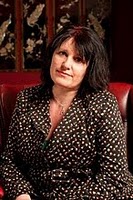
[Interview] Lorette C. Luzajic

Lorette C. Luzajic lives in Toronto, Ontario where she works as an artist and an author.

Her books include The Astronaut’s Wife: Poems of Eros and Thanatos (Handymaiden Editions, 2006); Goodbye, Billie Jean: the Meaning of Michael Jackson (Handymaiden Editions, 2010) and Fascinating Writers: twenty-five unusual lives (Idea Fountain Editions, 2011).

In this interview, Lorette Luzajic talks about her writing:

When did you start writing?

The cliché but true answer is that there was never a time I didn’t write. I started making up stories and researching projects as soon as I could read, which was very early on. There was never a time for me outside of that identity.

I was very earnest in my childhood, dutifully preparing my double-spaced typewritten poems for submissions to literary journals, complete with the obligatory self-addressed stamped envelopes, in the days before email submissions.

It never dawned on me that submitting my youthful-hearted works to adult literary journals was a waste of time. I saved each rejection and kept track of what pieces were sent where. Many editors kindly took the time to encourage my talent and direct it to more appropriate venues – for years I treasured these handwritten rejection slips as meaningful.

It wasn’t all for naught, however - quite a few childhood poems made their way into the pages of small zines and journals, and I wrote a few religious articles for magazines that had no idea I was a teenager. I won a contest in a Christian magazine when I was twelve. Since adulthood, hundreds of poems, stories, and articles have been widely published in zines, journals, blogs, magazines, anthologies - from Modern Poetry to Dog Fancy.

My colleague, writer Crad Kilodney, who is brilliant, once wrote that getting accepted by a magazine or publisher at a young age is the worst thing that can happen to a writer. Ever after that, they are sure they have what it takes and don’t prepare for another life.

How would you describe your writing?

Right now I am wrapping up a collection of short fiction stories.

I also just released a collection called Fascinating Writers: twenty-five unusual lives.

The topics I write about range extensively, but I think what my favourite and most inspired works are people stories. The best response from my audience so far has been about my Fascinating People series - which are subjective, experiential essays about interesting personages throughout history, especially artists and writers. People who are curious about culture and history and people are the readers who most appreciate these pieces.

I confess that I go about everything backwards.

To be successful, you should probably decide on your audience and write for them. I tend to write what interests me most and hope for an audience. I don’t recommend this approach to writing or art, not unless you are independently wealthy or have a day job.

Which authors influenced you most?

Isabel Allende was a true inspiration in her way of experiencing the magic of life.

Ray Bradbury inspired me because he has written every single day for some eight decades, and striving for this kind of tenacity has helped teach me great discipline and focus, which are not in my nature.

I admire the way different authors use language, from e. e. cummings to Donna Tartt to Haruki Murakami - I am given permission to use the language I see fit and see if I can’t create something of my own, something original.

I read Oscar Wilde when I need to regain a caustic sensibility and a dose of courage. But by and large, I devour non-fiction on nearly every topic under the sun... Mark Kurlansky, Camille Paglia, Matt Ridley, Michael Shermer, Thomas Moore... I believe in unlimited thinking.

How have your personal experiences influenced your writing?

I have lived a life of great passion and intensity. I think those things come through in my work, both my writing and my visual artwork.

Since I am quite averse to wasting any part of my life doing something banal that I don’t wish to do, my concern is how I can find my own place in the business of art and publishing. I don’t play the game well. I want complete creative control. I studied journalism in university but I have no interest in strict reporting. I am impatient and want to write about what I want to write about, as opposed to following a reasonable plan. It would have been much easier if I had just gone to work for a single newspaper or if I followed the advice of a literary agent who sought me out. But I didn’t want to stop all the things I have going on in my head to try to adhere to the tried and true methods of working as a writer.

I don’t want to wait or switch gears. I’m not saying this is wise, but it has made me incredibly innovative. I rose to the challenge by creating a creativity portal, the Idea Fountain, which combines my work as an artist and as a writer, along with my pet cause, freedom of expression.

Since I feel so strongly about freedom of expression being the fundamental human right, the foundation of all freedoms, and so grateful for my own freedom to write and paint, I tied all of this up as “fiercely independent.” Now I run the whole show.

I started Idea Fountain Editions for my books and for other people’s books in the future. I sell my art online and promote my ideas independently. I welcome buyers and sponsors and patrons. And I pledge ten percent, a tithe of my product earnings, to promote freedom of expression.

My biggest challenge is that when you do it all yourself, and you don’t play the game, then you actually are on your own. It can be scary. I take credit for everything I do - and that includes the mistakes. I am responsible for every aspect of my work, which includes the stuff I’m not very good at, like promotion and administrative work. But I’m learning, and I’m so happy and so grateful. And I feel a sense of authentic connection with my small but loyal fan base. Those who enjoy my work don’t want me to be anybody but myself.

Do you write everyday?

Yes. Around seven a.m. I bound out of bed and leap to the coffee machine. I can’t wait to wake up and get to my desk, starting even as I wait for the coffee to brew. I work for several hours on a particular project, determined in one of my many lists of things to do. Important emails and interviews and research are all part of it.

Then I spend several more hours working on a bunch of different projects for a half hour here, ten minutes there, an hour here. There are always many things underway. I thrive when working on fifty things at the same time, but each one advances slowly.

Deadline items take front seat in the morning. I also work in my studio in the afternoons, often moving back and forth from my desk to my easel in half hour shifts. I only stop working when my carpal tunnel syndrome forces me away from my desk or I have a meeting or some other obligation or commitment.

I try to take walking or stretching breaks and get a bit of exercise since the work is sedentary.

In the evening I make plans with family and friends, get some exercise, cook, and sometimes I stay home to read and to keep working. I am totally obsessed with creating. I can’t seem to create enough. I am trying to make up for lost time when in the past, I was not focused or disciplined or didn’t know how to go about what I wanted to do. But I remind myself that the well will run dry if I don’t get out and live, too.

How many books have you written so far?
How long did it take you to write Fascinating Writers?

My latest book is about fascinating writers, exactly as titled. I get to know 25 writers and share my experiences in a gossipy, personable style that invites everyday readers into literature, rather than limiting enjoyment to a more scholarly crowd.

Technically it has taken about three years to compile the 25, since I am never working on one thing at a time.

How did you find a publisher for the book?

As I mentioned above, I started my own publishing company, Idea Fountain Editions, as an initiative of Idea Fountain Productions.

The advantages of small press publishing include creative control, expediency, and innovation.

The disadvantages are stigma and the lack of marketing support. The stigma that self-publishers or small presses have is the idea that someone couldn’t find a traditional publisher because the books are sub-par or unprofessional.

This stigma is often founded in reality - there is a veritable sea of bad books drowning the populace with atrocious poetry from hopefuls everywhere.

With small presses, there might be only one or a couple of people working on everything from overall design to proofreading, so there might be errors that companies with millions of dollars to work with won’t make. But it’s all relative, since the independent press is also highly innovative, offering more variety since its investments and expectations are not necessarily to hit the New York Times Bestseller list (though no one would scoff at making it!).

Creative control in my small press means I get to decide what goes in and what goes on the cover - frankly, I can’t believe the terrible cover art of the vast majority of large press publishing.

Also, bad books are not exclusive to the small press. The vast majority of books are forgettable, and the vast majority of books are poor sellers. But to me, that doesn’t matter. If someone puts themselves out there, I admire that. Only a few people will have a million fans. Only a few books will be brilliant enough to transcend history as classics. And who cares if someone wants to share their bad poetry with their friends and family? We sneer at the gall of someone who dares to put their stuff out there, when we don’t have to buy it. But we all pay taxes that go into grants that pay for so-called legitimate writers to write boring books that no one will read.

We just as often sneer at the big best-selling writers for their mass-manufactured approach to writing - but it is these few who allow the industry to exist, since nearly every writer, old and new, loses money for its publishers. Publishing is a losing game.

I try to accept all of it, and believe there is room for all of us. This doesn’t mean that I think all literature is equal - quite the opposite. I think literature serves many different purposes. No one is forced to be an audience to what they don’t like - but I can’t see any harm in people expanding their horizons in different directions, either. Academic readers might do good to relax with sentimental mush from time to time - and readers who are intimidated by the elitism of classicists shouldn’t be discouraged from trying to experience the joy of hallmark literature. Everyone can benefit from reading from the opposite end of their political spectrum and learning something about their own confirmation biases.

I work hard at my art and writing. I try to find an audience that appreciates my work. I live humbly thus far, but I live in a “room of my own” and spend each and every day doing what I love.

What will your next book be about?

My next book is a collection of short fiction stories. It will be out this year. My second poetry collection is also pending and will probably be out this year, too.

The companion to Fascinating Writers is underway - Fascinating Artists: twenty-five unusual lives. I’m hard at work on it, and hope to see its completion this year, but it takes a considerable amount of time to write each piece and I don’t want to rush them. I want them to be inspired.

What would you say has been your most significant achievement as a writer?

The Idea Fountain, which merged my visual art work, my writing work, and my passion for freedom for all people - freedom of expression - is my most significant achievement.

The Fountain will, I hope, continue to flow with new ideas and generate new ways to work, to market myself, and to support creativity and freedom for people who live under tyranny. Through the umbrella of the Fountain, I want to continue to learn about history and politics and promote the art of people who are not as fortunate as I am. It is a tremendous blessing to be born free, to 20th century Canada.

I used to feel guilty for “frittering” my time away on art and writing when I should have been doing useful tasks - “real” work. Now I know that it is a privilege wasted to not pursue my creative potential when historically I wasn’t allowed to do so. I would not have the same privilege if I were born into socialism or theocracy. In a way, I feel committed to making the most of my writing and art because it is a privilege few have.

I hope for the day that all men, women, and children will be free. And I’m optimistic, despite the atrocities and censorships and torments and war that people endure. The Idea Fountain is about my hope and optimism, and finding that place of gratitude is my most significant achievement thus far.

Related books:

,,

Related articles:

Wednesday, August 31, 2011

Interview _ Erik Schmidt

Erik Schmidt lives in Georgia and is a sports editor and a freelance writer.

10 of his short stories appear in the anthology, Cover Stories: A Euphictional Anthology (CreateSpace, 2010).

In this interview, Erik Schmidt talks about his writing:

When did you start writing?

I had to write fictional stories throughout elementary school, but I started taking it seriously — or at least as seriously as any 11-year-old boy can take anything beyond backyard football and baseball cards — in sixth grade.

Our teacher, Mrs. Jacoby, consistently had us write 100-word essays and then read them aloud in class. I remember thinking some of the topics were boring or uninspiring, so I started creating my own themes for my own amusement. They weren’t anything special, but it was important for me to realize that innovation, creative thinking, and stepping outside the expected parameters are huge elements in the writing process.

There was no epiphany or mind-blowing realization in regards to becoming a published writer. When I was a junior in high school, I saw an ad for a sports writer for a twice-weekly newspaper called the Wall Herald in New Jersey. The owner, I think his name was Ed Brown, had his own airport. The Herald ran a regular contest where you had to find a small caricature of Mr. Brown flying a plane somewhere in the paper. If you found him, you won an ice cream sundae. Basically, this wasn’t the New York Times, so I figured, “What the hell?”

I realize this doesn’t paint the most romantic of literary pictures, but I loved sports, I was a decent writer, and this seemed like a better way to earn money than working as a dishwasher or telemarketer. Again, this isn’t a feel good, movie-of-the-week story. I applied for the job, they invited me in for an interview, and I drove down there. I showed them a few clips from my high school paper, the editor looked them over, and then she asked if I had a driver’s license and a car.

I had both.

They hired me.

I subsequently decided to turn this into a career. I majored in journalism at the University of Georgia and ultimately found work as a sports editor at The Oconee Enterprise in Watkinsville, Ga. I’ve had two stints there and along the way I’ve done some freelance work for daily papers, magazines and a website or two.

As for becoming a published writer in the fictional realm, again, there wasn’t any exact “I know what I must be” moment. It was just something I thought I could do and something that would allow a more creative outlet beyond structured sports writing.

I do know several people who absolutely have to write. I’m not one of them. If I write something and someone wants to buy it, that’s great. If not, so be it. I’ll live. Of course, I’ll live better if everyone buys it. I’m certainly not against that scenario.

How would you describe the writing you are doing?

Aside from the sports writing that pays my bills, my work can be classified as semi-realistic, humorous fiction. I’ll take a completely believable scenario and let it run a step beyond ordinary. It keeps things in the real world, yet entertains. At least that’s the idea.

I despise the phrase, “target audience.” It confines the human race to three commercially motivated categories: age, gender, and annual income. I don’t write for any of these. I write for people who refuse to take life too seriously. I write for people who aren’t easily offended. I write for people who aren’t afraid to acknowledge that “Corporate America” is nothing more than a two-word excuse that permits the wealthy to abuse the middle and lower classes. Okay, I really don’t write for that third group. But I admire their attitude.

In the writing you are doing, which authors have influenced you the most?

This is always an interesting question, and here I’d like to point out that while I respect the classic writers every kid wades through in high school as well as their modern day contemporaries, I’m not a fan of the traditional style of novel writing. It involves far too much verbiage.

I’ve read books where an author uses three paragraphs to describe a mountain. Honestly, I’m impressed by the vocabulary involved here, but personally, I detest that level of intricacy. It’s not necessary. I know what a mountain looks like. Tell me how high it is and whether or not it’s snow-covered. I can figure out the rest.

As such, I can’t get enough of books from Chuck Klosterman, Dave Barry, and Carl Hiaasen. As journalists, they have a straight-to-the-point style that grabs your attention and doesn’t let go. Just as importantly, they share a biting wit and a tremendous sense of humor. In my opinion, these are the most entertaining writers around. Since I write to entertain and not to fill pages with 17 long-winded portraits of the color blue, theirs is a style I can relate to and embrace.

How have your personal experiences influenced your writing?

First and foremost, as a journalist I talk to a lot of people. Ergo, I have a decent handle on realistic verbal communication which helps put believable dialog in my fictional works. Along these lines, my wife complains to me that I have too much profanity in my stories. My response is simple, “People curse a lot.”

Outside of dialog, I’m sure my personal experiences are similar to those of most other writers. You drink with friends, you spend time with family, you get into the occasional scrape with the law, etc. Some things you remember and draw upon for ideas. Others you don’t.

What are your main concerns as a writer?

In regards to the process of writing, sometimes I worry that my central conflict isn’t strong enough. Sometimes I don’t think I’ve fully developed my main characters. Sometimes I think I’m just rewriting someone else’s story. Sometimes I think my conflict, my characters, and the story I’m writing all suck.

I don’t have a set way to deal with any of this and there’s no way to describe how these issues are resolved. Sometimes I scrap the entire story and sometimes I just make a key tweak or two. That’s it.

What are the biggest challenges that you face?

I think getting published is the biggest challenge facing any "new" writer. I’ve spoken to authors at signings and seminars and perused countless books on the topic.

Essentially, if you don’t know someone, the whole process appears to be a crap shoot. I know that may sound bitter or harsh, but let’s face it. Just like you can go to a dive bar and see a random band that sounds just as good as Seether or Nickelback or whoever, there are unpublished writers out there who have written a novel that’s just as good as something you might find on the shelf at Borders or Barnes & Noble. Maybe the published author wrote a better query letter or maybe the agent who read the unpublished author’s query was hung over that day. In my mind, it’s that random. I could be wrong, but that’s my feeling.

Thankfully, the self-publishing world has the capability to dent this norm. Sure, there are self-published works out there that are absolute garbage, but at least self-publishing gives writers the opportunity to find an audience who can label their work as garbage. And I mean that in an incredibly positive sense.

Agents and publishers aren’t the only people on the planet who can read and form an opinion. Just about anyone with a high school diploma has that capacity. Self-publishing allows for the opportunity, at the very least, to succeed or fail without a middle-man censor.

Do you write every day?

I’m not one of these people who designates two, three, or four hours of free time a day to write.

If I feel like writing (aside from my actual sports writing job where knocking out a 12-15-inch story is something I can do in my sleep), I write. If I don’t feel like it, I don’t write.

Obviously, if I was a paid novelist and my livelihood was dependent on the written word, I would change this habit ASAP. However, at this point it’s not necessary to do so.

That being said, I don’t have a process or schedule when I write. If I have an idea for a chapter or a screenplay scene, I write it. If I have another idea, I keep writing. If I’m out of ideas, I stop.

I’ve found that I can’t force quality creativity. Again, if it meant the difference between having the air conditioning on and the power turned off, I would certainly reconsider this thought process. Whether or not I’d succeed is another question.

How many books have you written so far?

I’ve written one novel called Hair Ball that I’m currently in the process of marketing. The log line is as follows: When two fallen rock stars from the days of Guns n Roses attempt to blackmail a Florida politician to finance their career resurrection, they inadvertently intertwine the lives of a Norwegian assassin with a foul-mouthed parrot, a smug attorney suffering from hair envy, and a pop metal tribute band single-handedly keeping the spandex and hair spray industries afloat.

I’ve also written five screenplays, although none of them have sold.

In addition to that, I contributed 10 short stories to a compilation entitled, Cover Stories that was released on June 21, 2010. The material encompasses a wide range of territory, from horror to romance to comedy to stuff I don’t wish to describe for fear of misinterpreting another author’s meaning.

Christian Dumais organized the entire process and centered it around something called euphiction. Chris and some of the other writers busted their tails coming up with a definition for this and there’s actually a Wikipedia entry for it.

Here’s a quick explanation: Euphiction is a writing genre where writers do literary “cover versions” of specific songs, a marriage of musical inspiration with the written word, or a story that works like a three-minute single.

Basically, we all picked an album and wrote stories inspired by the titles of 10 songs from that album. I chose Sugartooth’s self-titled debut, which is really an incredible body of music. However, because I was unable to obtain permission to use the titles, I had to change my story titles at the last minute to avoid any post-publication complications.

Of course, I don’t blame Sugartooth for any of this. They broke up over 10 years ago. My issue is with the corporate stranglehold on such issues and I’ll hold this grudge until the day they pry the Miller Lite bottle from my cold, dead hands.

How long did it take you to come up with the material that appears in Cover Stories?

From start to finish, I think it took about a year. I wasn’t really paying attention.

We went the self-publishing route, and I believe that was the thinking from Day 1. Simply put, it was more practical.

The down side, of course, is that we have to market the book ourselves. Thankfully, we have several authors on board who are incredibly accomplished at this. They love virtual cafes, blogs, etc. Their passion has proven to be a tremendous boon.

Which aspects of the work you put into the book did you find most difficult?

Choosing which album to base the stories on was by far the most difficult task — unless you count the current marketing process. I have a rich CD collection and depending on the day, any one of them could be in my top 10.

Honestly, I ended up choosing Sugartooth because a friend and I had just been discussing little-known bands that deserved to make it big. A day or two later, Derrek Carriveau, one of the other writers and a close friend of Chris’s, sent me an email asking if I’d be interested in participating in this project. It made my decision a lot easier.

Which aspects of the work did you enjoy most?

I liked the challenge of the word limit. Christian set a strict cap of 1,000 words per story. As I mentioned earlier in the interview, I’m not a fan of unnecessary verbiage. However, to create a protagonist, plot, crisis, and resolution all within 1,000 words still proved difficult at times. Fortunately, I think the most I ever had to cut was about 100 words.

Also, as a music lover, the idea of assisting in the pioneering of what will hopefully become an accepted genre in euphiction was very appealing.

What sets your contribution to Cover Stories apart from other things you've written?

Working as part of a collaborative effort was unique. Also, I only knew two of the writers, Derrek and Chris, going into this, so reading thoughts from “strangers” was a new experience.

However, with one or two exceptions, the content of my stories is similar to what I usually write about. I didn’t branch out too much. It’s not that I feel my style is unchangeable. I just happen to like it.

What will your next book be about?

I’m currently writing a yet-to-be-titled novel about a Jewish Little League team subjected to a roster overhaul. It’s kind of South Park meets The Bad News Bears.

What would you say has been your most significant achievement as a writer?

Well, I’ve won several awards as a sports writer from the Georgia Press Association, but honestly, just completing Hair Ball was my biggest achievement. Even if I never make a dime off that book, I’m extremely proud of the finished product. I busted my ass on it, and seeing it through to an actual ending was very rewarding.

Related articles:

Sunday, August 28, 2011

[Interview] Tony Attwood

Tony Attwood has an honours degree in psychology from the University of Hull, an M.A. in clinical psychology from the University of Surrey, and a Ph.D. from University College London.

He runs a diagnostic and treatment clinic for children and adults with Asperger’s Syndrome, in Brisbane, Australia and is the author of books which include The Complete Guide to Asperger's Syndrome (Jessica Kingsley Publishers, 2008), Asperger's Syndrome: A Guide for Parents and Professionals (Jessica Kingsley Publishers, 1997) and Asperger's and Girls (Jessica Kingsley Publishers, 1997).

In this interview, Dr Tony Attwood talks about his work:

When and why did you first become interested in Asperger's syndrome?

I first became interested in Asperger's syndrome in the early 1990's when we finally had some diagnostic criteria for Asperger's syndrome which I was able to use in my clinical practice. I had been interested in Autism Spectrum Disorders (ASD) since 1971. At that time our knowledge of ASD was primarily in the area of classic autism and the silent aloof child, however, it became very clear that some of the children were certainly not silent or aloof.

What do you like best about your work?

I think that the greatest enjoyment is seeing the progress of individuals that I have known for a number of years, in terms of self-understanding, abilities and circumstances.

I also enjoy the compliments and feedback from people with Asperger's syndrome, their parents and other professionals for the knowledge that I have and the strategies that I have acquired over the years to encourage particular abilities.

Who or what inspires you?

I have the greatest inspiration from those with Asperger's syndrome. I think they are heroes for the way they cope with the challenges they face in their daily life. I am also inspired by those who support the person with Asperger's syndrome from parents and partner to teachers and therapists.

What do you hope for the future for Asperger's syndrome?

I think, in the long term, I would hope that people with Asperger's syndrome have a greater understanding of their qualities and difficulties. I would also hope that there is a change in attitude from seeing Asperger's syndrome as a tragedy to a different way of thinking.

What is your favourite book and film?

I have really enjoyed the Harry Potter books by J. K. Rowling. Although they were originally written for children I think that they are an inspiration for people of all ages. I particularly enjoy the wisdom of various characters especially Dumbledore.

I have also enjoyed the film versions of the Harry Potter books for the special effects and ability to entrance the audience. I do realise that Harry Potter is not everyone's favourite taste but I have read each book twice, which I have not done since I was at school having to read the English literature text for the GCE 'O' Level. One day I would like to meet J. K. Rowling to express my appreciation for her imagination and writing such enthralling books.

(c) Jessica Kingsley Publishers 2011

This article was first published in the Jessica Kingsley Publishers Autism, AS and Related Conditions Newsletter in June 2008

Related books:

,,

Related articles:

Saturday, August 27, 2011

[Interview_2] Tendai Huchu

Tendai Huchu's first novel, The Hairdresser of Harare (Weaver Press, 2010) is set during the height of the social, economic and political problems Zimbabwe experienced recently.

In August 2011, The Hairdresser of Harare was longlisted for the Not the Booker Prize. One reviewer said the novel offered "insight into a society in flux, with believable characters grappling with identity and gender issues, with power, privilege, and politics"  while another reviewer described it as "a  compelling story which will tag your emotions every which way; from love, to tragedy, to jealousy, to terror ... all told with a certain humour that makes it bitter sweet."

The novel has also been translated into German where it is available as Der Friseur von Harare (Peter Hammer Verlag Gmbh, 2011).

In an earlier interview, Tendai Huchu spoke about the factors that motivated him to start writing.

He now talks about his second novel, An Untimely Love (Whiskey Creek Press, 2010):

Do you write every day?

I couldn’t write every day, real life also has a claim on me. When I do write I write in intense bursts lasting a couple of weeks or months.

It starts with an idea ... how else could it start? ... but not just any idea and there are a great many of those, but the one that won’t leave my mind but whirls around knocking at the window until I have no choice but to act.

I write in bed, we all know a great many pleasurable things happen in bed and it ends when the idea manifests itself as words on paper which we then call the novel.

How many books have you written so far?

The Hairdresser of Harare published by Weaver Press was my first novel. It follows the story of Vimbayi, awoman who falls in love with a man who turns out to be gay during the height of the socio-economic and political problems in Zimbabwe in the middle part of the last decade.

An Untimely Love then followed and that was published by Whiskey Creek Press. The idea behind An Untimely Love began when I read Victor Hugo’s, The Last Day of A Condemned Man. I wanted to experiment with that narrative structure and so I paid tribute to him by writing a novella, The Last Day of a Suicide Bomber which I put on bibliotastic.com for readers to access free of charge.

The novella tells the story of a young terrorist who falls in love on the day he is supposed to execute him mission and this, of course, throws his world in turmoil. I stayed faithful to Hugo’s original and cut the story off at that indeterminable point where we do not quite know what happens next once he reaches his target, the London Underground.

I received feedback from readers who enjoyed the story but they all demanded to know what happens next and I had to agree with them that even when I finished the story I had a niggling doubt that this was not the end. So, I followed up with two other novellas, An Untimely Love and Love’s Labours which together form the novel An Untimely Love.

The process of writing, redrafting and modifying the final novel took a year, not including the time I spent producing the first novella which adds a couple of months. It was published as in December 2010 as an ebook.

How did you choose a publisher for the book?

I sent out multiple submissions and had offers from four ePublishers, all based in America. I went with Whiskey Creek Press simply because of the feedback I got from another author who is published with them.

Which were the most difficult aspects of the work you put into An Unimely Love?

I think terrorism was at the fore of Western public consciousness for a huge chunk of the last decade, it’s only gradually been overtaken by the economy now so I think my main difficulty was handing the book sensitively.

The story is told from the perspective of Khalid Patel, the young terrorist, and this meant he couldn’t be the cardboard cut-out villain with a big beard shouting “Allahu Akbar” that you see in Hollywood movies. He is all too human ... an idealist with big ideas who hopes to transform the world ... something most of us can relate to from our twenties. As an author, I then had to accept those values and allow him to grow instead of forcing my values onto him.

What did help me a great amount was a bit of information I chanced upon in a discussion on the biological roots of human aggression between Thomas Hayden and Malcolm Potts and they spoke briefly about The Black September group which was behind the Munich Massacre. It turns out one of the reasons the group was effectively neutered was when its members were offered housing and an allowance on condition they got married by the PLO. It seems that as they became family men they lost their appetite for acts of violence which is the same trajectory Khalid Patel goes through once he falls in love.

Which aspects of the work did you enjoy most?

I was working in first person, present tense for the first time on a subject that fascinates me. As an author I moved from playing God into, as it were, becoming the Character for a brief moment and that was quite a high, with a rush of all sort emotions.

What sets An Untimely Love apart from other things you've written?

My body of work is still quite small, two novels and a couple of published short stories. But An Untimely Love stands out because I was writing about people from a culture and religion different to my own which meant a lot of research but, ultimately, what you find is that people aren’t too different from one another and their actions and motivations are comprehensible.

We all wake up in the morning, pee and think about food ... that’s basic ... but in these small universals, you have an infinite amount of variation from group to group and person to person ... I think the way to describe it is as a "literary chaos" theory.

What would you say has been your most significant achievement as a writer?

I think as an author if you look back and start gloating about past accomplishments then you’re finished, you might as well be dead.

You’re always evolving that’s why Jeffery Archer went back and rewrote Kane and Abel a couple of years ago, he’s a better craftsman. Stephen King too talks about thinking about how he can write an even better book and I think that’s all you want to focus on as a writer.

Related articles:

Thursday, August 25, 2011

[Interview_3] Alice Lenkiewicz

Alice Lenkiewicz is an artist, a writer and a poetry and art magazine editor.

She is also the author of a collection of poems, Men Hate Blondes (origional plus, 2009) and a novella, Maxine (Bluechrome Publishing, 2005).

In earlier interviews, she spoke about the series of events that led to her setting up Neon Highway, the magazine she edits with Jane Marsh and about some of the ways in which she approaches her work as a writer.

In this interview, Alice Lenkiewicz talks about the factors that inform her writing:

In the writing you are doing, which authors influenced you most?

This is not an easy question. I have read a number of authors who inspire me in various ways. However, I think there are certain authors who write in such a way that the impression they leave on you never quite diminishes.

For instance, Nadja by Andre Breton was always interesting to me for its semi-autobiography, its non-linear structure and references to Paris surrealists and their preoccupations and attitude toward everyday life while exploring notions of love and physical passion.

I admire Margaret Atwood. Her novel, The Handmaid’s Tale impressed me as well as Marge Piercy’s Woman on the Edge of Time. I have always engaged with the idea of women’s struggle to survive and achieve.

I am interested in the idea of victim and matron. The Handmaid's Tale provides strong imagery and reference to the idea of male dominance but also female dominance. I am always very aware of the female ‘matron’. I think this idea has been misinterpreted and undermined in our society. The idea of female gaolers. I have been a victim of male dominance as well as female power and it is not a pleasant experience. Atwood writes this well along with Marge Piercy who also draws attention to society’s prescriptive attitudes towards female madness.

This leads to my other interest, the Victorian novel and Jane Eyre, one of my favorite books along with Wide Sargasso Sea, its sequel by Jean Rhys. The Yellow Wallpaper by Charlotte Perkins Gilman is another novel that also explores the idea of Victorian female madness and Kate Millets’s The Loony Bin Trip is a fascinating read.

I am also interested in the outsider. Camus and his novel The Outsider along with Kafka’s novel, The Trial fascinates me because of the looming authority and unfairness of society and how it can falsely misjudge people.

Anais Nin interests me. I find her work, although primarily sexual also fascinating for its freedom and references to her travels and unusual experiences.

I lived in New Mexico for a year and it was there that I absorbed a new culture and read a variety of books from Latin America and the US such as Isabelle Allende and Toni Morrison. I also enjoy Angela Carter’s interpretation of the traditional fairytales. Throughout this time I lived in Los Cerrillos, New Mexico with my future husband (although I did not realize he was at the time). We camped in the canyon lands, through Utah, Nevada, on the edge of the Great Basin desert. We travelled through Seattle, Oregon and went to live in Idaho. These were all fascinating and existential experiences for me where I dropped all my links with everyday normal living and went to live in a very free and natural way without any rules or schedules. I just painted and wrote every day. It was here that I wrote my fairytales that I am now editing as well as painting many images based on the Virgin of Guadalupe.

Icons and the Virgin Mary have always been a fascination to me, their healing and the idea of beauty and compassion are powerful elements in influencing my work.

These books and experiences have all influenced me because they are about life, travel, emotions, struggles, violence and love . They make you see other cultures, other lives, other communities, suffering happiness.

It is this subject matter that interests me. I draw this into my poems and use a variety of techniques to convey my ideas. Usually I use either free verse or prose poetry. Sometimes I create more formulaic poetry depending on the kind of effect I am interested in. Men Hate Blondes, my first full collection of poems is a mixture of prose, formulaic and free verse.

How have your personal experiences influenced your writing?

I was brought up in an unusual family. My father was an artist, the Plymouth artist, Robert Lenkiewicz and his attitude to parenting was somewhat . . . different. I had a close friendship with him and he inspired me a great deal. Everything he introduced me to while I grew up was interesting. Looking back he gave me a gift and that gift was to love life and to try to make my life as interesting as possible. He was a magical person and looking back I feel very honoured to have had this kind of experience as a child, to be painted, to be tutored, to be shown an array of artistic opportunities and skills. I used to watch him paint. He used to like talking while he painted so often he would give a kind of unplanned commentary on his working process. I used to love listening to him talk about colour and tone, moods and allegory in painting. He was a very clever man, he knew what he was doing. His main love was to collect antique books and he used to show me the spells, some of which were centuries old. I used to bind his books and we talked for hours about art and our lives.

I was brought up originally in Cornwall. Robert and my mother Mouse rented a cottage. Life changed, they divorced and Robert formed his studio on the Barbican. We moved to Plymouth. My mother was poor and we lived quite a rough and meagre lifestyle moving from one flat to another. I think they were desperate times for my mother.

She and my father had both come from middleclass upbringings, my mother from Maidenhead with her own boat and parties and my father brought up in Golders Green in a hotel for Jewish refugees. My mother had come from a simple world to a bohemian whirl of misfits and now she and my dad were left to pick up the pieces. My mother did not do so well. It was difficult for her with three children and a single mum in the late 60s and early 70s. She needed support but didn’t find this for a long time.

We lived in Plymouth in a council house in a posh area which was kind of strange but life changed for the better and we made many friends who used to drop by for cups of coffees and tea before the days of internet and mobile phones. We all socialised, watched old movies and went for long walks and had our dreams.

I met my first proper boyfriend when I was 17 and moved out of home. We found a flat in a big house in Plymstock near the beach. It was beautiful there.

We drove to Cornwall often in John’s open top car. They were fun times. He was into film and often we would climb Cornish hilltops with equipment dressed very avant-garde and then he would film me in an old ruin or church, that sort of thing. We loved each other but most first loves don’t last. We moved to London and our relationship became rocky.

I had a few violent incidents in London that affected the rest of my life. I had just moved away from London with John to Brighton. Things were still a bit up in the air so we arranged to meet in London for the day and talk. Things happened that day that created a strange fate that I won’t go into but I ended up alone and wandered to my old flat in Harlesden. I was only 19 and had no idea how to look for places properly. I was attacked by a stranger when I visited my old flat badly, dragged into a room and raped and beaten. I almost died had it not been for a neighbour who heard me scream and decided to call the police.

I spent some time in counselling. For a while it ruined my life. I remember asking Robert what I should do. I said I could not forget it. I remember him turning round to me and saying, “You must forget it Alice, you must!’. I remember the look in his face and it gave me strength. I enrolled on to a kung fu course, Wu Shu Kwan Chinese boxing group in Burgess Hill. I was taught by a good man called Nurul from Bangladesh. He and his brother had started the group to help defend others who had suffered from violence. It was kind of a hobby for me at first but became more important as time went on. I trained for four years and became very fit. I passed my black belt after doing my exam in London under the examination of Mr Chang and his wife, Trish. My anger had become manageable and I was finally free to be myself again. I have them to thank for that.

Different cultures have always interested me. I have always loved to travel and meet people from all over. When I first moved to London to Harlesden, I met Anita who shared my flat. She was the same age as me about 17 and from Ghana. She and her friends opened up a new world for me. They took me to parties and cooked for me. It was great fun. She introduced me to a new world of people in London.

Later, when I lived in Lewes, East Susses outside Brighton I also met Valerie and Christine who were French. We had many years of fun in our early 20s where we travelled and were creative. I worked in the Anne of Cleves Museum in Lewes. My life was idyllic. Valerie and I would dress up and go to parties and clubbing in Brighton. We walked across the Sussex Downs and I would paint and life was really wonderful.

One day my sister, Valerie and I were sitting on Brighton beach. We decided to go to America. I had wanted to go to Russia but we ended up in the US. We started off in New York, went to Boston and down to Chicago, over to Dallas, down to New Orleans, and then up to the Grand Canyon. However our lives were changing and we ended up going our separate ways. Suddenly our differences became magnified and we all wanted different things.

Valerie went to Florida, Becky went to San Francisco and I got on a coach and decided to go where fate took me. It was very exciting. I ended up getting off the Greyhound in Santa Fe, New Mexico. This was the beginning of a new era for me in terms of how it affected my whole life. New Mexico was a magic portion creatively. I fell in love with the area and it inspired me for many years.

What are your main concerns as a writer?

This is a difficult one and it is a mixture of a few things.

In general I am quite happy with the way I am going. I enjoy the freedom I have with my work. I can write when I want and how I want to. I enjoy publishing other writers and providing other writers with a chance to be published. Some of the writers I have published are doing some great things and now have their own collections out etc so that is a really good feeling and makes me realise just how important Neon Highway has been in contributing to help poets climb the publishing ladder.

I think if I have any concerns then it is sometimes a sense of exhaustion, in terms of the aftermath of my work. Poetry needs publicity but it is not the easiest of things to publicize. Poetry is a difficult genre to get out there. I feel few people outside the small press scene know who I am so often there is sometimes a sense of where do I go next and what is it I want? Do I want to aim to publish beyond the small press and why?

When I first began writing, the idea of being a successful writer was always associated in my mind with the big publishers but having been part of the small presses and spoken to so many talented writers and critics involved with the small press scene over the years, these two boundaries have blurred for me. You start to see a very different side of writing and publishing when you produce a magazine. Small press is not about amateur writing. I have read some exceptional poetry and prose. Small presses are there to provide an opening for poets to be heard and read and if they were not there it would be very difficult for poets to find this opportunity, as poetry is kind of a closed world and is not always the easiest genre to be accepted in.

Basically, there are just so many unknown poets who deserve to be interviewed and published. I feel there needs to be more support and opportunities for up and coming poets, more radio station opportunities and far more variation in people’s level of understanding in this day and age of what constitutes poetry because poetry is fun and it’s there for everyone to enjoy and learn.

I want to carry on publishing poets and writing and illustrating my own work. Neon Highway is not only a poetry magazine serving a function to publish but it is also an art performance. It is part of my poetics. Jane Marsh, my assistant editor (my fictional alter ego) provides the link of poetry into art and of creating an ongoing timeline of poets, art and prose in print. The printed magazine is the beauty of it all, especially in this day and age where printed matter is so unfashionable.

The main challenge I face is that I am both an artist and a poet. I also curate and edit and I am a mother of two children. I have to find time to devote my energies into these areas..

Some people have suggested I work towards getting an agent but then Jane Marsh is already my agent. Sometimes I feel we both may need an extra helping hand but it’s not vital.

Related articles:

Wednesday, August 24, 2011

[Interview] Paula Leyden


Paula Leyden was born in Kenya and grew up in Zambia. She spent most of her adult life in South Africa. Currently, she lives in Ireland.

She made her debut as an author with the publication of The Butterfly Heart (Walker Books, 2011).

In this interview, Paula Leyden talks about her writing:

When did you start writing?

I started writing fiction late in life – when I moved to Ireland eight years ago. Before that my writing experience had been mainly in the field of human rights, more agitational and reporting kind of writing.

Once I had decided that I would like to try my hand at fiction I registered for a course called Write That Novel. It was run by Siobhán Parkinson, now our Children’s Laureate.

I found it extremely useful as it was a very practical course focussing on things like plotting, character development, dialogue, pace etc.

While on that course I did an exercise that then turned into my first novel (written before The Butterfly Heart and not yet published) for children. Once the course finished (it was a part-time course, two hours a week for three months) some of the students in the group felt they would like to continue meeting as a writer’s group – and we have been meeting since then for the past five years. We call ourselves The Crab Apple group.

How would you describe the writing you are doing?

I am writing various things.

My first book and the sequel to it are for children aged 10 upwards, these are the ones published by Walker Books. If I was to categorise them I suppose they would be part fiction, part fantasy and part adventure. The first one addresses a serious issue, that of child marriage, but I hope not in a pedagogic fashion. I would not like to read a book that hectored me so I see no reason to write one.

I have also written a couple of adult books (not yet published) one set on Death Row in South Africa under Apartheid, and the other also set in South Africa which, in some way, deals with a sense of belonging and apartness.

Who is your target audience?

I do not write for a target audience – I write and if the story ends up (as with the Butterfly Heart) appealing to children, then so be it. I have, however, had a lot of very good feedback from adults who have read it, so I like to think it has crossover appeal.

In the writing you are doing, which authors influenced you most?

There are authors whose writing I love – but I am not sure whether they have influenced me. Gabriel Garcia Marquez, Barbara Kingsolver, Elmore Leonard, Williams Carlos Williams, Aesop’s Fables and folk tales mainly from Southern Africa that I have read and re-read. The writing of these has been largely a re-telling of stories handed down through the ages, so no one writer could be identified here.

And have your own personal experiences influenced your writing in any way?

Every part of my life has influenced my writing.

I was born in Kenya and then grew up in Zambia, then lived my adult life in South Africa – bits and pieces of all of these places are in my writing.

My childhood, my observations of people, being a mother, my working life – every little bit of me goes into my writing. I am sure everyone who writes is like that – we live and we learn, in every sense of the word.

What are your main concerns as a writer?

My main concern is to make sure that I always am the best that I can be. To be true to myself and what I know. Never to slip into lazy habits or assume anything. To keep disciplined – because that is what you have to keep if you are to make progress. Without discipline you may as well fold up the computer, or throw away the pencil!

What are the biggest challenges that you face?

My challenge, now that we’re on the subject, is discipline. Each book that I write, my discipline improves (I think ...)

Do you write everyday?

I write most days and in the morning. If I am on a deadline I can write later but I find my brain is freshest in the early morning.

I have a room in our home in which I write, which is a privilege. I start each writing session where I ended, if I am in the first draft. However I have a horrible tendency when editing to go back to the start each time – then I end up with a tightly edited first section and a scrabbled second section! I am trying to cure myself of that.

How many books have you written so far?

I have written six books – but only The Butterfly Heart is published. The sequel will come out next year – no title yet.

The Butterfly Heart was published by Walker Books UK on March 3, this year, it was endorsed by Amnesty International.

I have also had a short story published in a Jack and Jill Foundation book, and a short story published in African Writing.

What would you say The Butterfly Heart is about?

My latest book is The Butterfly Heart – it is set in Zambia and is told through two voices, Ifwafa and elderly man who has a magical way with snakes, and Bul-Boo, a young girl. It follows Bul Boo and her twins sister Madillo’s efforts to save their friend Winifred from being married off to a much older man. To do this they seek help from their friend Ifwafwa.

How did you chose a publisher for the book?

I am represented by a wonderful agent, Sophie Hicks of Ed Victor Ltd. In London. And it was Sophie who secured a publishing deal with Walker Books for me for The Butterfly Heart and its sequel.

Walker Books have been absolutely fantastic to deal with and I am extremely happy to be published by them.

Which aspects of the work you put into the book did you find most difficult?

I didn’t really find it difficult once I got started. My usual difficulty is in plotting – not in writing. I work from character, and find that characters come easily to me. So I usually write with little idea of where the characters will take me, which has both advantages and disadvantages. But once I have a general idea then the writing comes easily.

I enjoy the feeling I get when I feel I am getting on top of the story, when it almost feels as though it will write itself.

What sets The Butterfly Heart apart from other things you've written?

Probably the magical realism element within it. And I love that that emerged in this story.

What will your next book be about?

The next one follows Bul-Boo and Madillo into another adventure – but this time the main narrator will be Fred, their next door neighbour.

What would you say has been your most significant achievement as a writer?

Being accepted onto Sophie Hick’s books and signing with Walker Books! It led to me being published.

Related articles:

Saturday, August 20, 2011

[Interview_2] Christian A. Dumais

Christian A. Dumais is the author of Empty Rooms Lonely Countries (CreateSpace, 2009).

His work has been featured in magazines that include Shock Totem and GUD Magazine as well as in the anthology, Cover Stories (CreateSpace, 2010).

In this interview, Christian Dumais talks about his contribution to Cover Stories:

How would you describe Cover Stories?

In Cover Stories, 10 young writers from around the globe cut deep into the tracks of their favorite albums to produce something that's more than just a mix tape of divergent fictions; they are the scouts for a new literary invasion ...

It’s an anthology of short stories all inspired by some of your favorite songs: 100 stories. 10 Writers. 1 New Genre. We call the work euphiction, which is the marriage of musical inspiration with the written word: a story that's a three minute single.

The writers include Simon Neil, Derrek Carriveau, T. P. Whited, Erik Schmidt, Suzi M., A.C. Noia, Derek Handley, Matt Gamble, N. Pendleton and myself. Plus there’s an introduction by Freddie & Me’s Mike Dawson and an afterword by Sean P. Murray.

I’m in excellent company.

Have you written other books?

My previous book was Empty Rooms Lonely Countries, which you were kind enough to interview me about before. While I wish I could take credit for all of the amazing short stories in Cover Stories, only 10% of the book is mine.

My 10 stories in Cover Stories took me about six weeks from rough drafts to final rewrites. As far as editing and putting the book together, from the day I sent out emails to the other writers asking if they’d like to participate in the project to the day the book was finally published was exactly one year.

When was Cover Stories published?

The book was published on June 21, 2010, which was World Music Day. It’s available online and in bookstores.

Which were the most difficult aspects of the work you put into the book?

That’s an easy one. Getting through all of the legal stuff that comes with writing stories about music, especially if you’re using lyrics and song titles. It was a much longer process than we originally anticipated made worse by some mistakes made at the very beginning by me.

Every book you do creates a new set of challenges, and Cover Stories was no exception. That said, the delays and the hurdles jumped to get the book published actually made the book stronger in the end.

What did you enjoy most?

The best part about a project like this is getting the stories from the other writers and being able to sit down and enjoy them.

It was thrilling to see an idea I had slowly come to life with the help of some extraordinary writers. I really felt like the luckiest person in the world.

In what way is the material you wrote for Cover Stories similar to other things you've written?

I’m sure there might be similarities, but that’ll be for the reader to determine.

I made a sincere effort to distance myself from my usual bag of tricks and push myself to a different place with the writing. I’ll let you know when I hear what readers have to say.

What will your next book be about?

I’m staring at two vastly different projects at the moment and which one I choose depends on a lot of variables. With luck, I’ll be back here again next year and I’ll happily tell you all about it.

In the meantime, I ask everyone to give Cover Stories a shot. The official website is live and you’ll find lots of information about the anthology, as well as a free 10 story sampler of the book.

Related Articles:

Friday, August 19, 2011

[Interview] Chris Nicholson

Chris Nicholson is a lecturer in the Centre for Psychoanalytic Studies at the University of Essex and has worked in a range of children's services for over 10 years.

In addition to that, he is a trustee of the Charterhouse Group of Therapeutic Communities; a fellow of the International Institute of Child and Adolescent Mental Health and a regular speaker at bi-annual conferences on the poet and author Robert Graves.

Chris Nicholson is also co-author of Children and Adolescents in Trauma: Creative Therapeutic Approaches (Jessica Kingsley Publishers, 2010).

In this interview, he talks about his work:

How did you first become involved in children's services?

In the mid-90s I was finishing a joint honours degree in English literature and Philosophy at the University of Kent, in Canterbury. I had rather immersed myself in the reading and read way beyond what was required for these courses. In consequence I had an experience which the poet Robert Graves illustrates in "The Philosopher" where Threading logic between wall and wall he finds that he has Truth captured without increment of flies, or, in other words, the impingement of actual physical existence. I left university with a strong desire to avoid bookishness, and so determinate to find direct work with people.

In this way I arrived, naively, with my neck exposed to the axe, in a small residential children's home in Kent. Here staff worked a straight 50 hour a week in 12 hour shifts including waking nights, often back to back - I was told this system provided continuity to the young people. In fact it exhausted staff leaving them less able contain the disturbing feelings being projected into them by the young people.

There were five young people living in the home aged 11 to 18 often with only one or two staff members on shift. They presented with regular violence, self-harm, absconding and property damage, and seemed to exult in creating chaos. There wasn't anything in the training or culture of the home that could be considered a theoretical model by which these things could be understood, but there were a few books in the staff office. Over the long waking nights, on those occasions where the young people were settled and the long list of staff chores were complete, I fell upon these books in desperation despite my earlier edict to avoid them.

I discovered that there was a distinction to be made between control of children, which the home focused on implicitly, and something called containment which I didn't fully understand. I also learned that where children's homes were experiencing a large amount of 'acting out' this could be due to the way the home was managed as opposed to simply being down to the children. This was a shock as I have great respect for the managers who seemed to be good people. Still, I began to look for any correspondence between management structures, policies, or care arrangements and children's behaviour.

Why are creative therapeutic approaches good to use when working with children and adolescents in trauma?

There are many reasons why creative approaches are good to use with young people.

I'll emphasise two.

The first has to do with the relationship that exits between art and psychodynamic thinking. In creative activities, for example, film, painting or literature, the interpretative potential of the underlying symbols, metaphors, and analogies, finds a commonality with psychodynamic thinking. In art, as in psychodynamic work, it is not merely the outward appearance of things which holds our attention, but all that lies beneath. When young people engage in creative pursuits they have the opportunity to offer their own instinctive metaphors and symbols. They can develop their own narratives throwing up exactly that kind of material which psychodynamic practitioners utilise.

The second concerns the need to address a certain rigidity in thought and behaviour. In reasonably healthy families, infants experience attunement to their emotional and physical needs so that they can internalise good experience and so come to trust their relationship with caregivers. Their own experience become validated through the recognition and adaptation of caregivers to their needs which in turn provides the internal space in which the core self (a strong ego or sense of self-worth) can become established. Gradually the infant develops a sense of understanding and adaptation between its internal world and that of others, especially through flexible, creative play and communication.

However, traumatic experiences are, to some extent, deterministic. If a child has grown up in a family where one or both adults operate in ways we would define as neglecting or abusing there are usually rigid modes of communication in place and these have the opposite effect to the healthy kind described above. For example, traumatic events during the first two to three years of life have far-reaching effects on neurological development. Those who experience early trauma are prone to a certain rigidity of intellectual and emotional response. Howe (2005) emphasised this trait:
They fail to adapt to and cope with change, whether in their own feeling states or external relationships. In effect, the brain lacks complexity. It operates in a relatively rigid, compartmentalized way, lacking integration between many of its key social, cognitive and emotional operations. 
(p.262).

The importance of a creative approach then, is that it can divert negative thinking and feeling down a different and altogether more positive pathway. Through sensitively handled, creative interaction and by the use of creative approaches with traumatised young people, their characteristic rigidity begins to loosen. New possibilities emerge, the mutative nature of create endeavours. In time, they may be able to see painfully familiar situations in different and helpful ways that can lead to their forming a new response.

Could you describe one creative approach to us and how it could be implemented?

I will briefly describe a creative approach I used with a group of five 15 to 16-year-old care leavers at Donyland Lodge in Essex.

Children who live with their own families tend to stay at home today into their early 20s due to extended education and economic dependence. The time allowed for looked after children to finish growing up is, by contrast, incredibly compressed, as they generally leave for independence or semi-independence at around 16 years. While this is happening, they have to cope with a host of problems which put added pressure on them, e.g. painful and chaotic family dynamics, how to make reliable friendships, overcoming huge distrust, not infrequent changes of social worker, finishing school and exams, not to mention the giddying psychological and physical experience of middle adolescence. It must feel to them like being in the back seat of a car as someone else accelerates along a dangerous highway.

Due to this, the outcomes for young people include having higher levels of homelessness, lower educational attainments, higher rates of unemployment, greater dependency on welfare benefits, unstable career patterns, higher levels of offending, and problems with mental health and substance misuse. With poor interpersonal skills, low self-esteem and confidence the scene is set for social isolation and further disaffection.

How can we help already disaffected young people in such a way as to prepared them for what lies ahead? How can we help them to gain the kind of experiential learning which might give them some slight grasp of how important it will be to prepare now?

At Donyland we integrated Life Skills into the curriculum from age 15 years and included a wide range of teaching relevant to care leavers. We began the course with bridge building. The young people are provided newspaper, cellotape, glue, string, scissors, a ruler and other arts and crafts items. They are asked to build a bridge that spans, say 10 centimetres in height and 40 centimetres across, and that a toy car can travel over. We give them 40 minutes to do this exercise. But 25 minutes in, we tell them that there has been a change of plan and then now have only 5 minutes left to complete their bridge. This causes great anxiety. But then, just as the 5 minutes are nearly up, we inform them that things have again changed and they still have 5 minutes left.

You can imagine how much emotional holding and support the young people need during this activity and how robust the staff need to be to manage the consequent acting out in terms of resentment, sabotage of their own and other's bridges, doubt about completion or quality and so on. But all this comes to fruition later as we unpack the underlying significance of the bridges: This is your bridge from Donyland into independence. How easy is it to get on and off the bridge? How stable is it? Does it have any supports and who or what are those supports going to be on your actual journey? How did you deal with the stress evoked? Did you help or hinder each other? Did you ask for help from adults or feel that you had to go it alone? What influence did this have upon your bridge? The young people are asked to assess each other's bridges and say what might improve it and how this links to leaving care.

We also connect this exercise with research into leaving care, for example Mike Stein's What Works in Leaving Care? (Barnados, 1997) and talk to the young people about what has been learned from previous care leavers. Finally, to really help the staff team get in touch with the plight of young people at this stage in their lives, they (and they means, care, education, administrative, ancillary and management staff) were all asked to undertake the same exercise in training.

Would you be able to tell us about your work with Therapeutic Communities?

Whatever people say about Therapeutic Communities (TCs) they are remarkable places.

After my first experience of working in a children's home, coming to work at a therapeutic community for 21 mixed gender adolescents in the Essex countryside was a revelation. Here there was a model based upon a number of key theorists, only some of whom were involved in TCs ... Winnicott, Bion, Dockar-Drysdale, Bowlby and the American Efrain Bleiberg (who emphasizes reflection function).

There were also pot-belly pigs, goats and rabbits, gardening, hovering and mountains of washing up.

Alongside community meeting and art therapy, the routines of daily life were conscripted as a part of the therapeutic milieu ... everybody could play a part to support community life.

The TCs I've worked in were always striving to develop, to redefine themselves in the light of the ever new experiences young people brought to the community. They advocated not so much children's rights (which is policy driven), but their equality and humanity, and ability to take ownership of their lives and the life of the community to which they'd come.

Children appreciated the fact that what they had to say, however distorted by previous experience, mattered to the adults and would be thought about. They also witnessed staff having to learn, and be self-reflective and take responsibility for their own actions openly. The sense of children and adults struggling and striving together could be very powerful and enabled some very hard to reach children to make contact with others in a meaningful way and feel a part of something larger.

My work was mostly around admission, assessment and leaving care. For young people, these experiences can feel like being forced, being judged and being pushed out especially where they already feel dragged from pillar to post and constantly assessed. The art was in finding ways to ensure these actives could function as a part of the therapeutic endeavour, and might, if careful handled, become a corrective experiences of which the young person was very much an active part.

I am pleased to find that London Placements are using membership of the Community of Communities annual review cycle as a criteria for determining if a placement is considered therapeutic. In my experience, a therapeutic community, like any therapeutic service, can only remain therapeutic, through constant striving, reflection about how it operates, experiential training and a process of assessment and review from external sources.

What are you currently reading in your spare time?

Most of my reading, spare or otherwise, relates to the course I teach at Essex University, Therapeutic Communication and Therapeutic Organisations.

Staff working in residential child care, in psychiatric adolescent units or in schools need to have read Hinshelwood on organisations, Salzberger-Wittenberg on the emotional issues of teaching and learning. They need to know about early development from Klein, Stern, Bowlby and Wadell.

But if they are anything like me, they may also be sustained by poetry, like that of Robert Graves, who I'm always reading, or Rilke who heals the heart while breaking it over and over: Each torpid turn of the world has such disinherited children, to whom longer what's been, and not yet what's coming, belongs.

Cary's recent biography, The Man Who Wrote Lord of the Flies is fascinating. Golding wrote well about children and how they see the world in many of his books other than Lord of the Flies, and Cary, despite his superior tone, can't help but admire him.

The next novel I plan to read is Christina Stead's The Man Who Loved Children. I discovered this through the extraordinary introduction by Randall Jarrell which is a work of art in its own right.

My wife has just lent me several books on the Oedipus Complex, and I'm reading Pollyanna with my eldest daughter. So, happy families!

Finally, I'm half way through Richard Glover's 1804 epic poem Leonidas (as in the recent film, 300). This suits me nicely. A different kind of egg for Easter.

(c) Jessica Kingsley Publishers 2011

This article was first published in the Jessica Kingsley Publishers Social Work Newsletter in March 2010

Related articles: