Showing posts with label Bollocks to Brexit. Show all posts

Saturday, August 24, 2019

Interview _ David R Mellor

David R Mellor is from Liverpool, England. He spent his late teen homeless in Merseyside. He found understanding and belief through words, and his work has been aired widely, at the BBC, The Tate, galleries and pubs, and everything in between.

His books include the poetry collections, What A Catch (Mellordramatic, 2012) and Some Body (Mellordramatic, 2014). One of his poems has also been featured in Bollocks to Brexit: an Anthology of Poems and Short Fiction (CivicLeicester, 2019).

In this interview, David talks about his writing:

When did you start writing?

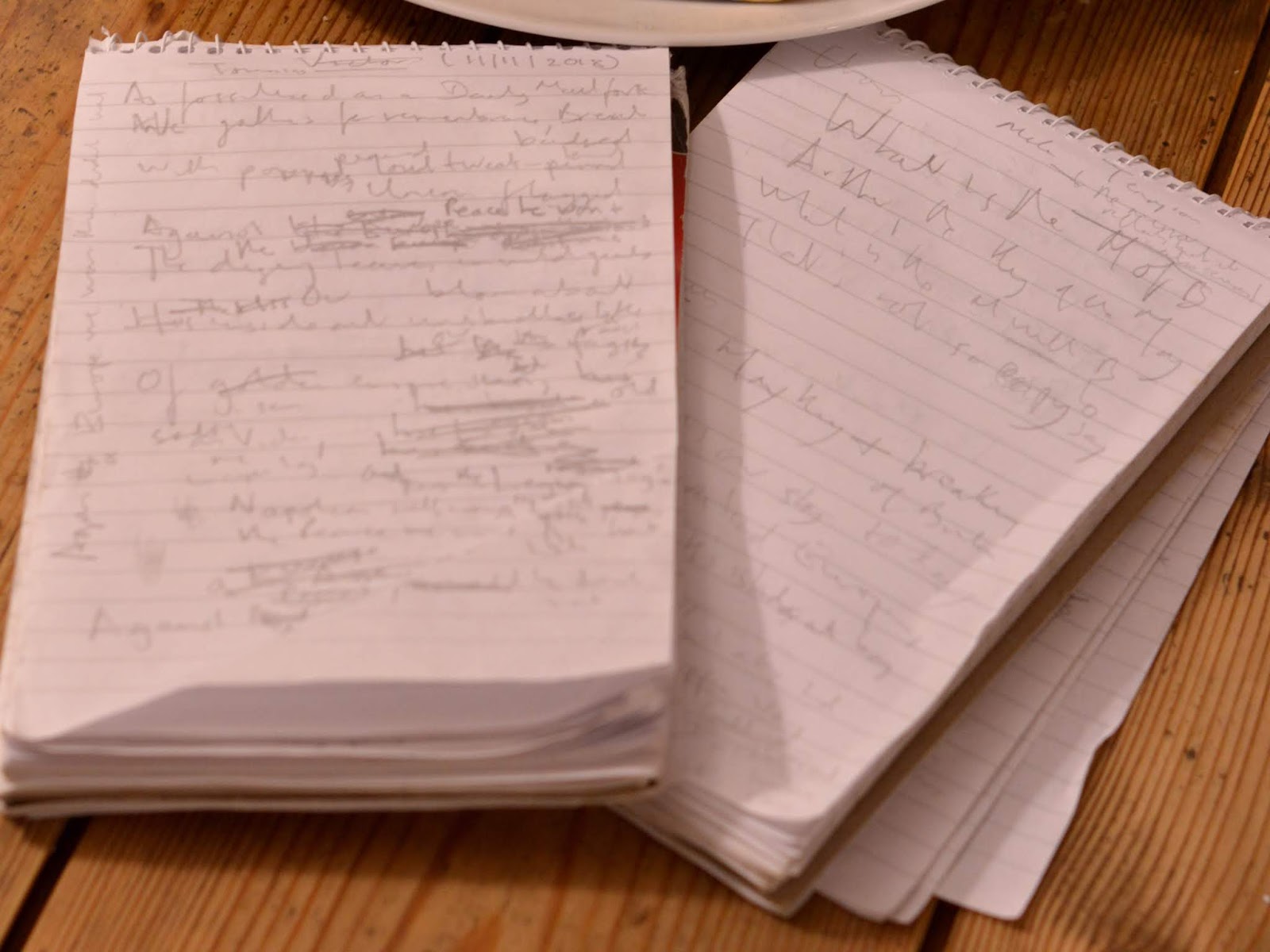
In my early 20s, I started to carry a notebook with me everywhere I went. (Still do). I wasn’t that well educated at the time. To me, words... they were just words. After a while I saw them as what they were. Writing was a way of finding my voice after a very troubled childhood.

I was published in the poetry press, then found a local publisher, and I’ve had three books out.

I’ve played pubs, art galleries and everything in-between since.

How would you describe the writing you are doing?

A friend of mine stated that what I’m doing is trying to stop things that have already happened either personally or politically and I guess there is something in that.

The poetry is brutally honest. Being from Liverpool and from a working class background gives a bit of edge to what I do, especially in performance. I don’t think I change what I write to suit audiences.

In the writing you are doing, which authors influenced you most?

Wilfred Owen. I was lucky, later in life, to be poet-in-residence for a while for the society in the north.

Emily Dickinson, Sylvia Plath, Dylan Thomas. But also music, The Smiths and David Sylvian. The former provided an alternative northern voice, the latter for deep spirituality in his songs.

How have your own personal experiences influenced your writing?

Completely. You can only be that and true to that. Anything else is being fake.

What are the biggest challenges that you face?

Acknowledging that I am a writer and have something to say. My parents still don’t recognise what I do.

Do you write everyday?

I’ve carried a notebook with me everyday since the mid 80s. It’s like a friend, a friend to myself. Usually when I’m out and about a word or sentence will pop into my head and will write itself.

When I don’t write for a few days, I feel out of kilter.

How many books have you written so far?

What A Catch (2012), Some Body (2014), and Express Nothing (2019).

Each are a build up of world, personal, social and political.

Best found on Amazon or via paypal.

What is your latest book about?

Express Nothing presents my take on modern life and the human conditions. It is a collection of poems written over the last few years. Choosing which to include was agonising.

The book was published in April 2019 by a small publishers in my local area, who have always been supportive and good to me.

Which aspects of the work you put into the book did you find most difficult?

In the book, there are a number of poems that are deeply personal and you wonder if people will get it, but I believe if you have felt something then others have too.

In the book, there are also a number of poems that I have been wanting to send out into the world for a while and some that are more meditative and gentle or in which I’ve captured something deeper. I enjoyed working on these a lot.

What would you say has been your most significant achievement as a writer?

I am always touched after performances when people say a reason they relate to a poem and having 20.000 YouTube hits on my site MellorDR.

One of your poems has been featured in Bollocks to Brexit: an Anthology of Poems and Short Fiction. How did the poem come about?

I saw a Facebook post about the book, so decided to send it. The poem changes verses of the Hokey Cockey and how we danced ourselves to this terrible point concluding in comic irony over the cliff.

Humour and politics have long been a British tradition.

Why is it important for poets to speak up on social, political and related matters?

Politics affects people's lives and words can be very subversive and powerful.

In your view, what do anthologies like Bollocks to Brexit add to poetry and public discourse?

Brexit is vile, driven by snobby elites and hateful narrow-minded Brits. This book, Bollocks to Brexit is a statement that we don’t all support Brexit or the thinking that’s led to the verge the country is now on.

Friday, July 26, 2019

Interview _ Jacob Lund

Jacob Lund’s poetry has been published in Openings, the annual anthology of The Open University and in N2 Poetry, London. He has worked as a reviewer for the Daily Telegraph, and has published on Shakespeare in academic journals. He lives in Brighton.

In this interview, Jacob talks about his writing:

When did you start writing?

I only began writing poetry seriously about three years ago, though before that I had been published as a book reviewer for the Daily Telegraph’s youth magazine Juiced. I have also been a contributor to NATE and EMag, writing mostly on Shakespeare and on literary theory.

After a conversation with the poet, short story writer and memoirist Dr. John O’Donoghue, I went home and found quite a lot of half-finished poems, fragments, titles, images – and realised that a few of them were probably worth completing.

A friend of mine who teaches at the University of Cambridge, Dr. Sean McEvoy, encouraged me to carry on with the work, and I began by giving a reading in Norwich, alongside Andrea Holland, Naomi Foyle and others. The poet Peter Pegnall invited me to do this. At about the same time I had started to contribute regularly to the magazine of The Open University Poetry Society, and my first published work was in their anthology, Openings.

I never really took the decision to want to be published: I just write and hope that others will find something of interest. I think that if I started to try to guess at what people might want to read, I wouldn’t be able to write at all.

How would you describe the writing you are doing?

The very first poems I had published were to do with ageing, memory and loss, though more recently I have been engaged with ideas of identity, nationhood and history, and this has coincided of course with the UK’s decision to leave the EU.

Some of the poetry is written, loosely speaking, in blank verse, and for two reasons: first, it is a form that offers wonderful flexibility in terms of rhythm and movement; second, it is the form in English verse that is so frequently associated with argument, ideology and rhetoric – in Shakespeare’s soliloquies or in Milton, for example – and I guess I have more or less consciously taken the decision to try to speak to that tradition, to a poetry that has the power to make the case for change.

I also write in free verse, so that I am able to work with allusions and intertexts, some of which might be in languages other than English. Overall, I guess I am a kind of modernist writer, though I am not sure that this sort of categorisation is all that helpful.

Who is your target audience?

My target audience is anyone who cares to look. I am hugely grateful for people’s responses to what I write, whatever those responses are, but I’m not really motivated to write for particular groups.

In the writing you are doing, which authors influenced you most?

This is a difficult one. I read widely and eclectically in terms of poetry, and I think there are probably many influences of which I am barely aware. I do think, however, that it is my responsibility as a writer to know as much as I can about what has gone before – it’s part of the job.

How have your own personal experiences influenced your writing?

My early poems touched upon personal loss and the subjective experience of getting older, but I have always been conscious that poetry can become boringly self-obsessed. I think that, unless they are for private use, poems need to reach out in one way or another.

More recently, I have visited areas of the UK that are unfamiliar to me, and my experiences there have started to allow me to write in a more observational way, I think. Lately, I have been to the Isle of Grain, Swindon, and Dungeness. These locations appear in a poetry collection I am writing about identity, nationhood and history.

What are your main concerns as a writer?

I am always concerned with the capacity of language to handle the truths of who we are or where we are, and I think that I deal with this simply by continuing to try to write. It doesn’t always work, of course.

The biggest challenge as a writer, I think, is to challenge your readers. I never, ever lose sight of the fact that people who see your poetry will quickly apprehend cliché, tiredness, overused tropes… and discard your work, which is absolutely fair enough!

Do you write every day?

I write every week, certainly, though not in a particularly structured way. A session might include writing up a draft from rough notes, then editing a piece that is well on its way to completion. I also love to prevaricate, which is good news for coffee sellers and BBC Sport, I think. I have a notebook and pen, but the main work is done on a PC: I like the coldness of type: it makes me somehow more critical of what I have before me, and this really helps with redrafting and editing.

What would you say has been your most significant achievement as a writer?

It’s those moments when you realise that you have made people think. Nothing beats this.

Some of your poems are featured in Bollocks to Brexit: an Anthology of Poems and Short Fiction. What would you say the poems are about?

I have two poems in the anthology. ‘Views along the English Coast’ is about the fragility of people’s lives in times of economic and political trouble, and of how in the end we have much in common with those who, too often, are deemed by reactionary political voices to be undesirable.

The other poem, called ‘The Territorial’, takes an imaginary English male figure who represents a sick, post-imperial, far right set of attitudes that are both echoed and challenged by other cultures. The emergence of ultra-conservative and fascist organisations in the UK, Europe and the USA are, I think, my preoccupations where this poetry is concerned, though the ostensible vehicle for responding to these developments is Brexit.

How have the poems been received?

I am absolutely delighted that some readers have been curious about and interested in the work. To say why they have been received well would sound way too much like self-congratulation – not my game at all.

Why is it important for poets to speak up on social, political and related matters?

I think that all art forms can speak to the political discourse of their time – and to other times as well. It’s difficult to make a special case for poetry, except perhaps that it has the capacity to handle political and social issues in a highly compressed way that doesn’t necessarily need to lose the nuance of argument.

In your view, what do anthologies like Bollocks to Brexit add to poetry and public discourse?

I think that the strength of an anthology like Bollocks to Brexit lies in its range of arguments, forms and tones, and in its linguistic variety. It gives the book its chance to engage with a broad audience, at a time when public engagement in politics has never been more important.

Wednesday, July 17, 2019

Interview _ Gareth Calway

Gareth Calway is a published poet, novelist, playwright, lyricist and member of folkband, the Penland Phezants.

His works include Doin Different (Poppyland, 2016) and Bound for Jamaica (Collins, 2012).

Like Eric Idle and John Major, he resented his birthday (March 29) being stolen for Brexit Day 2019. These poems are his revenge.

His poems have also been featured in Bollocks to Brexit: an Anthology of Poems and Short Fiction (CivicLeicester, 2019).

In this interview, Gareth talks about his writing:

When did you start writing? 

At school (late 60s, early 70s). I started by imitating lyrics by 'thinking' groups and artists like the Beatles, Dylan, Leonard Cohen and Hendrix, self-publishing these as lyrics sheets on mock-up fantasy albums by my own fantasy band. At the time, the hippie movement seemed all to my youthful and optimistic mind to be embarked on a search for 'the answer' (many were but some weren't) and I honestly didn’t distinguish much between writers I was studying at school (like Wordsworth and DH Lawrence), rock bands and Biblical prophets and psalmodists.

I was motivated to write such portentous lyrics by a would-be gnostic yearning to express and share wisdom, which I was constantly trying to imbibe from poets and lyricists and which interested me much more than mundane life in a teenage wasteland. In truth, of course, I knew very little about life and most of what I read or listened to was beyond my experience or understanding. Not all, though, and as a writer I was regarded by my contemporaries as a sincere and enigmatic 'seeker' after something, if no-one was quite sure what, and by the older generation as unsettling and vaguely dangerous.

How did you decide you wanted to be a published writer?

I loved the engagement of 60s and 70s folk/rock performers (the folk protest scene, Beatles, Dylan, Elvis Costello etc) with their audiences through words that spoke to and mobilised their generation. I also loved learning the history of English Literature at school and assumed that writers like Chaucer, Shakespeare and the Romantic Poets were just earlier versions of such a protest scene. I wanted nothing else than to be part of that, to perhaps one day be listed among the artists who had spoken to and influenced their time.

At University I contributed to the undergraduate writing magazines available and afterwards began contributing to such journals as London Delhi Poetry Quarterly, Encounter, Footnotes, Anglo Welsh Review, New Welsh Review etc and (usually with less success) entering poetry competitions.

How would you describe the writing you are doing now?

Musical, with a unity of sound and meaning - often using forms (like the folk ballad, the rap, the sonnet and the Urdu ghazal) that can be put to music and sung and/or dramatised like an actor's lines.

Who is your target audience?

I would like to connect with young, modern, diverse, multicultural Britain as well as my own generation i.e a contemporary folk audience and to be a 'word on the street' at least as much as in the classroom.

I think poets that matter are those with a vision of who we really are and can be.

I am a poet of Britain, which I love (i.e as a patriot who loves his country rather than hates everybody else's country: not every so-called 'patriot' makes that distinction sadly!) very much including the fact that we have always been defined, diversified and continually improved by embracing peoples and influences from 'abroad'. For example, I write using the Persian ghazal (albeit in English translation) more than any other form and this connects me with the ancient, Eastern tradition of love poetry it embodies as well as its exciting modern re-definitions in fusions of Eastern and Western psychology and culture in Britain, India and everywhere in between.

A language and a literature defines a land: we need a new one to reflect the 'internationally-connected', 'global-embracing' Britain we can become and writing that speaks this kind of 'English' can help to create it. Rooted here, in our unique landscape and history, but speaking beyond to our diverse selves and the world. The 'canon' of English Literature was never narrow anyway – Chaucer, the Father of English Literature is a vibrant new creole of Anglo-Saxon, French, Italian languages and traditions etc. The Tudor sonnet was from Italy (and originated in the Persian ghazal). A poet can help forge and express a new 'national consciousness', help to expand how we think, in the very opposite way from which some politicians - speaking what Orwell would call Newspeak - narrow it down.

What steps are you taking to connect with the audience you would like to reach?

I do most of my poetry performing at folk festivals (and folk clubs) arts centres, museums, history groups, village halls, churches etc - often though not always with and in a touring band - so I have a folk-musical audience more than a 'poetry reading' one.

Folk club audiences tend to be older; folk festivals have a range of ages. I reach a more diverse and international (including a younger) audience by posting my work online … I have regular listeners, viewers and readers in India, America, the Near East, Australia etc as well as in British cities ... and through radio appearances and/or recordings played on the radio (BBC as well as internet radio stations).

The internet is one way of overcoming my geographical semi-isolation from the more obvious and diverse centres of artistic exchange; another is a willingness to travel and tour. It would definitely be easier poet-wise to be in a diverse modern 'happening' city but rural Norfolk does have the compensation of being earthed in the rhythms of country life and the seasons and a lot of untold or under-told stories to tell, if not always the places to tell them in.

In the writing you are doing, which authors influenced you most?

Hafiz, John Donne, Shakespeare, Chaucer, TS Eliot, Yeats, UA Fanthorpe, Leonard Cohen, Bob Dylan, Elvis Costello and the tradition of the folk ballad because they craft their verse with their minds at full stretch but always from an aching heart and don't forget to tell stories to the tavern, and be (like Hafiz) part of national life "from the road sweeper to the university don."

I also like Dante’s assumption that poetry is a vocation, that the poet can construct a panoramic vision (which, in his case, embraces all of European civilisation in an attempt to embrace the whole of human experience.) His Universe is driven by Love - which the poetry both philosophises upon and actually manifests in passages of heartfelt lyrical intensity and in the terza rima form imitates Italian speech patterns and chats and chants by turn in a heightened but still natural way. This ambitious role for the poet still seems a measure to which modern poets, in a very different world, can aspire, helping to combine our much greater diversity with a sense of shared humanity and combat our tendency to social fragmentation and atomisation. Oddly enough it was James Joyce’s modernist rejection of Dante as the Catholic model of the artist, replacing it with Joyce’s own epiphanic view of art as a ‘priest of the imagination- i.e a modernisation of Dante’s own vocation- that appealed to me.

Without such an aspiration for our art as a wondering, seeking, delighting, sense-making adventure, poetry would be merely entertainment or crossword puzzle clever. (Not that there’s anything wrong with either of those as part of the larger artistic role: we could all have done with more comedy in the Divine Comedy! )

How have your own personal experiences influenced your writing?

I have always seen poetry as a wrestle with self, other, heart, head, form, music and meaning towards self-knowledge and self-expression, the expression of - or making conscious of - a vision. But humour, comedy and not taking oneself TOO seriously are also part of that. I try to balance satire with forbearance and, if I fail, to at least make my 'victims' die laughing.

I want to make people think about the human condition, feel deeply and laugh at human absurdity. I want words to sing and carry emotion, to be a solace in themselves but also to motivate anyone who hears them to be lifted and encouraged into making the world a better place.

I don't like the way 'serious' poetry has developed a reputation for being so difficult that now even English teachers avoid it. I learn mine by heart and perform it like theatre - or with my drum or my folk band as the lyrics to our songs - to try to connect with audiences before they put a barrier of "oh God this is poetry" in the way of letting it touch, amuse or inspire them. In other words, getting poetry back to its roots in music and feeling and spirit as well as ideas and complexity.

I believe poetry is a calling not a business; the true poet seeks his or her soul not how to market it.

Do you write every day?

I write every day. I don't have sessions as such. Poetry is always working away either at the back or front of my mind.

How many books have you written so far?

One comic novel, River Deep Mountain High, set in a state school in the Welsh valleys, 1968 - present, a requited but long unconsummated love story, Bluechrome, 2008.

One short novel for children, Bound for Jamaica, about the Atlantic slave trade, Collins, 2009.

Cromwell's Talking Head, a dramatic monologue 'spoken' by Oliver Cromwell, Diggers 2012.

Various educational books for secondary school English, most notably for Classical Comics (Study Guides about Jane Eyre and the Canterville Ghost) and as series editor / writer of the best selling 8 book "Aiming at Progress in..." series which is the only publication which ever earned me any real money! Collins, 2009.

Nine books of poetry:

City Zen, self-published pamphlet 1982, Zen snapshots of inner city Gloucester;

Coming Home, 3 sections: dramatic monologues of mineral, vegetable, animal stages of evolution (free verse); of historical moments (various historical forms); of spiritual planes of consciousness (ghazals) King of Hearts Publishing, 1991;

Britain's Dreaming, Frontier Publishing, 3 sections: Boudicca's revolt against Rome as a sort of Greek tragedy in classical, lyrical and 'punk' verse; poems about industrial decline in the Eastern valley of Wales; mystical ghazals, 1998;

The Merchant of Bristol, a Tudor sonnet sequence about a 16th century Mayor of Bristol who smuggled leather and grain to Iberia and wine from it. The Day Dream Press, 2004;

Sheer Paltry, Bristol City Football Club, 2004; football sonnets, chants and personal accounts of being a fan;

The House on the River, sonnets and free verse telling the story of Norwich from primeval to present through one house on a river; King of Hearts Publishing, 2004,

Exile In His Own Country, Bluechrome, 2006, a 'best of' collection of all previous;

Doin Different, 39 New Ballads from the East of England, folk ballads telling the story of Eastern England notably Norfolk through historical figures and ordinary folk, Poppyland, 2015;

6 Degrees of Separation; 7 Degrees of Love, Sheriar Press, 2016, mystical ghazals, sonnets and villanelles about a life following the Indian mystic Meher Baba.

What is your latest book about?

6 Degrees of Separation; 7 Degrees of Love is about the 'calling' of poetry as a spiritual vocation and a path to perfect happiness through desperate trials.

I was working on the book from 1979 to 2016 in terms of its individual poem content ... it's a lifelong achievement and story. The final stages or conceptualisation or refining as a collection larger than the sum of its parts took about 3 years.

The book was published in America by Sheriar Press in 2016. Some whole sections had appeared in my earlier collections … like Coming Home and Britain's Dreaming ... Sheriar gave me the chance to put all my 'spiritual' ghazals and poems in one book as a coherent statement, as a sort of odyssey through inner space.

The fact that the publisher is based in America and that my connection with them is distant and online is a disadvantage in some ways but they sell more than my other poetry books to a targeted audience there so it may actually be an advantage not to be physically involved in marketing it myself.

Which were the most difficult aspects of the work you put into the book?

I am not a fundamentalist and yet the book deals with fundamentals - God, spiritual questing, death, divine love, who we are beyond the physical world etc - so I find it a challenge to address these issues without losing the tavern audience.

It would be easy to lose touch with real readers by sounding 'religious' instead of engaging with the real issues of our times, which religious language has become alienated from. A bit like waging a crusade in the name of one's God instead of the much much more difficult task of actually practising the love all Faiths repeatedly prescribe as the cure.

Which aspects of the work did you enjoy most?

I love crafting metaphysical words, phrases and ideas into the fiendishly difficult rhyme and metre of the ghazal (or the Petrarchan sonnet) form, wrestling all that profundity into something simple and musical and heartfelt as possible.

I love speaking the resulting 'magical' patterns aloud by heart or having a musician sing and play them. I enjoy this because it's making conscious and easy the wisdom I think we all have and when it communicates to listeners, it's bliss.

The truth is simple but only some pretty intense metaphysical work mastering words, ideas and form can make it so (says he, paradoxically, but then our life itself is paradoxical.)

What sets the book apart from other things you've written? 

This is an interesting question because I think it's because it's all in the present. Much of my work is historical in one way or another, even if only the history of my own life, and it's often set hundreds of years ago. 6 Degrees of Separation; 7 Degrees seems to inhabit an eternal present stretching away beyond the past and the future.

This book is also more intensely personal than much of my work - I more typically invent characters, living in history - and yet oddly more universal as well.

I hadn't really realised this until you asked.

In what way is it similar to the others?

I like working in tight 'musical' forms and metres: the discipline and need for economy helps me distil a lot of feeling.

By nature, I am garrulous, discursive and excursive - always trying to make sense and with a lot of words flowing out – so, the discipline of such form is vital.

What will your next book be about?

Nursery Rhymes - the way they often record real events in history in a gnomic, epigrammatic way. I will explore this with a show with my folk band, the Penland Phezants.

Two of your poems, “Tommy's 100th” and "Breck's Isle" are featured in Bollocks to Brexit: an Anthology of Poems and Short Fiction. What would you say the poems are about?

“Tommy's 100th” was one of those out-of-the-blue experiences where I knew as soon as it started that a poem was going to result. I was at a village memorial, rain and leaves gusting everywhere - the 100th anniversary of 1918 - wondering if there's a moment when remembrance becomes ossified into something else, not so much a grateful salute to the fallen as a perpetuation of dead grievances.

Brexit seemed very much in the air and little remembrance, for example, of those huge parts of Europe with which we were allied though both World Wars, Polish airmen at the Battle of Britain etc etc, or of all the Commonwealth nations who had rallied to defend this land. "The Europe we won (against extreme nationalism) then didn't want" sums up the tragedy of all that for me.

"Breck's Isle" comes from a King Arthur sequence - the Arthur myth (myth defined as an eternal present beyond the past and the future) records the seismic moments when Britain has been invaded and heroically defended but has also absorbed all we've been invaded and enriched by: Saxons, Normans and everything since. For example, Lancelot is both the Celtic god Llugh and the much later Norman knight Lancelot du lac.

We should have more confidence in Britain to cope and grow with age-old change and diversity and learn the mythical lesson of Vorgigern King of Little Britain who tried to shut it all out and perished. We don't live in a vacuum; Britain is greater in Europe than isolated from it. Breck and his isle is my modern mythical version of Vortigern.

How have the poems been received?

With laughter (notably the Daily Mail font line) and with acknowledgement of the 'greater' patriotism the poems expresses; the rejection of the Farage-fake-running-scared patriotism which is so destructive of our national interest...

Also, acknowledgement of the attempt to embrace the whole nation including the Brexit side of the argument and a greater patriotism (a love of modern, diverse, inclusive Britain) that is harder to do than simply asserting a counter-credo to Farage/Bojo et al.

Why is it important for poets to speak up on social, political and related matters?

Because I think poetry, unlike much of our politics, will naturally tolerate nuances and contradictions and express them honestly - even sometimes when the author him/herself may 'think' he/she is doing something else. As Yeats said, out of the argument with others we make rhetoric or politics; out of the argument with ourselves, poetry.

In your view, what do anthologies like Bollocks to Brexit add to poetry and public discourse?

They give everyone a say - including many that are often unheard or have uncomfortable things to say, things that demand your consideration or human allegiance rather than simply your vote. They present a human face to all sides of the story.

Monday, July 15, 2019

Interview _ Katherine Cleave

Katherine Cleave is a Fine Artist living in Barnes. Since graduating from Goldsmiths College, her artwork has been displayed at several London galleries and events. Her work presents an ironic play of words, phrases and images juxtaposed to create a lively stage on which to probe reality. Recent work includes a small collection of poems.

In this interview, Katherine talks about her writing:

When did you start writing?

I started writing during my Thesis in the final year of my BA in Fine Art and Theoretical Criticism. I had based my work on a comparison between the playwright, Luigi Pirandello and the Fine Artist, Jannis Kounellis. The work required a leap of faith but I wanted to show that, in essence, it is not the medium that is important, but the message. I consider myself an artist: sometimes I paint, sometimes I write – with varying degrees of success!

How would you describe the writing you are doing?

I write poetry. The abstract nature appeals to me and I love the collaged effect of words and sounds seeking to convey a moment/emotion/concern. I enjoy playing with a tale, told from a humorous angle with dark undercurrents… the bitter aftertaste is what attracted me to writing.

This year, I decided to put a couple of poems in for some competitions and anthologies purely to access a new audience and I was curious to get some feedback. I googled ‘Poetry Competition 2019’ and then selected a couple of entries based on subjects that interested me. One competition was entitled ‘About Time’ for the Roger McGough Poetry Prize and the other was a call for poems and short fiction on the theme, ‘Bollocks to Brexit’, edited by Ambrose Musiyiwa.

Who is your target audience?

In all honesty, I’m not sure I have written enough to be able to answer this question. As with most art, I suspect it is more a case of certain works appealing to different people depending on their individual experience or interests.

In the writing you are doing, which authors influenced you most?

For a while, Haruki Murakami’s work entitled Killing Commendatore, felt as though it was written for me alone to the point that I intend to recreate the painting as described if only to recreate that feeling.

I often listen to audible books during dog walks since I find it frees my mind to paint the characters and their world to such a degree it feels as though I am there – away from the words on the page.

I also love the juxtaposition of time in David Mitchells’ books and I was also influenced by the conversational tone of Diana Evans recent work, Ordinary People.

Recent membership of The Poetry Society has also proved inspiring and I always look forward receiving my quarterly Poetry Reviews.

How have your personal experiences influenced your writing?

I recently retold a story from my past, which made me laugh out loud although revisiting the past as an adult, inevitably involved confronting the serious consequences of my past actions. I found the experience both refreshing and rather disconcerting.

I also discovered that when I get too precious with part of a painting, unable to go forward or back, a ‘painters block’ as I call it, re-channeling those thoughts into writing has proved to be a successful compromise to an artistic stalemate.

What are your main concerns as a writer?

I am fascinated by several themes such as the creation and appraisal of art; the individual within society; concepts surrounding time; fragility of health; death and masquerade.

I invariably approach a sensitive topic employing humour and farce. Both the creation and analysis are much more enjoyable plus it offers a casual stage from which to deal a hefty blow when the audience is relaxed.

My biggest challenges are, if I am honest, developing a strict regime to write regularly and, more importantly, to actually DO something with it. (I am exceedingly good at creating things for no other reason than the satisfaction of doing it.)

Do you write everyday?

I do not write every day but I do find myself sitting at my computer several times a week when the mood takes me. I tend to have left it to within a couple of hours of collecting the kids, and then dare myself to rush my thoughts out in the premise that I will ‘tidy up’ the poem later. Sometimes the rewrites are radical sometimes minimal. Some are canned before they see the light of day.

My poem, ‘Timeline’, was published this year in About Time, an anthology of shortlisted entries from the Roger McGough Poetry Prize published by Arts Richmond. Another poem entitled ‘Exit, Stage Right’ was published in Bollocks to Brexit: an Anthology of Poems and Short Fiction, edited by Ambrose Musiyiwa and published in 2019 by CivicLeicester.

What are you working on at present?

My current project is a collection of around 30 of my poems with accompanying artwork entitled Thought Threads.

Although the majority of the poems were created or revised in the past 6 months, it has taken me approximately 1 year to put the collection together.

I intend to publish Thought Threads this summer through self-publishing with KDP on Amazon.

I like the idea of the immediacy of self-publishing despite the fact that it lacks the marketing angle or the support of an editor. Maybe that will become more relevant in time when I have a greater body of work but for now I am more interested in having a physical volume with which I can gain feedback.

Your poem, ‘Exit, Stage Right’ is featured in Bollocks to Brexit: an Anthology of Poems and Short Fiction. What would you say the poem is about?

I wrote 'Exit, Stage Right' as a satirical take on Brexit. I wanted to capitalise on the them-and-us in society; the polarised black and white extremes from what is invariably a position of ignorance. I am particularly frustrated with the ‘I support this side and I’m sticking to it regardless’ pack mentality in politics. The endless repeating of meaningless empty catchphrases such as ‘Brexit means Brexit’, ‘Leave means Leave’ etc. has become an increasingly desperate mantra. I picture my poem read by a beery, aggressive, Shane Meadows character crossed with Johnny Rotten as he drunkenly slurs the words to ‘Road Runner’ having ‘forgotten the words’. Sadly the anthem ceases to be amusing when it could signify the financial ruin of many people and the unfortunate rise of racism in our country; hence the rather sad, deflated repetition at the end, ‘Here we go, here we go, here we go’.

How have the poems been received?

I live in London so it’s hardly surprising that most of the poems in the anthology went down very well (although doubtful if the same could be said for our MP Zac Goldsmith, who I am told, has also received a copy!) On a more serious note, despite Brexit being a tentative subject for many families, I was heartened to see we could still all laugh and enjoy the poems, which has since broken the ice and served to heal a few unspoken rifts in the process.

Why is it important for poets to speak up on social, political and related matters?

In order to both understand why we feel a certain way and in order to comprehend a different perspective, it is essential to have discussion. Various art forms provide a useful stage to have that communication in a non-threatening environment. The abstract nature of poetry allows observations to be subtly hinted or bluntly stated or even just offer an alternative version of reality to that expressed on various media platforms.

Politics can divide but there is no reason why it should. It is important to listen objectively in order to fully understand why someone has voted the way they have or feels the way they do. It is invariably the polarisation in society that has led people to lash out in anger – often in a ballot box with dire consequences.

In your view, what do anthologies like Bollocks to Brexit add to poetry and public discourse?

The anthology acts as a sponge, soaking up the thoughts and feelings felt by many but voiced by few. It felt cathartic to be involved in the process and hopefully the combined musings of several writers can channel some of that dissent to make people question our current political crisis and it also highlights the ‘them and us’ which is both mirrored in public discourse and on the streets. ‘We can’t solve problems using the same kind of thinking we used when we created them’, as someone wise once said.

Friday, July 12, 2019

Interview _ Trefor Stockwell

Trefor Stockwell studied English at Bangor University, and has recently completed his PhD in Creative Writing. He now lives on the Isle of Anglesey where he concentrates on writing and performing poetry. Currently he is working on a novel.

In this interview, Trefor talks about his writing:

When did you start writing?

I have always written but have taken it much more seriously since University.

My writing efforts are of an eclectic nature: poetry, prose and the occasional article. My audience is anyone who finds my work interesting. Primarily though I write for myself, and if others then enjoy it that’s a bonus.

I have never really wanted to be published for the sake of it, but it became an expectation when I started to do post-graduate work on creative writing.

Which writers influenced you most?

The writers who have influenced me most are: Angela Carter and Salman Rushdie both of whom were cited in my PhD thesis on creative writing.

I not only enjoyed their work for its unique, and sometimes quirky, approach to subject matter, but also it inspired my own approach to the situation I found myself in: at the time I was living in a small Bulgarian village, and was at the time the only Westerner in the valley. Although I was made welcome, I still sensed a feeling of isolation. I was also struggling to come to terms with the changes to the country - this was in the early days of transition to the EU and a change from a centuries old agrarian to a more capitalist society. My writing needed to reflect this change, and the fact that my presence - no matter how sympathetic I was to the culture - was leaving a cultural footprint: the villager were researching me just as much as I was them. My work, therefore, grew increasingly more Magical Realist in nature.

How else have your personal experiences influenced your writing?

I think all writers are influenced by events in their own lives. In my own case I have always tried to convey a left wing political message in my work. I also find that the loss of a loved one in a tragic accident led to some rather dark and cathartic poetry. Both of these elements are to be seen in my poetry collection, Life, Love, Politics and Other Silliness.

What are your main concerns as a writer?

My writing is becoming increasingly more political, this is especially so in my poetic efforts. This has become more so since the advent of the Brexit debate and the increasing drift toward extreme idealistic national politics. I have become alarmed with the similarities to the situation in 1930s Germany. Poetry is my way of expressing those fears.

Do you write every day?

I write on most days but do allow myself time away from the keyboard. My biggest challenge is self-discipline; I try to allocate myself a certain amount of time each day and treat it like a job.

I find I must force myself to start, but then find that once I do it’s even more of an effort to stop.

I have published four works: A novel: Clerical Errors, Secular Lies; two short story collections: Bread and Wine and The Tales of Ivan Levsky; one poetry collection: Life, Love, Politics and Other Silliness.

What is Life, Love, Politics and Other Silliness?

It is a poetry collection.

It was written over a number of years. The more personal aspects of the collection were the most difficult to write, but also the most rewarding and cathartic. The collection was published by Dorogoy Press/LuLu in 2018. I completed all the layout work myself.

The main advantage of this, is that I can order as and when required and also sell through Amazon.

One of your poems, ‘When We Weren’t Looking’, is featured in Bollocks to Brexit: an Anthology of Poems and Short Fiction. What would you say the poems are about?

‘When We Weren’t Looking’ was written in response to my growing concerns about where our country is heading since the referendum. It was written very recently, and reflects on the fact that our own apathy appears to be allowing the unspeakable to come about by stealth. It is also about my own fear that the referendum has been the touchstone to a release of national xenophobia and a right wing agenda that harks back to a golden age which in truth never really existed. In my opinion the only way for us as a nation to reunite is take the whole thing back to the people - either as a people's vote, or through a people's assembly.

How has the poem been received?

Difficult to say, but it appears to have found favour with audiences. Why this is, is again, difficult to say, but either they approve, or are very kind – probably a mixture of both.

Why is it important for poets to speak up on social, political and related matters?

It has always been important for people in the arts to speak out. Quite often artists, writers, musicians and the like are the first to notice the defects in society, and are possibly more trusted by that society than the political leaders,

In your view, what do anthologies like Bollocks to Brexit add to poetry and public discourse?

Anthologies such as Bollocks to Brexit allow disparate views to be broadcast more widely rather than relying on the mainly biased opinion of the media, or the meaningless sound bytes of the political class: 'strong and stable' and 'Brexit means Brexit' are two examples of slogans that are completely without meaning, yet are repeated over and over again, until they become perceived as absolute truisms, this is aided by a media that is in the main controlled by the very rich, and entirely influenced by the need for profit.

Wednesday, July 10, 2019

Interview _ Sarra Culleno

Sarra Culleno is a London-born, Manchester-based UK poet, a mother of two and an English teacher.

She writes about issues that include children’s rights, motherhood, identity, technology and politics. Her work has been published in magazines and anthologies that include Les Femmes Folles (‘Lost in my DMs’, ‘Song of the Young Mother’ and ‘Phone Phantom Pantoum’), Three Drops (‘PMT Virelai’), Hidden Voices (‘Hansel and Gretel, the Woodcutter’s Children’) and in Bollocks to Brexit: an Anthology of Poems and Short Fiction (CivicLeicester, 2019).

In 2019, Sarra was longlisted for the Cinnamon Press Pamphlet Prize and appeared as a featured poet at HerStories Festival, Celebrate Whalley Range, and That’s What She Said (For Books Sake).

Readings can be found on her YouTube channel and through her Instagram and Twitter profiles.

In this interview, Sarra talks about her writing:

When did you start writing?

I've always written, but only started sending pieces to publishers this year.

I'm an English teacher, so I have taught the nuts and bolts of poetry for sixteen years. My two children are now old enough for me to have a hobby which led me to performance poetry and spoken word events.

How would you describe the writing you are doing?

It's a mixture of formal and blank verse, on themes of dual heritage identity, motherhood, monogamy, the education system, gender, and politics.

The motherhood poems are autobiographical, as are the dual heritage identity poems. I'm of Iranian-Irish descent which did not seem particularly interesting or unique to me until I left London in my twenties.

My poems on the education system are rooted in my experiences as a classroom teacher and mother of primary school age children.

I hadn't realised the impact Sylvia Plath had on my writing till recently. I can see the influence of her cadences and extended metaphor. Hafsa Aneela Bashir, more recently; her bravery is raw and visceral which made me braver when writing about painful personal experiences such as post-natal depression.

What are your main concerns as a writer?

My main concern is producing a finished poem, but I can't stop tinkering with syllable counts, metre and so on even after I've sent them off! I'm very badly organised, so I do not keep track of what I've submitted where... Sooner or later a publisher is going to get very cross with my simultaneous submissions!

What are the biggest challenges that you face? And, how do you deal with these challenges?

Rejections are hard to take, but it's an unavoidable part of writing. It's also a chance to ask myself what I can improve.

Do you write everyday?

I can't write everyday. I have a demanding full-time career and two small children. I get my ideas while driving home. Before I get out of the car I scribble them into a notebook. Once the children are asleep, I'll do my research and choose a suitable form which I hope will enhance the meaning or topic. Finally, I'll sew it together and then review it in a day or two. Then the tinkering starts... And never stops!

I'm writing my poetry collection at the moment. I started it in February and I'm still working on it now. I have about forty poems I'm happy with and many more I've cut. When I have about eighty, I'll submit it for publishing as a book rather than a chapbook. An early draft of it was longlisted for the Cinnamon Press Pamphlet Prize this year. I hope I've improved on it since then.

When I've finished, I'll submit it to small presses based in the North West and London as it will be easier for me to be involved in launch events. The types of publishers which I think would be a good fit, would be women-focused and known for releasing titles exploring gender.

Which aspects of the work you are putting into the poems do you find most difficult? Why do you think this was so?

I ended up scrapping all my spoken word poetry from publishing submissions, and I will not usually read my more formal poetry at performance events. I love both for different reasons, but only a few of my poems cross over. I've tried to include a number of accessible poems in my collection, which are not in the least oblique or literary, hoping this will broaden appeal. I've recorded readings for some of these on my YouTube channel.

I most enjoy writing poetry when an idea emerges of its own accord, and writes itself. It's depressing when there's a "drought", though.

I'm looking forward to the school holidays to start the writing flow off again.

One of your poems, ‘Terza Rima's Woke Blog’ is featured in Bollocks to Brexit: an Anthology of Poems and Short Fiction. How did the poem come about?

I wrote ‘Terza Rima's Woke Blog’, for my pupils and younger colleagues. Neither can build any stability into their futures, and yet they are the hardest working and most conscientious people that I know. I feel their generation is forsaken.

Advertising agencies were employed to peddle Brexit and manufacture consent. Marketing companies know that facts will not sell products, but that emotions sell a brand. There needs to be awareness raised for both sides, that referendums are opinion polls, not unbreakable contracts. Perhaps this is where poets could help.

Why is it important for poets to speak up on social, political and related matters?

It's important for everyone to speak up. But if you have an unusual way of saying it, it's to your advantage.

My worry is that Brexit is what Chomsky might call "a Roman Game of Circus" designed to incite a very narrow but impassioned debate involving both left and right, to distract us all from what is really going on: the stripping of human rights to bring our workforce in line with China and India, and to colonise our publicly owned assets in the TTIP deal. Chomsky, in his explanation of how we are kept passive, puts it better than me, when he says in The Common Good, "Limit the spectrum of acceptable opinion, but allow very lively debate within that spectrum..."

In your view, what do anthologies like Bollocks to Brexit add to poetry and public discourse? Why does this matter?

As a reader, I prefer anthologies as you get a broader perspective on a theme, and experience multiple forms and styles.

Politically, art resonates better than facts, figures and debates. And if Brexit proved anything, it's that people follow their hearts. Not their minds.

The TTIP deal was debated a lot on social media before the referendum - it has vanished entirely since. The debates on public services, spending, living standards, and many other pressing issues are silenced now too. Brexit is the greatest political distraction ever contrived. It was never a possibility or even a yes/no question. It's important for anyone who realises this, on the left AND the right to reach people still arguing about a non-starter distraction. We still have to protect our hard won rights from the greedy, who will happily turn us into an impoverished, enslaved, poisoned and hateful nation.

Brexit is “a non-starter distraction” because it was invented as a Roman Game of Circus, purely to divert debate from other issues. It is an impossibility, but while we all argue about it, our civil rights and public assets are being stripped under our noses. It is useful for the government to prolong their inevitable admission that it was never going to happen, as this cultivates a climate of fear and apathy, which controls everyone (those of us already impoverished, and also anyone left who realises however little we have can be taken away). I believe they will push the deadline forward each time it arrives until they eventually admit they had no intention or means to take the eggs out of a cake which is already baked. So to speak.

Monday, July 8, 2019

Interview _ Paul Francis

Paul Francis is a prolific, versatile poet, living in Much Wenlock. He has published two collections, Various Forms and 5-string Banjo, and a range of topical pamphlets. He is active on the local circuit of poetry readings and has been placed in six national poetry competitions.

In this interview, Paul talks about his writing:

When did you start writing?

I wrote my first poem at the age of ten and haven’t stopped since.

There wasn’t a clear moment where it could be said I decided I wanted to be a published writer. I’ve always read, so I’ve thought of writers as important, and writing as a worthwhile activity. It’s a natural step from there to think, “Why not me?”

How would you describe the writing you are doing?

Varied, enjoyable, most of it transitory.

When I write, I don’t start from the audience. I start from the writing and then go looking for the audience. For most of what I do, the immediate audience is other writers who go to poetry events around the West Midlands.

Sometimes it reaches beyond that, through a series of accidents. I discovered a week ago that the leader of an Orkney Ramblers holiday I went on in 2014 has been reading my Orkney Sonnets to his recent customers. Totally gobsmacking, but good to know.

Which authors influenced you most?

Shakespeare, Shelley, George Orwell for a start. Shakespeare and Shelley (‘Ozymandias’) for the sonnets, Shelley (‘Masque of Anarchy’) and Orwell for the politics.

The range and intensity of Shakespeare’s sonnets have always impressed me – there’s so much you can find in this apparently limited form. ‘Ozymandias’ is terrific. It came out of a challenge between Shelley and a friend – write a sonnet about a recent visit to the British Museum. It’s a powerful, well-organised sonnet that proceeds towards its conclusion, getting better all the time BUT it also plays around with the formal rhyme scheme. It’s not simply three four line chunks with a couplet tacked on to the end.

‘Masque of Anarchy’ is a great poem. short lines, tight rhyming and controlled anger all the way through.

What I like about Orwell is the aim for clarity – look hard, but keep what you’re writing as clear and simple as you can.

How have your own personal experiences influenced your writing?

I was brought up in a very pleasant middle-class home. Lots of books, time for reading, supportive parents etc.

It was only when I went to Raymond Williams’ lectures, and then started teaching in a Nottinghamshire mining town, that I registered how differently many people lived – and what a rough deal a large proportion of the population got from those who were in power.

This is really far too big to take on in this context. It’s about social class and money and power, and the recognition of how they operate in society.

Has there been a change from when I started teaching till now? How long have you got? I’ve written two books about this, What’s Wrong with the National Curriculum? and The Best Policy? Honesty in education, 1997-2001.

What are your main concerns as a writer?

Making topical, political subject matter the content of poems which are good in themselves, not just a rant.

I have regular arguments with poetry friends about what poems can and can’t do. My view is hugely ambitious – poems can convey information, develop arguments etc... I need to work on the text, so as to convince sceptics that I might have a point.

What are the biggest challenges that you face?

Not huge. I’m retired, and have a pension. It’s a comfortable life. I write what I want to, and nothing hangs on what happens to it. I like trying to write different kinds of stuff.

The challenges I face are largely technical. I like regular forms, but recognise the current hostility to full rhyme and iambic pattern. One challenge is to try to face the potential criticism of those elements without sacrificing them – keeping the sense and the movement as active as possible.

Do you write everyday?

Most days. Sessions aren’t formal, and might be short. I’m lucky that I write fast, and always have plenty to write about.

How many books have you written so far?

I wrote three books about education, and various packs of educational materials.

I’ve written an autobiography and a novel, and have had three collections of plays for schools published (by Edward Arnold and CUP).

I’ve self-published two main collections of poems (Various Forms and 5-string Banjo), and fifteen pamphlets of various kinds.

My latest pamphlet is In the Dark, about social media during Brexit. It’s just over a dozen pages. Actual writing time, a few days. Research and thinking about it, nearer three years.

Which aspects of the work did you enjoy most?

I love manipulating information, ordering material – with this pamphlet, putting together the reference notes, sorting through the piles of (yes, actual paper) cuttings was a real buzz, and the actual writing itself, finding key images, hearing a phrase arrive in my head, which has the right sound.

In the Dark is very gritty – closely tied to the actual details of the Brexit debate – not appealing material for many readers; but, the pamphlet is accessible, easy to read and has a very clear position. I’m not coy about saying what I’m for and against.

How did you find a publisher for the pamphlet?

I’m a huge fan of self-publication, provided it’s done right, i.e. thought about, thoroughly checked, seen by critical eyes before publication. Given those conditions, it’s quick and cheap. Though, obviously, it can also be self-indulgent and a waste of everyone’s time.

What are you working on next?

Sonnets with notes will be published later this year. What’s different about it is that there are notes on each of the fifty sonnets, but they’re deliberately printed on the same page. To some that will be horrifying, but I compare it to poetry readings, where the commentary of poets on their work is often illuminating, leading to a deeper appreciation of the work. My gamble is that by giving more importance to the notes, I potentially increase readers’ chances of enjoying the poems.

You have two poems, ‘The Pitch’ and ‘Maverick’, in Bollocks to Brexit: an Anthology of Poems and Short Fiction. What would you say the poems are about?

‘The Pitch’ is about the damage of Brexit, to both sides. It adapts the Romeo and Juliet story, of two lovers divided by their feuding families, to the Brexit division between Remain and Leave.

I think Brexit has been a disaster, but that’s not simply because I’d have liked the result to be different. We’ve all suffered from the poisoning of the atmosphere, and these two young lovers are both casualties. Their death is a tragedy, but so is the future we face – uncertainty, expense, no clear gain achieved by massive upheaval.

‘Maverick’ is about Arron Banks – I don’t think we look anything like closely enough at how the Leave campaign was run, and why it worked. It’s not just that they told lies, it was the way they told them. We have to learn from that, as active citizens who can’t simply rely on the media to tell us what’s happening. The Daily Mail picked the BBC as one of the heroes of the Brexit campaign, and that’s a pretty damning indictment of their unwillingness to ask tough questions, and thoroughly investigate the promises that were made. We have to be sceptical and well-informed, if we’re not going to be seriously misled - as we were in this campaign.

How have the poems been received?

Generally, reception has been favourable. For years I was told that people don’t want to hear or read poems about politics. I don’t think that was true then, and I’m certain it’s not true now. Total strangers often come up at poetry readings to thank me for reading stuff about what’s on the news. Some people are allergic to rhymed poems, and I can see / hear the sneer start to form, but in performance the rhymes and the rhythm have their own appeal – especially to non-poets!

Why is it important for poets to speak up on social, political and related matters?

Because we’re citizens, and we need to share, and be together. Those feelings of outrage, anxiety need to be expressed – that’s how we get a better future.

In your view, what do anthologies like Bollocks to Brexit add to poetry and public discourse?

It’s tricky, because we’ve been – deliberately – divided into tribes. Not many leavers will pick up this book. If they do, will they be impressed, let alone convinced? I doubt it. But it does help our morale.

As one of the participants said, I’m sure there’ll be leavers, with their own poems, and a different anthology might try to mix the two, provide a portrait of a range of views. But that’s some way down the road, and a much tougher ask. For the moment, this is a start, and it’ll do.

Friday, July 5, 2019

Interview _ Deborah Harvey

Deborah Harvey is a Bristol poet and novelist and is Co-director of The Leaping Word poetry consultancy.

Her poems have been widely published in journals and anthologies, and broadcast on Radio 4’s Poetry Please. Her fourth poetry collection, The Shadow Factory, will be published by Indigo Dreams in summer 2019.

In this interview, Deborah talks about her writing:

When did you start writing?

I started writing poems and stories when I was a young child and continued throughout primary school, but at secondary school the emphasis shifted onto learning for the purpose of passing exams, rather than exploring any creativity we might have, and eventually I stopped writing altogether.

Then, decades later, when I was struggling to raise four children and my marriage was falling apart, I had a very vivid, urgent dream, which seemed to me to be saying that unless I found a way of expressing myself, something important in me would die. So there I was, knowing I had to write poetry but not even sure what a poem was.

I started to write what came, though, and to read poetry too, and gradually the process became less agonising.

How and when did you decide you wanted to be a published writer?

My life’s ambition, even during all the years when I wasn’t writing, was to take up an eighth of an inch on a bookshelf somewhere, so being published was always going to be something I would pursue, despite being an introvert by nature.

I also believe that all writing, but especially poems, only really achieve their potential when they are in the mind of the reader; poetry is essentially a collaborative art, so sticking your neck above the poetry parapet is essential for the development of your work.

I found my publishers, Ronnie Goodyer and Dawn Bauling of Indigo Dreams, by winning a competition they were running with publication as its prize, back in 2010. My fourth collection, The Shadow Factory, will be published by them this autumn.

How would you describe the writing you are doing?

I love the unique relationship with time that poetry has; how you can be walking along a line in a poem and fall through a hole into a whole new era or universe even. I’m mostly exploring that notion at the moment and it’s a fertile, imaginative place to be.

I write for anyone who feels they are on the edge of things, watching. I’ve always struggled to fit in with the expectations of others, and events in my life have only reinforced that sense of being on the outside of things. It might be painful at times, but I think it’s a useful situation to be in for a writer.

Which authors influenced you most?

Being brought up in the Methodist tradition meant I was exposed to poetic images, language and cadences for several hours every Sunday from a very young age. I used to love the call and response of psalm reading, and hymns were great because I got to stand on the pew and sing words I didn’t understand but which were mysterious and conjured pictures in my head – fiery cloudy pillars, chariots rising into the sky, all that sort of stuff. So the poets of the Old Testament and Charles Wesley have a lot to answer for.

Similarly, my father would take me to the library every week as a child, but left me to my own devices when it came to choosing books, so I often ended up with stories for older children or young adults that I could read but couldn’t fully understand, and that’s when the imagination comes into play. It’s the same approach you need to adopt when you’re reading poetry; a willingness to bring your own experiences to the poem.

As for poets themselves, there’s Alice Oswald, Kathleen Jamie and Stanley Kunitz for the way they capture nature; Charles Simic for his startling imagery; Neruda for always taking the reader with him on his huge associative leaps; Raymond Carver for his story-telling; Heaney and U A Fanthorpe for their unremitting humanity; Carol Ann Duffy for her surety of touch; Tracy K Smith for her startling depth and breadth; Leonard Cohen for sounding like God; I could go on.

How have your own personal experiences influenced your writing?

Most poets I know have led tumultuous lives and write as a means of turning their experiences into stories that make sense to them; finding a way to express yourself creatively is a hugely healing act. I’m no exception.

What are your main concerns as a writer?

Are my poems any good? Will anyone want to listen to me wittering on? And when I’m not writing, will I ever write a poem again? ... the usual stuff. Although I think self-doubt is an important part of creativity. If you start getting cocky or churning out poems for the sake of it, that’s the time to really worry.

What are the biggest challenges that you face?

Time management. Balancing the need to earn a living, and be a mother and a carer, and publicise my work, with actually writing the stuff.

Do you write every day?

The nature of my day jobs means that most days I have no routine. This makes setting aside a length of time to write without interruption difficult. Luckily, I tend to write poems out of the corner of my eye, so as long as I have a notebook and pen to hand, I can still work on them as I go along. In that respect I’m like my grandmother, who also wrote poems; she raised eleven children between the wars, including triplets, and was run off her feet but she always kept a scrap of paper and a pencil in her apron pocket to jot down lines of poems as they came to her.

Even if I can’t write every day, I try to do something that will feed into my writing, whether it’s reading poetry or prose, walking somewhere new or in a place that has resonance for me, doing a bit of research, going to hear another, better poet read, watching starlings in the garden. Then, even if I’m stuck in discouragement, at least I can tell myself I’m cobbling together a ladder to climb out.

How many books have you written so far?

Communion – poetry collection, published in 2011 by Indigo Dreams Publishing

Dart – a historical novel about a family living on Dartmoor during the Black Death, published in 2013 by Tamar Books, an imprint of Indigo Dreams Publishing

Map Reading for Beginners - poetry collection, published in 2014 by Indigo Dreams Publishing

Breadcrumbs – a memoir of a marriage in poetry, published in 2016 by Indigo Dreams Publishing

The Shadow Factory - poetry collection, to be published in autumn 2019 by Indigo Dreams Publishing

What is your latest book about?

My father died last year so quite a few of the poems in The Shadow Factory concern themselves with childhood, the passage of time, the ageing process, and death. I think it’s the poet’s job to be clear-eyed about things we as humans don’t always want to acknowledge and I’ve tried to do this without being depressing. The darker sequences are offset by more surreal poems of the imagination, a sequence based on Leonora Carrington’s portraits, and my poem 'Oystercatchers' which won the 2018 Plough Prize Short Poem competition and is a small redemption all on its own.

When I finish putting the book together, the poems in it will span four or five years, although most of them will have been written in the last two years. This is because if I write a poem that doesn’t quite fit the theme of the collection I’m engaged in writing, I’ll keep it back for inclusion in a later collection, as long as it still holds up.

How did you choose a publisher for the book?

The Shadow Factory will be published in the autumn of this year; I don’t have a date yet but it’s soon.

My publishers have shown me great loyalty, which I am glad to reciprocate. A close and respectful working relationship makes the editing process far less fraught than it might otherwise be, and everyone is happy with the end result.

Which aspects of the work you put into the book did you enjoy?

I love the whole process of writing, editing and publishing my poems; I also enjoy taking them out into the world, and reading them.

I was about to say that nothing quite beats that moment of inspiration, but actually, that’s not the case; I’m most moved when people tell me that a certain poem of mine touched them or connected with their lives. In a way it stops being your poem at that point and takes its place in the world.

Many poets use their stories to feed their work, and I’m no exception. The important thing is to leave enough space in each poem for the reader to inhabit it with their own personal experiences, because only then does a poem become relevant.

What sets The Shadow Factory apart from other things you've written?

My poems are all in my voice; I also think there’s a certain sensibility that permeates all of them, and sometimes I detect echoes of and responses to earlier work that have come through subconsciously. I like to think my poems are getting better the more I read of other people’s work, the more I go to hear great poets read, and the more I write.

What will your next book be about?

Apart from a doomed attempt to escape in the 80s, I’ve lived in the same city all my life and have amassed stories, family anecdotes and memories, old photos, historical snippets, the voices you hear in the queue at the bus stop, the way places change and people come and go, but the city remembers how it always was and keeps re-creating itself in that image. The past in the present. I want to write all that.

What would you say has been your most significant achievement as a writer?

I’ve been very fortunate: I’ve won some prizes, I’ve had a poem read on Radio 4’s Poetry Please, and my books take up more than an eighth of an inch on my bookshelf, but the most significant achievement is making connections with people who read my poems and who are kind enough to tell me. I can’t really ask for more than that.

Two of your poems, 'Yes, there will also be singing' and 'So says the owl' are featured in Bollocks to Brexit: an Anthology of Poems and Short Fiction. How did the poems come about? What led you to write the poems and to present them in the form that they take?

I was politicised as a teenager in the 70s, through the Anti-Nazi League and Rock Against Racism, and if anything I’ve moved further to the left over the years, not least because of the monumental battles I and my disabled children have had to wage over the years to secure them the education and benefits they need. I’m also fiercely in favour of freedom of movement and multiculturalism, so the thought of being trapped on this island with racists, homophobes and ableists who attack anyone who isn’t like them is appalling.

For a long time I’ve wanted to channel some of my political feeling into my poetry, but I’m not a declamatory poet and I don’t really write invective. With the two poems in Bollocks to Brexit, I found a way of making a political point by referring to earlier historical events in one and a late medieval painting in the other, thus underscoring how progress isn’t linear, and how we are in the process of repeating the mistakes of the past.

Why is it important for poets to speak up on social, political and related matters?

A poem, like a song, a play or a painting, might reach someone when rhetoric fails. I come from Bristol and you can’t deny the political impact Banksy has had. Poetry is our national art form and poets have been given the ability to communicate in an especially resonant way; it’s up to us to rise to the challenge also.

Shelley claimed that “poets are the unacknowledged legislators of the world”. I think that’s a bit of an exaggeration, but in times of crisis all artists have a responsibility to respond as best they can. And this is certainly a time of crisis, and not just because of Brexit. We are reaping what Thatcher sowed, and it’s the younger generation who are suffering the most.

Wednesday, July 3, 2019

Interview _ Ceinwen E. Cariad Haydon

Ceinwen E. Cariad Haydon lives in Newcastle upon Tyne, UK. She writes short stories and poetry and has been widely published in web magazines and print anthologies.

She graduated with an MA in Creative Writing from Newcastle University in December 2017.

In this interview, Ceinwen talks about the work she is doing:

The Wombwell Rainbow states that you believe everyone’s voice counts. Please elaborate.

Traditionally, a narrow group of men has controlled which writing is published, which narratives and voices are heard. This produces skewed accounts and neglects to progress the articulation of the true range of human experience.

Literature has played a big part in investing the norms of the dominant group with high value, and by reference the majority of people are ‘othered’ because they will not/do not/cannot conform to or share these. The ‘others’ are therefore perceived, and often perceive themselves (due to social conditioning), as ‘less than’.

Things are changing, but not fast enough, in my view. Everyone has a valid and interesting story to tell. As a reader and as a writer I am concerned to listen and celebrate people’s differences.

In workshops, I support individuals to express their unique stories and creativity through the written and spoken word. Many people have characteristics that lead them to be marginalised and silenced by the mainstream, and the education system has insidiously groomed them to feel that they and their experiences do not count. These are the very voices that everyone in our communities should be able to hear, acknowledge and value.

Currently you are developing practice as a creative writing facilitator and are working with hard to reach groups. Which groups are these? What makes them hard to reach? As a creative writing facilitator, what do you do with them, and why is this work important? Why does it matter? 

At the moment, I am mainly working with people living with dementia and their carers, and also with other groups of elders. These individuals are from a variety of backgrounds, but all experience elements of ageism. Many have learnt to be quiet and compliant, in the belief that no-one would want to listen to them.

Workshops concentrate on imagination rather than memory as this values the present moment in their lives and avoids the anxiety that can manifest when the emphasis is on retrieving memories. Clearly, memories do come to the fore, but this remains within the control of the person and is not sought by someone external.

The work provides opportunities for creativity, social connection, agency, validation and fun. It is wonderful to see people’s personalities blossom within the group, along with their stories.

In some circumstances, if they consent, I ‘harvest’ their words and order/frame them into a poem. I do not alter their verbatim expressions, but might pare some words back, introduce refrains or re-order lines. These pieces remains their work, I am merely the scribe. There are moments of joy and recognition when people hear their poems subsequently.

I also use the ‘Timeslips’ group story telling method. People respond to an image, often quite an unusual one that speaks to the imagination. I ask open questions and accept the answers offered unconditionally, (embracing even contradictory ones). In this way a short story develops. This is read back at the end and a title is chosen. Each person has their own copy a week later.

In the past, professionally, I have worked with survivors of abuse, offenders, people experiencing mental ill-health, young mothers and many others. I hope to widen my area of practice as a facilitator to include people who have lived with challenges of this sort.

In terms of access to groups, I use existing networks, often set up for other purposes, and offer taster sessions. Then, if there is interest, I develop a scheme of work after consultation with those involved and their representatives. Breaking the silence and creating a space in which people can communicate and connect openly can led to self-generated support networks of great value.

In 2018, not only were you highly commended in the Blue Nib Chapbook Competition, you were also shortlisted for the Neatly Folded Paper Pamphlet Competition, and won the Hedgehog Press Poetry Songs to Learn & Sing Competition. Can you say something more about this and what you are doing to build on this success?

As a late starter, I didn’t have a large body of work when I commenced my MA in Creative writing in 2015. I also started the course as a prose writer and emerged a poet. Since then I have submitted individual pieces widely and have had acceptances amongst the inevitable rejections. My next step is to aim to achieve publication of a pamphlet or collection. I am due to have two chapbooks published in the next few months, and this represents a next step towards my goals.

I find that I sometimes submit work prematurely, in my enthusiasm, and I am still learning how to edit effectively.

Your work has also been featured in a number of print anthologies. Can you say something about the work and the anthologies?

Some of the anthologies that I have been featured in are political in nature and focus on an individual issue. These include:

  • Planet in Peril, Fly on the Wall Poetry, 2019; and
  • The Poets Speak Anthologies [‘And’ Vol.1, ‘More in Common’ Vol 2, ‘Water Rights Vol. 3, ‘Pandemonium’ Vol. 4 and ‘In or Out’, Vol 5.], Jules Poetry Playhouse, New Mexico, 2017/18

The subject of Planet in Peril is self-evident, The Poets Speak Anthologies were published in response to the election of Donald Trump.

In my work I try to balance the immediacy of threats, an implied or explicit call to action and hope. Humans are very resourceful and if we can use these talents well, I believe we can change our destinies for the better. However, currently we are leaving things very late in the day.

I have been published in other anthologies and printed magazines, and my work has been varied, often more introspective.

In 2018, one of your poems, ‘No Woman is Indispensable’ was published in Write to Be Counted: an Anthology of Poetry to uphold Human Rights (The Book Mill, 2018). What inspired the poem? What do you hope the reader will take from the poem?

This dystopian poem expressed my distress about the undervaluing and abuse of girls and women. Although it is stark, it does not seem to fall far outside of the bounds of possibility and, in some societies, parallel practices are, or have been, present.

I have two daughters and a teenaged granddaughter, and I cannot bear to think of how their life trajectories might be curtailed or derailed by structural sexism or the misogyny of individuals.

Another of your poems, ‘March 2019, SOS’ is featured in Bollocks to Brexit: an Anthology of Poems and Short Fiction. What would you say the poems are about? How did the poem come about?

In my poem I try to balance feelings of desperation with hope. I recognise the ruptures and cumulative costs caused by the Brexit process, and see the way it has torn the fabric of our communities, but I hope that one day this mess will be consigned to history and people will have moved on towards the interests of the many rather than the few. I intend to sow disquiet because energy is needed to avoid the worst outcomes, but also to avoid a ‘nothing left to lose’ tone.

The worst outcomes would include the fragmentation of communities, a closing off of life opportunities for ourselves and our children, a rise in poverty, an increase in tribalism (and its correlate – violence), hostility towards those different from ourselves, the breakdown of civic society, further polarisation of power and wealth, the lethal poisoning of our planet and the triumph of fascism.

However, it is critical that we don’t underestimate our personal power, especially when we act collaboratively with others. Hopelessness and despair are the fastest routes to foster the very things that we might dread. Impotent apathy is not an option if we want to survive the challenges of our times – those that are global and those on our street.

Why is it important for poets to speak up on social, political and related matters?

Everyone who has gleaned some understanding of current environmental risks should use their means of communication, their art and their humanity to alert others to the hazards that encircle us. This includes alt-right politics, global and personal insecurity, climate change, unfair distribution of resources, oppression of difference, gender inequalities, persecution or denial of human rights to people with protected characteristics and other systemic abuses of power.

Poetry, in particular, engages both the emotions and cognition of readers in subtle yet powerful ways. Alternative perspectives can be introduced and generated before hostile defences come into play. To “tell the truth but tell it slant”, as Emily Dickinson advised allows for human to human contact and, therefore, transformation, as awareness is extended.

In your view, what do anthologies like Bollocks to Brexit add to poetry and public discourse? And why does this matter?

People have always needed stories, whether historical or imagined, through which to learn and to celebrate their humanity. Poetry tells stories and/or explores internal narratives whilst leaving space for the reader to relate to the content on their own terms, drawing on their own experiences.

The public have been so ground down by the mainstream media’s reporting of Brexit and connected issues that hearts have hardened. This has resulted in people living in silos with their own prejudices and preconceptions.

Poetry has the potency to ventilate and stir, which has the potential to join people together rather than rip them apart. Without this, public discourse becomes sclerotic, polarised and driven by narcissistic individuals who have accessed the means to control the state and the flow and nature of information. They are frequently mendacious and careless of the common good.

All this matters because our survival as individuals and, by extrapolation, the survival of our communities and our earth, depend on all of us developing increased awareness and a sense of fundamentally shared lives. The consequences of negligence and self-seeking nationalism will be visited upon every one of us.