Showing posts with label Translation. Show all posts

Thursday, August 15, 2019

Interview _ Marija Todorova

Marija Todorova has worked for international organizations that include the United Nations Development Programme (UNDP), the United Nations High Commissioner for Refugees (UNHCR), the Department for International Development (DFID), and the Organization for Security and Co-operation in Europe (OSCE).

She is currently a Postdoctoral Fellow at The Hong Kong Polytechnic University. Her research interests include interpreters in mediation, intercultural education, and visual representation in translation.

Todorova is an Executive Council member of International Association for Translation and Intercultural Studies (IATIS). She holds a PhD in Translation Studies from the Hong Kong Baptist University, and a PhD in Peace and Development Studies from University Ss. Cyril and Methodius Skopje.

In this interview, Maria Todorova talks about translation, peacebuilding and Journeys in Translation:

What would you say is the role of translation or translation studies in peacebuilding?

For me, language is maybe one of the most important aspects of both peacebuilding and development. In the current state of the world when we are witnessing increasing numbers of refugee crises around the globe, the need for language professionals who work alongside humanitarian personnel is greater than ever.

My interest in this topic started with my employment with the United Nations High Commissioner for Refugees (UNHCR) during the Kosovo conflict in 1999 and the ensuing refugee crisis in Macedonia in 2001 as well as the repatriation process in Kosovo. I was interpreting for the refugees at the Macedonia-Kosovo border as well as in various refugee camps throughout Macedonia, and for the internally displaced people and minorities in Kosovo. This was a truly life-changing experience for me.

I have done a lot of research to explore some of the aspects that make interpreting in conflict different and specific.

My personal experience provides me with a lot of insight, and I also conducted interviews with people who were working as interpreters in both the Kosovo refugee crises and the European refugee crises. Although employed primarily for their linguistic skills, field staff working in situations of emergency often decide to adopt a role similar to that of a mediator, and giving voice to the vulnerable. In doing this they undertake tasks beyond the scope of the work of a language broker and more of a peacebuilder.

Can you tell us more about the book chapter, "Interpreting conflict: Memories of an interpreter"?

Interpreters have been traditionally seen as invisible. Even when their presence is mentioned by historians, interpreters working in conflict zones are rarely referred to by name or given space to share their stories and comment. However, if we listen to their accounts we may be able to learn a lot about how they feel and how they perform their tasks.

The chapter you mention was published in Transfiction: Research into the realities of translation fiction (John Benjamins Publishing Company, 2014), edited by Klaus Kaindl, Karlheinz Spitzl. The chapter makes an attempt to make some sense of the life of a Serbian interpreter in a Kosovo US Army base by examining the main character of Tanja Jankovic’s semi-autobiographical work of fiction, The Girl from Bondsteel. The novel is an account of how an interpreter copes with the difficult situation of being “in between”. This ‘in-betweenness’, however, does not mean being in a place which is neutral or objective, in between cultures. For Diana, the main character in the novel, this means constantly making decisions and taking sides based on her own ideologies and loyalties which are connected with specific cultural spaces, and not with the ‘in-between’.

And, with Zoran Poposki, you co-authored "Public memory in post-conflict Skopje: Civic art as resistance to narratives of ethnicity and disintegration". Can you tell us more about that chapter as well?

The violent conflicts in the countries emerging out of former Yugoslavia may be a thing of the past but the ethnic and nationalistic tensions underlying them remain part of the daily life in the new independent states. This article looks at how art in public space is used to promote or resist the legacy and ideology of ethnic division, disintegration and conflict.

The article, in Post-Conflict Performance, Film and Visual Arts: Cities of Memory (Palgrave Macmillan, 2016), edited by Des O'Rawe and Mark Phelan, explores tactics of creative resistance to the official public narrative of ethnicity, history and disintegration, focusing on the work of a few Macedonian new media artists who seek to resist the government-led transformation of Skopje’s public space into a place of division and spectacular power. One of these artists, Zoran Poposki has produced several projects focusing his art on transforming the public space from a place of exclusion into a place of inclusion and representation of the multifaceted nature of Skopje’s citizens.

In the article, we also focus on the difference between public art proper (artworks in public space commissioned by governmental or corporate entities that ultimately reproduce existing mechanisms and relations of power as well as a culture that glorifies violence); and civic art (artworks in the public sphere, largely immaterial in form and created through broad participatory processes that are representative of various counter-publics and help create a culture of peace).

You are also the author of "Hong Kong Diversity in Anglophone Children’s Fiction". Tell us more.

A few years ago, my family and I moved to Hong Kong. Moving to a new country for us meant being able to learn a new culture, experience it in our own unique way, and adding that layer to our existing (multi)cultural experiences.

It also meant implanting a bit of ourselves in the diverse and cosmopolitan culture of Hong Kong.

We do this by embracing the local literary and art scene. Hong Kong offers a unique possibility to do this due to its production of local books in the English language.

I was particularly drawn to children’s literature because of its potential to transform and change deeply rooted stereotypes.

My study, "Hong Kong Diversity in Anglophone Children’s Fiction" (in Cultural Conflict in Hong Kong: Angles on a Coherent Imaginary (Palgrave Macmillan, 2018), edited by Jason S. Polley, Vinton W.K. Poon and Lian-Hee Wee), approaches fiction books for children as framing and representation sites that contest or promote stereotypes. Books should assist children in building their identities and thus encourage children to accept differences and reject discrimination. They should serve to open young readers’ horizons to other cultures and ways of life, thereby helping them to overcome fears that stem from ignorance.

The written word has a great potential to convey to children information about social diversity. One of the goals of effective use of children’s literature is to familiarize and celebrate cultural difference, to develop interaction, experience, understanding, and respect for people from different cultures. Both Anglophone children’s books and the Anglophone authors from Hong Kong speak to the diversity in Hong Kong, but migrant and ethnic minority experiences are still less likely to become the center of Anglophone children books published and distributed in Hong Kong.

How did you get involved with Journeys in Translation?

Translation is not only my profession; it is something I take great pleasure in. In addition to my work as an award-winning professional translator of numerous literary works primarily catering to a particular market, serving as a volunteer translator gives me the opportunity to participate in the socio-cultural processes by promoting the voices of the marginalized periphery.

For several years, I have served as a volunteer translator for the International Children’s Digital Library, translating children’s picture books in Macedonian. It all started with the translation of the picture book, Ciconia, Ciconia by the Croatian author, Andrea Petrlik Huseinović, about a white stork who is forced to leave its home destroyed by war.

In Hong Kong, I have served as a co-translator for the Hong Kong Poetry Festival, introducing Macedonian, Bosnian and Serbian poetry to Hong Kong readers. On the other hand, literature produced in and about Hong Kong is often overlooked by foreign translators and critics, rarely getting the attention it deserves as part of the world literary scene. Thus, my translation students at the Hong Kong Baptist University and I curated a website that introduces new contemporary prose and poetry from Hong Kong authors to English readers.

Hong Kong is also home of a significant migrant and refugee community. Recently, I was invited as guest speaker at a literary sharing on the issue of belonging and hospitality. Here I shared some of the poetry from Journey in Translation and the poems were received with great interest.

Marija Todorova's translation, into Macedonian, of Emma Lee’s “Stories from 'The Jungle'”, Over Land, Over Sea: Poems for those seeking refuge (Five Leaves Publications, 2015) p.85. 

Which were the most challenging aspects of the work you put into the initiative?

Translating poetry is not an easy task. Poetry contains a multi-layered and complex language, condensed with images and feelings, very different from any other literary genre. Translating poetry means that one has to interpret all the potential meanings embedded in these features. For some poems this meant retaining the poetic form as well. Whether or not this is at all possible when translating poetry from one language to another is a big question. Finding the right words to make the same impact in a new language can be very challenging.

Which were the most enjoyable aspects of the work?

Translating poetry is a very rewarding task. By translating the poetry in the Journeys in Translation project into Macedonian language I hope to contribute to the internationalization of the narratives of refugees and their plight. With this translation I hope to confront and change the misperceptions and stereotypes of the ‘other’ as enemy, along with providing positive models for acceptance and integration. This acceptance of cultural diversity as a positive thing and not as an obstacle helps promote models of coexistence and the expansion of identity.

As Macedonia has been affected by several refugee crises over the years, these poems will find resonance with the readers affected by the cultural conflict still present in the country.

Translating into Macedonian does not only represent sharing different voices and perspectives with the Macedonian readers. For me, it also means preserving the Macedonian language.

What would you say is the value of initiatives like Journeys in Translation?

Culture has been seen as an integral part of conflict, being both the cause of and channel for direct violence and its justification, as art can also be used to perpetuate cultural violence. Johan Galtung defines ‘cultural violence’ as referring to aspects of culture such as religion, language, art, empirical science and formal science, all of which justify direct and structural violence.

Art has an important role to play in the symbolic continuation or challenging of that culture of violence. Art, in all forms, is used as resistance to narratives of hate. The artist is a citizen, too, who reacts to social problems in the city just like everyone else.

By being an oppositional aesthetic practice, art of the activist or socially engaged type can offer powerful resistance to the state’s power structures, becoming civic art, the type of ‘art that promotes and creates civic values, invites and fosters citizen participation in public affairs’, all of which are essential to the functioning of democracy as a discursive space. In this process, culture is perceived as vital to social transformation, conflict mediation and resolution.

Editor's Note:

Journeys in Translation aims to facilitate cross- and inter-cultural conversations around the themes of home, belonging and refuge.

The project encourages people who are bilingual or multilingual to have a go at translating 13 of the 101 poems from Over Land: Over Sea: Poems for those seeking refuge (Five Leaves Publications, 2015) from English into other languages and to share the translations, and reflections on the exercise through blogs, letters, emails to family and friends, and on social media.

So far, the 13 poems that are being used as part of the project have been translated into languages that include Italian, German, Shona, Spanish, Bengali, British Sign Language, Farsi, Finnish, French, Turkish and Welsh. 

Over Land, Over Sea was edited by Kathleen Bell, Emma Lee and Siobhan Logan and is being sold to raise funds for Doctors Without Borders/ Médecins Sans Frontières (MSF), Leicester City of Sanctuary and the Nottingham and Nottinghamshire Refugee Forum.

Copies of the anthology are available from Five Leaves Bookshop (Nottingham).

More information on how Over Land, Over Sea came about is available here.

Saturday, September 9, 2017

Interview _ Dania Schüürmann

Dania Schüürmann, born in Münster, Germany, studied Social and Cultural Anthropology (BA) at VU University, Amsterdam, Netherlands and Interdisciplinary Latin American Studies (MA) at Free University Berlin, Germany.

She completed her PhD in Brazilian literature in 2012. Since 2016 she works as an author and literary translator from Portuguese and Dutch in Berlin.

In this interview, Dania talks about project management, literature and Journeys in Translation.

How would you describe the work that you do? What drew you to it? How did you start?

Since 2016 only I am working as a freelance translator and author.

After having completed my PhD in literature, I have been working in the area of project management for some years, but somehow I couldn’t get rid of literature. I kept on reading a lot and one day began writing myself, which somehow changed things.

When you are dealing with literature as an academic, you are also passionate about it, but looking at it from an analytical perspective only. I simply never dared to write myself and when I began with it, it was a revelation – it was very hard to produce something I liked, it still is, I am still actually always totally unsatisfied and have never published anything until today, but it makes me happy.

Translating literature makes part of this new productive relationship with literature and is equally hard and equally satisfying. But I am still a total beginner in translating and writing – I am currently working on my first literary translation for real.

What would you say are the most challenging aspects of the work you are doing?

The most challenging aspects – well, there are so many! I suppose that persistent self-doubts are one of those aspects ... difficult sometimes to deal with. You try very much to do your best, but it’s solitary work that normally also takes quite a long time, so that means you are struggling yourself with the words and the text and no one can really help you.

I really like an essay of the German philosopher and literary scholar (and translator) Walter Benjamin who talks about the Aufgabe des Übersetzers. Aufgabe means task, but the word also refers to the verb aufgeben and that is to give up. As a translator you have to make so many decisions with every sentence, you have to be decisive, but to be good, you also have to be aware of all the pitfalls and difficulties and sometimes you also have to give up and let go to really be able to create something new, the new text, the translated one. So, there are quite some difficulties and challenges in translating as in writing as well, but still it’s a very rewarding work.

Dania Schüürmann's translation into German of “What’s in a Name”, a poem by Penny Jones, from Over Land, Over Sea: Poems for those seeking refuge (Five Leaves Publications, 2015) p.5.

What would you say are some of the things that connect the various aspects of the work that you are doing?

Translating and writing are both about language. Also, I am teaching German classes in Berlin – another language-related issue. Language would be the material I am working with in all the aspects of my work.

I think that perhaps I am very fascinated by the relationship between form and content, i.e. texts in which the form cannot be separated from the content really. And that’s an enormous challenge for the writer as for the translator.

Which writers influenced you most?

I am very much into Portuguese and Brazilian literature, so I suppose writers as Clarice Lispector, João Guimarães Rosa and also the more unknown Hilda Hilst have influenced me a lot.

In poetry, I like Rilke a lot, somehow, poems I prefer to read in German, my mother tongue. But generally I read a lot and cannot always define how writers have influenced me.

I suppose I am fascinated by how writers as Lispector or Rosa have created their very own language and literary style ... form and content are intricately interwoven and that’s what I deeply admire.

How did you get involved with Journeys in Translation?

A friend of mine sent me an e-mail talking about the project. Since I was also involved in a project of encounters between German people here in Berlin and refugees from all over the world, I was immediately interested. As a translator I thought I could make a contribution.

Most challenging certainly was the fact that I am normally not translating from English and I suppose that some of the poets also have different mother tongues. That’s a challenge and very intriguing at the same time.

What I really liked is that whilst translating a poem you really have to make it your own; it’s a way of intense reading and listening to the other writer that wrote it. It’s an act of communication, a very focused one, without haste. Exactly in that way we should also talk to each other more often, I think.

What would you say is the value of initiatives like Journeys in Translation?

The value of an initiative like Journeys in Translation is exactly this – by the exercise of translation you listen carefully and intensely to the Other. That’s what I think our society should be more like, a community of listeners. The Other has so much to tell and perhaps, by listening very well, you might became another, too.
Dania Schüürmann's translation into German of “Dislocation”, a poem by Pam Thompson, from Over Land, Over Sea: Poems for those seeking refuge (Five Leaves Publications, 2015) p.120.

Editor's Note:

Journeys in Translation aims to facilitate cross- and inter-cultural conversations around the themes of home, belonging and refuge.

The project encourages people who are bilingual or multilingual to have a go at translating 13 of the 101 poems from Over Land, Over Sea: Poems for those seeking refuge (Five Leaves Publications, 2015) from English into other languages and to share the translations, and reflections on the exercise on blogs, in letters and emails to family and friends, and on social media.

So far, the 13 poems that are being used as part of the project have been translated into languages that include Italian, German, Shona, Spanish, Bengali, British Sign Language, Farsi, Finnish, French, Turkish and Welsh. Currently, over 20 people from all over the world are working on the translations. More translations and more languages are on the way.

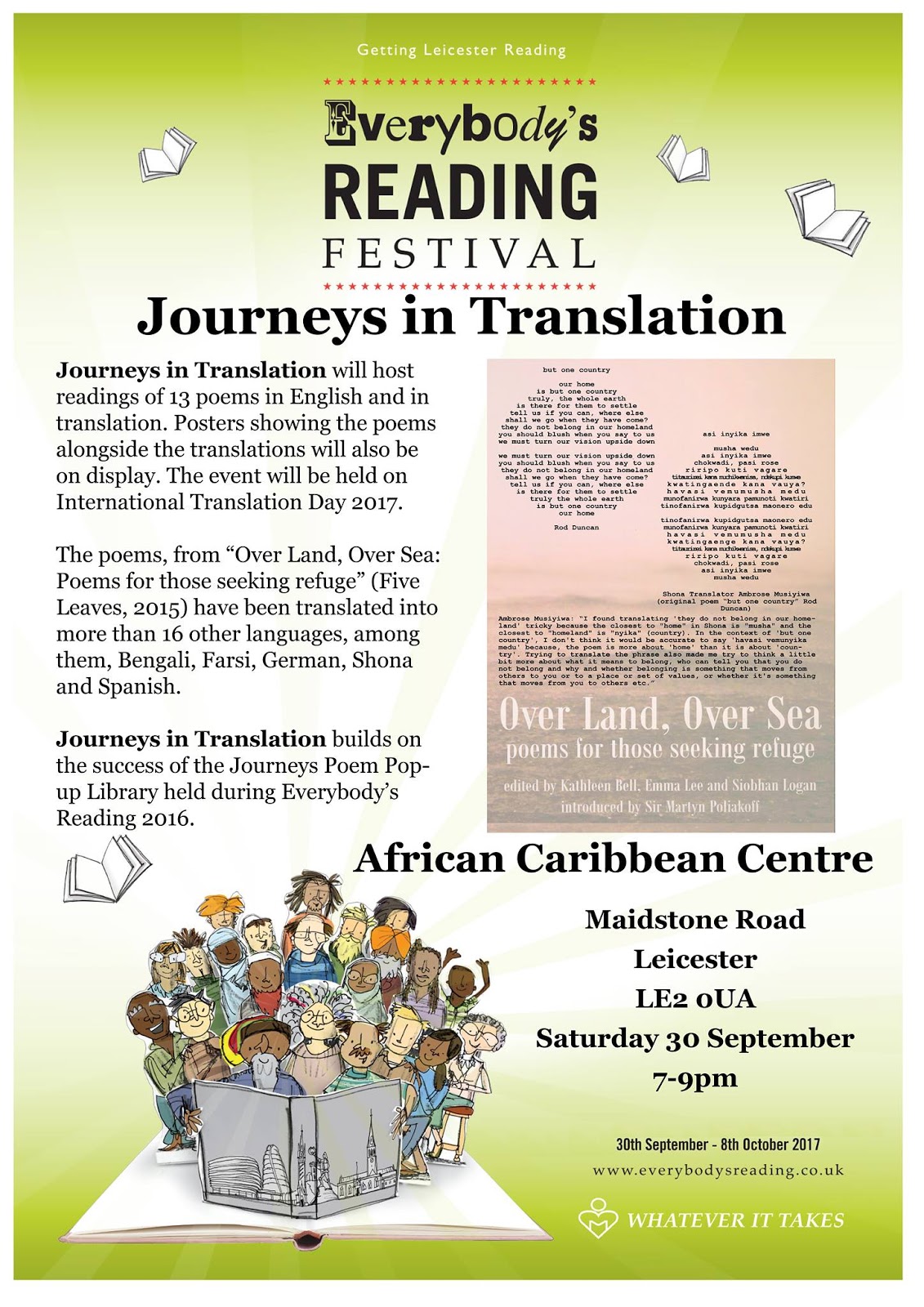
In Leicester, Journeys in Translation will culminate in an event that is going to be held on September 30 as part of Everybody's Reading 2017. During the event the original poems and translations will be read, discussed and displayed.

Over Land, Over Sea: Poems for Those Seeking Refuge (Five Leaves Publications, 2015) was edited by Kathleen Bell, Emma Lee and Siobhan Logan and is being sold to raise funds for Doctors Without Borders/ Médecins Sans Frontières (MSF)Leicester City of Sanctuary and the Nottingham and Nottinghamshire Refugee Forum.

Copies of the anthology are available from Five Leaves Bookshop (Nottingham).

More information on how Over Land, Over Sea came about is available here.

Saturday, June 17, 2017

Journeys in Translation — an International Translation Day and Everybody's Reading 2017 celebration

As part of events to mark International Translation Day 2017 and as part of Everybody's Reading, Journeys in Translation will be hosting an event at which 13 poems will be read in English and in translation.

Posters showing the poems alongside the translations will also be on display.

The event will be held at the African Caribbean Centre on International Translation Day which, this year, falls on Saturday, September 30.

The poems, from Over Land, Over Sea: Poems for those seeking refuge (Five Leaves Publications, 2015) have been translated into more than 16 other languages, among them, Arabic, Bengali, Chinese, Farsi, German, Hindi, Italian, Shona and Spanish.

The event is free and open to all.

If you cannot make it to the September 30 event in Leicester, you could:

  1. translate or encourage others to translate as many of the 13 poems as possible,
  2. share the translations and reflections on the translations through blogs, in letters and emails to family and friends and on social media, and/or
  3. organise a related event in your locality at which the 13 poems and translations will be read and discussed and let us know how the event goes.
Over Land, Over Sea: Poems for those seeking refuge was edited by Kathleen Bell, Emma Lee and Siobhan Logan. The anthology is being sold to raise funds for Doctors Without Borders/ Médecins Sans Frontières (MSF), Leicester City of Sanctuary and the Nottingham and Nottinghamshire Refugee Forum.

Copies of the anthology are available from Five Leaves Bookshop (Nottingham).

*See also:

[1] How Over Land, Over Sea came about
[2] Interviews with Journeys in Translation poets and translators
[3] The 13 Journeys in Translation poems:

[a] "but one country", Rod Duncan (Over Land, Over Sea: Poems for those seeking refuge, Five Leaves Publications, 2015) p.123
[b] "Children of War", Malka Al-Haddad (p.119)
[c] "Come In", Lydia Towsey (p.16)
[d] "Framed", Marilyn Ricci (p.114)
[e] "Song for Guests", Carol Leeming (p.92)
[f] "Stories from 'The Jungle'", Emma Lee (p.85)
[g] "The Humans are Coming", Siobhan Logan (p.79)
[h] "The Man Who Ran Through the Tunnel", Ambrose Musiyiwa (p.1)
[i] "Through the Lens", Liz Byfield (p.121)
[j] "Waiting", Kathy Bell (p.62)
[k] "What's in a Name", Penny Jones (p.5)
[l] "Yalla", Trevor Wright (p.94)
[m] "Dislocation", Pam Thompson (p.120)

Thursday, May 18, 2017

Leicester Libraries to host Poetry Translation Workshops during the 2017 Festival of Learning

Do you live in Leicester or Leicestershire? Can you speak more than one language? Or, are you learning another language? These free, poetry translation workshops taking place in libraries, from May 23 to May 27, are for you.


Journeys in Translation and the Leicester Library Service are holding a series of poetry translation workshops as part of the 2017 Festival of Learning.

The workshops are open to all and will suit anyone who is bilingual, multilingual or who is learning another language.

They offer participants the chance to read, discuss and look at how 13 poems from the anthology, Over Land, Over Sea: Poems for those seeking refuge (Five Leaves Publications, 2015) might be translated from English into other languages in an informal, relaxed and supportive atmosphere.

No prior translation experience is required.

The workshops will be held on:


The workshops will be delivered by Journeys in Translation coordinator, Ambrose Musiyiwa who is also the co-editor of Welcome to Leicester (Dahlia Publishing, 2016), a poetry anthology that explores what Leicester means to people who know the city well.

Ambrose Musiyiwa says:
Estimates suggest over 40% of the people in Leicester are either bilingual or multilingual. Other estimates suggest more than 100 languages are spoken in Leicester every day. 
Through translating poems, the workshops are an opportunity to celebrate the multiplicity of languages in Leicester and the richness they bring.
It will also be interesting to see what happens when a poem migrates from one language to another.
Journeys in Translation encourages people who are bilingual or multilingual or who are learning another language to have a go at translating 13 poems from Over Land, Over Sea from English into other languages and to share their translations and reflections on the exercise on blogs, in letters and emails to family and friends, on social media and at poetry and spoken word events.

The 13 poems have, so far, been translated into at least one of 17 languages that include Arabic, Bengali, British Sign Language, Chinese, Farsi, Turkish and Welsh. All 13 poems have been translated into Italian, 10 into Spanish, and 10 into German.


Journeys in Translation will culminate in an event that is going to be held on September 30 as part of Everybody's Reading 2017.

During the event the original poems and translations are going to be read and discussed. Posters showing the original poems and translations will also be on display.

Over Land, Over Sea: Poems for those seeking refuge was edited by Kathleen Bell, Emma Lee and Siobhan Logan and is being sold to raise funds for Doctors Without Borders/ Médecins Sans Frontières (MSF), Leicester City of Sanctuary and the Nottingham and Nottinghamshire Refugee Forum.

Development Librarian, Matthew Vaughan says
We were really excited to be offered these workshops as part of our Festival of Learning programme of events.

The workshops are highly relevant to both libraries and multicultural Leicester. They will appeal to anyone who speaks more than one language or who is learning another language and are not to be missed."
Notes:

[1] For more information on Journeys in Translation, contact Ambrose Musiyiwa, Email: amusiyiwa@googlemail.com

[2] The translation workshops are free and open to all. Booking advised. Participants can book a place by calling the libraries the workshops are being held at.

[3] Copies of the 13 poems will be available at the respective libraries on the respective days. Anyone interested can also join the Journeys in Translation Facebook group where the 13 poems are available for download.

[4] The Festival of Learning runs from 22 - 27 May and features a variety of events, workshops and information and learning sessions across a number of libraries and community centres.