Showing posts with label leicester. Show all posts

Saturday, May 2, 2020

Interview _ Siobhan Logan

Siobhan Logan is a storyteller and poet.

Her first collection of poems and non-fiction, Firebridge to Skyshore: A Northern Lights Journey (original plus, 2009), was sponsored by auroral scientists at the University of Leicester. It was performed at the British Science Museum, the National Space Centre and Ledbury Poetry festival.

Her second collection, Mad, Hopeless & Possible: Shackleton’s Endurance Expedition, was also published by Original Plus Press, whilst Philae’s Book of Hours was published on the European Space Agency’s website.

Logan's poetry is widely published in magazines and short stories appear in various anthologies, including Wednesday’s Child (Factor Fiction, forthcoming 2020), Leicester Writes Anthology 2017 (Dahlia Books) and Mrs Rochester’s Attic (Mantle Press 2017). In 2014, she led a WW1 writing residency for 14-18 NOW and in 2015 co-edited a Five Leaves Books anthology for refugee solidarity, Over Land, Over Sea.

She is co-director of indie publisher, Space Cat Press, who published her poetry/ non-fiction collection Desert Moonfire: The Men Who Raced to Space in 2019. When not being led astray by stories or dodging the claws of an errant ‘space cat’, Logan teaches Creative Writing at De Montfort University.

In this interview, Siobhan Logan talks about poetry, Desert Moonfire and the race to space.

How would you describe Desert Moonfire: The Men Who Raced To Space?

Desert Moonfire is a collection of poetry and non-fiction about the era when humans became a space-faring species. The narrative centres on two scientists, Sergei Korolev and Wernher von Braun, who designed the rockets that got us there. These two rivals from either side of the Iron Curtain mirrored each other’s lives in uncanny ways, as they struggled to realise their dreams of spaceflight. And it turns out to be a rather dark tale with our protagonists passing through gulags and concentration camps as well as nuclear near misses along the way.

The rocket technology was very much a product of superpower conflict, with the Cold War driving the whole Sixties space project. So that stark front cover depicting a night-time rocket launch captures the mood of Desert Moonfire’s story – both ‘chilling and exhilarating.’ However, I did also get interested in how science fiction first sparked these impossible imaginings for early space pioneers. And indeed, how scientists eventually used sci-fi films and TV shows to harness the public’s support for realising such costly and dangerous ventures.

What influences does Desert Moonfire draw on?

I’m never aware of particular influences when I write. But years of reading – non-fiction, poetry, fiction – no doubt seeped into the boggy ground that I worked over for this project. And sometimes got lost in. It took me seven years, all told. Lots of biographies and books about the Space Race. Also immersing myself in films, TV shows and other art of the period. Because this book did feel rather like writing historical fiction.

I loved going back to read the sci-fi of Jules Verne, HG Wells and others and watching obscure Russian sci-fi films as well as Hollywood B movies etc.

The book began with a sequence of poems which are imaginative re-enactments of real-life events. My friend Rod Duncan has described these as ‘non-fiction poems’. But I approach the material as a storyteller and I’ve been drawn to other poets who write in narrative form. So I think of Susan Richardson’s marvellous sequences about Arctic explorers in Creatures of the Intertidal Zone (Cinnamon Press, 2007) or Lydia Towsey’s The Venus Papers (Burning Eye Books 2015) where the goddess washes ashore in the UK as a Mediterranean migrant. Or the poems of Emma Lee who unfolds tightly compressed narratives in a single poem with great delicacy. Like Desert Moonfire, Lee often draws upon true-life histories, whether WW2 children in the Blitz or women navigating refugee camps more recently. (See The Significance of a Dress, Arachne Press 2020). So yes, I enjoy poetry collections with lots of storytelling and big thematic sweeps, whether historical, mythical or contemporary.

Why does poetry matter?

Why does any creative work matter? Perhaps the instinct to create might counter that to destroy. Or at least keep us sane.

At a time when the world seems to be in free-fall, when we are racked by political crises, a global pandemic and the accelerating crisis of climate change, stories have never been more important. They are at the heart of who we are and how we envision our future as well as our past. They transmit our values and generate the stuff of identity.

My book about the Sixties Space Race came out in 2019 just as the world was moving into a second Space Race. Many countries and companies are chasing to colonise the Moon’s South Pole and its buried supplies of water and minerals. It’s worth looking back to understand the dynamics that drove the last Space Race and ask whether we want to write a different narrative this time round.

Poems to me are stories but in a sung form. Carol Ann Duffy talks about poems singing the stuff of our lives, the everyday as well as the big life events. Like the people singing in deserted streets or calling from balconies, poems will be passed across our spaces of isolation. They remind us of the hidden music of our lives and relationships.

Which were the most difficult aspects of the work you put into Desert Moonfire?

The problematic aspects of the work always generate the most interesting material and push you to dig deep creatively. With non-fiction, it’s about doing masses of research and then compressing these large, complex narratives into a few chapters that each have their own distinct story arc. Trying to make sure the research doesn’t suffocate the narrative. So I’m using novelistic techniques to give pace and urgency to the story of two men caught up in this superpower to chase to the Moon.

For Wernher von Braun, the Prussian baron, it was always a matter of opportunism. Pitching his projects first to the Nazis and then to the American state, to win a chance at ‘the Big Time’, as he called it. But Sergei Korolev faced an ongoing struggle to survive the upheavals of Russia’s Civil war, Stalinist Purges and Soviet realpolitik.

Mostly this comes across as a very male world, as my title suggests. It’s typified by von Braun’s engineers decorating their V-2 test rockets with the logo of a naked woman astride a crescent moon. Women surfaced in sci-fi films as alien sirens or glamorous astronauts but seemed confined to the spectators’ stadium or the back office in the real space programme. The truth was more complex of course. It’s only recently that NASA’s begun to acknowledge and celebrate long-buried accounts of its female and Afro-American ‘Hidden Figures’.

The core of my narrative remains two men from either side of the Cold war locked into the machine of political conflict. But I did explore their relationships with women and wanted those voices to come through in certain poems.

The challenge with the poetry was to find a human centre, given this context of technology and global politics. While the non-fiction chapters conjure up vast social forces at work, the poems open intimate windows into the two men’s lives. They put us right there, in the immediacy of their world.

Often with poetry, it’s about finding a surprising metaphor or image that illuminates the scene. So when I was writing about Korolev sitting out the Cuban missile crisis in October 1962, I came across a brief reference to his wife Nina serving up a watermelon. What a gift that was! The whole poem "Martian Watermelon" was built around that footnote, from the red fleshy fruit to the sound of the pips. His men had been trying to launch a rocket to Mars when their launch pad was taken over by the military to ready a nuclear missile for firing.

By contrast, I’d read several accounts of the night the secret police arrested him in the Thirties but couldn’t find out what music he put on the record player while he waited for the knock on the door. That gave me freedom to invent. The spiky rhythms of a tango inspired two poems about the police harassment that dogged his career. So these unexpected details pulled me into their world and I hope that works for the reader too.

What sets the book apart from other things you’ve written? And in what way is it similar to the others

Desert Moonfire is similar to my previous collections, such as Firebridge to Skyshore: A Northern Lights Journey, in that it combines poetry and non-fiction with a strong narrative structure and touches on science, history and politics along the way.

My chapbook Mad, Hopeless & Possible: Shackleton’s Endurance Expedition told an equally dramatic story of two linked Antarctic expeditions during 1914-17 when notions of empire-building and heroism collided in devastating ways. That was another all-male adventure shaped by the somewhat toxic ideologies of the time.

Yet Desert Moonfire is a scaled-up narrative. It starts off discussing the 19th century science-fiction which inspired a generation of rocketeers and rounds off their story in the 1970s, a century later. So yes, the ambition of this book marked a shift for me. I was in no hurry with it, wanting the book to find its own form and the right publishing home too.

Where Firebridge and Mad, Hopeless & Possible both centred on journeying across wild frozen landscapes, Desert Moonfire has a biographical impulse, tracing the life journeys of two men who lived through extraordinary times.

I have noticed there’s various styles and voices here, including poems about deserts and cars and movies, shape poems inspired by rocket technology, dramatic monologues in the voice of bystanders and loved ones, poems of gulags and concentration camps as well as space modules and two lunar book enders. So hopefully something for everyone.

How did you chose a publisher for the book? Why this publisher? And what advantages or disadvantages has this presented?

For some time, I weighed up whether to tilt this book more towards the popular non-fiction market, given the expanding scale of the narrative. Or alternatively to strip it down to a poetry chapbook with a tight focus on these two men’s intertwined lives. I researched possible publishers from both angles. In the end, I decided I wanted to try something different with this book. I knew from my previous collections that there is an audience for this kind of non-fiction and poetry combination but it is a niche audience that I encountered mainly by giving talks, shows and face-to-face readings.

With the sci-fi and space science strand in Desert Moonfire, I was thinking of taking this new book to SFF conventions too.

So I decided to set up my own imprint, Space Cat Press, with an eye on further space-themed books I have on the back-burner. And I was lucky enough to embark on that as a collaboration with freelance editor Darragh Logan Davies. She is the Kaylee of our Firefly rocket and without her, we’d never have got into orbit.

Having got that far, we considered the possibility of using our press to also publish work by other writers, in the form of space-themed anthologies. In that sense, Space Cat Press is a hybrid, combining an indie-author venture with micro-publishing at the non-commercial end of small presses. It’s enabled me to structure the Desert Moonfire book in exactly the way I wanted to and I’m thrilled with the design Darragh came up with. I love the feel and look of the finished article. Plus I’ve learnt a huge amount about how book production and marketing works.

The disadvantages are it takes a lot of time and energy. That’s definitely slowing my writing progress on new projects. We did rush into the anthology rather quickly after publishing Desert Moonfire, so it’s hard to get on with marketing that whilst editing our Race to the Stars submissions. But it’s been so much fun and a real inspiration to work with stories, poems and flash fiction by other writers and watching the anthology take shape. Everything from detailed structural and copy edits to budgeting to working out the brand of the book. And soon we’ll be getting to grips with e-publishing and doing virtual launches as well. Quite the small-press adventure.

What will your next book be about? And, what else are you working on?

Well, I’ll have editors’ credits on our Space Cat anthology, (working title Race to the Stars) which should be out in e-book format by the summer of 2020.

I then have a small chapbook lined up for the SCP roster with a sequence of poems about the European Space Agency’s Rosetta mission to chase a comet. An earlier digital version of this, Philae’s Book of Hours, appeared on the ESA website in 2015.

There’s another sprawling non-fiction book on the back-burner about those Space Race sci-fi films I got so engrossed with whilst researching Desert Moonfire. But on the front burner, right now, I’ve dividing my time between a poetry chapbook about my father (who passed away recently) and a dystopian fantasy novel which will probably develop into a trilogy - if I can ever get this first book edited into a readable shape!

So in between teaching creative writing at De Montfort University and running a small press publishing outfit, there are plenty of writing projects competing for my time.

See also:

Interview _ Siobhan Logan, Conversations with Writers, February 20, 2010
Interview _ Siobhan Logan, Conversations with Writers, 4 June 2007
Interview _ Siobhan Logan, Conversations with Writers, 11 April 2007

Friday, March 27, 2020

Interview _ Emma Lee

Emma Lee was born in South Gloucestershire and now lives in Leicestershire. She is on the committee of Leicester Writers’ Club and the steering group for the Leicester Writers’ Showcase.

Her poems, short stories and articles have appeared in many anthologies and magazines. Some of her poems have been been translated into languages that include Chinese, Farsi, German, Greek, Italian, Polish, Portuguese and Romanian.

Emma Lee co-edited Over Land, Over Sea: Poems for those seeking refuge (Five Leaves Publications, 2015) and Welcome to Leicester (Dahlia Publishing, 2016). She has four poetry collections, The Significance of a Dress (Arachne Press, 2020), Ghosts in the Desert (Indigo Dreams Publishing, 2015), Mimicking a Snowdrop (Thynks, 2014) and Yellow Torchlight and the Blues (Original Plus, 2004).

Her latest collection, The Significance of A Dress, has been described as "Poems informed by, and immersed in politics. Whether investigating the lives of refugees, families or women in crisis, everything has a significance beyond the surface. Beautiful, hair-raising words and form, utterly from the heart."

In this interview, Emma Lee talks about poetry and The Significance of A Dress.

How long did it take you to put the collection together?

The Significance of a Dress started back in 2015 when I was involved in co-editing Over Land, Over Sea: Poems for those seeking refuge (Five Leaves Publications, 2015), an anthology to raise awareness of the plight of refugees and raise funds for refugee charities.

After the anthology's publication, I was involved in the Journeys Poems Pop-up Library where postcards of some of the poems were distributed at Leicester Railway Station during Everybody's Reading 2016. In 2017, the start of Everybody's Reading coincided with International Translation Day so I organised an event where 13 of the poems from Over Land, Over Sea: Poems for those seeking refuge were read in their original English and one translation. In turn this led to my setting up Journeys in Translation.

By 2018 I had a collection of refugee-themed poems but hadn't really thought about getting them published as a collection although individual poems had been published in magazines and anthologies.

How did you chose a publisher for the collection? Why this publisher? And, what advantages or disadvantages has this presented?

Arachne Press put a call out for submissions for an anthology in 2018. Arachne like to publish a group of poems by each poet rather than just have one or two poems by each. I submitted some of my refugee poems.

Arachne Press got back and said they didn't want to put my poems in their anthology but were interested in a single author collection. The only sensible response to that request was to ask how many poems they wanted and The Significance of a Dress was born.

I'd been published in some of the anthologies Arachne had produced previously so I knew I was working with a committed, caring publisher.

The disadvantages so far have not been with the publisher but with the Covid-19 pandemic. I was due to hold a Leicester launch on 11 March but the venue was pulled with less than 24 hours' notice. Fortunately I found another and a launch still went ahead on 14 March. However, most poetry books are sold at readings and book fairs and those are all on hold for now.

Who is your target audience?

Anyone with an interest in the themes explored within.

Why does poetry matter?

It's difficult to reduce it to a soundbite. Jean-Claude Juncker said poetry doesn't matter and the focus should be on people's first needs, shelter and food. But that's a very reductive way of looking at humans. Maya Angelou spoke of there being no greater violence than an untold story within you. But refugees aren't always able to tell their stories and, for some, not telling their stories is more important than triggering their trauma by repeating stories. So poetry becomes a way of bearing witness, exploring those stories and raising awareness. Poetry's brevity and structure offer a way of processing strong emotions; we turn to poetry in times of hardship and in times of joy.

With (or in) the collection, what would you say are your main concerns? How do you deal with these concerns?

Themes emerge not only of refugees but violence done to, for example, women, through discrimination and dehumanisation. Through my poems I try to humanise those who have been rendered voiceless.

What influences does The Significance of a Dress draw on? 

I don't think there were any specific influences in The Significance of a Dress. I read and review widely so no doubt readers might pick up influences I wasn't aware of. I do try and indicate positives, even in traumatic subjects, such as those small acts of kindness that can make a huge difference.

Which aspects of the work you put into the book did you find most difficult?

I didn't conceive of the poems within The Significance of a Dress as a book until Arachne invited me to put a collection together. I was conscious that the main themes would make for hard reading so endeavoured to put in some lighter moments, such as a poem about playing a piano on College Green ("How Rapunzel Ends") or a bank teller struggling to spell a surname ("When Your Name's Not Smith" and the transformative power of music ("Put a Spell on those February Blues").

Which aspects of the work did you enjoy most?

The lack of pressure: because I wasn't selecting sample poems and sending them off to a publisher in the hope they'd consider a collection, the process of selecting and shaping The Significance of a Dress was done when I knew a publisher was interested.

What sets the book apart from other things you've written?

My first collection Yellow Torchlight and the Blues was hugely inspired by my time as a music reviewer. My second Mimicking a Snowdrop drew on a poet's autobiography and aspects of her life, particularly during the Second World War when she used her nurse's training to be a first responder and did voluntary work in a disadvantaged children's playgroup. My third Ghosts in the Desert features a lot of ghosts and contains a sequence about The Matrix.

So, the topics and issues explored in The Significance of a Dress are very different. It's also the first of my books to feature one of my embroideries on the cover.

In what way is it similar to the others?

I think some topics link all four collections, discrimination, feeling like an outsider, explorations of whose voices don't get heard and why that might be.

What will your next book be about?

No idea. I'm always writing poems, stories, reviews, articles so I don't think in terms of focusing on a next book. I keep writing and when I seem to have a body of work, I start arranging poems by theme and see what emerges.

What else are you working on?

I'm now reviews editor for The Blue Nib and still reviewing for other magazines. I have a couple of short stories to edit and am still writing individual poems, one based on Bruce Springsteen's explanation of why he doesn't like wind chimes.

See also:

● Interview _ Emma Lee, Conversations with Writers, 19 April 2017
● Interview _ Emma Lee, Conversations with Writers, 27 April 2007

Friday, June 7, 2019

East Midlands Poetry Library

The East Midlands Poetry Library is coming soon.

Coordinated by groups and individuals that include CivicLeicesterConversations with Writers and others, The Library will be like the National Poetry Library but based in Leicester in the UK.

The Library will have a particular bias towards poets and poetry from or on or inspired by the East Midlands.

What you can do:

● If you have any suggestions on how we can make the library happen or if you have ideas on what the library can become, please email: The Librarian.

● If you are you a poet, a publisher or a poetry events organiser based in the East Midlands, please get in touch, say hello, give us a wave.

● If you would like to be featured as part of The Library, please answer the questions found here and send your responses to us. (We will feature your responses on Conversations with Writers initially, and include the responses in East Midlands Poetry Library materials once The Library is up and running.)

Monday, October 1, 2018

Superheroes of Leicester

River Monster of Leicester
Superheroes of Leicester encourages people to imagine Leicester as home to a cast of superheroes.

Cities around the world that are similarly home to superheroes include Lagos, which is home to crimefighter, Abolaji Coker; Tokyo, Japan, which is home to the Super Young Team and Big Science Action; and, Boston, Massachusetts, which is the former home base of Wonder Woman, and the occasional residence of Aquaman and his wife Mera. (Massachusetts is also interesting because there's a place called Leicester in Massachusetts as well.)

Leicester, England where the Superheroes of Leicester will be from currently has two known monsters: the Dragon of Habitat Loss, which we first heard about at the St George's Festival Fringe that was held in the city in April 2018, and the River Monster which was discovered in the city in August 2018.

Superheroes of Leicester, the project will facilitate or bring out a graphic novel or comic book or series of such books imagining Leicester as a City of Superheroes.

If the project leads to books, the first books in the series could be published in 2019/20 by CivicLeicester, who have just given us Leicester 2084 AD: New poems about the city, a poetry anthology that encourages people to imagine what the city will be like in the year 2084, how it will get there and what it will mean to its citizens, residents and the rest of the world.

Expressions of interest in Superheroes of Leicester can be emailed to CivicLeicester@gmail.com

Notes:

i. Spotted on 25 August 2018, in Abbey Park, the River Monster is made from plastic waste dumped in the River Soar.
ii. For ideas on how to protect the environment, like and follow Leicester Friends of the Earth and the Canal & River Trust.
iii. See also: Red Leicester Choir's "Pointless Packaging".


Monday, March 19, 2018

Interview _ Bobba Cass

Bobba Cass grew up in the United States and was in the Peace Corps in Nigeria in the 1960s.

An academic whose advanced degrees were in English Literature and Cultural Studies, he has been an activist in struggles against apartheid, racism in schools, nuclear weapons and nuclear energy.

He organises Pinggg…K! a poetry event that meets monthly in Leicester for an evening of metrosexual open mic verse and a performance by a featured poet.

He came out in his late 40s following a police entrapment arrest.

In this interview,* Bobba Cass talks about the work he is doing.

You are often described as a literary activist. What forms does this activism take? And, how has it been received?

When I began coming out in the late 1980's and I experienced and welcomed the gentleness of other men, I began what I can only describe as 'hearing' a poetry which, in its intensity, was much more open about sensuality and sexuality than was then being published (much of this has changed today with poets being recognised for their intensity of detail, especially openly gay poets). I theorised this as metasexual verse.

After I retired from university lecturing in 2003, I got involved in open mic poetry events in Leicester. I noticed that there were no poets other than myself at that time (2006) who were speaking their sexuality. I began my performances with, Hi. I'm Bobba Cass, a gay grey poet.

I wanted to have an open mic poetry event that was personal and safe enough for those struggling with and exploring their sexuality, to be more direct. In 2011, I began Pinggg...K! which advertised itself as celebrating 'metrosexual verse' (the term, metrosexual based on Rikki Beadle-Blair's television soap, 'Metrosexuality'). Pinggg…K! is now in its seventh year and has seen a growing number of poets of all ages, genders, ethnicities, social backgrounds and mental and physical challenges, come forward and share their sexualities in monthly events, and this has in turn impacted on the wider poetry communities in Leicester.

In addition to Pinggg...K! events I have organised larger events that have brought together Leicester people from many backgrounds. I love Leicester, and am an advocate for its inclusivity. Although I set out here what I have done, there are many others who have been crucial to the growth that has taken place.

To celebrate five years of Pinggg…K! you published a limited edition book, four and twenty. How did the book come about?

Each month there had been a call and response couplet that worked humour out of the relationship of blackbird to earthworm, a humour that was free of the attitudes towards women, working people, black people, the disabled, the LGBT communities so often found at poetry events, especially those in pubs.

From the ranks of Pinggg...K! attenders (women and men, black and white, young and old, gay and straight, physically challenged and not, working class background and middle class, international and English), cartoons were produced to give visual energy to twenty of these couplets. And also four of the blackbird / earthworm genre best poems were included hence the four and twenty title of blackbird nursery rhyme fame.

four and twenty is a brief volume but encapsulates an activist energy that is evident in Leicester at its best.

I have occasional verse in other publications such as Welcome to Leicester (Dahlia Publishing, 2016), and several poems that can be seen and heard online. These internet poems I treasure because they are there as the result of other poet activists who have taken the time to record and post them in the ether.

When did you start writing?

Although I see myself mainly as a performer, especially as a poet, I have also written two novels, and they are part of a sequence which I hope one day will be published, especially in the Pacific Northwest of the United States where I grew up.

I am 78 years of age.  I began writing as a child in school, especially poetry. The greatest energy for writing came when I began coming out as a gay man in my late 40s.

My poetry, in its passion, is very sporadic and instantaneous - I am hearing phrases and responding to feelings and reflections. My novel writing is shaped by my interest in readability, something that can be enjoyed in a day for some or a week for others. The novels are no longer than 10 chapters.

I have lived in Leicester now most of my life. My poetry as performance has come about through the vitality of spoken word events in our city. My novels imagine more the audiences of my upbringing and experiences, for instance, living in Nigeria for four years in the 1960s and residing in countries different from that of my birth as well as where I grew up in Seattle. Thomas Wolfe wrote You Can’t Go Home Again. Once we begin to hear ourselves, the stories we tell, as if from different paths in life and different places of disposition, we struggle to find a joy. When that joy is found it fills our hearts with wanting to share it with others.

Which authors influenced you most?

Emily Dickinson and William Shakespeare are key influences on my poetry - Dickinson because of her brevity and intensity, Shakespeare because of his sonnets. The novels of Thornton Wilder (Bridge of San Luis Ray) and Laura Ingalls Wilder (House on the Prairie sequence) are paradigmatic.

What are the biggest challenges that you face? And, how do you deal with them?

I had been longing for someone who would love me and allow me to love them for a long time - desperate for that. By chance such a person has come into my life. There is a huge challenge around this commitment. I am still growing within myself.

I was on the stage as a child and that has informed my energy around performance. I had a mental breakdown at the end of my four years in Nigeria. I came out after 20 years of marriage and raising three sons. I have been an activist around peace, environmental, race and gender issues. These experiences have been formative.

I feel most passionate about wanting young people to have experiences in their lives that take them beyond their childhood environments so that they can sense what others lives might be like. I would like everyone to have some part of their childhood sheltered / regaled by the unconditional love of an elder close to them. For example, my grandmother lived with us when I was a child. Her love for me saw me through the most difficult moments of my early adult life when I had what was then called 'a mental breakdown'. I always hope that there will be someone like my grandmother, in everyone's life.

Do you write everyday?

The poetry is spontaneous. It happens in moments. The novels I set out to do and they are written within three to four months and then revised many times.

I am preparing to write my third novel, Nigeria! Nigeria! I was in Nigeria at the time of Biafra. I lived where the war first broke out.

This particular book will draw heavily on the letters I wrote home at the time, and will be epistolary. The underlying narrative will be an expansion of the life of a character, Donny, in the first two novels, and one of his friends.

Which are the most difficult aspects of the work you do?

With the poetry, the forms have been most various, and have required a lot of reworking in some instances. All of the poems are memorised and that by way of reworking. With the novels, the diction and dialogue have required many revisions. As with the poetry, I find hearing the writing aloud crucial.

Which aspects of the work do you enjoy most?

For the poetry, recalling particular moments that have an integrity in emotional relationships gives me a vitality and sense of achievement. For the novels realising conjunctions in the relationships of the characters that go beyond initial imaginings always seems miraculous.

What would you say has been your most significant achievement as a writer and as a literary activist?

For the poetry, my greatest of achievement has been the interaction with other writers in Leicester, and my part in bringing this about. For the novels, I hope that my persistence in working on the narratives over a long period of time in my late adult life will be regarded as a big achievement.

My greatest joy as a literary activist is the shared experience of celebration. To me this is live. It is spontaneous. It is what we can all bring to an event. It is primarily spoken. We attempt to capture it in words. And that is a great challenge. But the greater challenge is allowing ourselves to be wise in each other.

Oscar Frank is one of our spoken word community – a wonderful oral tradition poet. One afternoon as I was rushing to get a train to Nottingham, Oscar saw me near the train station. He was eating from a cob, but he had to say to me what was uppermost in his mind, “Time is longer than a rope, Bobba. Time is longer than a rope!” That night, in recollection, the meaning and this poem was in my heart. (‘Farrels’ is my word for the muscles either side of the urethra in the phallus):

for Oscar

time is longer than the rope
that farrels through our dreams
that wrinkles with a bartered hope
that lithes with peril beams

when that ourselves eventuates
to dust galactic streams
the time that was
more likely still
a carnal apple gleams


*This interview was first published in the magazine, Great Central, in March 2017

Wednesday, December 13, 2017

Leicester and Leicestershire look at how to raise profile of literature and literary scene

Individuals and groups that have an interest in the literary activity that takes place in Leicester and Leicestershire are meeting to look at what can be done to raise the profile of the scene locally, nationally and internationally.

The meeting is free and open to all and is taking place at the Bishop Street Methodist Church, 10a Bishop Street, on 13 December 2017, in Leicester, from 6.30pm till 9.30pm.

Speaking at the event are:

Henderson Mullin, Chief Executive Officer, Writing East Midlands (WEM)
James Urquhart, Relationship Manager for Literature in the Midlands, Arts Council England
Cllr Sarah Russell, Deputy City Mayor with responsibilities for Children, Young People's Services, Leicester City Council
Farhana Shaikh, Dahlia Publishing / Leicester Writes Short Story Prize / The Asian Writer
Matthew Pegg, Mantle Arts / Mantle Lane Press
Emma Lee, President, Leicester Writers Club; and
Bobba Cass, Pinggg...k!

The event is being hosted by the Leicester Writers' Showcase, and will be chaired by Attenborough Arts Centre director, Michaela Butter MBE.

The speakers will give the view they have of the literary scene in Leicester and Leicestershire and what they think can or ought to be done to raise the profile of the scene. They will also take part in a discussion and Question and Answer session with those present.

In addition to the presentations, there will be a display of books by local writers as well.

Leicester Librarian Matthew Vaughan says, "The Leicester Writers’ Showcase started in January 2017 and hosts a literary event once a month at the Central Library on Bishop Street.

"The Showcase aims to create space for conversations between readers, writers, spoken word artists, publishers, booksellers, and venues.

"The event we are hosting at the Bishop Street Methodist Church is part of the conversation people in the city and county need to have about the literary activity that takes place here and what can be done to increase its visibility."

Events that have been held as part of the Leicester Writers’ Showcase include launch-style events; readings, talks, and Q&A sessions; as well as, the Leicester and Leicestershire Writers’ Fair that was held during Everybody’s Reading 2017 and which is going to become a regular feature of the literary scene in Leicester.

Other Showcase plans include a Local Writers' Corner featuring books by local writers and which will be hosted by the Leicester Central Library.

About the speakers

Bobba Cass is a gay grey poet born in Seattle, Washington, USA but living in Leicester / Leicestershire since 1973. He organises a monthly poetry event, Pinggg…K! which celebrates the metrosexuality of verse. He is a member of Peoples Arts Collective. He is currently working on a series of fables for children, from Gramps with Love.

Bobba Cass will read from poetry and fables that draw on his life on three continents and on his experiences as an events organiser and grandad.

Emma Lee is President of Leicester Writers' Club. Her most recent poetry collection is Ghosts in the Desert (IDP, 2015). She co-edited Over Land, Over Sea: poems for those seeking refuge (Five Leaves, 2015) and Welcome to Leicester (Dahlia Publishing, 2016). Emma Lee blogs at http://emmalee1.wordpress.com. She reviews for The High Window Journal, The Journal, London Grip and Sabotage Reviews and has been shortlisted for the Best Reviewer Saboteur Award.

Emma will share insights from the Leicester Writers' Club which meets every Thursday at Phoenix Square in the heart of Leicester's Cultural Quarter. The Club is for professional and semi-professional writers and includes novelists, poets, short story writers, non-fiction writers, children's writers and scriptwriters. Members are both widely published and award-winners. The Club provides constructive criticism on work in progress, visiting industry speakers, social events, advanced masterclasses and a writers' retreat.

Farhana Shaikh is a writer and publisher born in Leicester. She edits The Asian Writer, an online magazine championing Asian literature and runs the small press, Dahlia Publishing which publishes regional and diverse writing. Farhana hosts the popular Writers Meet Up Leicester as well as Leicester Writes Festival of New Writing. In 2017, she won Travelex & Penguin’s The Next Great Travel Writer competition and is currently part of Curve’s Cultural Leadership programme.

Drawing on her experience as a writer, editor, publisher and events organiser, Farhana will give the view she has of the literary scene in Leicester and the region and suggest what can be done to raise the profile of the scene.

Matthew Pegg is Director of Mantle Arts, a participatory arts organisation based in Coalville, Leicestershire. He is also a published writer, playwright and graphic designer. Matthew will share insights from Mantle which, since 2015, has been running Red Lighthouse, a creative writing programme focused on publishing, development opportunities for Midlands writers and community projects.

Mantle also runs a writer development programme for authors interested in writing for children and young adults which includes the Wolves and Apples biannual conference on writing for children and a series of master classes on aspects of writing for the young. The next one of which is in March 2018.

In addition to that, Mantle Arts runs community projects that include playwriting projects in schools, song writing in care homes and a community audio drama about William Wordsworth’s time living in Leicestershire. Mantle Lane Press, Mantle’s publishing arm, issues a series of small books by Midlands writers, fiction anthologies and factual and historical books with a Midlands connection.

Cllr Sarah Russell is Deputy City Mayor with responsibilities for Children, Young People's Services, Leicester City Council. She has been a Councillor for 10 years and part of the City’s Executive team for the last 8 years. Throughout that time, Cllr Russell has been a passionate supporter of the Libraries Service and has taken every opportunity to promote books and reading. Despite no longer having responsibility for Library Services, Cllr Russell has continued to be the Reading Champion for the City Council and seeks to work with schools, young people and communities to promote reading (and writing) for pleasure as well as for formal means.

Henderson Mullin is Chief Executive Officer of Writing East Midlands which delivers writing-based projects and skills development opportunities across the region. Before setting up WEM in 2008, he ran Index on Censorship, a campaigning publisher which supports of freedom of expression. Henderson has worked in the arts sector for over 20 years and has sat on the Boards of several organisations including Writers and Scholars International, Free Word Centre, Human Rights House Foundation Oslo, Open Word FM, New Arts Exchange, FLUPP Literature Festival (Rio), Nottingham Literature Festival, and Nottingham UNESCO City of Literature, and the mighty Loughborough Foxes Women and Girls Football Club.

Henderson will be talking about what is happening on a regional and strategic level elsewhere and how WEM might support a process of developing the profile of Leicester’s writing and writers going forward.

James Urquhart is the Relationship Manager for Literature in the Midlands for Arts Council England. After 15 years as a freelance literary critic, regularly published in a range of UK broadsheets, James joined Arts Council England in 2010. His role as Relationship Manager includes offering development and funding advice and monitoring Arts Council England investments in literature projects and organisations.

James will give the view he has of the Leicester/shire literary scene and future possibilities. He will also talk about the Arts Council’s funding programme, Grants for Arts and Culture (formerly known as Grants for the Arts), which is open to writers, artists and organisations.

About the Chair

Michaela Butter MBE has over 30 years of experience working in the arts as a curator, promoter and funder. Currently Director of Attenborough Arts Centre, the University of Leicester's arts centre, she is responsible for developing an inclusive approach to a growing public programme of performing and visual arts, with a strong emphasis on supporting emerging talent, creative learning and community engagement. She also plays a growing role in wider cultural policy at the University of Leicester and beyond.

*See also:

1. Leicester & Leicestershire: City and County of Literature, Eventbrite listing
2. Grassroutes: Contemporary Leicestershire Writing, University of Leicester
3. Cultural Exchanges Festival, De Montfort University Leicester (DMU)
4. Ross Bradshaw, "States of Independence", 17 March 2012 (Video)

Saturday, September 23, 2017

Nottingham poet & British Sign Language translator to take part in Int. Translation Day event

Elvire Roberts, a poet and British Sign Language translator and interpreter from Nottingham will be taking part in Journeys in Translation, an event that is being held at the African Caribbean Centre in Maidstone Road, Leicester on September 30, to mark International Translation Day 2017.

The event is being held as part of Everybody's Reading, Leicester's nine-day festival of reading.

As part of the event, Elvire Roberts will translate two poems, Pam Thompson's "Dislocation" and Trevor Wright's "Yalla", from English into British Sign Language.

International Translation Day is held around the world annually on 30 September.

For the Journeys in Translation, 13 poems were selected from Over Land, Over Sea: Poems for those seeking refuge, a poetry anthology published in 2015 by Nottingham's Five Leaves Publications.

The poems have since been translated into more than 20 languages.

The poems are also being 'translated' in other ways as well. For example, one of the poems, "Yalla" has been treated to a Contemporary Music for All (CoMA East Midlands) musical conceptualisation, and, two visual artists are currently working on visual responses or illustrations to the poems.


The poems and at least one translation of each will be performed at the Journeys in Translation event in Leicester on September 30.

Posters of the poems and translations will also be on display at the event.

Elvire Roberts says,
Translating poetry from English into British Sign Language is the ultimate challenge because the two languages work differently and have a completely different structure.

It was a delight to be able to talk to the Over Land, Over Sea poets Pam Thompson and Trevor Wright, check my understanding with them, and ask about intended effects.

With Pam’s poem, I knew immediately how the handshapes would work, that repetition and rhythm were particularly important, as well as keeping the vocabulary true to the original. With Trevor’s poem I needed to hear about the pictures he saw in his mind’s eye so that I could re-create them in British Sign Language's inherent filmic mode.
Elvire Roberts and Trevor Wright at the Quiet Riot disability Poetry event that was held on 21 April 2017 as part of the Nottingham Poetry Festival which was also the first outing of the British Sign Language translation of "Yalla".

Project coordinator, Ambrose Musiyiwa says,
Journeys in Translation aims to facilitate cross- and inter-cultural conversation around themes of home, belonging and refuge. It encourages speakers, learners and teachers of other languages to translate or encourage others to translate as many of the 13 poems as possible and to share the translations and reflections on the translations through blogs, in letters and emails to family and friends, on social media, and elsewhere.

The initiative also encourages people, as individuals or communities, to organise related events in their localities. The events could be translation workshops or sessions at which the 13 poems and translations are read and discussed.

Over Land, Over Sea: Poems for those seeking refuge was edited by Kathy Bell, Emma Lee and Siobhan Logan and is being sold to raise funds for Doctors Without Borders/ Médecins Sans Frontières (MSF), Leicester City of Sanctuary and the Nottingham and Nottinghamshire Refugee Forum.

So far, the anthology has raised about £3,000 for the three charities.

Five Leaves Publications director, Ross Bradshaw says,
In 2015, towards the end of summer, a group of East Midlands writers started discussing the refugee crisis.

The outcome was Over Land, Over Sea, which brings together poems and short fiction from 80 writers from around the world all of whom, through the anthology, respond to people who are seeking refuge, the journeys they are making and how they are being received in Europe and in countries like Britain.

Some of the contributors to the anthology are well-known or are at the start of their career. Some are refugees or from other migrant families, others have campaigned or raised funds for refugees in the past.

Journeys in Translation builds on Over Land, Over Sea and, like the anthology on which it is based, encourages people to look closely at language and images and the effect these have on how we treat people who are looking for refuge. It is good to see there are people in villages, towns and cities in Britain and around the world simultaneously working on the translations.
Editor's Note:

Journeys in Translation aims to facilitate cross- and inter-cultural conversations around the themes of home, belonging and refuge.

The project encourages people who are bilingual or multilingual to have a go at translating 13 of the 101 poems from Over Land, Over Sea: Poems for those seeking refuge (Five Leaves Publications, 2015) from English into other languages and to share the translations, and reflections on the exercise on blogs, in letters and emails to family and friends, and on social media.

So far, the 13 poems that are being used as part of the project have been translated into languages that include Italian, German, Shona, Spanish, Bengali, British Sign Language, Farsi, Finnish, French, Turkish and Welsh. 


Copies of the anthology are available from Five Leaves Bookshop (Nottingham).


More information on how Over Land, Over Sea came about is available here.

Saturday, September 16, 2017

Derby poet to take part in Leicester International Translation Day celebration

Derby poet, Trevor Wright will be taking part in Journeys in Translation, an event that takes place at the African Caribbean Centre in Maidstone Road, Leicester, LE2 0UA, on 30 September from 7pm onwards, to mark International Translation Day 2017.

The event is being held as part of Everybody's Reading, Leicester's annual nine-day festival of reading.

For Journeys in Translation, 13 poems were selected from Over Land, Over Sea: Poems for those seeking refuge, a poetry anthology published in 2015 by Nottingham's Five Leaves Publications. The poems were then translated into over 20 other languages.

The poems and at least one translation of each will be performed at the Journeys in Translation event in Leicester on September 30.

Posters of the poems and translations will also be on display at the event.

As part of event, Trevor Wright will be reading his poem, "Yalla", accompanied by British Sign Language interpreter and translator, Elvire Roberts.

Trevor Wright says,
I centred “Yalla" on one person who was in transit and had lost all but one of their family.

The poem came to me when I was on holiday watching kids playing in small plastic boats from the beach and walked back into the holiday let to see, on TV, people in large and precarious plastic boats on the Mediterranean. Stories about people losing whole families began to filter through.

With "Yalla", I also wanted to mark the resilience and hope that carried people on, a hope and resilience that, I have to say, we don't honour enough.
Trevor Wright works part-time in social care and is co-director of InSight, a community interest company that provides autism awareness training. His first poetry collection, Outsider Heart, was published by Nottingham's Big White Shed in November 2016.

Trevor Wright and Elvire Roberts at the Quiet Riot disability Poetry event that was held on 21 April 2017 as part of the Nottingham Poetry Festival which was also the first outing of the British Sign Language translation of "Yalla".

Project coordinator, Ambrose Musiyiwa says,
Journeys in Translation aims to facilitate cross- and inter-cultural conversation around themes of home, belonging and refuge.

It encourages speakers, learners and teachers of other languages to translate or encourage others to translate as many of the 13 poems as possible and to share the translations and reflections on the translations through blogs, in letters and emails to family and friends, on social media, and elsewhere.

The initiative also encourages people, as individuals or communities, to organise related events in their localities. The events could be translation workshops or sessions at which the 13 poems and translations are read and discussed.
Over Land, Over Sea was edited by Kathleen Bell, Emma Lee and Siobhan Logan and is being sold to raise funds for Doctors Without Borders/ Médecins Sans Frontières (MSF), Leicester City of Sanctuary and the Nottingham and Nottinghamshire Refugee Forum.

So far, the anthology has raised about £3,000 for the three charities.

Trevor Wright's poem, "Yalla", Over Land, Over Sea: Poems for those seeking refuge (Five Leaves Publications, 2015) p. 94. Translated into Farsi by Mina Minnai.

Five Leaves Publications director, Ross Bradshaw says,
In 2015, towards the end of summer, a group of East Midlands writers started discussing the refugee crisis. The outcome was Over Land, Over Sea, which brings together poems and short fiction from 80 writers from around the world all of whom, through the anthology, respond to people who are seeking refuge, the journeys they are making and how they are being received in Europe and in countries like Britain.

Some of the contributors to the anthology are well-known or are at the start of their career. Some are refugees or from other migrant families, others have campaigned or raised funds for refugees in the past.

Journeys in Translation builds on Over Land, Over Sea and, like the anthology on which it is based, encourages people to look closely at language and images and the effect these have on how we treat people who are looking for refuge.

It is good to see there are people in villages, towns and cities in Britain and around the world simultaneously working on the translations.
Editor's Note:

Journeys in Translation aims to facilitate cross- and inter-cultural conversations around the themes of home, belonging and refuge.

The project encourages people who are bilingual or multilingual to have a go at translating 13 of the 101 poems from Over Land, Over Sea: Poems for those seeking refuge (Five Leaves Publications, 2015) from English into other languages and to share the translations, and reflections on the exercise on blogs, in letters and emails to family and friends, and on social media.

So far, the 13 poems that are being used as part of the project have been translated into languages that include Italian, German, Shona, Spanish, Bengali, British Sign Language, Farsi, Finnish, French, Turkish and Welsh. 


Copies of the anthology are available from Five Leaves Bookshop (Nottingham).


More information on how Over Land, Over Sea came about is available here.

Saturday, June 17, 2017

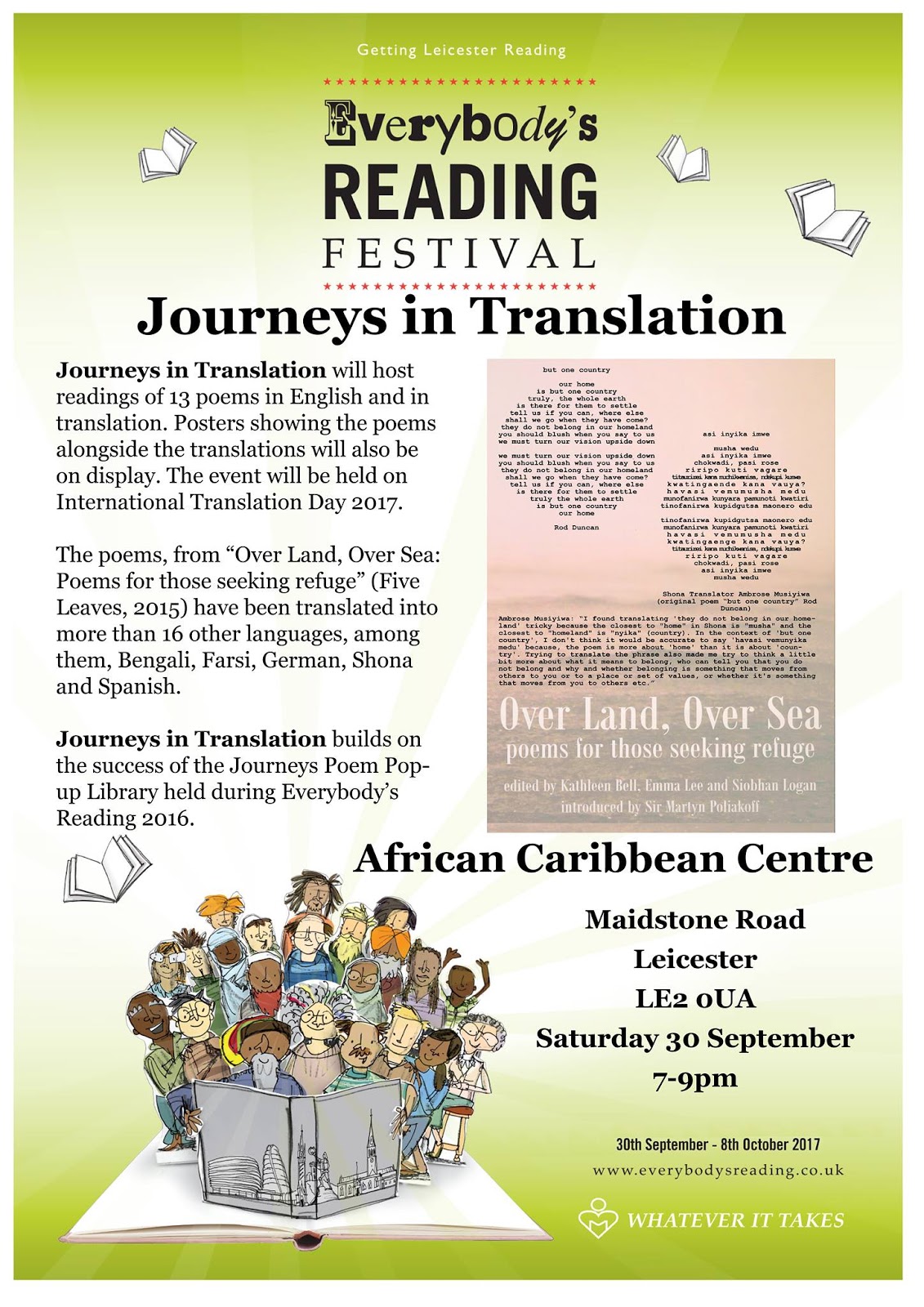
Journeys in Translation — an International Translation Day and Everybody's Reading 2017 celebration

As part of events to mark International Translation Day 2017 and as part of Everybody's Reading, Journeys in Translation will be hosting an event at which 13 poems will be read in English and in translation.

Posters showing the poems alongside the translations will also be on display.

The event will be held at the African Caribbean Centre on International Translation Day which, this year, falls on Saturday, September 30.

The poems, from Over Land, Over Sea: Poems for those seeking refuge (Five Leaves Publications, 2015) have been translated into more than 16 other languages, among them, Arabic, Bengali, Chinese, Farsi, German, Hindi, Italian, Shona and Spanish.

The event is free and open to all.

If you cannot make it to the September 30 event in Leicester, you could:

  1. translate or encourage others to translate as many of the 13 poems as possible,
  2. share the translations and reflections on the translations through blogs, in letters and emails to family and friends and on social media, and/or
  3. organise a related event in your locality at which the 13 poems and translations will be read and discussed and let us know how the event goes.
Over Land, Over Sea: Poems for those seeking refuge was edited by Kathleen Bell, Emma Lee and Siobhan Logan. The anthology is being sold to raise funds for Doctors Without Borders/ Médecins Sans Frontières (MSF), Leicester City of Sanctuary and the Nottingham and Nottinghamshire Refugee Forum.

Copies of the anthology are available from Five Leaves Bookshop (Nottingham).

*See also:

[1] How Over Land, Over Sea came about
[2] Interviews with Journeys in Translation poets and translators
[3] The 13 Journeys in Translation poems:

[a] "but one country", Rod Duncan (Over Land, Over Sea: Poems for those seeking refuge, Five Leaves Publications, 2015) p.123
[b] "Children of War", Malka Al-Haddad (p.119)
[c] "Come In", Lydia Towsey (p.16)
[d] "Framed", Marilyn Ricci (p.114)
[e] "Song for Guests", Carol Leeming (p.92)
[f] "Stories from 'The Jungle'", Emma Lee (p.85)
[g] "The Humans are Coming", Siobhan Logan (p.79)
[h] "The Man Who Ran Through the Tunnel", Ambrose Musiyiwa (p.1)
[i] "Through the Lens", Liz Byfield (p.121)
[j] "Waiting", Kathy Bell (p.62)
[k] "What's in a Name", Penny Jones (p.5)
[l] "Yalla", Trevor Wright (p.94)
[m] "Dislocation", Pam Thompson (p.120)

Sunday, May 21, 2017

Interview _ Grant Denkinson

Grant Denkinson is an Open Access and Research Data Advisor at the University of Leicester's David Wilson Library. He is also a qualified psychotherapist and is one of the contributors to Purple Prose (Thorntree Press LLC, 2016), a new book about bisexuality in Britain.

In this interview, Denkinson talks about writing, sexuality and Purple Prose:

How would you describe Purple Prose?

Purple Prose presents different forms of writing about various aspects of being bisexual, such as being a bi person of faith and so on. Each chapter curates a number of personal experiences, collected thoughts and even tentative advice, together with quotes, cartoons and poems.

The chapter I co-curated with Juliet Kemp covers bisexuality and non-monogamy. The bi community I've been part of has been talking about how you can be bi and happily monogamous, non-monogamous in various ways, or not in relationships at all. Relationships of all kinds we could think of are spoken about in Purple Prose.

We make no argument for one shape of relationship being better than another, just that different ways to love and relate might work better for different people.

How did the book come about?

Kate Harrad decided a book about bisexuality in UK should exist and then made it happen and edited contributions from the UK bisexual community into Purple Prose.

While there has been an active bi movement in UK for many decades, there has not been a UK book by and about bisexuals since Sue George's Women and Bisexuality from 1993.

There have been some excellent academic works and some books from US. However, the UK is a significantly different context and we wanted something for everyone that speaks to personal experience rather than as part of the academic debates.

What are some of the other ways in which Purple Prose is significant?

I'd like this book to be part of making the whole world a better place since bi people are everywhere. We'll only be a small part, but we can play a part.

More specifically, there are a lot of people who, over their lives, have loved, fancied or had some form of sex with several people where those people were not all of the same gender. Many people in UK have had such thoughts or experiences. It seems important to me that there is at least one book out there that says people in this situation are not alone, which acts like a conversational prompt, which mentions aspects of the joys or stresses that they might have, and which comes from a place similar to home rather than from thousands of miles away.

I've met few bisexual people compared to how many there probably are.

Purple Prose is significant because a book can be a private experience. You don't need to be out to anyone to read a book. Books are portable and can be sent and read anywhere. Books last and are preserved in libraries and on bookshelves and can be quoted from and loaned to friends.

Also, many people know others who may be bi and who perhaps they want to understand better without needing to ask intrusive questions or treating one person's experiences as the same as many people's experiences. To gain this understanding, they can read autobiographical journals on-line and articles and news. They can listen to partners, friends and acquaintances. They can pick out films or listen to interviews on the radio or find a podcast. All these things are important but none of them offer the experience that comes from a good book on the subject.

How long did it take to the book together?

The process from conception to launch was a couple of years. Many of the writers met at events and we mainly collaborated online.

A number of UK publishers considered bisexuality too niche a subject despite recent surveys which show that around half of young people do not identify as gay or straight.

It was important to us to have the book properly produced to high quality while keeping the price aimed for the mass market. We therefore crowdfunded to cover the costs of producing the first print run of Purple Prose with Thorntree Press, a small publisher in U.S., who took the chance to expand from their speciality of books about non-monogamy.

Crowdfunding also showed us that there was a reasonably broad interest in the book.

It is wonderful to see the final version, a tangible thing that didn't exist before and can now be out there in the world to fare as it may.

I think we have a good book ... a book that is part of efforts to raise awareness around the complexity and diversity of human sexuality and which lets many voices shine and which does not reduce people to soundbites and simplistic characters.


Purple Prose 
(Thorntree Press LLC, 2016) was written for and by bisexuals in the UK.

Described as, "the first of its kind", Purple Prose: Bisexuality in Britain features interviews, essays, poems and commentary on topics that include definitions of bisexuality, intersections of bisexuality with other identities, stereotypes and biphobia, being bisexual at work, teenage bisexuality, bisexuality through the years, the media's approach to bisexual celebrities, and fictional bisexual characters. 


Which were the most difficult aspects of the work you put into the book?

The bi community I know has been good at accepting and talking about various aspects of complicated, diverse and sometimes fluid human sexuality including how gender or disability intersect with lives, what options for relationship shapes we might consider, and the emotional and physical feelings related to various bodily practices related to BDSM.

We are also catching up on dealing with other parts of bi lives that include race, ethnicity and class.

Making sure we adequately gave voice to those we don't hear from enough because of racism and the like was a challenge. We never wanted to be tokenistic.

Word-of-mouth and the friend-to-friend networks we enjoy can lead us to mainly speak to people like we are personally, in similar positions in society. We wanted a broader approach.

Also, we're all pretty much volunteers on this. We have the whole rest of our lives to live and some of our community are constantly or often having to struggle more in life because of how they are disabled or because they are dealing with the consequences of prejudice.

What are some of the things from your personal experience that influence your writing?

I've been out as bisexual for about half my life and feel most at home as part of the UK and international bi communities. There I feel I can just be myself rather than feel the need to downplay any part of myself or need to keep explaining the basics of my attraction to some people who don't all share the same gender. I've tended to a high level of frustrated energy towards social progress and this has led to me community organising and volunteering often around sex, sexuality and relationships.

I was born in Nottingham in 1971 and have moved around England with work or study as well was living as a kid in Los Angeles because my parents wanted to try the place out.

I've lived in Leicester about a dozen years and love the mix of people and how much of a beacon we can be to show how positive multicultural living can be. I like how much is going on within 15 minutes bicycle ride from my house and that I will meet good people and friends at pretty much anything I go to.

I have never worked out what I want to do when I grow up. I'm into science and techie things and work these days for University of Leicester in the David Wilson Library promoting and supporting open scholarship. I'm also a qualified psychotherapist and support students at De Montfort University and in private practice.

What are your main concerns as a writer? And, how do you deal with these concerns?

In the back of my mind I'm aware of some of the violent backlash or relationship damage that can follow being out and out so publicly. However, I'm in a privileged position with good people around me and I hope any negative reaction I do get will be a sign of possible change and progress and will help others in the future.

I don't think of myself as a writer but cannot deny that I write. There are better crafters of words, better thinkers, people with more experience and knowledge and many other more marginalised voices trying to be heard.

I can amplify and signpost to other writers. I can encourage others to express themselves as they wish and try to lower barriers. I can keep expressing myself despite my inner critics so others may be emboldened to do the same.

If I write and others are inspired to write something better then I have helped offer a step and a goad. Perhaps some people will read and have happier lives or help others to do so. If the only response someone has is critical, that is OK, too ... It shows they are thinking around the the subject.

When did you start writing?

I mainly wrote for myself rather than for others until there were things I wanted to say to a geographically distributed community.

There used to be a magazine in the UK bi community called BiFrost which stopped publication in 1995, just when I was meeting the annual national get-together for bisexuals, friends and allies called BiCon.

Many people wanted a newsletter so Bi Community News was formed and I edited it for a while and still write there.

I've also contributed as a chapter writer or interviewee to a few books and pieces of research work. I wrote a chapter, "SM and Sexual Freedom: A Life History", as an activist, for Safe, Sane and Consensual: Contemporary Perspectives in Sadomasochism by Darren Langdridge and Meg Barker published by Palgrave Macmillan in 2007.

I am currently sharing the findings of a project I conducted recently which collates experiences of bisexual people using emotional support or mental health services and which I hope will lead to better training and professional practice.

And although I am not committing to writing more for books right now, I note that there hasn't been a recent UK book on non-monogamies. I also write snippets and scene settings for fiction as my brain keeps coming up with such narratives and I wonder what would happen if I put them down together on some pages.

Do you write everyday?

I tend to write in bursts of enthusiasm.

I'd like to be better at getting into a writing mood quickly and getting some words down in pockets of dead time throughout the day and be more tolerant of interruptions.

In the writing you are doing, which authors influenced you most?

Writing about sexuality I have much appreciated a number of writers of more ephemeral forms on-line and in zines over the years as well as books such as Pat Califia's Speaking Sex to Power, John Preston's My Life as a Pornographer and Carol Queen's Real Life Nude Girl. These take an unapologetic, brave and clear look at how things could and should be in a better world.

I've also loved bits of recent history including No Bath But Plenty of Bubbles by Lisa Power from the oral history of the Gay Liberation Front; veteran of the campaign for homosexual equality, the late Antony Grey's writings; and Pressing Matters by Christine Burns about the successful Press for Change work around transgender issues.

I can mention books around bisexuality but there are rather a lot of them and an annotated bibliography might be more appropriate!

I feel lucky to have met a number of contemporary bi writers as well as having read their words.

I tend to read speculative fiction, occasionally utopian writers like Iain M. Banks or Ursula K. LeGuin, and dystopian, urban / technical, universe building authors.

I value books above other media and so approach writing for one with care.

Much of my thinking comes from both my own life and the many bi lives I have intersected with. I take the anger, the fear and the hope and joy and try to approach them all as true parts of our stories.
I have felt very open and am operating from a reasonably integrated "me" and am closely connected and moved by some wonderful people when writing.

I am also aware of writing with some horrible experiences in mind because they should not have happened or because people can do better.

And I have spoken to enough people in comic shops and bars to remember that concepts that might have been polished or kicked around in niche communities probably make no sense to the rest of the world ... because of that, I try to be as clear as possible when I write or speak.