Siobhan Logan is a storyteller and poet.
Her first collection of poems and non-fiction, Firebridge to Skyshore: A Northern Lights Journey (original plus, 2009), was sponsored by auroral scientists at the University of Leicester. It was performed at the British Science Museum, the National Space Centre and Ledbury Poetry festival.
Her second collection, Mad, Hopeless & Possible: Shackleton’s Endurance Expedition, was also published by Original Plus Press, whilst Philae’s Book of Hours was published on the European Space Agency’s website.
Logan's poetry is widely published in magazines and short stories appear in various anthologies, including Wednesday’s Child (Factor Fiction, forthcoming 2020), Leicester Writes Anthology 2017 (Dahlia Books) and Mrs Rochester’s Attic (Mantle Press 2017). In 2014, she led a WW1 writing residency for 14-18 NOW and in 2015 co-edited a Five Leaves Books anthology for refugee solidarity, Over Land, Over Sea.
She is co-director of indie publisher, Space Cat Press, who published her poetry/ non-fiction collection Desert Moonfire: The Men Who Raced to Space in 2019. When not being led astray by stories or dodging the claws of an errant ‘space cat’, Logan teaches Creative Writing at De Montfort University.
In this interview, Siobhan Logan talks about poetry, Desert Moonfire and the race to space.
How would you describe Desert Moonfire: The Men Who Raced To Space?
Desert Moonfire is a collection of poetry and non-fiction about the era when humans became a space-faring species. The narrative centres on two scientists, Sergei Korolev and Wernher von Braun, who designed the rockets that got us there. These two rivals from either side of the Iron Curtain mirrored each other’s lives in uncanny ways, as they struggled to realise their dreams of spaceflight. And it turns out to be a rather dark tale with our protagonists passing through gulags and concentration camps as well as nuclear near misses along the way.
The rocket technology was very much a product of superpower conflict, with the Cold War driving the whole Sixties space project. So that stark front cover depicting a night-time rocket launch captures the mood of Desert Moonfire’s story – both ‘chilling and exhilarating.’ However, I did also get interested in how science fiction first sparked these impossible imaginings for early space pioneers. And indeed, how scientists eventually used sci-fi films and TV shows to harness the public’s support for realising such costly and dangerous ventures.
What influences does Desert Moonfire draw on?
I’m never aware of particular influences when I write. But years of reading – non-fiction, poetry, fiction – no doubt seeped into the boggy ground that I worked over for this project. And sometimes got lost in. It took me seven years, all told. Lots of biographies and books about the Space Race. Also immersing myself in films, TV shows and other art of the period. Because this book did feel rather like writing historical fiction.
I loved going back to read the sci-fi of Jules Verne, HG Wells and others and watching obscure Russian sci-fi films as well as Hollywood B movies etc.
The book began with a sequence of poems which are imaginative re-enactments of real-life events. My friend Rod Duncan has described these as ‘non-fiction poems’. But I approach the material as a storyteller and I’ve been drawn to other poets who write in narrative form. So I think of Susan Richardson’s marvellous sequences about Arctic explorers in Creatures of the Intertidal Zone (Cinnamon Press, 2007) or Lydia Towsey’s The Venus Papers (Burning Eye Books 2015) where the goddess washes ashore in the UK as a Mediterranean migrant. Or the poems of Emma Lee who unfolds tightly compressed narratives in a single poem with great delicacy. Like Desert Moonfire, Lee often draws upon true-life histories, whether WW2 children in the Blitz or women navigating refugee camps more recently. (See The Significance of a Dress, Arachne Press 2020). So yes, I enjoy poetry collections with lots of storytelling and big thematic sweeps, whether historical, mythical or contemporary.
Why does poetry matter?
Why does any creative work matter? Perhaps the instinct to create might counter that to destroy. Or at least keep us sane.
At a time when the world seems to be in free-fall, when we are racked by political crises, a global pandemic and the accelerating crisis of climate change, stories have never been more important. They are at the heart of who we are and how we envision our future as well as our past. They transmit our values and generate the stuff of identity.
My book about the Sixties Space Race came out in 2019 just as the world was moving into a second Space Race. Many countries and companies are chasing to colonise the Moon’s South Pole and its buried supplies of water and minerals. It’s worth looking back to understand the dynamics that drove the last Space Race and ask whether we want to write a different narrative this time round.
Poems to me are stories but in a sung form. Carol Ann Duffy talks about poems singing the stuff of our lives, the everyday as well as the big life events. Like the people singing in deserted streets or calling from balconies, poems will be passed across our spaces of isolation. They remind us of the hidden music of our lives and relationships.
Which were the most difficult aspects of the work you put into Desert Moonfire?
The problematic aspects of the work always generate the most interesting material and push you to dig deep creatively. With non-fiction, it’s about doing masses of research and then compressing these large, complex narratives into a few chapters that each have their own distinct story arc. Trying to make sure the research doesn’t suffocate the narrative. So I’m using novelistic techniques to give pace and urgency to the story of two men caught up in this superpower to chase to the Moon.
For Wernher von Braun, the Prussian baron, it was always a matter of opportunism. Pitching his projects first to the Nazis and then to the American state, to win a chance at ‘the Big Time’, as he called it. But Sergei Korolev faced an ongoing struggle to survive the upheavals of Russia’s Civil war, Stalinist Purges and Soviet realpolitik.
Mostly this comes across as a very male world, as my title suggests. It’s typified by von Braun’s engineers decorating their V-2 test rockets with the logo of a naked woman astride a crescent moon. Women surfaced in sci-fi films as alien sirens or glamorous astronauts but seemed confined to the spectators’ stadium or the back office in the real space programme. The truth was more complex of course. It’s only recently that NASA’s begun to acknowledge and celebrate long-buried accounts of its female and Afro-American ‘Hidden Figures’.
The core of my narrative remains two men from either side of the Cold war locked into the machine of political conflict. But I did explore their relationships with women and wanted those voices to come through in certain poems.
The challenge with the poetry was to find a human centre, given this context of technology and global politics. While the non-fiction chapters conjure up vast social forces at work, the poems open intimate windows into the two men’s lives. They put us right there, in the immediacy of their world.
Often with poetry, it’s about finding a surprising metaphor or image that illuminates the scene. So when I was writing about Korolev sitting out the Cuban missile crisis in October 1962, I came across a brief reference to his wife Nina serving up a watermelon. What a gift that was! The whole poem "Martian Watermelon" was built around that footnote, from the red fleshy fruit to the sound of the pips. His men had been trying to launch a rocket to Mars when their launch pad was taken over by the military to ready a nuclear missile for firing.
By contrast, I’d read several accounts of the night the secret police arrested him in the Thirties but couldn’t find out what music he put on the record player while he waited for the knock on the door. That gave me freedom to invent. The spiky rhythms of a tango inspired two poems about the police harassment that dogged his career. So these unexpected details pulled me into their world and I hope that works for the reader too.
What sets the book apart from other things you’ve written? And in what way is it similar to the others
Desert Moonfire is similar to my previous collections, such as Firebridge to Skyshore: A Northern Lights Journey, in that it combines poetry and non-fiction with a strong narrative structure and touches on science, history and politics along the way.
My chapbook Mad, Hopeless & Possible: Shackleton’s Endurance Expedition told an equally dramatic story of two linked Antarctic expeditions during 1914-17 when notions of empire-building and heroism collided in devastating ways. That was another all-male adventure shaped by the somewhat toxic ideologies of the time.
Yet Desert Moonfire is a scaled-up narrative. It starts off discussing the 19th century science-fiction which inspired a generation of rocketeers and rounds off their story in the 1970s, a century later. So yes, the ambition of this book marked a shift for me. I was in no hurry with it, wanting the book to find its own form and the right publishing home too.
Where Firebridge and Mad, Hopeless & Possible both centred on journeying across wild frozen landscapes, Desert Moonfire has a biographical impulse, tracing the life journeys of two men who lived through extraordinary times.
I have noticed there’s various styles and voices here, including poems about deserts and cars and movies, shape poems inspired by rocket technology, dramatic monologues in the voice of bystanders and loved ones, poems of gulags and concentration camps as well as space modules and two lunar book enders. So hopefully something for everyone.
How did you chose a publisher for the book? Why this publisher? And what advantages or disadvantages has this presented?
For some time, I weighed up whether to tilt this book more towards the popular non-fiction market, given the expanding scale of the narrative. Or alternatively to strip it down to a poetry chapbook with a tight focus on these two men’s intertwined lives. I researched possible publishers from both angles. In the end, I decided I wanted to try something different with this book. I knew from my previous collections that there is an audience for this kind of non-fiction and poetry combination but it is a niche audience that I encountered mainly by giving talks, shows and face-to-face readings.
With the sci-fi and space science strand in Desert Moonfire, I was thinking of taking this new book to SFF conventions too.
So I decided to set up my own imprint, Space Cat Press, with an eye on further space-themed books I have on the back-burner. And I was lucky enough to embark on that as a collaboration with freelance editor Darragh Logan Davies. She is the Kaylee of our Firefly rocket and without her, we’d never have got into orbit.
Having got that far, we considered the possibility of using our press to also publish work by other writers, in the form of space-themed anthologies. In that sense, Space Cat Press is a hybrid, combining an indie-author venture with micro-publishing at the non-commercial end of small presses. It’s enabled me to structure the Desert Moonfire book in exactly the way I wanted to and I’m thrilled with the design Darragh came up with. I love the feel and look of the finished article. Plus I’ve learnt a huge amount about how book production and marketing works.
The disadvantages are it takes a lot of time and energy. That’s definitely slowing my writing progress on new projects. We did rush into the anthology rather quickly after publishing Desert Moonfire, so it’s hard to get on with marketing that whilst editing our Race to the Stars submissions. But it’s been so much fun and a real inspiration to work with stories, poems and flash fiction by other writers and watching the anthology take shape. Everything from detailed structural and copy edits to budgeting to working out the brand of the book. And soon we’ll be getting to grips with e-publishing and doing virtual launches as well. Quite the small-press adventure.
What will your next book be about? And, what else are you working on?
Well, I’ll have editors’ credits on our Space Cat anthology, (working title Race to the Stars) which should be out in e-book format by the summer of 2020.
I then have a small chapbook lined up for the SCP roster with a sequence of poems about the European Space Agency’s Rosetta mission to chase a comet. An earlier digital version of this, Philae’s Book of Hours, appeared on the ESA website in 2015.
There’s another sprawling non-fiction book on the back-burner about those Space Race sci-fi films I got so engrossed with whilst researching Desert Moonfire. But on the front burner, right now, I’ve dividing my time between a poetry chapbook about my father (who passed away recently) and a dystopian fantasy novel which will probably develop into a trilogy - if I can ever get this first book edited into a readable shape!
So in between teaching creative writing at De Montfort University and running a small press publishing outfit, there are plenty of writing projects competing for my time.
See also:
● Interview _ Siobhan Logan, Conversations with Writers, February 20, 2010
● Interview _ Siobhan Logan, Conversations with Writers, 4 June 2007
● Interview _ Siobhan Logan, Conversations with Writers, 11 April 2007
Showing posts with label east midlands. Show all posts
Saturday, May 2, 2020
Friday, March 27, 2020
Interview _ Emma Lee
Emma Lee was born in South Gloucestershire and now lives in Leicestershire. She is on the committee of Leicester Writers’ Club and the steering group for the Leicester Writers’ Showcase.
Her poems, short stories and articles have appeared in many anthologies and magazines. Some of her poems have been been translated into languages that include Chinese, Farsi, German, Greek, Italian, Polish, Portuguese and Romanian.
Emma Lee co-edited Over Land, Over Sea: Poems for those seeking refuge (Five Leaves Publications, 2015) and Welcome to Leicester (Dahlia Publishing, 2016). She has four poetry collections, The Significance of a Dress (Arachne Press, 2020), Ghosts in the Desert (Indigo Dreams Publishing, 2015), Mimicking a Snowdrop (Thynks, 2014) and Yellow Torchlight and the Blues (Original Plus, 2004).
Her latest collection, The Significance of A Dress, has been described as "Poems informed by, and immersed in politics. Whether investigating the lives of refugees, families or women in crisis, everything has a significance beyond the surface. Beautiful, hair-raising words and form, utterly from the heart."
In this interview, Emma Lee talks about poetry and The Significance of A Dress.
How long did it take you to put the collection together?
The Significance of a Dress started back in 2015 when I was involved in co-editing Over Land, Over Sea: Poems for those seeking refuge (Five Leaves Publications, 2015), an anthology to raise awareness of the plight of refugees and raise funds for refugee charities.
After the anthology's publication, I was involved in the Journeys Poems Pop-up Library where postcards of some of the poems were distributed at Leicester Railway Station during Everybody's Reading 2016. In 2017, the start of Everybody's Reading coincided with International Translation Day so I organised an event where 13 of the poems from Over Land, Over Sea: Poems for those seeking refuge were read in their original English and one translation. In turn this led to my setting up Journeys in Translation.
By 2018 I had a collection of refugee-themed poems but hadn't really thought about getting them published as a collection although individual poems had been published in magazines and anthologies.
How did you chose a publisher for the collection? Why this publisher? And, what advantages or disadvantages has this presented?
Arachne Press put a call out for submissions for an anthology in 2018. Arachne like to publish a group of poems by each poet rather than just have one or two poems by each. I submitted some of my refugee poems.
Arachne Press got back and said they didn't want to put my poems in their anthology but were interested in a single author collection. The only sensible response to that request was to ask how many poems they wanted and The Significance of a Dress was born.
I'd been published in some of the anthologies Arachne had produced previously so I knew I was working with a committed, caring publisher.
The disadvantages so far have not been with the publisher but with the Covid-19 pandemic. I was due to hold a Leicester launch on 11 March but the venue was pulled with less than 24 hours' notice. Fortunately I found another and a launch still went ahead on 14 March. However, most poetry books are sold at readings and book fairs and those are all on hold for now.
Who is your target audience?
Anyone with an interest in the themes explored within.
Why does poetry matter?
It's difficult to reduce it to a soundbite. Jean-Claude Juncker said poetry doesn't matter and the focus should be on people's first needs, shelter and food. But that's a very reductive way of looking at humans. Maya Angelou spoke of there being no greater violence than an untold story within you. But refugees aren't always able to tell their stories and, for some, not telling their stories is more important than triggering their trauma by repeating stories. So poetry becomes a way of bearing witness, exploring those stories and raising awareness. Poetry's brevity and structure offer a way of processing strong emotions; we turn to poetry in times of hardship and in times of joy.
With (or in) the collection, what would you say are your main concerns? How do you deal with these concerns?
Themes emerge not only of refugees but violence done to, for example, women, through discrimination and dehumanisation. Through my poems I try to humanise those who have been rendered voiceless.
What influences does The Significance of a Dress draw on?
I don't think there were any specific influences in The Significance of a Dress. I read and review widely so no doubt readers might pick up influences I wasn't aware of. I do try and indicate positives, even in traumatic subjects, such as those small acts of kindness that can make a huge difference.
Which aspects of the work you put into the book did you find most difficult?
I didn't conceive of the poems within The Significance of a Dress as a book until Arachne invited me to put a collection together. I was conscious that the main themes would make for hard reading so endeavoured to put in some lighter moments, such as a poem about playing a piano on College Green ("How Rapunzel Ends") or a bank teller struggling to spell a surname ("When Your Name's Not Smith" and the transformative power of music ("Put a Spell on those February Blues").
Which aspects of the work did you enjoy most?
The lack of pressure: because I wasn't selecting sample poems and sending them off to a publisher in the hope they'd consider a collection, the process of selecting and shaping The Significance of a Dress was done when I knew a publisher was interested.
What sets the book apart from other things you've written?
My first collection Yellow Torchlight and the Blues was hugely inspired by my time as a music reviewer. My second Mimicking a Snowdrop drew on a poet's autobiography and aspects of her life, particularly during the Second World War when she used her nurse's training to be a first responder and did voluntary work in a disadvantaged children's playgroup. My third Ghosts in the Desert features a lot of ghosts and contains a sequence about The Matrix.
So, the topics and issues explored in The Significance of a Dress are very different. It's also the first of my books to feature one of my embroideries on the cover.
In what way is it similar to the others?
I think some topics link all four collections, discrimination, feeling like an outsider, explorations of whose voices don't get heard and why that might be.
What will your next book be about?
No idea. I'm always writing poems, stories, reviews, articles so I don't think in terms of focusing on a next book. I keep writing and when I seem to have a body of work, I start arranging poems by theme and see what emerges.
What else are you working on?
I'm now reviews editor for The Blue Nib and still reviewing for other magazines. I have a couple of short stories to edit and am still writing individual poems, one based on Bruce Springsteen's explanation of why he doesn't like wind chimes.
See also:
● Interview _ Emma Lee, Conversations with Writers, 19 April 2017
Her poems, short stories and articles have appeared in many anthologies and magazines. Some of her poems have been been translated into languages that include Chinese, Farsi, German, Greek, Italian, Polish, Portuguese and Romanian.
Emma Lee co-edited Over Land, Over Sea: Poems for those seeking refuge (Five Leaves Publications, 2015) and Welcome to Leicester (Dahlia Publishing, 2016). She has four poetry collections, The Significance of a Dress (Arachne Press, 2020), Ghosts in the Desert (Indigo Dreams Publishing, 2015), Mimicking a Snowdrop (Thynks, 2014) and Yellow Torchlight and the Blues (Original Plus, 2004).
Her latest collection, The Significance of A Dress, has been described as "Poems informed by, and immersed in politics. Whether investigating the lives of refugees, families or women in crisis, everything has a significance beyond the surface. Beautiful, hair-raising words and form, utterly from the heart."
In this interview, Emma Lee talks about poetry and The Significance of A Dress.
How long did it take you to put the collection together?
The Significance of a Dress started back in 2015 when I was involved in co-editing Over Land, Over Sea: Poems for those seeking refuge (Five Leaves Publications, 2015), an anthology to raise awareness of the plight of refugees and raise funds for refugee charities.
After the anthology's publication, I was involved in the Journeys Poems Pop-up Library where postcards of some of the poems were distributed at Leicester Railway Station during Everybody's Reading 2016. In 2017, the start of Everybody's Reading coincided with International Translation Day so I organised an event where 13 of the poems from Over Land, Over Sea: Poems for those seeking refuge were read in their original English and one translation. In turn this led to my setting up Journeys in Translation.
By 2018 I had a collection of refugee-themed poems but hadn't really thought about getting them published as a collection although individual poems had been published in magazines and anthologies.
How did you chose a publisher for the collection? Why this publisher? And, what advantages or disadvantages has this presented?Arachne Press put a call out for submissions for an anthology in 2018. Arachne like to publish a group of poems by each poet rather than just have one or two poems by each. I submitted some of my refugee poems.
Arachne Press got back and said they didn't want to put my poems in their anthology but were interested in a single author collection. The only sensible response to that request was to ask how many poems they wanted and The Significance of a Dress was born.
I'd been published in some of the anthologies Arachne had produced previously so I knew I was working with a committed, caring publisher.
The disadvantages so far have not been with the publisher but with the Covid-19 pandemic. I was due to hold a Leicester launch on 11 March but the venue was pulled with less than 24 hours' notice. Fortunately I found another and a launch still went ahead on 14 March. However, most poetry books are sold at readings and book fairs and those are all on hold for now.
Who is your target audience?
Anyone with an interest in the themes explored within.
Why does poetry matter?
It's difficult to reduce it to a soundbite. Jean-Claude Juncker said poetry doesn't matter and the focus should be on people's first needs, shelter and food. But that's a very reductive way of looking at humans. Maya Angelou spoke of there being no greater violence than an untold story within you. But refugees aren't always able to tell their stories and, for some, not telling their stories is more important than triggering their trauma by repeating stories. So poetry becomes a way of bearing witness, exploring those stories and raising awareness. Poetry's brevity and structure offer a way of processing strong emotions; we turn to poetry in times of hardship and in times of joy.
With (or in) the collection, what would you say are your main concerns? How do you deal with these concerns?
Themes emerge not only of refugees but violence done to, for example, women, through discrimination and dehumanisation. Through my poems I try to humanise those who have been rendered voiceless.
What influences does The Significance of a Dress draw on? I don't think there were any specific influences in The Significance of a Dress. I read and review widely so no doubt readers might pick up influences I wasn't aware of. I do try and indicate positives, even in traumatic subjects, such as those small acts of kindness that can make a huge difference.
Which aspects of the work you put into the book did you find most difficult?
I didn't conceive of the poems within The Significance of a Dress as a book until Arachne invited me to put a collection together. I was conscious that the main themes would make for hard reading so endeavoured to put in some lighter moments, such as a poem about playing a piano on College Green ("How Rapunzel Ends") or a bank teller struggling to spell a surname ("When Your Name's Not Smith" and the transformative power of music ("Put a Spell on those February Blues").
Which aspects of the work did you enjoy most?
The lack of pressure: because I wasn't selecting sample poems and sending them off to a publisher in the hope they'd consider a collection, the process of selecting and shaping The Significance of a Dress was done when I knew a publisher was interested.
What sets the book apart from other things you've written?
My first collection Yellow Torchlight and the Blues was hugely inspired by my time as a music reviewer. My second Mimicking a Snowdrop drew on a poet's autobiography and aspects of her life, particularly during the Second World War when she used her nurse's training to be a first responder and did voluntary work in a disadvantaged children's playgroup. My third Ghosts in the Desert features a lot of ghosts and contains a sequence about The Matrix.
So, the topics and issues explored in The Significance of a Dress are very different. It's also the first of my books to feature one of my embroideries on the cover.
In what way is it similar to the others?
I think some topics link all four collections, discrimination, feeling like an outsider, explorations of whose voices don't get heard and why that might be.
What will your next book be about?
No idea. I'm always writing poems, stories, reviews, articles so I don't think in terms of focusing on a next book. I keep writing and when I seem to have a body of work, I start arranging poems by theme and see what emerges.
What else are you working on?
I'm now reviews editor for The Blue Nib and still reviewing for other magazines. I have a couple of short stories to edit and am still writing individual poems, one based on Bruce Springsteen's explanation of why he doesn't like wind chimes.
See also:
● Interview _ Emma Lee, Conversations with Writers, 19 April 2017
Wednesday, July 24, 2019
Interview _ Deborah Tyler-Bennett
Deborah Tyler-Bennett is a poet and fiction writer with eight volumes of poems and three volumes of short linked stories to her credit. She is currently working on her first novel, Livin' in a Great Big Way. Her new volume, Ken Dodd Takes a Holiday, will be out from King's England in 2019.
Her poems have also been featured in anthologies that include Bollocks to Brexit: an Anthology of Poems and Short Fiction (CivicLeicester, 2019), Leicester 2084 AD: New Poems about The City (CivicLeicester, 2018) and Welcome to Leicester (Dahlia Publishing, 2016).
In an earlier interview, Deborah talked about her concerns as a writer, and some of the influences she draws on.
In this new interview, Deborah talks about her latest book, Mr Bowlly Regrets, and about poetry and politics:
Do you write every day?
I do write everyday: on trains; in cafés; in bars; at home; in other settings. I try and give myself a timetable between teaching Adult Ed creative writing, workshops, and performances, and the writing itself. I think the important thing is to do it. If the session is me writing alone, I split my day between the writing and reading aloud what I’ve done so far. I end when I feel the writing’s becoming stale and I need a break. I think knowing when to stop’s an art like anything else.
How many books have you written so far?
I have just finished the manuscript of my ninth poetry collection and am working on my first novel. I’ve also written three books of linked short fictions set in the world of variety. Also, I’ve had published a poetry pilot for schools and three creative writing textbooks and packs. I was fortunate enough to co-author the Victoria and Albert Museum’s creative writing web package with Gillian Spraggs. See below for details:
Volumes and Chapbooks: Poetry
Forthcoming 2019: Ken Dodd Takes a Holiday (King’s England).
Mr Bowlly Regrets (King’s England, 2017)
Napoleon Solo Biscuits (King’s England, 2015)
Volume Using Record Office Collection, Leicester:
Friendship’s Scrapbook (University of Leicester, 2015, reprinted and re-issued as two volumes in 2017, with extracts being published by the University’s Centre for New Writing in Women’s Writing in the Midlands 1750-1850, 2016). Two of the poems were later displayed on the front of Leicester University’s David Wilson Library and in the new Digital Resource Centre, for International Women's Day, 2018. ‘A Walk with Susanna Watts’ from the collection also appeared in Welcome to Leicester (Dahlia Publishing, 2016). Two Responses to the poems, plus a poem based on images of child migrants appeared in Leicester 2084 AD (CivicLeicester, 2018).
Kinda Keats (Shoestring, 2013): Inspired by Residency at Keats House, Hampstead.
Revudeville (King’s England, 2011): Featured many poems inspired by adult and school museum workshops.
Mytton … Dyer … Sweet Billy Gibson (Nine Arches, 2011). Three portraits in verse.
Pavilion (Smokestack, 2010). Poems set in Brighton and featuring images of Dandies.
Clark Gable in Mansfield (King’s England, 2003)
Selected Poems:
Take Five (Shoestring, 2003); The Staring Owl: An Anthology of Poems by the Poets of the King’s England Press (King’s England, 2017)
Special Museum Volume:
Ballad of Epping and Other Poems (Leicestershire Open Museum Pilot, 2007-2008)
Three linked books of short stories set in the 1940s/ 1950s/ 1960s world of variety:
Turned Out Nice Again (King’s England, 2013),
Mice That Roared (King’s England, 2015),
Brand New Beat (King’s England, 2017).
Museum and Education Volumes:
Words and Things: Writing Creatively from Objects and Art (with Mark Goodwin et al, Leicestershire County Council, 2008).
Speaking Words: Writing for Reading Aloud (Crystal Clear, 2005),
Poetry, Prose, and Playfulness for Teachers and Learners (with Mark Goodwin, Leicestershire County Council, 2004).
Museum Packs:
Leicestershire and Nottingham museums (includes Art and Education packs for Leicester’s Open Museum).
Special Commission, Victoria and Albert Museum:
Co-authored creative writing adult education web-package for the Victoria and Albert Museum with Gillian Spraggs, which included two of my poems on objects, these have since been used for summer schools at Wake Forest University, NC, USA and elsewhere.
See also Wellcome Collection work at the British Society for the History of Science (BSHS).
What is your latest book about?
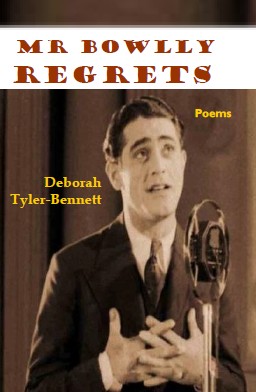
It’s called Mr Bowlly Regrets, is a book of poems, and came out from King’s England Press in 2017. It has many poems about growing up, memory, and change, some on performers, including Britain’s Bing Crosby, the wonderful Al Bowlly. It also contains a sequence on the First World War, which came from a series of Lottery Funded workshops done for Diseworth and other Leicestershire villages. Those poems often contain images of real soldiers from the villages’ war memorials.
I’ve also just completed a further volume of poems for King’s England, Ken Dodd Takes a Holiday which is due out later in 2019. The poems are mainly about theatre and imagery from the lives of Music Hall and Variety performers – of which an elegy for Ken Dodd (to my mind the last of the Victorian inspired performers) is key to the rest of the poems.
On top of these, I’m working on my first novel, Livin’ in a Great Big Way, for the same publisher. This tells the story of Dad, Rosa, and their daughter, Spring, who live on Velia Street, Sutton-in-Ashfield. When the novel opens it’s 1946. Spring’s beloved Aunt, Reena, is dying, and her husband, Nev, is just back from service in Italy. The family have kept things buttoned-up throughout the war, but as Reena fades, secrets and confessions begin spilling out. Also, Dad has visions of moving up in the world, while Rosa’s happy where she is. This is not to mention Grandad Stocks who lives with Mrs Close, much to the family’s shame, Mrs Jim, next door neighbor and Velia Street’s beating heart, and Butcher Mr Cole and his odd wife – whose dreadful crime will come to haunt them all.
How long did it take you to write the book?
My forthcoming book of poems has taken me a couple of years but, interestingly-enough, some of the poems are earlier ones I had in magazines and have since re-written. The poems in Mr Bowlly, likewise, took a couple of years to write, and King’s England published it in 2017. The novel was begun on the way back from the Callander Poetry Weekend in Scotland, in 2017. At first, I thought it was a short story, but it got longer and longer. So, in the end I had to admit it was a novel and carry on!
How did you chose a publisher for the book? Why this publisher? What advantages and/or disadvantages has this presented? How are you dealing with these?
Over the years I’ve had many publishers including Shoestring Press, Smokestack, University of Leicester Press, Leicester County Council Press, Nine Arches Press, and others. But the majority-of my stories and poems have been published by King’s England Press, Huddersfield, under direction of Steve Rudd. When they accepted my first volume of poems, Clark Gable in Mansfield in 2003, they published mainly historic and children’s books. Over years their poetry and fiction lists have grown, and I’ve come to trust Steve’s judgement as an editor. He’s allowed me a lot of consultation on how the volumes look, and how my poetry and prose is presented. He’s also allowed me to experiment and been honest over what did and didn’t work. So, I’ve enjoyed working with him and continue to do so.
Which aspects of the work you put into the book did you find most difficult? Why do you think this was so? How did you deal with these difficulties?
I think with most of my books of poems I deal with memory and characters a lot. I want the poems to be true to the ‘voices’ of various narratives and narrators. So, I think about who sees, who speaks, and period detail as I work. In Mr Bowlly, I wanted the title poem to bring Al Bowlly’s life, the fact he’s such a great performer and yet didn’t get his fair dues from history (he died in 1941 during the blitz, is buried in a communal grave, and has a blue plaque but no statue), and his wonderful singing voice to life. In performance I sing bits of the poem. If someone comes away from reading the volume to watch a clip of him on YouTube, I’ll be happy.
Which aspects of the work did you enjoy most? Why is this?
I enjoyed playing with poetic form in Mr Bowlly – there are sonnets, monologues in rhyming couplets, shaped poems, a poem to the rhythm Longfellow uses in ‘Hiawatha’, unrhymed couplets, and poems chiefly in dialogue. I love playing with form and have previously used sestinas and villanelles, which I go back to in my forthcoming book. Form really tests you, makes you think, and alters the poetic ‘voice.’ I review many poetry books and always feel a bit cheated when a poet doesn’t stretch themselves via form. Lots of unrhymed ‘free verse’ (like many poems I find the term doesn’t really describe what a verse with structures you come up with is) can feel much the same to me. So, I like testing the limits of a poem, and form helps me do this.
What sets the book apart from other things you’ve written?
Although most books represent developments and, hopefully, advancements in style and technique, I think Mr Bowlly differed in that I wanted the sections of the book to be read in tandem, but also stand alone.
I also think I dealt with the subject matter of the First World War in a more sequential way. Those poems were important to me as they dealt with histories of real soldiers that I came across during my workshops and I really wanted to get things right. I also realised that I used the poems to memorialise people who may not have got much of a memorial in death, a technique I began with an earlier poem about my Great Grandad’s son – ‘James William Gibson’ (in Mytton …Dyer …Sweet Billy Gibson) – who died in infancy and was buried below the cemetery wall. The soldiers I came across and used in poems for this newer volume often came from Institutions like the Industrial Schools, so, their next of kin might be their last employer.
In what way is it similar-to the others?
I think I’ve looked at similar histories and voices throughout my poetic career – maybe I’m fascinated with the ‘little things’ in history (both familial and wider) which, as my friend Ray Gosling once remarked, might be more important than the big things.
What will your next book be about?
As this will be the novel, I’d say about family life, of the triumphs and tragedies of human beings being able to live and work together. I realised, also, that the book has a lot of images of craft, (sewing, making, cooking etc.) that may go un-sung as a talent because people separate if from art. I collect vintage items from the 1940s, and often go to 1940s events, loving the music, endurance, and style of the period. Talking to historians and re-enactors (there are some splendid displays on the Home Front, from wedding dresses to the contents of a larder) has made me aware that making something from nothing is a skill to celebrate and venerate – yet often it’s passed-over in favour of the more showy-and-expensive object.
I have begun collecting brooches made by women (started when Mum gave me a brooch made by my Great Aunt from fuse wire, a belt buckle, and buttons shaped like flowers) and marvel at the artistry they create from things you would throw away. I wanted the novel to celebrate craft as someone’s art, their talent, and love – hence Reena in the book is a wonderful seamstress, and Mrs Jim comments at what she might have achieved with money behind her.
What would you say has been your most significant achievement as a writer?
I think, like most writers it’s carrying on writing. Not many people get to do what they love every day, and I think that’s something to be celebrated and, also, marveled at. Obviously, getting published is significant, as it gives your voice an audience, and I hope never to take this for granted. I’ve also been very lucky in the places I’ve worked and read in from the Wellcome Trust, Brighton Pavilion, and Keats House in Hampstead (where I did a residency), to small art galleries, schools and colleges – I wouldn’t have guessed, early on, that I’d work for any of them.
You have a poem featured in Bollocks to Brexit: An Anthology of Poems and Short Fiction. How did the poem come about?
I was tremendously pleased to be asked to be in the book and another poem on Brexit, ‘Ennui’, appears in my new collection. As a writer and someone who has always considered themselves a European, the divisions occasioned by Brexit have made me tremendously sad. I think that the poem, which I wrote especially for the volume, gave me an opportunity to highlight these divisions as they seem to me.
I hope the poem gives you a whistle-stop tour of what I observed after the vote, and how I consider it is the young who will suffer loss of opportunities, from which European Citizens such as myself benefited, from this most disastrous decision. When you feel that your voice is not being heard above shouting – poetry can give you your voice back.
Why is it important for poets to speak up on social, political and related matters?
Poetry has always spoken out on such matters! From Shelley to Blake, Suffragette poets to John Cooper Clarke, poets speak for themselves but also often for the excluded, and those finding themselves ‘voiceless.’
I think it’s worth considering that people sometimes remember lines from a poem giving protest, such as poems by Sassoon, Owen, and Graves from the First World War and those lines come to represent certain times in history perhaps more poignantly than anything else.
What do anthologies like Bollocks to Brexit add to poetry and public discourse?
In a time of shouting, it’s important to hear something more measured, and in a time when phrases such as ‘will of the people’ are being bandied about, it’s a good thing to remember that not all ‘people’ are being represented. You can read a poem over-and-over again, and think about it, come back to it. I always thought Barrack Obama sounded a better statesman than most, because I felt he’d considered his words with care.
Poetry considers its words with care.
Seamus Heaney talked of the right words in their proper places. I think public discourse, at present, is lacking in thoughtful, measured words. Perhaps it’s up to poetry to fill-in the gap.
Her poems have also been featured in anthologies that include Bollocks to Brexit: an Anthology of Poems and Short Fiction (CivicLeicester, 2019), Leicester 2084 AD: New Poems about The City (CivicLeicester, 2018) and Welcome to Leicester (Dahlia Publishing, 2016).
In an earlier interview, Deborah talked about her concerns as a writer, and some of the influences she draws on.
In this new interview, Deborah talks about her latest book, Mr Bowlly Regrets, and about poetry and politics:
Do you write every day?
I do write everyday: on trains; in cafés; in bars; at home; in other settings. I try and give myself a timetable between teaching Adult Ed creative writing, workshops, and performances, and the writing itself. I think the important thing is to do it. If the session is me writing alone, I split my day between the writing and reading aloud what I’ve done so far. I end when I feel the writing’s becoming stale and I need a break. I think knowing when to stop’s an art like anything else.
How many books have you written so far?
I have just finished the manuscript of my ninth poetry collection and am working on my first novel. I’ve also written three books of linked short fictions set in the world of variety. Also, I’ve had published a poetry pilot for schools and three creative writing textbooks and packs. I was fortunate enough to co-author the Victoria and Albert Museum’s creative writing web package with Gillian Spraggs. See below for details:
Volumes and Chapbooks: Poetry
Forthcoming 2019: Ken Dodd Takes a Holiday (King’s England).
Mr Bowlly Regrets (King’s England, 2017)
Napoleon Solo Biscuits (King’s England, 2015)
Volume Using Record Office Collection, Leicester:
Friendship’s Scrapbook (University of Leicester, 2015, reprinted and re-issued as two volumes in 2017, with extracts being published by the University’s Centre for New Writing in Women’s Writing in the Midlands 1750-1850, 2016). Two of the poems were later displayed on the front of Leicester University’s David Wilson Library and in the new Digital Resource Centre, for International Women's Day, 2018. ‘A Walk with Susanna Watts’ from the collection also appeared in Welcome to Leicester (Dahlia Publishing, 2016). Two Responses to the poems, plus a poem based on images of child migrants appeared in Leicester 2084 AD (CivicLeicester, 2018).
Kinda Keats (Shoestring, 2013): Inspired by Residency at Keats House, Hampstead.
Revudeville (King’s England, 2011): Featured many poems inspired by adult and school museum workshops.
Mytton … Dyer … Sweet Billy Gibson (Nine Arches, 2011). Three portraits in verse.
Pavilion (Smokestack, 2010). Poems set in Brighton and featuring images of Dandies.
Clark Gable in Mansfield (King’s England, 2003)
Selected Poems:
Take Five (Shoestring, 2003); The Staring Owl: An Anthology of Poems by the Poets of the King’s England Press (King’s England, 2017)
Special Museum Volume:
Ballad of Epping and Other Poems (Leicestershire Open Museum Pilot, 2007-2008)
Three linked books of short stories set in the 1940s/ 1950s/ 1960s world of variety:
Turned Out Nice Again (King’s England, 2013),
Mice That Roared (King’s England, 2015),
Brand New Beat (King’s England, 2017).
Museum and Education Volumes:
Words and Things: Writing Creatively from Objects and Art (with Mark Goodwin et al, Leicestershire County Council, 2008).
Speaking Words: Writing for Reading Aloud (Crystal Clear, 2005),
Poetry, Prose, and Playfulness for Teachers and Learners (with Mark Goodwin, Leicestershire County Council, 2004).
Museum Packs:
Leicestershire and Nottingham museums (includes Art and Education packs for Leicester’s Open Museum).
Special Commission, Victoria and Albert Museum:
Co-authored creative writing adult education web-package for the Victoria and Albert Museum with Gillian Spraggs, which included two of my poems on objects, these have since been used for summer schools at Wake Forest University, NC, USA and elsewhere.
See also Wellcome Collection work at the British Society for the History of Science (BSHS).
What is your latest book about?
It’s called Mr Bowlly Regrets, is a book of poems, and came out from King’s England Press in 2017. It has many poems about growing up, memory, and change, some on performers, including Britain’s Bing Crosby, the wonderful Al Bowlly. It also contains a sequence on the First World War, which came from a series of Lottery Funded workshops done for Diseworth and other Leicestershire villages. Those poems often contain images of real soldiers from the villages’ war memorials.
I’ve also just completed a further volume of poems for King’s England, Ken Dodd Takes a Holiday which is due out later in 2019. The poems are mainly about theatre and imagery from the lives of Music Hall and Variety performers – of which an elegy for Ken Dodd (to my mind the last of the Victorian inspired performers) is key to the rest of the poems.
On top of these, I’m working on my first novel, Livin’ in a Great Big Way, for the same publisher. This tells the story of Dad, Rosa, and their daughter, Spring, who live on Velia Street, Sutton-in-Ashfield. When the novel opens it’s 1946. Spring’s beloved Aunt, Reena, is dying, and her husband, Nev, is just back from service in Italy. The family have kept things buttoned-up throughout the war, but as Reena fades, secrets and confessions begin spilling out. Also, Dad has visions of moving up in the world, while Rosa’s happy where she is. This is not to mention Grandad Stocks who lives with Mrs Close, much to the family’s shame, Mrs Jim, next door neighbor and Velia Street’s beating heart, and Butcher Mr Cole and his odd wife – whose dreadful crime will come to haunt them all.
How long did it take you to write the book?
My forthcoming book of poems has taken me a couple of years but, interestingly-enough, some of the poems are earlier ones I had in magazines and have since re-written. The poems in Mr Bowlly, likewise, took a couple of years to write, and King’s England published it in 2017. The novel was begun on the way back from the Callander Poetry Weekend in Scotland, in 2017. At first, I thought it was a short story, but it got longer and longer. So, in the end I had to admit it was a novel and carry on!
How did you chose a publisher for the book? Why this publisher? What advantages and/or disadvantages has this presented? How are you dealing with these?
Over the years I’ve had many publishers including Shoestring Press, Smokestack, University of Leicester Press, Leicester County Council Press, Nine Arches Press, and others. But the majority-of my stories and poems have been published by King’s England Press, Huddersfield, under direction of Steve Rudd. When they accepted my first volume of poems, Clark Gable in Mansfield in 2003, they published mainly historic and children’s books. Over years their poetry and fiction lists have grown, and I’ve come to trust Steve’s judgement as an editor. He’s allowed me a lot of consultation on how the volumes look, and how my poetry and prose is presented. He’s also allowed me to experiment and been honest over what did and didn’t work. So, I’ve enjoyed working with him and continue to do so.
Which aspects of the work you put into the book did you find most difficult? Why do you think this was so? How did you deal with these difficulties?
I think with most of my books of poems I deal with memory and characters a lot. I want the poems to be true to the ‘voices’ of various narratives and narrators. So, I think about who sees, who speaks, and period detail as I work. In Mr Bowlly, I wanted the title poem to bring Al Bowlly’s life, the fact he’s such a great performer and yet didn’t get his fair dues from history (he died in 1941 during the blitz, is buried in a communal grave, and has a blue plaque but no statue), and his wonderful singing voice to life. In performance I sing bits of the poem. If someone comes away from reading the volume to watch a clip of him on YouTube, I’ll be happy.
Which aspects of the work did you enjoy most? Why is this?
I enjoyed playing with poetic form in Mr Bowlly – there are sonnets, monologues in rhyming couplets, shaped poems, a poem to the rhythm Longfellow uses in ‘Hiawatha’, unrhymed couplets, and poems chiefly in dialogue. I love playing with form and have previously used sestinas and villanelles, which I go back to in my forthcoming book. Form really tests you, makes you think, and alters the poetic ‘voice.’ I review many poetry books and always feel a bit cheated when a poet doesn’t stretch themselves via form. Lots of unrhymed ‘free verse’ (like many poems I find the term doesn’t really describe what a verse with structures you come up with is) can feel much the same to me. So, I like testing the limits of a poem, and form helps me do this.
What sets the book apart from other things you’ve written?
Although most books represent developments and, hopefully, advancements in style and technique, I think Mr Bowlly differed in that I wanted the sections of the book to be read in tandem, but also stand alone.
I also think I dealt with the subject matter of the First World War in a more sequential way. Those poems were important to me as they dealt with histories of real soldiers that I came across during my workshops and I really wanted to get things right. I also realised that I used the poems to memorialise people who may not have got much of a memorial in death, a technique I began with an earlier poem about my Great Grandad’s son – ‘James William Gibson’ (in Mytton …Dyer …Sweet Billy Gibson) – who died in infancy and was buried below the cemetery wall. The soldiers I came across and used in poems for this newer volume often came from Institutions like the Industrial Schools, so, their next of kin might be their last employer.
In what way is it similar-to the others?
I think I’ve looked at similar histories and voices throughout my poetic career – maybe I’m fascinated with the ‘little things’ in history (both familial and wider) which, as my friend Ray Gosling once remarked, might be more important than the big things.
What will your next book be about?
As this will be the novel, I’d say about family life, of the triumphs and tragedies of human beings being able to live and work together. I realised, also, that the book has a lot of images of craft, (sewing, making, cooking etc.) that may go un-sung as a talent because people separate if from art. I collect vintage items from the 1940s, and often go to 1940s events, loving the music, endurance, and style of the period. Talking to historians and re-enactors (there are some splendid displays on the Home Front, from wedding dresses to the contents of a larder) has made me aware that making something from nothing is a skill to celebrate and venerate – yet often it’s passed-over in favour of the more showy-and-expensive object.
I have begun collecting brooches made by women (started when Mum gave me a brooch made by my Great Aunt from fuse wire, a belt buckle, and buttons shaped like flowers) and marvel at the artistry they create from things you would throw away. I wanted the novel to celebrate craft as someone’s art, their talent, and love – hence Reena in the book is a wonderful seamstress, and Mrs Jim comments at what she might have achieved with money behind her.
What would you say has been your most significant achievement as a writer?
I think, like most writers it’s carrying on writing. Not many people get to do what they love every day, and I think that’s something to be celebrated and, also, marveled at. Obviously, getting published is significant, as it gives your voice an audience, and I hope never to take this for granted. I’ve also been very lucky in the places I’ve worked and read in from the Wellcome Trust, Brighton Pavilion, and Keats House in Hampstead (where I did a residency), to small art galleries, schools and colleges – I wouldn’t have guessed, early on, that I’d work for any of them.
You have a poem featured in Bollocks to Brexit: An Anthology of Poems and Short Fiction. How did the poem come about?
I was tremendously pleased to be asked to be in the book and another poem on Brexit, ‘Ennui’, appears in my new collection. As a writer and someone who has always considered themselves a European, the divisions occasioned by Brexit have made me tremendously sad. I think that the poem, which I wrote especially for the volume, gave me an opportunity to highlight these divisions as they seem to me.
I hope the poem gives you a whistle-stop tour of what I observed after the vote, and how I consider it is the young who will suffer loss of opportunities, from which European Citizens such as myself benefited, from this most disastrous decision. When you feel that your voice is not being heard above shouting – poetry can give you your voice back.
Why is it important for poets to speak up on social, political and related matters?
Poetry has always spoken out on such matters! From Shelley to Blake, Suffragette poets to John Cooper Clarke, poets speak for themselves but also often for the excluded, and those finding themselves ‘voiceless.’
I think it’s worth considering that people sometimes remember lines from a poem giving protest, such as poems by Sassoon, Owen, and Graves from the First World War and those lines come to represent certain times in history perhaps more poignantly than anything else.
What do anthologies like Bollocks to Brexit add to poetry and public discourse?
In a time of shouting, it’s important to hear something more measured, and in a time when phrases such as ‘will of the people’ are being bandied about, it’s a good thing to remember that not all ‘people’ are being represented. You can read a poem over-and-over again, and think about it, come back to it. I always thought Barrack Obama sounded a better statesman than most, because I felt he’d considered his words with care.
Poetry considers its words with care.
Seamus Heaney talked of the right words in their proper places. I think public discourse, at present, is lacking in thoughtful, measured words. Perhaps it’s up to poetry to fill-in the gap.
Friday, July 19, 2019
Interview _ Deborah Tyler-Bennett
Deborah Tyler-Bennett’s forthcoming volume, Ken Dodd Takes a Holiday, is out from King’s England Press in 2019, and her first novel, Livin’ In a Great Big Way is in preparation for the same publisher. She also has two recent volumes from the same publisher – Mr Bowlly Regrets – Poems, and Brand New Beat: Linked Short Fictions Set in the 1960s (both 2017).
She’s had seven collections of poetry published, some previous volumes being Napoleon Solo Biscuits (King’s England, 2015), poems based on growing up in the 1960s and ‘70s, and Kinda Keats (Shoestring, 2013), work deriving from a residency at Keats House, Hampstead.
Her first collection of linked, 1940s set, short stories, Turned Out Nice Again came out from King’s England in 2013, and a sequel, set in the 1950s, Mice that Roared was published in 2015, Brand New Beat, set in the 1960s, represents the final part of the trilogy.
In 2016, The Coffee House Anthology from Charnwood Arts marked the final volume of Coffee House magazine, which she edited for twenty-five issues over fifteen years (this was featured on the Poetry Society’s poetic map of England).
Translations and publications of her poems have appeared in Spain, Ireland, The US, Scotland, Austria, and Romania, where they were broadcast on Radio Bucharest. She’s also read in Belgium.
Deborah regularly reviews poetry and has written books and education packs on creative writing.
Recent poems have appeared in the anthologies Double Bill (Red Squirrel, 2014), Maps and Legends (Nine Arches, 2013), Strike Up the Band: Poems for John Lucas at Eighty (Plas Gwyn Books, 2017), and the Max Miller Society journal, who recently published the elegy for Ken Dodd that forms the title poem in her new book. New poems appear in Leicester 2084 AD (CivicLeicester, 2018).
She regularly performs her work and has appeared at many venues in Brighton, London, the East Midlands and nationally. She occasionally teams up with music hall expert Ann Featherstone to perform variety stories from her first two collections. She also does many workshops for adult and school groups, teaches writing classes for the WEA, and hosts workshops for national galleries and museums.
In 2018 one of her poems was displayed on the side of Leicester University Library, and one at its new digital resource centre, for International Women’s Day.
With Gillian Spraggs, she co-authored the Victoria and Albert Museum’s creative writing web pages. She’s also currently working on a new poetic sequence, The Ladies of Harris’s List set in the eighteenth-century, and a series of music hall poems with Andy Jackson.
In this interview, Deborah Tyler-Bennett talks about her writing:
When did you start writing?
I’ve been writing things down for as long as I can remember being able to write and recall composing poems and bits of stories from the age of about eight. I don’t think I started taking the writing seriously until I was in my early twenties. Then you realise you’re starting to have drawers and notebooks full of stuff and you need to do something creative with it. I don’t think I felt I’d earned being called a ‘writer’ until I’d had a significant amount of work published.
How did you decide you wanted to be a published writer?
I think the above realisation (that you have lots of work and unless someone else gets to read it, it’s a little pointless, and also you have no feedback on what others think of it) drives you to send work out. Personally, I began sending poems to little magazines and competitions. I felt that if I had a body of published work behind me, and people responded to it, then maybe I could send work away for consideration as a collection.
The more I had published in little magazines, the more I felt I was becoming part of a poetic community and, also, most crucially, the more I learned. Editors sending advice and encouragement was invaluable to me. I also considered the range of where I sent to – I had quite a few things published in Ireland and found the magazines there an aesthetic delight. To achieve publication takes a thick skin and the old cliché about all writers getting used to rejections is true – but these make the publications you do get, sweeter.
How would you describe the writing you are doing?
I think my writing has changed a lot over the years. At-the-moment, I’ve just finished my ninth volume of poetry and am working on new poems. I’m also writing my first novel. This comes after three volumes of linked short stories. It’s always hard to describe your own work but I think I’ve become fascinated by the lives of so-called ‘ordinary’ people – and have come to believe that no one has an ‘ordinary life.’
I think writing is a great way of conveying past and present – and have noticed two things, recently, in commentaries on my work. Firstly, people comment on my use of Nottinghamshire dialect, as if it’s something unusual to use. Secondly, people often think I’ve invented elements that come from my own background and family history. I feel as if we’re living at a cultural time where, if we’re not careful, and despite the success of writers like Sally Wainwright and Andrew Graves on the script writing and poetry scenes, we’ll be going back to the idea of the arts as a preserve of the privileged and socially connected.
I realise what’s not unusual for me, seems unusual to some, and that there are many assumptions made about writing from ‘ordinary’ life.
I’m also using a lot of images and characters from music hall in my poetry (my new book’s titled Ken Dodd Takes a Holiday) as I do think that this reflects a type of history that often gets ignored, sidelined, or damned with the loaded phrase ‘popular culture.’
I’ve also started to take my painting more seriously and exhibit work and suspect that the colours and textures I use in visual art creep into my poems and stories.
Who is your target audience?
This question is interesting. When I started, I don’t think I thought in terms of a ‘target audience.’ Most poets I know are just glad to get an audience. But I do think over time I’ve become aware that with poetry in particular - I want my work to be accessible to the widest possible audience. I don’t really want someone to leave a reading of mine saying: “I didn’t get it.” Or “I think that was aimed at a poetry or literary-critical group.”
The same is also true of fiction. I like it when an audience laughs, holds its breath, or even joins-in. Maybe that’s the music hall influence again. I like it even more when someone approaches me after a reading to say that they didn’t think poetry was for them, but they enjoyed what I did and would go to a reading again. I try my stories out on local audiences, or reading them aloud at home, and hope that anyone who wanted to read something could do so without fear of being either talked at, down to, or addressed in a jargon clearly meant for a specific crowd.
In the writing you are doing, which authors influenced you most?
Like most writers, I love so many authors (both classic and contemporary) that it’s hard to narrow it down. I think the biggest influence on my poetry and storytelling has been the Orkney writer George Mackay Brown. He wrote novels, stories, poems, a column for his local paper, libretti, dramas and work for festivals. He could catch how people spoke, vibrant imagery of time and place and was fascinated by blurring boundaries between chronological periods. And his images are so vital, instead of saying someone was hungover he describes them as having a mouth ‘full of ashes’, lipstick imprinting a man’s cheek becomes ‘red birds’ – magic!
There are so many contemporary poets I admire, and I like those such as Emma Lee and Andrew Graves who are always experimenting and pushing the boundaries of what they do. Simon Armitage, Mark Goodwin, and John Hegley make me question how I write and what I can learn from people experimenting with language. Carol Leeming makes me think of how I perform and how I can do more, as do Ian Macmillan, Benjamin Zephaniah, and others. John Cooper Clarke, obviously, has an unmatchable status as performer and writer, I’ve always loved watching, hearing and reading him. I think it was Mark E. Smith of The Fall who said he didn’t wholly trust people who didn’t like John Cooper Clarke, and I think that’s sound (oh, that, and Elvis, too).
In prose, I’m still a huge fan of Dickens, as I think he tells such memorable stories full of such vibrant oddities. I did a PhD thesis on Djuna Barnes, and still find her work extraordinary. One book that I’ve found my most re-read is an anthology by John Sampson called The Wind on the Heath, about gypsies and published in the nineteen twenties. The stories and poems in it sing.
Likewise, I write a lot of ghost stories and am a huge fan of the form, loving E. Nesbit, Mary E. Braddon, Dickens, M.R. James, Ian Blake, and Susan Hill. Stars all. I think ghost stories are hard but worth it and reading around the genre helps you know your way around the structures of it. I swap ghost stories with Scottish writer, Ian Blake, and we enjoy a correspondence over the genre.
Sally Evans who edited Poetry Scotland has been a huge influence on my work, reading techniques, and has inspired me as a poet. Her poems do so much within economic lines and lingering images and I’ve never met anyone so welcoming and generous to her fellow poets. For years she and Ian King ran the Callander Poetry Weekend and it was a joy to attend and perform at that.
Lastly, I love European writing, and have always considered myself blessed as a writer to be part of Europe. The culture which includes writers as diverse as Balzac, Marco Vici, Hugo and Colette is an ever self-enriching one, and we have been fortunate indeed to be part of that.
How have your own personal experiences influenced your writing?
I think even if your telling of a certain story doesn’t seem connected to your own life experience, that experience will be embedded in this somewhere. Sometimes stories come directly from my family history, places travelled or lived in, or people met. Other stories might seem removed from the above, but actually- have elements of my experience in them.
Occasionally I write from a current event, and it’s true that living in ‘interesting times’ (a polite way of saying that you turn the news on every night wondering what on earth could have happened today) these ‘event’ based poems grow in number. Over the past year I’ve written poems as responses to the disaster of Brexit and about how lack of empathy leads people to disregard what’s happening to fellow human beings in front of their noses.
Even a poem based in the nineteenth century (‘The Boy Acrobat’s Villanelle’ published in Leicester 2084 AD) ended with an image of twenty-first century child migrants, children whose Dickensian plight can only be ignored via a spectacular lack of empathy.
What are your main concerns as a writer?
Like most writers, I want to tell a story (whether in poetry or prose) well, and make the reader feel that the read was worth it. I also like putting people and places before the reader that come from my own growing-up, family stories, and local legends. I became aware in my late teens that my Grandma’s language, her bit of Nottinghamshire, and the world she grew up in, was vanishing. Like George Mackay Brown’s Orkney, I wanted to get some of it down before it went all together.
When I was writing my three volumes of stories set in variety, I had a desire to make the reader’s emotional response to the short fictions similar to those they’d get in a theatre – a story might bring a lump to your throat one minute and make you laugh in the next.
As with all such techniques and concerns, writers just have-to keep going, and I know whatever I’ve planned the story might well have other ideas. During the variety stories, an old lady, Grandwem (a cross between my Grandma and Great Aunt, plus some others) was going to be a minor character. She had other ideas and became the mainstay of all three books, the glue holding the family together.
In my current novel, the plan I’d made crashed and burned as a minor character did something awful as I wrote, and I had to go back and revise the whole first part of the book! Like painting, I love the unknown element that creeps in when you write, making me think of the old blues adage: ‘Make God laugh, tell him all your plans.”
What are the biggest challenges that you face? And, how do you deal with them?
I think for writers, challenges can be divided into practical working challenges, and aesthetic challenges.
The second category includes the obvious thing of being true to your ‘voice’ and the stories and poetic narratives you want to tell. In other words, it’s easy to become distracted from your purpose, think there are more fashionable things you could be writing, or forget why you wanted to tell a certain story in the first place. I’ve found it very useful to stop from time-to-time and ask: ‘why did you want to write this?’ I also find Robert Graves idea of ‘the reader over your shoulder’ very useful. Imagine someone looking at your work ‘over your shoulder’ – ask ‘what will they get out of it?’ If the answer is ‘not enough’ then that’s the time for a re-write or re-vision.
The first category I mentioned - the practical working challenge - may cover several bases. How much money do you need to earn to keep writing? Where does funding come from? How much time a week do you spend actually-writing? Is this time enough?
Due to current events, arts funding is going to become tighter, outreach for writers lessening as they are excluded from European opportunities, and I foresee writers who flourish will be previously established, have to work many more hours to stay afloat, or have private incomes and connections.
Reading information from literary bodies already indicates as much. I hope I’m wrong, and that writers beginning as I did from ordinary schools and backgrounds will have opportunities similar to mine. But I think most writers from state schools will struggle more, and that all writers will face challenges we couldn’t have seen prior to 2017. The challenge is (to mis-quote a US President) to do it because it is hard, to do it because it is there – to do it because that’s what you do. And (to misquote a US boxing legend) if you do what you love, strive to be the best at it you can be.
She’s had seven collections of poetry published, some previous volumes being Napoleon Solo Biscuits (King’s England, 2015), poems based on growing up in the 1960s and ‘70s, and Kinda Keats (Shoestring, 2013), work deriving from a residency at Keats House, Hampstead.
Her first collection of linked, 1940s set, short stories, Turned Out Nice Again came out from King’s England in 2013, and a sequel, set in the 1950s, Mice that Roared was published in 2015, Brand New Beat, set in the 1960s, represents the final part of the trilogy.
In 2016, The Coffee House Anthology from Charnwood Arts marked the final volume of Coffee House magazine, which she edited for twenty-five issues over fifteen years (this was featured on the Poetry Society’s poetic map of England).
Translations and publications of her poems have appeared in Spain, Ireland, The US, Scotland, Austria, and Romania, where they were broadcast on Radio Bucharest. She’s also read in Belgium.
Deborah regularly reviews poetry and has written books and education packs on creative writing.
Recent poems have appeared in the anthologies Double Bill (Red Squirrel, 2014), Maps and Legends (Nine Arches, 2013), Strike Up the Band: Poems for John Lucas at Eighty (Plas Gwyn Books, 2017), and the Max Miller Society journal, who recently published the elegy for Ken Dodd that forms the title poem in her new book. New poems appear in Leicester 2084 AD (CivicLeicester, 2018).
She regularly performs her work and has appeared at many venues in Brighton, London, the East Midlands and nationally. She occasionally teams up with music hall expert Ann Featherstone to perform variety stories from her first two collections. She also does many workshops for adult and school groups, teaches writing classes for the WEA, and hosts workshops for national galleries and museums.
In 2018 one of her poems was displayed on the side of Leicester University Library, and one at its new digital resource centre, for International Women’s Day.
With Gillian Spraggs, she co-authored the Victoria and Albert Museum’s creative writing web pages. She’s also currently working on a new poetic sequence, The Ladies of Harris’s List set in the eighteenth-century, and a series of music hall poems with Andy Jackson.
In this interview, Deborah Tyler-Bennett talks about her writing:
When did you start writing?
I’ve been writing things down for as long as I can remember being able to write and recall composing poems and bits of stories from the age of about eight. I don’t think I started taking the writing seriously until I was in my early twenties. Then you realise you’re starting to have drawers and notebooks full of stuff and you need to do something creative with it. I don’t think I felt I’d earned being called a ‘writer’ until I’d had a significant amount of work published.
How did you decide you wanted to be a published writer?
I think the above realisation (that you have lots of work and unless someone else gets to read it, it’s a little pointless, and also you have no feedback on what others think of it) drives you to send work out. Personally, I began sending poems to little magazines and competitions. I felt that if I had a body of published work behind me, and people responded to it, then maybe I could send work away for consideration as a collection.
The more I had published in little magazines, the more I felt I was becoming part of a poetic community and, also, most crucially, the more I learned. Editors sending advice and encouragement was invaluable to me. I also considered the range of where I sent to – I had quite a few things published in Ireland and found the magazines there an aesthetic delight. To achieve publication takes a thick skin and the old cliché about all writers getting used to rejections is true – but these make the publications you do get, sweeter.
How would you describe the writing you are doing?
I think my writing has changed a lot over the years. At-the-moment, I’ve just finished my ninth volume of poetry and am working on new poems. I’m also writing my first novel. This comes after three volumes of linked short stories. It’s always hard to describe your own work but I think I’ve become fascinated by the lives of so-called ‘ordinary’ people – and have come to believe that no one has an ‘ordinary life.’
I think writing is a great way of conveying past and present – and have noticed two things, recently, in commentaries on my work. Firstly, people comment on my use of Nottinghamshire dialect, as if it’s something unusual to use. Secondly, people often think I’ve invented elements that come from my own background and family history. I feel as if we’re living at a cultural time where, if we’re not careful, and despite the success of writers like Sally Wainwright and Andrew Graves on the script writing and poetry scenes, we’ll be going back to the idea of the arts as a preserve of the privileged and socially connected.
I realise what’s not unusual for me, seems unusual to some, and that there are many assumptions made about writing from ‘ordinary’ life.
I’m also using a lot of images and characters from music hall in my poetry (my new book’s titled Ken Dodd Takes a Holiday) as I do think that this reflects a type of history that often gets ignored, sidelined, or damned with the loaded phrase ‘popular culture.’
I’ve also started to take my painting more seriously and exhibit work and suspect that the colours and textures I use in visual art creep into my poems and stories.
Who is your target audience?
This question is interesting. When I started, I don’t think I thought in terms of a ‘target audience.’ Most poets I know are just glad to get an audience. But I do think over time I’ve become aware that with poetry in particular - I want my work to be accessible to the widest possible audience. I don’t really want someone to leave a reading of mine saying: “I didn’t get it.” Or “I think that was aimed at a poetry or literary-critical group.”
The same is also true of fiction. I like it when an audience laughs, holds its breath, or even joins-in. Maybe that’s the music hall influence again. I like it even more when someone approaches me after a reading to say that they didn’t think poetry was for them, but they enjoyed what I did and would go to a reading again. I try my stories out on local audiences, or reading them aloud at home, and hope that anyone who wanted to read something could do so without fear of being either talked at, down to, or addressed in a jargon clearly meant for a specific crowd.
In the writing you are doing, which authors influenced you most?
Like most writers, I love so many authors (both classic and contemporary) that it’s hard to narrow it down. I think the biggest influence on my poetry and storytelling has been the Orkney writer George Mackay Brown. He wrote novels, stories, poems, a column for his local paper, libretti, dramas and work for festivals. He could catch how people spoke, vibrant imagery of time and place and was fascinated by blurring boundaries between chronological periods. And his images are so vital, instead of saying someone was hungover he describes them as having a mouth ‘full of ashes’, lipstick imprinting a man’s cheek becomes ‘red birds’ – magic!
There are so many contemporary poets I admire, and I like those such as Emma Lee and Andrew Graves who are always experimenting and pushing the boundaries of what they do. Simon Armitage, Mark Goodwin, and John Hegley make me question how I write and what I can learn from people experimenting with language. Carol Leeming makes me think of how I perform and how I can do more, as do Ian Macmillan, Benjamin Zephaniah, and others. John Cooper Clarke, obviously, has an unmatchable status as performer and writer, I’ve always loved watching, hearing and reading him. I think it was Mark E. Smith of The Fall who said he didn’t wholly trust people who didn’t like John Cooper Clarke, and I think that’s sound (oh, that, and Elvis, too).
In prose, I’m still a huge fan of Dickens, as I think he tells such memorable stories full of such vibrant oddities. I did a PhD thesis on Djuna Barnes, and still find her work extraordinary. One book that I’ve found my most re-read is an anthology by John Sampson called The Wind on the Heath, about gypsies and published in the nineteen twenties. The stories and poems in it sing.
Likewise, I write a lot of ghost stories and am a huge fan of the form, loving E. Nesbit, Mary E. Braddon, Dickens, M.R. James, Ian Blake, and Susan Hill. Stars all. I think ghost stories are hard but worth it and reading around the genre helps you know your way around the structures of it. I swap ghost stories with Scottish writer, Ian Blake, and we enjoy a correspondence over the genre.
Sally Evans who edited Poetry Scotland has been a huge influence on my work, reading techniques, and has inspired me as a poet. Her poems do so much within economic lines and lingering images and I’ve never met anyone so welcoming and generous to her fellow poets. For years she and Ian King ran the Callander Poetry Weekend and it was a joy to attend and perform at that.
Lastly, I love European writing, and have always considered myself blessed as a writer to be part of Europe. The culture which includes writers as diverse as Balzac, Marco Vici, Hugo and Colette is an ever self-enriching one, and we have been fortunate indeed to be part of that.
How have your own personal experiences influenced your writing?
I think even if your telling of a certain story doesn’t seem connected to your own life experience, that experience will be embedded in this somewhere. Sometimes stories come directly from my family history, places travelled or lived in, or people met. Other stories might seem removed from the above, but actually- have elements of my experience in them. Occasionally I write from a current event, and it’s true that living in ‘interesting times’ (a polite way of saying that you turn the news on every night wondering what on earth could have happened today) these ‘event’ based poems grow in number. Over the past year I’ve written poems as responses to the disaster of Brexit and about how lack of empathy leads people to disregard what’s happening to fellow human beings in front of their noses.
Even a poem based in the nineteenth century (‘The Boy Acrobat’s Villanelle’ published in Leicester 2084 AD) ended with an image of twenty-first century child migrants, children whose Dickensian plight can only be ignored via a spectacular lack of empathy.
What are your main concerns as a writer?
Like most writers, I want to tell a story (whether in poetry or prose) well, and make the reader feel that the read was worth it. I also like putting people and places before the reader that come from my own growing-up, family stories, and local legends. I became aware in my late teens that my Grandma’s language, her bit of Nottinghamshire, and the world she grew up in, was vanishing. Like George Mackay Brown’s Orkney, I wanted to get some of it down before it went all together.
When I was writing my three volumes of stories set in variety, I had a desire to make the reader’s emotional response to the short fictions similar to those they’d get in a theatre – a story might bring a lump to your throat one minute and make you laugh in the next.
As with all such techniques and concerns, writers just have-to keep going, and I know whatever I’ve planned the story might well have other ideas. During the variety stories, an old lady, Grandwem (a cross between my Grandma and Great Aunt, plus some others) was going to be a minor character. She had other ideas and became the mainstay of all three books, the glue holding the family together.
In my current novel, the plan I’d made crashed and burned as a minor character did something awful as I wrote, and I had to go back and revise the whole first part of the book! Like painting, I love the unknown element that creeps in when you write, making me think of the old blues adage: ‘Make God laugh, tell him all your plans.”
What are the biggest challenges that you face? And, how do you deal with them?
I think for writers, challenges can be divided into practical working challenges, and aesthetic challenges.
The second category includes the obvious thing of being true to your ‘voice’ and the stories and poetic narratives you want to tell. In other words, it’s easy to become distracted from your purpose, think there are more fashionable things you could be writing, or forget why you wanted to tell a certain story in the first place. I’ve found it very useful to stop from time-to-time and ask: ‘why did you want to write this?’ I also find Robert Graves idea of ‘the reader over your shoulder’ very useful. Imagine someone looking at your work ‘over your shoulder’ – ask ‘what will they get out of it?’ If the answer is ‘not enough’ then that’s the time for a re-write or re-vision.
The first category I mentioned - the practical working challenge - may cover several bases. How much money do you need to earn to keep writing? Where does funding come from? How much time a week do you spend actually-writing? Is this time enough?
Due to current events, arts funding is going to become tighter, outreach for writers lessening as they are excluded from European opportunities, and I foresee writers who flourish will be previously established, have to work many more hours to stay afloat, or have private incomes and connections.
Reading information from literary bodies already indicates as much. I hope I’m wrong, and that writers beginning as I did from ordinary schools and backgrounds will have opportunities similar to mine. But I think most writers from state schools will struggle more, and that all writers will face challenges we couldn’t have seen prior to 2017. The challenge is (to mis-quote a US President) to do it because it is hard, to do it because it is there – to do it because that’s what you do. And (to misquote a US boxing legend) if you do what you love, strive to be the best at it you can be.
Monday, July 1, 2019
East Midlands poetry catalogue
As part of efforts towards setting up the East Midlands Poetry Library, we are putting together a catalogue of East Midlands poets and their work.
Are there East Midlands poets you know of who should be on the list? Can you add them to the list?
We are also aware that Black, Asian and ethnic minority poets are under-represented in how the literary landscape in the East Midlands is imagined. Do you know any Black, Asian and ethnic minority poets who should be on the list as well?
If you are a poet, in addition to adding your name to the catalogue, please also respond to the questions accessible here.
Are there East Midlands poets you know of who should be on the list? Can you add them to the list?
We are also aware that Black, Asian and ethnic minority poets are under-represented in how the literary landscape in the East Midlands is imagined. Do you know any Black, Asian and ethnic minority poets who should be on the list as well?
If you are a poet, in addition to adding your name to the catalogue, please also respond to the questions accessible here.
Wednesday, June 12, 2019
Interview _ Andrew Button
Andrew Button is from Market Bosworth and has had poems published in various magazines including Orbis, Staple, The Interpreter’s House, Iota and Ink, Sweat and Tears. His pamphlet, Dry Days in Wet Towns, was published in 2016 and a first full collection, Melted Cheese on the Cosmic Pizza in 2017 by erbacce press.
In this interview, Andrew talks about his writing:
When did you start writing?
From the age of fourteen I always wanted to be a writer. The late Liverpool poet, Adrian Henri, was an early inspiration. He was invited to my school to encourage pupils to write and perform their poetry. From the ensuing workshop sessions, an anthology of our poems was published and presented at a performance evening for parents. I suppose I started writing seriously for magazine publication in my early twenties.
Adrian Henri and a very supportive English teacher convinced me that I had a talent for writing poetry and it progressed from there. This is going to sound like the stereotypical writers struggle, but from my early twenties I worked at my poems diligently, sent them off to magazines and got the majority of them back with a polite no thank you. Undeterred and buoyed on by minor successes, I persevered.
How would you describe the writing you are doing?
I aim to write poetry that is both amusing and thought-provoking. My poetry is observational, anecdotal and ironic and mostly drawn from the world around me. I like to see myself as a poetic eavesdropper! My sources of inspiration range from quirky news stories and themes (woodlice, horses in McDonalds, a man obsessed with roundabouts), popular culture and occasionally my own life experiences.
My target audience are adults who want their sense of wonder and amusement to be engaged. To write poems that are stepping stones for adult lives and experiences often drawing on common cultural reference points. Subconsciously, I have always written for an adult audience.
In the writing you are doing, which authors influenced you most? Why did they have this influence?
There are so many poets I admire. I love the imagery of Keats, the evocations and language used by Larkin. The humour of Roger McGough, Adrian Henri, Ian McMillan and Simon Armitage. The wit and poignancy of the Scottish poet, Liz Lochhead. I like Paul Farley (The Boy From the Chemist is Here to See You is a marvellous collection). I know a lot of local poets that deserve greater attention like Maria Taylor, Geraldine Clarkson, Jayne Stanton and Roy Marshall, all of whom I would recommend. When I attend an Open Mic event, I am one of those people who always buys somebody’s new book!!
The irony is that Ray Bradbury’s descriptive prose has been the biggest influence on my development as a writer. Appropriately, one critic described his work as the ‘poetry of the ordinary’. Another element of his writing that has inspired me is his ability to communicate a sense of wonder. That sense of wonder that children have and many lose in adulthood. I read somewhere that to be considered a well-rounded adult you need to retain a slice of that sense of wonder. Ray Bradbury captured it, bottled it and released it through his writing to millions of people all over the world. I tried my hand at writing short stories when I was younger but quickly began to realise that the poem was my chosen form of literary expression – or rather, it chose me!
How have your own personal experiences influenced your writing?
For a long time I wrote poems that were mainly observational and not about me. However, even in these poems I have realised that some of the aspects of my life and experience has seeped into them unconsciously. Recently, however, I have been drawing on personal experiences and in some cases, events that happened a long time ago. For example, there is a poem in my first full collection about a bicycle accident when I was seventeen! I think that as a writer, ideas for poems or stories often float to the surface many years later.
What are your main concerns as a writer?
As I have stated before, in my writing I am striving to make people laugh and ponder. I tend to be preoccupied with the themes of obsession, eccentricity, the minutiae of life, nostalgia and popular culture (especially music, art, literature and cinema).
I believe that as a poet of one my greatest challenges is to convince people that poetry is for sharing. Poetry should be given out with prescriptions, by the milkman, with school dinners. Poets should be parachuted into offices and shops, banks and supermarkets because there are still masses of people who think poetry is a foreign language and not for them. For me, getting out and reading my poems in as many public venues as possible is the way to meet this challenge.
Do you write everyday?
I think it is very important to get into a ‘writing routine’. I am fortunate in that I work part time. So, I set aside every Tuesday and Thursday morning for writing. Setting aside time regularly on a weekly basis is crucial. It is vital to keep the ‘writing muscle’ working. The very act of getting something down on paper helps the creative process. It is like a potter shaping his piece of clay. Even if inspiration is deserting me, I will revisit a poem that I am unhappy with or research a subject that is currently preoccupying me. That helps to kick-start the poetry brain. Reading a book and listening to music often lead me somewhere with a phrase or a lyric that catches my imagination. As my greatest influence, Ray Bradbury said, ‘Keep writing. Don’t stop.’
How many books have you written so far? And how did you find a publisher for them?
Dry Days in Wet Towns (a poetry pamphlet), erbacce press, Liverpool, 2016.Melted Cheese on the Cosmic Pizza (first full poetry collection), erbacce press, Liverpool, 2017.
In 2016, I entered the erbacce poetry competition and my runners up prize was to have a pamphlet published (Dry Days in Wet Towns, erbacce , Liverpool, UK, 2016).
Melted Cheese on the Cosmic Pizza was published in Liverpool in November, 2017. Well, in truth, some of the poems were originally hatched back in my late twenties, but many have evolved into what you see in the book.
How would you describe Melted Cheese on the Cosmic Pizza?
The best way to describe what the book is about is to use quotes from the back cover:
As Siobhan Logan (another Leicestershire poet) wrote on the back of my book:
Like a poetry jukebox, quirky titles invite you to spin their tracks. Button's poems swerve from the apocalyptic to the domestic, from cosmic to comic, on the flip of a coin; rhymes pinging with wit and sudden pathos. Clocks, bereavement, mislaid love, B-sides, a rent-collecting Lowry and star-hopping Elvis, all jostle to leave you humming their tune, thumbing a knock-out phrase long after they're played out. Stack up those dimes and settle in; you won't be short-changed here.Which aspects of the work you put into the book did you find most difficult?
To be honest, I did not find any part of the process difficult. I submitted a batch of poems to my publisher who then made the final selection of titles to be included. The editing was minimal and in fact the front cover design and quotes for the back cover took the longest time to organise.
Which aspects of the work did you enjoy most?
Seeing the final front cover and the arrangement of my poems was the biggest thrill. It still is. The dream becomes a reality.
What sets Melted Cheese on the Cosmic Pizza apart from other things you've written?
It was my first full collection and for that reason it will always be a special moment in my writing career.
In what way is it similar to the others?
It has established the themes, style and voice introduced in my fledgling pamphlet.
What would you say has been your most significant achievement as a writer?
To date my most significant achievement as a poet has been to have my first full collection published and to take it out on the road at various poetry open mics throughout 2018 and into 2019. As a poet you have to be visible. From a young age I always wanted to make people laugh. It’s a drug but a very desirable addiction. Writing anything humorous is a challenge and precarious. It is so easy to overdo it. One conclusion I have come to is that there is a lot of humour to extract from real life situations. I hope that comes across in my poetry. My raison d’etre as a poet is to write poems that make people laugh and think, and often at the same time.
What will your next book be about?
I am currently working towards my second poetry collection and am aiming to submit a manuscript towards the end of 2019 / early 2020.
Details of Andrew Button’s books can be found on the erbacce press website.
Friday, June 7, 2019
East Midlands Poetry Library
The East Midlands Poetry Library is coming soon.
Coordinated by groups and individuals that include CivicLeicester, Conversations with Writers and others, The Library will be like the National Poetry Library but based in Leicester in the UK.
The Library will have a particular bias towards poets and poetry from or on or inspired by the East Midlands.
What you can do:
● If you have any suggestions on how we can make the library happen or if you have ideas on what the library can become, please email: The Librarian.
● If you are you a poet, a publisher or a poetry events organiser based in the East Midlands, please get in touch, say hello, give us a wave.
● If you would like to be featured as part of The Library, please answer the questions found here and send your responses to us. (We will feature your responses on Conversations with Writers initially, and include the responses in East Midlands Poetry Library materials once The Library is up and running.)
Coordinated by groups and individuals that include CivicLeicester, Conversations with Writers and others, The Library will be like the National Poetry Library but based in Leicester in the UK.
The Library will have a particular bias towards poets and poetry from or on or inspired by the East Midlands.
What you can do:
● If you have any suggestions on how we can make the library happen or if you have ideas on what the library can become, please email: The Librarian.
● If you are you a poet, a publisher or a poetry events organiser based in the East Midlands, please get in touch, say hello, give us a wave.
● If you would like to be featured as part of The Library, please answer the questions found here and send your responses to us. (We will feature your responses on Conversations with Writers initially, and include the responses in East Midlands Poetry Library materials once The Library is up and running.)
Monday, March 19, 2018
Interview _ Bobba Cass
Bobba Cass grew up in the United States and was in the Peace Corps in Nigeria in the 1960s.
An academic whose advanced degrees were in English Literature and Cultural Studies, he has been an activist in struggles against apartheid, racism in schools, nuclear weapons and nuclear energy.
He organises Pinggg…K! a poetry event that meets monthly in Leicester for an evening of metrosexual open mic verse and a performance by a featured poet.
He came out in his late 40s following a police entrapment arrest.
In this interview,* Bobba Cass talks about the work he is doing.
You are often described as a literary activist. What forms does this activism take? And, how has it been received?
When I began coming out in the late 1980's and I experienced and welcomed the gentleness of other men, I began what I can only describe as 'hearing' a poetry which, in its intensity, was much more open about sensuality and sexuality than was then being published (much of this has changed today with poets being recognised for their intensity of detail, especially openly gay poets). I theorised this as metasexual verse.
After I retired from university lecturing in 2003, I got involved in open mic poetry events in Leicester. I noticed that there were no poets other than myself at that time (2006) who were speaking their sexuality. I began my performances with, Hi. I'm Bobba Cass, a gay grey poet.
I wanted to have an open mic poetry event that was personal and safe enough for those struggling with and exploring their sexuality, to be more direct. In 2011, I began Pinggg...K! which advertised itself as celebrating 'metrosexual verse' (the term, metrosexual based on Rikki Beadle-Blair's television soap, 'Metrosexuality'). Pinggg…K! is now in its seventh year and has seen a growing number of poets of all ages, genders, ethnicities, social backgrounds and mental and physical challenges, come forward and share their sexualities in monthly events, and this has in turn impacted on the wider poetry communities in Leicester.
In addition to Pinggg...K! events I have organised larger events that have brought together Leicester people from many backgrounds. I love Leicester, and am an advocate for its inclusivity. Although I set out here what I have done, there are many others who have been crucial to the growth that has taken place.
To celebrate five years of Pinggg…K! you published a limited edition book, four and twenty. How did the book come about?
Each month there had been a call and response couplet that worked humour out of the relationship of blackbird to earthworm, a humour that was free of the attitudes towards women, working people, black people, the disabled, the LGBT communities so often found at poetry events, especially those in pubs.
From the ranks of Pinggg...K! attenders (women and men, black and white, young and old, gay and straight, physically challenged and not, working class background and middle class, international and English), cartoons were produced to give visual energy to twenty of these couplets. And also four of the blackbird / earthworm genre best poems were included hence the four and twenty title of blackbird nursery rhyme fame.
four and twenty is a brief volume but encapsulates an activist energy that is evident in Leicester at its best.
I have occasional verse in other publications such as Welcome to Leicester (Dahlia Publishing, 2016), and several poems that can be seen and heard online. These internet poems I treasure because they are there as the result of other poet activists who have taken the time to record and post them in the ether.
When did you start writing?
Although I see myself mainly as a performer, especially as a poet, I have also written two novels, and they are part of a sequence which I hope one day will be published, especially in the Pacific Northwest of the United States where I grew up.
I am 78 years of age. I began writing as a child in school, especially poetry. The greatest energy for writing came when I began coming out as a gay man in my late 40s.
My poetry, in its passion, is very sporadic and instantaneous - I am hearing phrases and responding to feelings and reflections. My novel writing is shaped by my interest in readability, something that can be enjoyed in a day for some or a week for others. The novels are no longer than 10 chapters.
I have lived in Leicester now most of my life. My poetry as performance has come about through the vitality of spoken word events in our city. My novels imagine more the audiences of my upbringing and experiences, for instance, living in Nigeria for four years in the 1960s and residing in countries different from that of my birth as well as where I grew up in Seattle. Thomas Wolfe wrote You Can’t Go Home Again. Once we begin to hear ourselves, the stories we tell, as if from different paths in life and different places of disposition, we struggle to find a joy. When that joy is found it fills our hearts with wanting to share it with others.
Which authors influenced you most?
Emily Dickinson and William Shakespeare are key influences on my poetry - Dickinson because of her brevity and intensity, Shakespeare because of his sonnets. The novels of Thornton Wilder (Bridge of San Luis Ray) and Laura Ingalls Wilder (House on the Prairie sequence) are paradigmatic.
What are the biggest challenges that you face? And, how do you deal with them?
I had been longing for someone who would love me and allow me to love them for a long time - desperate for that. By chance such a person has come into my life. There is a huge challenge around this commitment. I am still growing within myself.
I was on the stage as a child and that has informed my energy around performance. I had a mental breakdown at the end of my four years in Nigeria. I came out after 20 years of marriage and raising three sons. I have been an activist around peace, environmental, race and gender issues. These experiences have been formative.
I feel most passionate about wanting young people to have experiences in their lives that take them beyond their childhood environments so that they can sense what others lives might be like. I would like everyone to have some part of their childhood sheltered / regaled by the unconditional love of an elder close to them. For example, my grandmother lived with us when I was a child. Her love for me saw me through the most difficult moments of my early adult life when I had what was then called 'a mental breakdown'. I always hope that there will be someone like my grandmother, in everyone's life.
Do you write everyday?
The poetry is spontaneous. It happens in moments. The novels I set out to do and they are written within three to four months and then revised many times.
I am preparing to write my third novel, Nigeria! Nigeria! I was in Nigeria at the time of Biafra. I lived where the war first broke out.
This particular book will draw heavily on the letters I wrote home at the time, and will be epistolary. The underlying narrative will be an expansion of the life of a character, Donny, in the first two novels, and one of his friends.
Which are the most difficult aspects of the work you do?
With the poetry, the forms have been most various, and have required a lot of reworking in some instances. All of the poems are memorised and that by way of reworking. With the novels, the diction and dialogue have required many revisions. As with the poetry, I find hearing the writing aloud crucial.
Which aspects of the work do you enjoy most?
For the poetry, recalling particular moments that have an integrity in emotional relationships gives me a vitality and sense of achievement. For the novels realising conjunctions in the relationships of the characters that go beyond initial imaginings always seems miraculous.
What would you say has been your most significant achievement as a writer and as a literary activist?
For the poetry, my greatest of achievement has been the interaction with other writers in Leicester, and my part in bringing this about. For the novels, I hope that my persistence in working on the narratives over a long period of time in my late adult life will be regarded as a big achievement.
My greatest joy as a literary activist is the shared experience of celebration. To me this is live. It is spontaneous. It is what we can all bring to an event. It is primarily spoken. We attempt to capture it in words. And that is a great challenge. But the greater challenge is allowing ourselves to be wise in each other.
Oscar Frank is one of our spoken word community – a wonderful oral tradition poet. One afternoon as I was rushing to get a train to Nottingham, Oscar saw me near the train station. He was eating from a cob, but he had to say to me what was uppermost in his mind, “Time is longer than a rope, Bobba. Time is longer than a rope!” That night, in recollection, the meaning and this poem was in my heart. (‘Farrels’ is my word for the muscles either side of the urethra in the phallus):
for Oscar
time is longer than the rope
that farrels through our dreams
that wrinkles with a bartered hope
that lithes with peril beams
when that ourselves eventuates
to dust galactic streams
the time that was
more likely still
a carnal apple gleams
*This interview was first published in the magazine, Great Central, in March 2017
An academic whose advanced degrees were in English Literature and Cultural Studies, he has been an activist in struggles against apartheid, racism in schools, nuclear weapons and nuclear energy.
He organises Pinggg…K! a poetry event that meets monthly in Leicester for an evening of metrosexual open mic verse and a performance by a featured poet.
He came out in his late 40s following a police entrapment arrest.
In this interview,* Bobba Cass talks about the work he is doing.
You are often described as a literary activist. What forms does this activism take? And, how has it been received?
When I began coming out in the late 1980's and I experienced and welcomed the gentleness of other men, I began what I can only describe as 'hearing' a poetry which, in its intensity, was much more open about sensuality and sexuality than was then being published (much of this has changed today with poets being recognised for their intensity of detail, especially openly gay poets). I theorised this as metasexual verse.
After I retired from university lecturing in 2003, I got involved in open mic poetry events in Leicester. I noticed that there were no poets other than myself at that time (2006) who were speaking their sexuality. I began my performances with, Hi. I'm Bobba Cass, a gay grey poet.
I wanted to have an open mic poetry event that was personal and safe enough for those struggling with and exploring their sexuality, to be more direct. In 2011, I began Pinggg...K! which advertised itself as celebrating 'metrosexual verse' (the term, metrosexual based on Rikki Beadle-Blair's television soap, 'Metrosexuality'). Pinggg…K! is now in its seventh year and has seen a growing number of poets of all ages, genders, ethnicities, social backgrounds and mental and physical challenges, come forward and share their sexualities in monthly events, and this has in turn impacted on the wider poetry communities in Leicester.
In addition to Pinggg...K! events I have organised larger events that have brought together Leicester people from many backgrounds. I love Leicester, and am an advocate for its inclusivity. Although I set out here what I have done, there are many others who have been crucial to the growth that has taken place.
To celebrate five years of Pinggg…K! you published a limited edition book, four and twenty. How did the book come about?
Each month there had been a call and response couplet that worked humour out of the relationship of blackbird to earthworm, a humour that was free of the attitudes towards women, working people, black people, the disabled, the LGBT communities so often found at poetry events, especially those in pubs.
From the ranks of Pinggg...K! attenders (women and men, black and white, young and old, gay and straight, physically challenged and not, working class background and middle class, international and English), cartoons were produced to give visual energy to twenty of these couplets. And also four of the blackbird / earthworm genre best poems were included hence the four and twenty title of blackbird nursery rhyme fame.
four and twenty is a brief volume but encapsulates an activist energy that is evident in Leicester at its best.
I have occasional verse in other publications such as Welcome to Leicester (Dahlia Publishing, 2016), and several poems that can be seen and heard online. These internet poems I treasure because they are there as the result of other poet activists who have taken the time to record and post them in the ether.
When did you start writing?
Although I see myself mainly as a performer, especially as a poet, I have also written two novels, and they are part of a sequence which I hope one day will be published, especially in the Pacific Northwest of the United States where I grew up.
I am 78 years of age. I began writing as a child in school, especially poetry. The greatest energy for writing came when I began coming out as a gay man in my late 40s.
My poetry, in its passion, is very sporadic and instantaneous - I am hearing phrases and responding to feelings and reflections. My novel writing is shaped by my interest in readability, something that can be enjoyed in a day for some or a week for others. The novels are no longer than 10 chapters.
I have lived in Leicester now most of my life. My poetry as performance has come about through the vitality of spoken word events in our city. My novels imagine more the audiences of my upbringing and experiences, for instance, living in Nigeria for four years in the 1960s and residing in countries different from that of my birth as well as where I grew up in Seattle. Thomas Wolfe wrote You Can’t Go Home Again. Once we begin to hear ourselves, the stories we tell, as if from different paths in life and different places of disposition, we struggle to find a joy. When that joy is found it fills our hearts with wanting to share it with others.
Which authors influenced you most?
Emily Dickinson and William Shakespeare are key influences on my poetry - Dickinson because of her brevity and intensity, Shakespeare because of his sonnets. The novels of Thornton Wilder (Bridge of San Luis Ray) and Laura Ingalls Wilder (House on the Prairie sequence) are paradigmatic.
What are the biggest challenges that you face? And, how do you deal with them?
I had been longing for someone who would love me and allow me to love them for a long time - desperate for that. By chance such a person has come into my life. There is a huge challenge around this commitment. I am still growing within myself.
I was on the stage as a child and that has informed my energy around performance. I had a mental breakdown at the end of my four years in Nigeria. I came out after 20 years of marriage and raising three sons. I have been an activist around peace, environmental, race and gender issues. These experiences have been formative.
I feel most passionate about wanting young people to have experiences in their lives that take them beyond their childhood environments so that they can sense what others lives might be like. I would like everyone to have some part of their childhood sheltered / regaled by the unconditional love of an elder close to them. For example, my grandmother lived with us when I was a child. Her love for me saw me through the most difficult moments of my early adult life when I had what was then called 'a mental breakdown'. I always hope that there will be someone like my grandmother, in everyone's life.
Do you write everyday?
The poetry is spontaneous. It happens in moments. The novels I set out to do and they are written within three to four months and then revised many times.
I am preparing to write my third novel, Nigeria! Nigeria! I was in Nigeria at the time of Biafra. I lived where the war first broke out.
This particular book will draw heavily on the letters I wrote home at the time, and will be epistolary. The underlying narrative will be an expansion of the life of a character, Donny, in the first two novels, and one of his friends.
Which are the most difficult aspects of the work you do?
With the poetry, the forms have been most various, and have required a lot of reworking in some instances. All of the poems are memorised and that by way of reworking. With the novels, the diction and dialogue have required many revisions. As with the poetry, I find hearing the writing aloud crucial.
Which aspects of the work do you enjoy most?
For the poetry, recalling particular moments that have an integrity in emotional relationships gives me a vitality and sense of achievement. For the novels realising conjunctions in the relationships of the characters that go beyond initial imaginings always seems miraculous.
What would you say has been your most significant achievement as a writer and as a literary activist?
For the poetry, my greatest of achievement has been the interaction with other writers in Leicester, and my part in bringing this about. For the novels, I hope that my persistence in working on the narratives over a long period of time in my late adult life will be regarded as a big achievement.
My greatest joy as a literary activist is the shared experience of celebration. To me this is live. It is spontaneous. It is what we can all bring to an event. It is primarily spoken. We attempt to capture it in words. And that is a great challenge. But the greater challenge is allowing ourselves to be wise in each other.
Oscar Frank is one of our spoken word community – a wonderful oral tradition poet. One afternoon as I was rushing to get a train to Nottingham, Oscar saw me near the train station. He was eating from a cob, but he had to say to me what was uppermost in his mind, “Time is longer than a rope, Bobba. Time is longer than a rope!” That night, in recollection, the meaning and this poem was in my heart. (‘Farrels’ is my word for the muscles either side of the urethra in the phallus):
for Oscar
time is longer than the rope
that farrels through our dreams
that wrinkles with a bartered hope
that lithes with peril beams
when that ourselves eventuates
to dust galactic streams
the time that was
more likely still
a carnal apple gleams
*This interview was first published in the magazine, Great Central, in March 2017
Subscribe to:
Comments (Atom)
-
Lauri Kubuitsile writes romances novels; crime fiction; books and stories for children and teenagers; and, literary fiction. She was shor...