Showing posts with label leicestershire. Show all posts

Wednesday, April 15, 2020

Interview _ Andrew Button

Andrew Button lives in Market Bosworth in western Leicestershire, England.

His poems have been published in magazines that include Orbis, Staple, The Interpreter’s House, Iota and Ink, Sweat and Tears.

His pamphlet, Dry Days in Wet Towns, was published in 2016 and a first full collection, Melted Cheese on the Cosmic Pizza in 2017 by erbacce press.

In this interview, Andrew Button talks about his latest collection of poems Music for Empty Car Parks and poetry in the time of Covid-19.

How would you describe Music for Empty Car Parks?

Music for Empty Car Parks is an eclectic mix of poems that wryly observe life with all its quirks and obsessions. Eccentricity and human preoccupations particularly fascinate me. You could say that is my poetical obsession!

How long did it take you to put the book together?

I have a large back catalogue of poems written over the years and it was a matter of selecting the best ones, old and new. I really enjoy the process and quite often it involves some revisions and even virtual re-writes.

The book itself came out in January 2020 and was published by Erbacce Press in Liverpool.

How did you chose a publisher for the book?

Erbacce published my previous book, Melted Cheese on the Cosmic Pizza at the end of 2017 which was my first full collection (and still available to buy from the publisher’s website and on Amazon). I respect erbacce and their publishing philosophy which is all about supporting the poet’s development. It was not a difficult choice to ask them to publish my second book. I have a positive and well established relationship with them and, of course, it helps that they actually like my poetry!!

Who is your target audience?

I have always maintained that my audience are adults still amazed or willing to be amazed by the wonders of human nature. As my favourite author, Ray Bradbury said, the most rounded adults are those that still retain an element of that childlike sense of wonder.

My aim as a poet is to make people laugh and ponder at the same time.

What influences does Music for Empty Car Parks draw on?

Poetically, I am largely influenced by the likes of Simon Armitage, Ian McMillan, Philip Larkin, Roger McGough and Adrian Henri to mention but a few.

In an unorthodox way, I am also heavily influenced by the science fiction and fantasy stories of the American author, Ray Bradbury. His fiction was very poetic. I read every single word of his voraciously from the age of 13.

Music and lyrics have also inspired me, too, and I would like to think that although I am not a rhyming poet per se, that my poems have an intrinsic rhythm. I am certainly an alliteration junkie!

Why does poetry matter?

Ah, the £64,000 question - or more like £64 in the case of a poet!

Even in the difficult days, in an unassuming way, poetry matters. People are popping up on programmes like BBC Breakfast with their poems about life in lockdown, their hopes and fears laid out in verse.

I think poetry is the undercurrent of our lives and poets are the ones who bring it to the surface for public consumption.

Increasingly, poets are finding a variety of imaginative ways to spread the words; online, outside, indoors, on beer mats… Social media and the internet has played a very important part.

You say why poetry matters is the £64,000 or £64 question. What do you mean by this? Why £64,000? And why £64?

What I mean is that it is the big question for poets and the poetry world. The example of £64 instead of £64,000 is a jocular reference to the fact that most poets don’t make much more but are grateful for what they earn.

With (or in) Music for Empty Car Parks, what would you say are your main concerns?

Yes. I do have my go-to themes. All writers and artists have their fixations. Some can focus on just one and write a whole book of poetry about it.

I have discovered that most humour comes from humour behaviour. I love watching people, eavesdropping, reading about their antics.

In the new book I have written a trilogy of poems about a man who is the world authority on roundabouts. His quirky singlemindedness is absorbing to me as a poet and of course there is a lot of comedy in his story. He’s been married three times for example. So, obviously, his all-consuming passion for roundabouts has affected his ability to maintain an intimate personal relationship (at least three times).

I have a quirky sense of humour myself which comes through in my book. Hopefully, my poet’s world view is unique.

I strive to find the unusual in everyday situations whether it’s marvelling at the variety of different toilet rolls or the removal of expiry dates on cucumbers in supermarkets.

Which aspects of the work you put into the book did you find most difficult?

If I’m honest, I don’t write many poems about myself and if I do it is often in the third person. There are occasional exceptions. For example, in the poem “Life lessons” in Music from Empty Car Parks, I write about a history teacher who inspired me at school. It isn’t because I can’t, but more about my natural writing style as an observer and commentator. Humour helps me to express myself and I like to explore subjects that interest me as well.

Having said all that, there are poems in my new book like “Six Month Man” where it is obvious, despite being written in the third person, that it is autobiographical albeit unashamedly comical. It is true to say, though, that I can see the funny side to most situations and experiences (including my own).

Which aspects of the work did you enjoy most?

I enjoy the whole process of creating a poem from the conception of the idea, the research, compilation of ideas, forming of the poem and refinement in the writing to the finished product (some argue that a poem or story is never finished but that is another discussion to be had at another time). It is such an immense thrill when you get the seed of an idea and it grows. Sometimes, it feels as if you are given the idea from the poetic ether. That as poets we retrieve these vague ideas and shape them into poems.

What sets the book apart from other things you've written?

I see the latest book more as another instalment in my writing career. It’s a philosophy of ‘welcome to the wacky world of Andrew Button’. I am always writing about new subjects and themes that interest me and striving to do so in entertaining ways. So, that will be evident over the two books I have written, I hope. The style is the same but the content is different.

In what way is it similar to the others?

It is similar in that there is a recognisable style. The same observational slant by and large. The mantra of chronicling human absurdity continues. It’s what I get off on as a writer!

Can you say more about the title poem?

The title poem started out as a poem in its own right before I decided to use it as the title of my collection. The inspiration for that poem came literally from an empty car park blaring out music. I thought to myself, How pointless. This then inspired me to write a poem about pointless situations. I had a lot of fun with that poem which really  lends itself to live performance!

How has Music for Empty Car Parks been affected by the state we are in with the coronavirus and Covid-19?

The book was conceived and collated before Coronavirus. So, in that sense there is no obvious connection. I hope, though, that my book might act as an antidote against the dark thoughts and despair prevalent in these dystopian times.

Smiles and laughter have not been outlawed.

And can you say more about the poem about toilet paper?

“The Bottom Line” is a poem that chronicles and celebrates the history of toilet paper manufacture in the UK encompassing the ghastly and the great!

My initial point of reference was my hideous childhood experiences with a severe medicated toilet paper that was a common feature of my school life in the 70s and 80s. With friends of the same age I was reminiscing about the notoriety of this product and even found an online forum where people were sharing their adverse experiences!

One of the ways people have responded to the coronavirus is by stockpiling toilet rolls? How would you explain this?

I think the whole toilet roll stockpiling syndrome is a symptom of the panic that broke out when people thought they would be holed up at home for weeks (which they are now, ha, ha). Basically, a siege mentality. I saw someone reacting to this online and it made me chuckle, because they quite rightly pointed out that if people contracted the virus, it wouldn't be coming out of that end!!!

What do you think a post-Covid 19 world could look like? Are there things the world is learning that it should retain? Are there things the world should let go of?

Hopefully, a post-Covid 19 world will mean there is a greater sense of community around the world and especially in the UK. Also, I would like to think that we will value the work of NHS and care workers more (increased Government funding will contribute to this significantly). More kindness and consideration to the more vulnerable members of our society must ensue. Overall, appreciating our families and life itself would be a desirable outcome.

And what will be the role of the poet in that world?

I see poets as imaginative observers and commentators. Most of us hold a light up to the world as it is and as it could be. We can be poetic healers with our metaphors and similes, insights and humour.

What will your next book be about?

It may be another smorgasbord of themes that tantalise me, or untypically for me, carry one thread through it. I don’t really know at the moment. It could even be a poetic view of the Coronavirus crisis we are living with. I have been keeping a daily diary of my poetic thoughts and observations of life in lockdown. So, watch this space!

What else are you working on?

I am currently involved in putting together a poetry performance for the Leamington Poetry Festival in July (if it still goes ahead). It features myself and three other fellow poets from the Midlands.

The show will be called Meta4.

We are all quirky, observational poets with a unique view of the world we inhabit.
Hopefully, it will happen and if it does come along and see it at the Temperance Art Café in Leamington Spa on Saturday 4th July at 3.30pm. Four local poets sparking off each other in an engaging melee of metaphors, similes, rhythms and rhymes.

Notes:

● Details of Andrew Button’s books can be found on the erbacce press website.
● See also: Interview: Andrew Button, Conversations with Writers, 12 June 2019

Friday, March 27, 2020

Interview _ Emma Lee

Emma Lee was born in South Gloucestershire and now lives in Leicestershire. She is on the committee of Leicester Writers’ Club and the steering group for the Leicester Writers’ Showcase.

Her poems, short stories and articles have appeared in many anthologies and magazines. Some of her poems have been been translated into languages that include Chinese, Farsi, German, Greek, Italian, Polish, Portuguese and Romanian.

Emma Lee co-edited Over Land, Over Sea: Poems for those seeking refuge (Five Leaves Publications, 2015) and Welcome to Leicester (Dahlia Publishing, 2016). She has four poetry collections, The Significance of a Dress (Arachne Press, 2020), Ghosts in the Desert (Indigo Dreams Publishing, 2015), Mimicking a Snowdrop (Thynks, 2014) and Yellow Torchlight and the Blues (Original Plus, 2004).

Her latest collection, The Significance of A Dress, has been described as "Poems informed by, and immersed in politics. Whether investigating the lives of refugees, families or women in crisis, everything has a significance beyond the surface. Beautiful, hair-raising words and form, utterly from the heart."

In this interview, Emma Lee talks about poetry and The Significance of A Dress.

How long did it take you to put the collection together?

The Significance of a Dress started back in 2015 when I was involved in co-editing Over Land, Over Sea: Poems for those seeking refuge (Five Leaves Publications, 2015), an anthology to raise awareness of the plight of refugees and raise funds for refugee charities.

After the anthology's publication, I was involved in the Journeys Poems Pop-up Library where postcards of some of the poems were distributed at Leicester Railway Station during Everybody's Reading 2016. In 2017, the start of Everybody's Reading coincided with International Translation Day so I organised an event where 13 of the poems from Over Land, Over Sea: Poems for those seeking refuge were read in their original English and one translation. In turn this led to my setting up Journeys in Translation.

By 2018 I had a collection of refugee-themed poems but hadn't really thought about getting them published as a collection although individual poems had been published in magazines and anthologies.

How did you chose a publisher for the collection? Why this publisher? And, what advantages or disadvantages has this presented?

Arachne Press put a call out for submissions for an anthology in 2018. Arachne like to publish a group of poems by each poet rather than just have one or two poems by each. I submitted some of my refugee poems.

Arachne Press got back and said they didn't want to put my poems in their anthology but were interested in a single author collection. The only sensible response to that request was to ask how many poems they wanted and The Significance of a Dress was born.

I'd been published in some of the anthologies Arachne had produced previously so I knew I was working with a committed, caring publisher.

The disadvantages so far have not been with the publisher but with the Covid-19 pandemic. I was due to hold a Leicester launch on 11 March but the venue was pulled with less than 24 hours' notice. Fortunately I found another and a launch still went ahead on 14 March. However, most poetry books are sold at readings and book fairs and those are all on hold for now.

Who is your target audience?

Anyone with an interest in the themes explored within.

Why does poetry matter?

It's difficult to reduce it to a soundbite. Jean-Claude Juncker said poetry doesn't matter and the focus should be on people's first needs, shelter and food. But that's a very reductive way of looking at humans. Maya Angelou spoke of there being no greater violence than an untold story within you. But refugees aren't always able to tell their stories and, for some, not telling their stories is more important than triggering their trauma by repeating stories. So poetry becomes a way of bearing witness, exploring those stories and raising awareness. Poetry's brevity and structure offer a way of processing strong emotions; we turn to poetry in times of hardship and in times of joy.

With (or in) the collection, what would you say are your main concerns? How do you deal with these concerns?

Themes emerge not only of refugees but violence done to, for example, women, through discrimination and dehumanisation. Through my poems I try to humanise those who have been rendered voiceless.

What influences does The Significance of a Dress draw on? 

I don't think there were any specific influences in The Significance of a Dress. I read and review widely so no doubt readers might pick up influences I wasn't aware of. I do try and indicate positives, even in traumatic subjects, such as those small acts of kindness that can make a huge difference.

Which aspects of the work you put into the book did you find most difficult?

I didn't conceive of the poems within The Significance of a Dress as a book until Arachne invited me to put a collection together. I was conscious that the main themes would make for hard reading so endeavoured to put in some lighter moments, such as a poem about playing a piano on College Green ("How Rapunzel Ends") or a bank teller struggling to spell a surname ("When Your Name's Not Smith" and the transformative power of music ("Put a Spell on those February Blues").

Which aspects of the work did you enjoy most?

The lack of pressure: because I wasn't selecting sample poems and sending them off to a publisher in the hope they'd consider a collection, the process of selecting and shaping The Significance of a Dress was done when I knew a publisher was interested.

What sets the book apart from other things you've written?

My first collection Yellow Torchlight and the Blues was hugely inspired by my time as a music reviewer. My second Mimicking a Snowdrop drew on a poet's autobiography and aspects of her life, particularly during the Second World War when she used her nurse's training to be a first responder and did voluntary work in a disadvantaged children's playgroup. My third Ghosts in the Desert features a lot of ghosts and contains a sequence about The Matrix.

So, the topics and issues explored in The Significance of a Dress are very different. It's also the first of my books to feature one of my embroideries on the cover.

In what way is it similar to the others?

I think some topics link all four collections, discrimination, feeling like an outsider, explorations of whose voices don't get heard and why that might be.

What will your next book be about?

No idea. I'm always writing poems, stories, reviews, articles so I don't think in terms of focusing on a next book. I keep writing and when I seem to have a body of work, I start arranging poems by theme and see what emerges.

What else are you working on?

I'm now reviews editor for The Blue Nib and still reviewing for other magazines. I have a couple of short stories to edit and am still writing individual poems, one based on Bruce Springsteen's explanation of why he doesn't like wind chimes.

See also:

● Interview _ Emma Lee, Conversations with Writers, 19 April 2017
● Interview _ Emma Lee, Conversations with Writers, 27 April 2007

Wednesday, July 24, 2019

Interview _ Deborah Tyler-Bennett

Deborah Tyler-Bennett is a poet and fiction writer with eight volumes of poems and three volumes of short linked stories to her credit. She is currently working on her first novel, Livin' in a Great Big Way. Her new volume, Ken Dodd Takes a Holiday, will be out from King's England in 2019.

Her poems have also been featured in anthologies that include Bollocks to Brexit: an Anthology of Poems and Short Fiction (CivicLeicester, 2019), Leicester 2084 AD: New Poems about The City (CivicLeicester, 2018) and Welcome to Leicester (Dahlia Publishing, 2016).

In an earlier interview, Deborah talked about her concerns as a writer, and some of the influences she draws on.

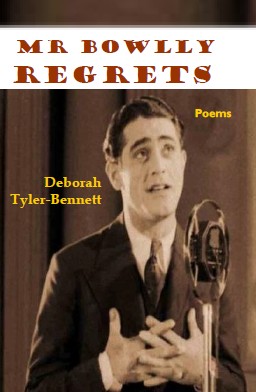
In this new interview, Deborah talks about her latest book, Mr Bowlly Regrets, and about poetry and politics:

Do you write every day?

I do write everyday: on trains; in cafés; in bars; at home; in other settings. I try and give myself a timetable between teaching Adult Ed creative writing, workshops, and performances, and the writing itself. I think the important thing is to do it. If the session is me writing alone, I split my day between the writing and reading aloud what I’ve done so far. I end when I feel the writing’s becoming stale and I need a break. I think knowing when to stop’s an art like anything else.

How many books have you written so far?

I have just finished the manuscript of my ninth poetry collection and am working on my first novel. I’ve also written three books of linked short fictions set in the world of variety. Also, I’ve had published a poetry pilot for schools and three creative writing textbooks and packs. I was fortunate enough to co-author the Victoria and Albert Museum’s creative writing web package with Gillian Spraggs. See below for details:

Volumes and Chapbooks: Poetry

Forthcoming 2019: Ken Dodd Takes a Holiday (King’s England).

Mr Bowlly Regrets (King’s England, 2017)

Napoleon Solo Biscuits (King’s England, 2015)

Volume Using Record Office Collection, Leicester:

Friendship’s Scrapbook (University of Leicester, 2015, reprinted and re-issued as two volumes in 2017, with extracts being published by the University’s Centre for New Writing in Women’s Writing in the Midlands 1750-1850, 2016). Two of the poems were later displayed on the front of Leicester University’s David Wilson Library and in the new Digital Resource Centre, for International Women's Day, 2018. ‘A Walk with Susanna Watts’ from the collection also appeared in Welcome to Leicester (Dahlia Publishing, 2016). Two Responses to the poems, plus a poem based on images of child migrants appeared in Leicester 2084 AD (CivicLeicester, 2018).

Kinda Keats (Shoestring, 2013): Inspired by Residency at Keats House, Hampstead.

Revudeville (King’s England, 2011): Featured many poems inspired by adult and school museum workshops.

Mytton … Dyer … Sweet Billy Gibson (Nine Arches, 2011). Three portraits in verse.

Pavilion (Smokestack, 2010). Poems set in Brighton and featuring images of Dandies.

Clark Gable in Mansfield (King’s England, 2003)

Selected Poems:

Take Five (Shoestring, 2003); The Staring Owl: An Anthology of Poems by the Poets of the King’s England Press (King’s England, 2017)

Special Museum Volume:

Ballad of Epping and Other Poems (Leicestershire Open Museum Pilot, 2007-2008)

Three linked books of short stories set in the 1940s/ 1950s/ 1960s world of variety:

Turned Out Nice Again (King’s England, 2013),

Mice That Roared (King’s England, 2015),

Brand New Beat (King’s England, 2017).

Museum and Education Volumes:

Words and Things: Writing Creatively from Objects and Art (with Mark Goodwin et al, Leicestershire County Council, 2008).

Speaking Words: Writing for Reading Aloud (Crystal Clear, 2005),

Poetry, Prose, and Playfulness for Teachers and Learners (with Mark Goodwin, Leicestershire County Council, 2004).

Museum Packs:

Leicestershire and Nottingham museums (includes Art and Education packs for Leicester’s Open Museum).

Special Commission, Victoria and Albert Museum:

Co-authored creative writing adult education web-package for the Victoria and Albert Museum with Gillian Spraggs, which included two of my poems on objects, these have since been used for summer schools at Wake Forest University, NC, USA and elsewhere.

See also Wellcome Collection work at the British Society for the History of Science (BSHS).

What is your latest book about?

It’s called Mr Bowlly Regrets, is a book of poems, and came out from King’s England Press in 2017. It has many poems about growing up, memory, and change, some on performers, including Britain’s Bing Crosby, the wonderful Al Bowlly. It also contains a sequence on the First World War, which came from a series of Lottery Funded workshops done for Diseworth and other Leicestershire villages. Those poems often contain images of real soldiers from the villages’ war memorials.

I’ve also just completed a further volume of poems for King’s England, Ken Dodd Takes a Holiday which is due out later in 2019. The poems are mainly about theatre and imagery from the lives of Music Hall and Variety performers – of which an elegy for Ken Dodd (to my mind the last of the Victorian inspired performers) is key to the rest of the poems.

On top of these, I’m working on my first novel, Livin’ in a Great Big Way, for the same publisher. This tells the story of Dad, Rosa, and their daughter, Spring, who live on Velia Street, Sutton-in-Ashfield. When the novel opens it’s 1946. Spring’s beloved Aunt, Reena, is dying, and her husband, Nev, is just back from service in Italy. The family have kept things buttoned-up throughout the war, but as Reena fades, secrets and confessions begin spilling out. Also, Dad has visions of moving up in the world, while Rosa’s happy where she is. This is not to mention Grandad Stocks who lives with Mrs Close, much to the family’s shame, Mrs Jim, next door neighbor and Velia Street’s beating heart, and Butcher Mr Cole and his odd wife – whose dreadful crime will come to haunt them all.

How long did it take you to write the book? 

My forthcoming book of poems has taken me a couple of years but, interestingly-enough, some of the poems are earlier ones I had in magazines and have since re-written. The poems in Mr Bowlly, likewise, took a couple of years to write, and King’s England published it in 2017. The novel was begun on the way back from the Callander Poetry Weekend in Scotland, in 2017. At first, I thought it was a short story, but it got longer and longer. So, in the end I had to admit it was a novel and carry on!

How did you chose a publisher for the book? Why this publisher? What advantages and/or disadvantages has this presented? How are you dealing with these?

Over the years I’ve had many publishers including Shoestring Press, Smokestack, University of Leicester Press, Leicester County Council Press, Nine Arches Press, and others. But the majority-of my stories and poems have been published by King’s England Press, Huddersfield, under direction of Steve Rudd. When they accepted my first volume of poems, Clark Gable in Mansfield in 2003, they published mainly historic and children’s books. Over years their poetry and fiction lists have grown, and I’ve come to trust Steve’s judgement as an editor. He’s allowed me a lot of consultation on how the volumes look, and how my poetry and prose is presented. He’s also allowed me to experiment and been honest over what did and didn’t work. So, I’ve enjoyed working with him and continue to do so.

Which aspects of the work you put into the book did you find most difficult? Why do you think this was so? How did you deal with these difficulties?

I think with most of my books of poems I deal with memory and characters a lot. I want the poems to be true to the ‘voices’ of various narratives and narrators. So, I think about who sees, who speaks, and period detail as I work. In Mr Bowlly, I wanted the title poem to bring Al Bowlly’s life, the fact he’s such a great performer and yet didn’t get his fair dues from history (he died in 1941 during the blitz, is buried in a communal grave, and has a blue plaque but no statue), and his wonderful singing voice to life. In performance I sing bits of the poem. If someone comes away from reading the volume to watch a clip of him on YouTube, I’ll be happy.

Which aspects of the work did you enjoy most? Why is this?

I enjoyed playing with poetic form in Mr Bowlly – there are sonnets, monologues in rhyming couplets, shaped poems, a poem to the rhythm Longfellow uses in ‘Hiawatha’, unrhymed couplets, and poems chiefly in dialogue. I love playing with form and have previously used sestinas and villanelles, which I go back to in my forthcoming book. Form really tests you, makes you think, and alters the poetic ‘voice.’ I review many poetry books and always feel a bit cheated when a poet doesn’t stretch themselves via form. Lots of unrhymed ‘free verse’ (like many poems I find the term doesn’t really describe what a verse with structures you come up with is) can feel much the same to me. So, I like testing the limits of a poem, and form helps me do this.

What sets the book apart from other things you’ve written?

Although most books represent developments and, hopefully, advancements in style and technique, I think Mr Bowlly differed in that I wanted the sections of the book to be read in tandem, but also stand alone.

I also think I dealt with the subject matter of the First World War in a more sequential way. Those poems were important to me as they dealt with histories of real soldiers that I came across during my workshops and I really wanted to get things right. I also realised that I used the poems to memorialise people who may not have got much of a memorial in death, a technique I began with an earlier poem about my Great Grandad’s son – ‘James William Gibson’ (in Mytton …Dyer …Sweet Billy Gibson) – who died in infancy and was buried below the cemetery wall. The soldiers I came across and used in poems for this newer volume often came from Institutions like the Industrial Schools, so, their next of kin might be their last employer.

In what way is it similar-to the others?

I think I’ve looked at similar histories and voices throughout my poetic career – maybe I’m fascinated with the ‘little things’ in history (both familial and wider) which, as my friend Ray Gosling once remarked, might be more important than the big things.

What will your next book be about?

As this will be the novel, I’d say about family life, of the triumphs and tragedies of human beings being able to live and work together. I realised, also, that the book has a lot of images of craft, (sewing, making, cooking etc.) that may go un-sung as a talent because people separate if from art. I collect vintage items from the 1940s, and often go to 1940s events, loving the music, endurance, and style of the period. Talking to historians and re-enactors (there are some splendid displays on the Home Front, from wedding dresses to the contents of a larder) has made me aware that making something from nothing is a skill to celebrate and venerate – yet often it’s passed-over in favour of the more showy-and-expensive object.

I have begun collecting brooches made by women (started when Mum gave me a brooch made by my Great Aunt from fuse wire, a belt buckle, and buttons shaped like flowers) and marvel at the artistry they create from things you would throw away. I wanted the novel to celebrate craft as someone’s art, their talent, and love – hence Reena in the book is a wonderful seamstress, and Mrs Jim comments at what she might have achieved with money behind her.

What would you say has been your most significant achievement as a writer?

I think, like most writers it’s carrying on writing. Not many people get to do what they love every day, and I think that’s something to be celebrated and, also, marveled at. Obviously, getting published is significant, as it gives your voice an audience, and I hope never to take this for granted. I’ve also been very lucky in the places I’ve worked and read in from the Wellcome Trust, Brighton Pavilion, and Keats House in Hampstead (where I did a residency), to small art galleries, schools and colleges – I wouldn’t have guessed, early on, that I’d work for any of them.

You have a poem featured in Bollocks to Brexit: An Anthology of Poems and Short Fiction. How did the poem come about?

I was tremendously pleased to be asked to be in the book and another poem on Brexit, ‘Ennui’, appears in my new collection. As a writer and someone who has always considered themselves a European, the divisions occasioned by Brexit have made me tremendously sad. I think that the poem, which I wrote especially for the volume, gave me an opportunity to highlight these divisions as they seem to me.

I hope the poem gives you a whistle-stop tour of what I observed after the vote, and how I consider it is the young who will suffer loss of opportunities, from which European Citizens such as myself benefited, from this most disastrous decision. When you feel that your voice is not being heard above shouting – poetry can give you your voice back.

Why is it important for poets to speak up on social, political and related matters?

Poetry has always spoken out on such matters! From Shelley to Blake, Suffragette poets to John Cooper Clarke, poets speak for themselves but also often for the excluded, and those finding themselves ‘voiceless.’

I think it’s worth considering that people sometimes remember lines from a poem giving protest, such as poems by Sassoon, Owen, and Graves from the First World War and those lines come to represent certain times in history perhaps more poignantly than anything else.

What do anthologies like Bollocks to Brexit add to poetry and public discourse?

In a time of shouting, it’s important to hear something more measured, and in a time when phrases such as ‘will of the people’ are being bandied about, it’s a good thing to remember that not all ‘people’ are being represented. You can read a poem over-and-over again, and think about it, come back to it. I always thought Barrack Obama sounded a better statesman than most, because I felt he’d considered his words with care.

Poetry considers its words with care.

Seamus Heaney talked of the right words in their proper places. I think public discourse, at present, is lacking in thoughtful, measured words. Perhaps it’s up to poetry to fill-in the gap.

Friday, July 19, 2019

Interview _ Deborah Tyler-Bennett

Deborah Tyler-Bennett’s forthcoming volume, Ken Dodd Takes a Holiday, is out from King’s England Press in 2019, and her first novel, Livin’ In a Great Big Way is in preparation for the same publisher. She also has two recent volumes from the same publisher – Mr Bowlly Regrets – Poems, and Brand New Beat: Linked Short Fictions Set in the 1960s (both 2017).

She’s had seven collections of poetry published, some previous volumes being Napoleon Solo Biscuits (King’s England, 2015), poems based on growing up in the 1960s and ‘70s, and Kinda Keats (Shoestring, 2013), work deriving from a residency at Keats House, Hampstead.

Her first collection of linked, 1940s set, short stories, Turned Out Nice Again came out from King’s England in 2013, and a sequel, set in the 1950s, Mice that Roared was published in 2015, Brand New Beat, set in the 1960s, represents the final part of the trilogy.

In 2016, The Coffee House Anthology from Charnwood Arts marked the final volume of Coffee House magazine, which she edited for twenty-five issues over fifteen years (this was featured on the Poetry Society’s poetic map of England).

Translations and publications of her poems have appeared in Spain, Ireland, The US, Scotland, Austria, and Romania, where they were broadcast on Radio Bucharest. She’s also read in Belgium.

Deborah regularly reviews poetry and has written books and education packs on creative writing.

Recent poems have appeared in the anthologies Double Bill (Red Squirrel, 2014), Maps and Legends (Nine Arches, 2013), Strike Up the Band: Poems for John Lucas at Eighty (Plas Gwyn Books, 2017), and the Max Miller Society journal, who recently published the elegy for Ken Dodd that forms the title poem in her new book. New poems appear in Leicester 2084 AD (CivicLeicester, 2018).

She regularly performs her work and has appeared at many venues in Brighton, London, the East Midlands and nationally. She occasionally teams up with music hall expert Ann Featherstone to perform variety stories from her first two collections. She also does many workshops for adult and school groups, teaches writing classes for the WEA, and hosts workshops for national galleries and museums.

In 2018 one of her poems was displayed on the side of Leicester University Library, and one at its new digital resource centre, for International Women’s Day.

With Gillian Spraggs, she co-authored the Victoria and Albert Museum’s creative writing web pages. She’s also currently working on a new poetic sequence, The Ladies of Harris’s List set in the eighteenth-century, and a series of music hall poems with Andy Jackson.

In this interview, Deborah Tyler-Bennett talks about her writing:

When did you start writing?

I’ve been writing things down for as long as I can remember being able to write and recall composing poems and bits of stories from the age of about eight. I don’t think I started taking the writing seriously until I was in my early twenties. Then you realise you’re starting to have drawers and notebooks full of stuff and you need to do something creative with it. I don’t think I felt I’d earned being called a ‘writer’ until I’d had a significant amount of work published.

How did you decide you wanted to be a published writer?

I think the above realisation (that you have lots of work and unless someone else gets to read it, it’s a little pointless, and also you have no feedback on what others think of it) drives you to send work out. Personally, I began sending poems to little magazines and competitions. I felt that if I had a body of published work behind me, and people responded to it, then maybe I could send work away for consideration as a collection.

The more I had published in little magazines, the more I felt I was becoming part of a poetic community and, also, most crucially, the more I learned. Editors sending advice and encouragement was invaluable to me. I also considered the range of where I sent to – I had quite a few things published in Ireland and found the magazines there an aesthetic delight. To achieve publication takes a thick skin and the old cliché about all writers getting used to rejections is true – but these make the publications you do get, sweeter.

How would you describe the writing you are doing?

I think my writing has changed a lot over the years. At-the-moment, I’ve just finished my ninth volume of poetry and am working on new poems. I’m also writing my first novel. This comes after three volumes of linked short stories. It’s always hard to describe your own work but I think I’ve become fascinated by the lives of so-called ‘ordinary’ people – and have come to believe that no one has an ‘ordinary life.’

I think writing is a great way of conveying past and present – and have noticed two things, recently, in commentaries on my work. Firstly, people comment on my use of Nottinghamshire dialect, as if it’s something unusual to use. Secondly, people often think I’ve invented elements that come from my own background and family history. I feel as if we’re living at a cultural time where, if we’re not careful, and despite the success of writers like Sally Wainwright and Andrew Graves on the script writing and poetry scenes, we’ll be going back to the idea of the arts as a preserve of the privileged and socially connected.

I realise what’s not unusual for me, seems unusual to some, and that there are many assumptions made about writing from ‘ordinary’ life.

I’m also using a lot of images and characters from music hall in my poetry (my new book’s titled Ken Dodd Takes a Holiday) as I do think that this reflects a type of history that often gets ignored, sidelined, or damned with the loaded phrase ‘popular culture.’

I’ve also started to take my painting more seriously and exhibit work and suspect that the colours and textures I use in visual art creep into my poems and stories.

Who is your target audience?

This question is interesting. When I started, I don’t think I thought in terms of a ‘target audience.’ Most poets I know are just glad to get an audience. But I do think over time I’ve become aware that with poetry in particular - I want my work to be accessible to the widest possible audience. I don’t really want someone to leave a reading of mine saying: “I didn’t get it.” Or “I think that was aimed at a poetry or literary-critical group.”

The same is also true of fiction. I like it when an audience laughs, holds its breath, or even joins-in. Maybe that’s the music hall influence again. I like it even more when someone approaches me after a reading to say that they didn’t think poetry was for them, but they enjoyed what I did and would go to a reading again. I try my stories out on local audiences, or reading them aloud at home, and hope that anyone who wanted to read something could do so without fear of being either talked at, down to, or addressed in a jargon clearly meant for a specific crowd.

In the writing you are doing, which authors influenced you most?

Like most writers, I love so many authors (both classic and contemporary) that it’s hard to narrow it down. I think the biggest influence on my poetry and storytelling has been the Orkney writer George Mackay Brown. He wrote novels, stories, poems, a column for his local paper, libretti, dramas and work for festivals. He could catch how people spoke, vibrant imagery of time and place and was fascinated by blurring boundaries between chronological periods. And his images are so vital, instead of saying someone was hungover he describes them as having a mouth ‘full of ashes’, lipstick imprinting a man’s cheek becomes ‘red birds’ – magic!

There are so many contemporary poets I admire, and I like those such as Emma Lee and Andrew Graves who are always experimenting and pushing the boundaries of what they do. Simon Armitage, Mark Goodwin, and John Hegley make me question how I write and what I can learn from people experimenting with language. Carol Leeming makes me think of how I perform and how I can do more, as do Ian Macmillan, Benjamin Zephaniah, and others. John Cooper Clarke, obviously, has an unmatchable status as performer and writer, I’ve always loved watching, hearing and reading him. I think it was Mark E. Smith of The Fall who said he didn’t wholly trust people who didn’t like John Cooper Clarke, and I think that’s sound (oh, that, and Elvis, too).

In prose, I’m still a huge fan of Dickens, as I think he tells such memorable stories full of such vibrant oddities. I did a PhD thesis on Djuna Barnes, and still find her work extraordinary. One book that I’ve found my most re-read is an anthology by John Sampson called The Wind on the Heath, about gypsies and published in the nineteen twenties. The stories and poems in it sing.

Likewise, I write a lot of ghost stories and am a huge fan of the form, loving E. Nesbit, Mary E. Braddon, Dickens, M.R. James, Ian Blake, and Susan Hill. Stars all. I think ghost stories are hard but worth it and reading around the genre helps you know your way around the structures of it. I swap ghost stories with Scottish writer, Ian Blake, and we enjoy a correspondence over the genre.

Sally Evans who edited Poetry Scotland has been a huge influence on my work, reading techniques, and has inspired me as a poet. Her poems do so much within economic lines and lingering images and I’ve never met anyone so welcoming and generous to her fellow poets. For years she and Ian King ran the Callander Poetry Weekend and it was a joy to attend and perform at that.

Lastly, I love European writing, and have always considered myself blessed as a writer to be part of Europe. The culture which includes writers as diverse as Balzac, Marco Vici, Hugo and Colette is an ever self-enriching one, and we have been fortunate indeed to be part of that.

How have your own personal experiences influenced your writing?

I think even if your telling of a certain story doesn’t seem connected to your own life experience, that experience will be embedded in this somewhere. Sometimes stories come directly from my family history, places travelled or lived in, or people met. Other stories might seem removed from the above, but actually- have elements of my experience in them.

Occasionally I write from a current event, and it’s true that living in ‘interesting times’ (a polite way of saying that you turn the news on every night wondering what on earth could have happened today) these ‘event’ based poems grow in number. Over the past year I’ve written poems as responses to the disaster of Brexit and about how lack of empathy leads people to disregard what’s happening to fellow human beings in front of their noses.

Even a poem based in the nineteenth century (‘The Boy Acrobat’s Villanelle’ published in Leicester 2084 AD) ended with an image of twenty-first century child migrants, children whose Dickensian plight can only be ignored via a spectacular lack of empathy.

What are your main concerns as a writer? 

Like most writers, I want to tell a story (whether in poetry or prose) well, and make the reader feel that the read was worth it. I also like putting people and places before the reader that come from my own growing-up, family stories, and local legends. I became aware in my late teens that my Grandma’s language, her bit of Nottinghamshire, and the world she grew up in, was vanishing. Like George Mackay Brown’s Orkney, I wanted to get some of it down before it went all together.

When I was writing my three volumes of stories set in variety, I had a desire to make the reader’s emotional response to the short fictions similar to those they’d get in a theatre – a story might bring a lump to your throat one minute and make you laugh in the next.

As with all such techniques and concerns, writers just have-to keep going, and I know whatever I’ve planned the story might well have other ideas. During the variety stories, an old lady, Grandwem (a cross between my Grandma and Great Aunt, plus some others) was going to be a minor character. She had other ideas and became the mainstay of all three books, the glue holding the family together.

In my current novel, the plan I’d made crashed and burned as a minor character did something awful as I wrote, and I had to go back and revise the whole first part of the book! Like painting, I love the unknown element that creeps in when you write, making me think of the old blues adage: ‘Make God laugh, tell him all your plans.”

What are the biggest challenges that you face? And, how do you deal with them?

I think for writers, challenges can be divided into practical working challenges, and aesthetic challenges.

The second category includes the obvious thing of being true to your ‘voice’ and the stories and poetic narratives you want to tell. In other words, it’s easy to become distracted from your purpose, think there are more fashionable things you could be writing, or forget why you wanted to tell a certain story in the first place. I’ve found it very useful to stop from time-to-time and ask: ‘why did you want to write this?’ I also find Robert Graves idea of ‘the reader over your shoulder’ very useful. Imagine someone looking at your work ‘over your shoulder’ – ask ‘what will they get out of it?’ If the answer is ‘not enough’ then that’s the time for a re-write or re-vision.

The first category I mentioned - the practical working challenge - may cover several bases. How much money do you need to earn to keep writing? Where does funding come from? How much time a week do you spend actually-writing? Is this time enough?

Due to current events, arts funding is going to become tighter, outreach for writers lessening as they are excluded from European opportunities, and I foresee writers who flourish will be previously established, have to work many more hours to stay afloat, or have private incomes and connections.

Reading information from literary bodies already indicates as much. I hope I’m wrong, and that writers beginning as I did from ordinary schools and backgrounds will have opportunities similar to mine. But I think most writers from state schools will struggle more, and that all writers will face challenges we couldn’t have seen prior to 2017. The challenge is (to mis-quote a US President) to do it because it is hard, to do it because it is there – to do it because that’s what you do. And (to misquote a US boxing legend) if you do what you love, strive to be the best at it you can be.

Wednesday, June 12, 2019

Interview _ Andrew Button

Andrew Button is from Market Bosworth and has had poems published in various magazines including Orbis, Staple, The Interpreter’s House, Iota and Ink, Sweat and Tears.

His pamphlet, Dry Days in Wet Towns, was published in 2016 and a first full collection, Melted Cheese on the Cosmic Pizza in 2017 by erbacce press.

In this interview, Andrew talks about his writing:

When did you start writing?

From the age of fourteen I always wanted to be a writer. The late Liverpool poet, Adrian Henri, was an early inspiration. He was invited to my school to encourage pupils to write and perform their poetry. From the ensuing workshop sessions, an anthology of our poems was published and presented at a performance evening for parents. I suppose I started writing seriously for magazine publication in my early twenties.

Adrian Henri and a very supportive English teacher convinced me that I had a talent for writing poetry and it progressed from there. This is going to sound like the stereotypical writers struggle, but from my early twenties I worked at my poems diligently, sent them off to magazines and got the majority of them back with a polite no thank you. Undeterred and buoyed on by minor successes, I persevered.

How would you describe the writing you are doing?

I aim to write poetry that is both amusing and thought-provoking. My poetry is observational, anecdotal and ironic and mostly drawn from the world around me. I like to see myself as a poetic eavesdropper! My sources of inspiration range from quirky news stories and themes (woodlice, horses in McDonalds, a man obsessed with roundabouts), popular culture and occasionally my own life experiences.

My target audience are adults who want their sense of wonder and amusement to be engaged. To write poems that are stepping stones for adult lives and experiences often drawing on common cultural reference points. Subconsciously, I have always written for an adult audience.

In the writing you are doing, which authors influenced you most? Why did they have this influence?

There are so many poets I admire. I love the imagery of Keats, the evocations and language used by Larkin. The humour of Roger McGough, Adrian Henri, Ian McMillan and Simon Armitage. The wit and poignancy of the Scottish poet, Liz Lochhead. I like Paul Farley (The Boy From the Chemist is Here to See You is a marvellous collection). I know a lot of local poets that deserve greater attention like Maria Taylor, Geraldine Clarkson, Jayne Stanton and Roy Marshall, all of whom I would recommend. When I attend an Open Mic event, I am one of those people who always buys somebody’s new book!!

The irony is that Ray Bradbury’s descriptive prose has been the biggest influence on my development as a writer. Appropriately, one critic described his work as the ‘poetry of the ordinary’. Another element of his writing that has inspired me is his ability to communicate a sense of wonder. That sense of wonder that children have and many lose in adulthood. I read somewhere that to be considered a well-rounded adult you need to retain a slice of that sense of wonder. Ray Bradbury captured it, bottled it and released it through his writing to millions of people all over the world. I tried my hand at writing short stories when I was younger but quickly began to realise that the poem was my chosen form of literary expression – or rather, it chose me!

How have your own personal experiences influenced your writing?

For a long time I wrote poems that were mainly observational and not about me. However, even in these poems I have realised that some of the aspects of my life and experience has seeped into them unconsciously. Recently, however, I have been drawing on personal experiences and in some cases, events that happened a long time ago. For example, there is a poem in my first full collection about a bicycle accident when I was seventeen! I think that as a writer, ideas for poems or stories often float to the surface many years later.

What are your main concerns as a writer?

As I have stated before, in my writing I am striving to make people laugh and ponder. I tend to be preoccupied with the themes of obsession, eccentricity, the minutiae of life, nostalgia and popular culture (especially music, art, literature and cinema).

I believe that as a poet of one my greatest challenges is to convince people that poetry is for sharing. Poetry should be given out with prescriptions, by the milkman, with school dinners. Poets should be parachuted into offices and shops, banks and supermarkets because there are still masses of people who think poetry is a foreign language and not for them. For me, getting out and reading my poems in as many public venues as possible is the way to meet this challenge.

Do you write everyday?

I think it is very important to get into a ‘writing routine’. I am fortunate in that I work part time. So, I set aside every Tuesday and Thursday morning for writing. Setting aside time regularly on a weekly basis is crucial. It is vital to keep the ‘writing muscle’ working. The very act of getting something down on paper helps the creative process. It is like a potter shaping his piece of clay. Even if inspiration is deserting me, I will revisit a poem that I am unhappy with or research a subject that is currently preoccupying me. That helps to kick-start the poetry brain. Reading a book and listening to music often lead me somewhere with a phrase or a lyric that catches my imagination. As my greatest influence, Ray Bradbury said, ‘Keep writing. Don’t stop.’

How many books have you written so far? And how did you find a publisher for them?

Dry Days in Wet Towns (a poetry pamphlet), erbacce press, Liverpool, 2016.

Melted Cheese on the Cosmic Pizza (first full poetry collection), erbacce press, Liverpool, 2017.

In 2016, I entered the erbacce poetry competition and my runners up prize was to have a pamphlet published (Dry Days in Wet Towns, erbacce , Liverpool, UK, 2016).

Melted Cheese on the Cosmic Pizza was published in Liverpool in November, 2017. Well, in truth, some of the poems were originally hatched back in my late twenties, but many have evolved into what you see in the book.

How would you describe Melted Cheese on the Cosmic Pizza?

The best way to describe what the book is about is to use quotes from the back cover:
As Siobhan Logan (another Leicestershire poet) wrote on the back of my book:
Like a poetry jukebox, quirky titles invite you to spin their tracks. Button's poems swerve from the apocalyptic to the domestic, from cosmic to comic, on the flip of a coin; rhymes pinging with wit and sudden pathos. Clocks, bereavement, mislaid love, B-sides, a rent-collecting Lowry and star-hopping Elvis, all jostle to leave you humming their tune, thumbing a knock-out phrase long after they're played out. Stack up those dimes and settle in; you won't be short-changed here.
Which aspects of the work you put into the book did you find most difficult?

To be honest, I did not find any part of the process difficult. I submitted a batch of poems to my publisher who then made the final selection of titles to be included. The editing was minimal and in fact the front cover design and quotes for the back cover took the longest time to organise.

Which aspects of the work did you enjoy most?

Seeing the final front cover and the arrangement of my poems was the biggest thrill. It still is. The dream becomes a reality.

What sets Melted Cheese on the Cosmic Pizza apart from other things you've written?

It was my first full collection and for that reason it will always be a special moment in my writing career.

In what way is it similar to the others?

It has established the themes, style and voice introduced in my fledgling pamphlet.

What would you say has been your most significant achievement as a writer?

To date my most significant achievement as a poet has been to have my first full collection published and to take it out on the road at various poetry open mics throughout 2018 and into 2019. As a poet you have to be visible. From a young age I always wanted to make people laugh. It’s a drug but a very desirable addiction. Writing anything humorous is a challenge and precarious. It is so easy to overdo it. One conclusion I have come to is that there is a lot of humour to extract from real life situations. I hope that comes across in my poetry. My raison d’etre as a poet is to write poems that make people laugh and think, and often at the same time.

What will your next book be about?

I am currently working towards my second poetry collection and am aiming to submit a manuscript towards the end of 2019 / early 2020.

Details of Andrew Button’s books can be found on the erbacce press website.

Wednesday, December 13, 2017

Leicester and Leicestershire look at how to raise profile of literature and literary scene

Individuals and groups that have an interest in the literary activity that takes place in Leicester and Leicestershire are meeting to look at what can be done to raise the profile of the scene locally, nationally and internationally.

The meeting is free and open to all and is taking place at the Bishop Street Methodist Church, 10a Bishop Street, on 13 December 2017, in Leicester, from 6.30pm till 9.30pm.

Speaking at the event are:

Henderson Mullin, Chief Executive Officer, Writing East Midlands (WEM)
James Urquhart, Relationship Manager for Literature in the Midlands, Arts Council England
Cllr Sarah Russell, Deputy City Mayor with responsibilities for Children, Young People's Services, Leicester City Council
Farhana Shaikh, Dahlia Publishing / Leicester Writes Short Story Prize / The Asian Writer
Matthew Pegg, Mantle Arts / Mantle Lane Press
Emma Lee, President, Leicester Writers Club; and
Bobba Cass, Pinggg...k!

The event is being hosted by the Leicester Writers' Showcase, and will be chaired by Attenborough Arts Centre director, Michaela Butter MBE.

The speakers will give the view they have of the literary scene in Leicester and Leicestershire and what they think can or ought to be done to raise the profile of the scene. They will also take part in a discussion and Question and Answer session with those present.

In addition to the presentations, there will be a display of books by local writers as well.

Leicester Librarian Matthew Vaughan says, "The Leicester Writers’ Showcase started in January 2017 and hosts a literary event once a month at the Central Library on Bishop Street.

"The Showcase aims to create space for conversations between readers, writers, spoken word artists, publishers, booksellers, and venues.

"The event we are hosting at the Bishop Street Methodist Church is part of the conversation people in the city and county need to have about the literary activity that takes place here and what can be done to increase its visibility."

Events that have been held as part of the Leicester Writers’ Showcase include launch-style events; readings, talks, and Q&A sessions; as well as, the Leicester and Leicestershire Writers’ Fair that was held during Everybody’s Reading 2017 and which is going to become a regular feature of the literary scene in Leicester.

Other Showcase plans include a Local Writers' Corner featuring books by local writers and which will be hosted by the Leicester Central Library.

About the speakers

Bobba Cass is a gay grey poet born in Seattle, Washington, USA but living in Leicester / Leicestershire since 1973. He organises a monthly poetry event, Pinggg…K! which celebrates the metrosexuality of verse. He is a member of Peoples Arts Collective. He is currently working on a series of fables for children, from Gramps with Love.

Bobba Cass will read from poetry and fables that draw on his life on three continents and on his experiences as an events organiser and grandad.

Emma Lee is President of Leicester Writers' Club. Her most recent poetry collection is Ghosts in the Desert (IDP, 2015). She co-edited Over Land, Over Sea: poems for those seeking refuge (Five Leaves, 2015) and Welcome to Leicester (Dahlia Publishing, 2016). Emma Lee blogs at http://emmalee1.wordpress.com. She reviews for The High Window Journal, The Journal, London Grip and Sabotage Reviews and has been shortlisted for the Best Reviewer Saboteur Award.

Emma will share insights from the Leicester Writers' Club which meets every Thursday at Phoenix Square in the heart of Leicester's Cultural Quarter. The Club is for professional and semi-professional writers and includes novelists, poets, short story writers, non-fiction writers, children's writers and scriptwriters. Members are both widely published and award-winners. The Club provides constructive criticism on work in progress, visiting industry speakers, social events, advanced masterclasses and a writers' retreat.

Farhana Shaikh is a writer and publisher born in Leicester. She edits The Asian Writer, an online magazine championing Asian literature and runs the small press, Dahlia Publishing which publishes regional and diverse writing. Farhana hosts the popular Writers Meet Up Leicester as well as Leicester Writes Festival of New Writing. In 2017, she won Travelex & Penguin’s The Next Great Travel Writer competition and is currently part of Curve’s Cultural Leadership programme.

Drawing on her experience as a writer, editor, publisher and events organiser, Farhana will give the view she has of the literary scene in Leicester and the region and suggest what can be done to raise the profile of the scene.

Matthew Pegg is Director of Mantle Arts, a participatory arts organisation based in Coalville, Leicestershire. He is also a published writer, playwright and graphic designer. Matthew will share insights from Mantle which, since 2015, has been running Red Lighthouse, a creative writing programme focused on publishing, development opportunities for Midlands writers and community projects.

Mantle also runs a writer development programme for authors interested in writing for children and young adults which includes the Wolves and Apples biannual conference on writing for children and a series of master classes on aspects of writing for the young. The next one of which is in March 2018.

In addition to that, Mantle Arts runs community projects that include playwriting projects in schools, song writing in care homes and a community audio drama about William Wordsworth’s time living in Leicestershire. Mantle Lane Press, Mantle’s publishing arm, issues a series of small books by Midlands writers, fiction anthologies and factual and historical books with a Midlands connection.

Cllr Sarah Russell is Deputy City Mayor with responsibilities for Children, Young People's Services, Leicester City Council. She has been a Councillor for 10 years and part of the City’s Executive team for the last 8 years. Throughout that time, Cllr Russell has been a passionate supporter of the Libraries Service and has taken every opportunity to promote books and reading. Despite no longer having responsibility for Library Services, Cllr Russell has continued to be the Reading Champion for the City Council and seeks to work with schools, young people and communities to promote reading (and writing) for pleasure as well as for formal means.

Henderson Mullin is Chief Executive Officer of Writing East Midlands which delivers writing-based projects and skills development opportunities across the region. Before setting up WEM in 2008, he ran Index on Censorship, a campaigning publisher which supports of freedom of expression. Henderson has worked in the arts sector for over 20 years and has sat on the Boards of several organisations including Writers and Scholars International, Free Word Centre, Human Rights House Foundation Oslo, Open Word FM, New Arts Exchange, FLUPP Literature Festival (Rio), Nottingham Literature Festival, and Nottingham UNESCO City of Literature, and the mighty Loughborough Foxes Women and Girls Football Club.

Henderson will be talking about what is happening on a regional and strategic level elsewhere and how WEM might support a process of developing the profile of Leicester’s writing and writers going forward.

James Urquhart is the Relationship Manager for Literature in the Midlands for Arts Council England. After 15 years as a freelance literary critic, regularly published in a range of UK broadsheets, James joined Arts Council England in 2010. His role as Relationship Manager includes offering development and funding advice and monitoring Arts Council England investments in literature projects and organisations.

James will give the view he has of the Leicester/shire literary scene and future possibilities. He will also talk about the Arts Council’s funding programme, Grants for Arts and Culture (formerly known as Grants for the Arts), which is open to writers, artists and organisations.

About the Chair

Michaela Butter MBE has over 30 years of experience working in the arts as a curator, promoter and funder. Currently Director of Attenborough Arts Centre, the University of Leicester's arts centre, she is responsible for developing an inclusive approach to a growing public programme of performing and visual arts, with a strong emphasis on supporting emerging talent, creative learning and community engagement. She also plays a growing role in wider cultural policy at the University of Leicester and beyond.

*See also:

1. Leicester & Leicestershire: City and County of Literature, Eventbrite listing
2. Grassroutes: Contemporary Leicestershire Writing, University of Leicester
3. Cultural Exchanges Festival, De Montfort University Leicester (DMU)
4. Ross Bradshaw, "States of Independence", 17 March 2012 (Video)

Monday, April 24, 2017

Interview _ Penny Jones

Penny Jones is a writer from Leicestershire.

She has been published by Fox Spirit Books, Factor Fiction Press, Five Leaves Publications, and Dahlia Publishing. Among other writers' conventions and conferences, she attends the monthly meet up of Leicester Writes.

In this interview, Penny Jones talks about her writing, Over Land, Over Sea and Journeys in Translation.

How would you describe the writing that you do?

I'm new to writing, so at the moment I write anything and everything. I find writing really hard, but find procrastinating really easy, so writing in different styles and genres means that I can try and fool my brain when it is telling me to give up.

I have recently finished the first draft of a novel, and throughout the process all I wanted to do was write the short story I had been commissioned to write; then when I was writing that, all I wanted to do was write the screenplay for the course I was attending, and now I'm doing that all I want to do is go back to re-writing the novel.

Who or what has had the most influence on you as a writer?

I read for pleasure, and admire writers who manage to take big issues and make them accessible through fiction.

I don't tend to stick to one style of literature and enjoy finding new writers, so each year I take up a different reading challenge; for example one year I made my way through the alphabet, another year all the authors had to be from different countries.

I want my writing to be as well rounded and diverse as possible, and so I want as wide an influence of subjects and authors as possible.

How have your personal experiences influenced your writing?

I very much put myself into each and every character I write about, especially my flaws. I like my characters to be well rounded, so I look at my experiences and use those to try and see how I would react to a situation. Also, my background as a psychiatric nurse helps as I can utilise the skills and knowledge that I use as a nurse, to empathetically see how my characters are feeling and how they would react; the protagonist in my novel is a young boy, so his reaction to events will be drastically different to my own.

What has been your most significant achievement as a writer so far?

My most significant achievement so far was my first commissioned piece, which was for a charity zine called Do Something by Factor Fiction Press. The first time you are asked to contribute to something, rather than sending in to an open submission, feels amazing.

How did you get involved with Journeys in Translation?

I felt very strongly about supporting Syrian refugees, so when I saw a post on Facebook, where they were looking for poems for a charity anthology I knew that I had to at least send them something, even though I hadn't written any poetry since my school days.

My poem "What's in a name?" was accepted for the anthology Over Land, Over Sea: Poems for those seeking refuge by Five Leaves Publications, and following on from that one of the editors, Emma Lee, asked if it could be included in a project to bring the message to as many people as possible through translation.

Penny Jones' poem, "What's in a Name?", on the pavement at the Leicester Against War / Leicester for Peace vigil that, since December 2015, is held every Friday at the Clock Tower in Leicester in solidarity with people everywhere who are bearing the brunt of war and those who are seeking refuge.

Which were the easiest aspects of the work you put into the project?

The easiest aspects of the work, was the idea for the poem. I can only really write poetry if I already have an idea in mind, and for this project it was already clear in my mind, that I wanted to look at humanising refugees.

I had seen and heard many people using the terms refugee and immigrant interchangeably, and it angered me that not only did people not understand the difference between someone who was a refugee and someone who was an immigrant; but also that these people who were dying had become faceless and nameless. So I wanted my poem to show that these were people, they were someone's son, daughter, brother, or sister.

Which were the most challenging?

The most challenging aspect of "What's in a name?" was that although the letter "E" is the most common letter used in England, it is the least common in Syria. This is a major issue when you are writing an acrostic using the word refugee, so finding three Syrian names that began with "E" was really difficult; especially as I wanted to use the name's meaning as the crutch for each line of the poem.

It took hours to find three Syrian names that began with "E", and I only then managed it because some Arabic names that are spelt with an "I" have alternative spellings that start with "E". "What's in a name" took about 10 hours to write, but 9 hours was just trying to find those three names.

Penny Jones' poem, "What's in a Name?", Over Land, Over Sea: Poems for those seeking refuge (Five Leaves Publications, 2015) p.5. Translated into Bengali by Rinita Banerjee‎.

What would you say is the value of initiatives like Journeys in Translation?

The value to initiatives like Journeys in Translation, is that you can get the message out to as many people as possible.

Language is a barrier that we all face, but if we can share our stories and our beliefs it can be a barrier we can peep over, shake hands, and discuss our differences, rather than remain hidden behind.

Editor's Note:

Journeys in Translation aims to facilitate cross- and inter-cultural conversations around the themes of home, belonging and refuge.

The project encourages people who are bilingual or multilingual to have a go at translating 13 of the 101 poems from Over Land: Over Sea: Poems for those seeking refuge (Five Leaves Publications, 2015) from English into other languages and to share the translations, and reflections on the exercise on blogs, in letters and emails to family and friends, and on social media.

So far, the 13 poems that are being used as part of the project have been translated into languages that include Italian, German, Shona, Spanish, Bengali, British Sign Language, Farsi, Finnish, French, Turkish and Welsh. Currently, over 20 people from all over the world are working on the translations. More translations and more languages are on the way.

In Leicester, Journeys in Translation will culminate in an event that is going to be held on September 30 as part of Everybody's Reading 2017. During the event the original poems and translations will be read, discussed and displayed.

Over Land, Over Sea: Poems for Those Seeking Refuge (Five Leaves Publications, 2015) was edited by Kathleen Bell, Emma Lee and Siobhan Logan and is being sold to raise funds for Doctors Without Borders/ Médecins Sans Frontières (MSF)Leicester City of Sanctuary and the Nottingham and Nottinghamshire Refugee Forum.

Copies of the anthology are available from Five Leaves Bookshop (Nottingham).

More information on how Over Land, Over Sea came about is available here.

Saturday, April 22, 2017

Interview _ David Wilkinson

David Wilkinson
David Wilkinson lives in Ashby de la Zouch and works as the Midlands Regional Officer for the Institute of Physics.

His debut novel, We Bleed the Same (Inspired Quill, 2014) was shortlisted for the East Midlands Book Award 2015.

In this interview, David Wilkinson talks about his concerns as a writer.

When did you start writing?

I have been making up stories set in my fictional “universe” since I was about five. These have been refined over the years until I had novel plots set in my mind. I would talk extensively to my wife about them and she kept saying I should try writing them out. Then a confluence of events occurred. First I got paid to write an article in a science magazine. Then I heard a successful playwright interviewed on BBC Radio 4 who used to be a girl in my English GCSE class, giving feelings of “well, if she can do it...” But mostly it was my wife just telling me to shut up and get on with it, buying me a course at the Leicester Writing School for my birthday in the process. 14th September 2011, the day after the first workshop, at around about lunchtime, was when I started writing!

How would you describe the writing you are doing?

It would firmly sit on the science fiction shelf, some would say space opera. However, the books are totally plot and character driven. It is about interesting people interacting with each other in a dysfunctional society that just happens to span half the galaxy.

The work is certainly adult and has plenty in it for the science fiction fan. However, several non-sci-fi fans who have read it, or parts of it, find themselves enjoying it too. It has a political thrust and also an undercurrent of feminism, so it would be nice to get into broader markets. As for why – I am just writing what I know and love.

Which authors influenced you most?

The very first science fiction books I read as a child were Spaceship Medic by Harry Harrison and Wheelie in the Stars by Nicholas Fisk.

There's a tiny homage to Medic in my first novel; I wonder if anyone can spot it.

As I got older I ploughed into most of Asimov and, like so many others, I owe future city building to the Caves of Steel.

Dystopias had a strong impact – From Huxley’s Brave New World to Orwell’s 1984.

The one standout novel that had the most influence on me was The Mote in God’s Eye by Niven and Pournelle. It really brought home to me the truth that good Science Fiction is about our contemporary world. I was also impressed by their amalgam of current and future tech. It really brought characters to the fore and had the power of story where characters were neither entirely good nor entirely bad.

What are your main concerns as a writer?

I’m not a fan of large swathes of description. I don’t enjoy reading it and I am not good at writing it (as evidenced by my cold readers, editors and anyone else who has ever got near an unedited version of my work). As a result I have learned about writing detail.

If you write about one of your characters tracing greasy outlines on the outside of their mug, you don’t have to write a long description of the squalor of the canteen they are sitting in. It also keeps the reader close to the action.

What are the biggest challenges that you face?

The biggest challenges are my everyday life. I have two children under eight and a full time job. I am also learning to play a concerto. Writing just fills in the odd free moment. I also write on trains – that’s where I am doing this interview now.

Do you write every day?

Taking into account the previous question, the writing experience is usually the same. I sit down and spend about 10 minutes reading over what has come before, ostensibly to get into the flow but really just to put off the moment of beginning.

Once I start, the first 15-20 minutes are a real struggle and on about a quarter of attempts, I stop in this time. Then, twenty minutes in, something magical happens and I hit the zone. Without apparent effort I will reel out about 750-800 words of good material. Then I feel tired and notice that an hour has passed since I sat down.

This varies sometimes.

In particularly compelling chapters I’ll be able to keep going and get down 2,000-2,500 words in a two-hour sitting.

As I approached the end of my last novel, I went into something of a frenzy, writing whole chapters in about an hour or so. In this way I wrote the last ten chapters (20,000 words) in less than a week. That bit needed a lot of editing!

How long did it take you to write We Bleed the Same?

I started writing We Bleed the Same in the novel workshop series my wife bought me. At that time it was the only fiction I had ever written. The publisher Inspired Quill gave me a contract and We Bleed the Same came out in July 2014.

It took almost exactly a year to complete the first draft. Afterwards there was about three months of personal editing. My cold readers then had it for a month before I spent another two months editing again. This is when I started sending it to agents.

David Wilkinson's debut novel, We Bleed the Same (Inspired Quill, 2014) was shortlisted for the East Midlands Book Award 2015.

How did you chose a publisher for the book?

Well, primarily Inspired Quill was the one that offered me a contract. They are a small, new publisher and they are operating as a social enterprise, putting income back into social programmes. They were very up front about the realities of signing with a young, small publisher – even presenting me with a list of pros and cons of their own. The main con is that they don’t have a large advertising budget. The pros include a more collegiate approach to editing, a personal relationship with the boss and a good deal on royalties.

Which aspects of the work you put into the book did you find most difficult? Why do you think this was so? And, how did you deal with these challenges?

Just keeping going. Getting the words down has always been my biggest irritation – I am much happier developing plot. I just have to hold my nose and get on with it.

Which aspects of the work did you enjoy most?

Plotting. I do it entirely in my head and write almost no notes. This lets me do it in the shower, driving the car or walking the dogs. It is always there, ticking away in the back of my mind and the wonderful thing is when revelatory story lines spring into my mind. At those moments I stop, smile and sometimes do a fist pump.

What sets We Bleed the Same apart from other things you've written?

Everything else I have written has been factual and in the field of forensic physics.

Are there any similarities?

I don’t like breaking the laws of physics – there is no artificial gravity or inertial dampening. Where I have had to extend science, I have tried to provide adequate explanations.

What will your next book be about?

It is a detective story set in the same “universe”.

In my first novel a character is reading a detective story set in a city they visit. It is this book, Pilakin: Falling Rubble, that I am writing. It is essentially SciFi Noir.

What would you say has been your most significant achievement as a writer?

Getting a publisher on my first piece of fiction.