Showing posts with label short fiction. Show all posts

Saturday, July 23, 2022

Welcome to Britain: a Call for Poetry and Short Fiction

CivicLeicester is inviting and accepting poems and short fiction on the theme, Welcome to Britain.

We welcome submissions exploring but not limited to:

  • images, issues, histories, lives, and demands that are currently in play in Britain today

  • daily life in Britain

  • reparations for slave trading, the use of slave labour and for benefiting from the slavery system (the extended global system involving plantation labour and slave-produced commodities etc)

  • issues that made the Black Lives Matter movement relevant to Britain, the current state of the movement and its possible futures

  • responses that engage with, contest and subvert the myths Britain tells about itself

  • responses to British politicians' attitudes towards the use of nuclear weapons and their fixation with the idea of pushing 'the button'

  • responses to Britain’s role in the current Ukraine-Russian War that go beyond, engage with or challenge the propaganda coming from both sides of the conflict

  • responses to how Britain positions itself in the world

  • migration, refugee and human rights issues in Britain,  and

  • issues affecting racialised and minoritised groups in Britain.


We welcome submissions from writers of all ages, based anywhere in the world. 


Please send the poems and/or short fiction to civicleicester@gmail.com by 2pm on Thursday, 8 September 2022.


Submission Guidelines


● Poems should be 40 lines or less

● Short prose 100 words or less.

● The poems and short prose should be on the theme, Welcome to Britain

● Submissions must be in English. In the case of translated work, it is the translator’s responsibility to obtain permission from the copyright holder of the original work.

● If submitting a poem or short prose that has been previously published, please give details of where it has appeared and confirm that you are the copyright holder.

● Ideally submissions will be typed single spaced and submitted either in the body of an email or as a .doc attachment.

● Please include a short biography of 100 words or less. This will be included in the anthology if your poem or short fiction is accepted. 

● You may submit a maximum of three poems or three pieces of short fiction or a combination of poems and short fiction. You do not have to submit all three at the same time, but the editors can only consider a maximum of three submissions.

● We welcome submissions from writers of all ages, based anywhere in the world.

● Please send the poems and short fiction to civicleicester@gmail.com by 2pm on Thursday, 8 September 2022.


CivicLeicester is an indy publisher that uses poetry, video, photography and the arts to highlight conversations. Books we have published include Poetry and Settled Status for All: An Anthology (2022), Black Lives Matter: Poems for a New World (2020) and Bollocks to Brexit: an Anthology of Poems and Short Friction (2019).

Monday, June 8, 2020

Black Lives Matter: a Call for Poems and Microfiction

Black Lives Matter: Poems for a New Word (CivicLeicester, 2020) is now available*

CivicLeicester is inviting and accepting poems and short fiction on the theme, Black Lives Matter.

We welcome submissions exploring any of the images, issues, triggers, histories, lives, demands and outcomes that are being highlighted by Black Lives Matter and current and past protests.

We welcome submissions from writers of all ages, based anywhere in the world.

The video of George Floyd dying as a white policeman pressed his knee against Floyd's neck and kept it there even after Floyd had stopped speaking or moving has triggered weeks of mass protests around the world.

The protests are taking place in the midst of a global pandemic that is also disproportionately killing people from Black, Asian and ethnic minority backgrounds.

Around the world people are demanding justice.

"Black Lives Matter", "Hands up, don't shoot", "Am I a threat?", "I can't breathe", "White silence is violence", "No justice, no peace", "Is my son next?", "Get your knee off my neck" have become rallying calls against police brutality and against the killing of Black people by the police. They have become rallying calls against racism, racial profiling and racialised inequality, discrimination and oppression.

Please send the poems and short fiction to civicleicester@gmail.com by 2pm on Tuesday, 7 July 2020

Submission Guidelines

● Poems should be 40 lines or less, and short fiction, 100 words or less.
● The poems and short fiction should be on the theme, Black Lives Matter.
● Submissions must be in English. In the case of translated work, it is the translator’s responsibility to obtain permission from the copyright holder of the original work.
● If submitting a poem or short fiction which has been previously published, please give details of where it has appeared and confirm that you are the copyright holder.
● Ideally submissions will be typed single spaced and submitted either in the body of an email or as a .doc attachment.
● Please include a short biography of 50 words or less. This will be included in the anthology if your poem is accepted. If you do not send a biography, it will be assumed you do not wish your biography to appear in the anthology.
● You may submit a maximum of three poems or three pieces of short fiction or a combination of poems and short fiction. You do not have to submit all three at the same time, but the editors can only consider a maximum of three submissions.
● We welcome submissions from writers of all ages, based anywhere in the world.
● Please send the poems and short fiction to civicleicester@gmail.com by 2pm on Tuesday, 7 July 2020.

Notes:

1. Black Lives Matter poetry anthology fundraising page
2. Black Lives Matter, Wikipedia entry
3. CivicLeicester is an indy publisher that uses video, photography and the arts to highlight conversations
 
*Updated on 17 November 2020 to show that Black Lives Matter: Poems for a New World (CivicLeicester, 2020) is now available.

Wednesday, July 24, 2019

Interview _ Deborah Tyler-Bennett

Deborah Tyler-Bennett is a poet and fiction writer with eight volumes of poems and three volumes of short linked stories to her credit. She is currently working on her first novel, Livin' in a Great Big Way. Her new volume, Ken Dodd Takes a Holiday, will be out from King's England in 2019.

Her poems have also been featured in anthologies that include Bollocks to Brexit: an Anthology of Poems and Short Fiction (CivicLeicester, 2019), Leicester 2084 AD: New Poems about The City (CivicLeicester, 2018) and Welcome to Leicester (Dahlia Publishing, 2016).

In an earlier interview, Deborah talked about her concerns as a writer, and some of the influences she draws on.

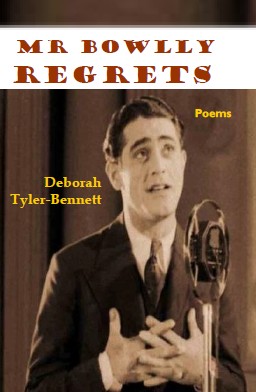
In this new interview, Deborah talks about her latest book, Mr Bowlly Regrets, and about poetry and politics:

Do you write every day?

I do write everyday: on trains; in cafés; in bars; at home; in other settings. I try and give myself a timetable between teaching Adult Ed creative writing, workshops, and performances, and the writing itself. I think the important thing is to do it. If the session is me writing alone, I split my day between the writing and reading aloud what I’ve done so far. I end when I feel the writing’s becoming stale and I need a break. I think knowing when to stop’s an art like anything else.

How many books have you written so far?

I have just finished the manuscript of my ninth poetry collection and am working on my first novel. I’ve also written three books of linked short fictions set in the world of variety. Also, I’ve had published a poetry pilot for schools and three creative writing textbooks and packs. I was fortunate enough to co-author the Victoria and Albert Museum’s creative writing web package with Gillian Spraggs. See below for details:

Volumes and Chapbooks: Poetry

Forthcoming 2019: Ken Dodd Takes a Holiday (King’s England).

Mr Bowlly Regrets (King’s England, 2017)

Napoleon Solo Biscuits (King’s England, 2015)

Volume Using Record Office Collection, Leicester:

Friendship’s Scrapbook (University of Leicester, 2015, reprinted and re-issued as two volumes in 2017, with extracts being published by the University’s Centre for New Writing in Women’s Writing in the Midlands 1750-1850, 2016). Two of the poems were later displayed on the front of Leicester University’s David Wilson Library and in the new Digital Resource Centre, for International Women's Day, 2018. ‘A Walk with Susanna Watts’ from the collection also appeared in Welcome to Leicester (Dahlia Publishing, 2016). Two Responses to the poems, plus a poem based on images of child migrants appeared in Leicester 2084 AD (CivicLeicester, 2018).

Kinda Keats (Shoestring, 2013): Inspired by Residency at Keats House, Hampstead.

Revudeville (King’s England, 2011): Featured many poems inspired by adult and school museum workshops.

Mytton … Dyer … Sweet Billy Gibson (Nine Arches, 2011). Three portraits in verse.

Pavilion (Smokestack, 2010). Poems set in Brighton and featuring images of Dandies.

Clark Gable in Mansfield (King’s England, 2003)

Selected Poems:

Take Five (Shoestring, 2003); The Staring Owl: An Anthology of Poems by the Poets of the King’s England Press (King’s England, 2017)

Special Museum Volume:

Ballad of Epping and Other Poems (Leicestershire Open Museum Pilot, 2007-2008)

Three linked books of short stories set in the 1940s/ 1950s/ 1960s world of variety:

Turned Out Nice Again (King’s England, 2013),

Mice That Roared (King’s England, 2015),

Brand New Beat (King’s England, 2017).

Museum and Education Volumes:

Words and Things: Writing Creatively from Objects and Art (with Mark Goodwin et al, Leicestershire County Council, 2008).

Speaking Words: Writing for Reading Aloud (Crystal Clear, 2005),

Poetry, Prose, and Playfulness for Teachers and Learners (with Mark Goodwin, Leicestershire County Council, 2004).

Museum Packs:

Leicestershire and Nottingham museums (includes Art and Education packs for Leicester’s Open Museum).

Special Commission, Victoria and Albert Museum:

Co-authored creative writing adult education web-package for the Victoria and Albert Museum with Gillian Spraggs, which included two of my poems on objects, these have since been used for summer schools at Wake Forest University, NC, USA and elsewhere.

See also Wellcome Collection work at the British Society for the History of Science (BSHS).

What is your latest book about?

It’s called Mr Bowlly Regrets, is a book of poems, and came out from King’s England Press in 2017. It has many poems about growing up, memory, and change, some on performers, including Britain’s Bing Crosby, the wonderful Al Bowlly. It also contains a sequence on the First World War, which came from a series of Lottery Funded workshops done for Diseworth and other Leicestershire villages. Those poems often contain images of real soldiers from the villages’ war memorials.

I’ve also just completed a further volume of poems for King’s England, Ken Dodd Takes a Holiday which is due out later in 2019. The poems are mainly about theatre and imagery from the lives of Music Hall and Variety performers – of which an elegy for Ken Dodd (to my mind the last of the Victorian inspired performers) is key to the rest of the poems.

On top of these, I’m working on my first novel, Livin’ in a Great Big Way, for the same publisher. This tells the story of Dad, Rosa, and their daughter, Spring, who live on Velia Street, Sutton-in-Ashfield. When the novel opens it’s 1946. Spring’s beloved Aunt, Reena, is dying, and her husband, Nev, is just back from service in Italy. The family have kept things buttoned-up throughout the war, but as Reena fades, secrets and confessions begin spilling out. Also, Dad has visions of moving up in the world, while Rosa’s happy where she is. This is not to mention Grandad Stocks who lives with Mrs Close, much to the family’s shame, Mrs Jim, next door neighbor and Velia Street’s beating heart, and Butcher Mr Cole and his odd wife – whose dreadful crime will come to haunt them all.

How long did it take you to write the book? 

My forthcoming book of poems has taken me a couple of years but, interestingly-enough, some of the poems are earlier ones I had in magazines and have since re-written. The poems in Mr Bowlly, likewise, took a couple of years to write, and King’s England published it in 2017. The novel was begun on the way back from the Callander Poetry Weekend in Scotland, in 2017. At first, I thought it was a short story, but it got longer and longer. So, in the end I had to admit it was a novel and carry on!

How did you chose a publisher for the book? Why this publisher? What advantages and/or disadvantages has this presented? How are you dealing with these?

Over the years I’ve had many publishers including Shoestring Press, Smokestack, University of Leicester Press, Leicester County Council Press, Nine Arches Press, and others. But the majority-of my stories and poems have been published by King’s England Press, Huddersfield, under direction of Steve Rudd. When they accepted my first volume of poems, Clark Gable in Mansfield in 2003, they published mainly historic and children’s books. Over years their poetry and fiction lists have grown, and I’ve come to trust Steve’s judgement as an editor. He’s allowed me a lot of consultation on how the volumes look, and how my poetry and prose is presented. He’s also allowed me to experiment and been honest over what did and didn’t work. So, I’ve enjoyed working with him and continue to do so.

Which aspects of the work you put into the book did you find most difficult? Why do you think this was so? How did you deal with these difficulties?

I think with most of my books of poems I deal with memory and characters a lot. I want the poems to be true to the ‘voices’ of various narratives and narrators. So, I think about who sees, who speaks, and period detail as I work. In Mr Bowlly, I wanted the title poem to bring Al Bowlly’s life, the fact he’s such a great performer and yet didn’t get his fair dues from history (he died in 1941 during the blitz, is buried in a communal grave, and has a blue plaque but no statue), and his wonderful singing voice to life. In performance I sing bits of the poem. If someone comes away from reading the volume to watch a clip of him on YouTube, I’ll be happy.

Which aspects of the work did you enjoy most? Why is this?

I enjoyed playing with poetic form in Mr Bowlly – there are sonnets, monologues in rhyming couplets, shaped poems, a poem to the rhythm Longfellow uses in ‘Hiawatha’, unrhymed couplets, and poems chiefly in dialogue. I love playing with form and have previously used sestinas and villanelles, which I go back to in my forthcoming book. Form really tests you, makes you think, and alters the poetic ‘voice.’ I review many poetry books and always feel a bit cheated when a poet doesn’t stretch themselves via form. Lots of unrhymed ‘free verse’ (like many poems I find the term doesn’t really describe what a verse with structures you come up with is) can feel much the same to me. So, I like testing the limits of a poem, and form helps me do this.

What sets the book apart from other things you’ve written?

Although most books represent developments and, hopefully, advancements in style and technique, I think Mr Bowlly differed in that I wanted the sections of the book to be read in tandem, but also stand alone.

I also think I dealt with the subject matter of the First World War in a more sequential way. Those poems were important to me as they dealt with histories of real soldiers that I came across during my workshops and I really wanted to get things right. I also realised that I used the poems to memorialise people who may not have got much of a memorial in death, a technique I began with an earlier poem about my Great Grandad’s son – ‘James William Gibson’ (in Mytton …Dyer …Sweet Billy Gibson) – who died in infancy and was buried below the cemetery wall. The soldiers I came across and used in poems for this newer volume often came from Institutions like the Industrial Schools, so, their next of kin might be their last employer.

In what way is it similar-to the others?

I think I’ve looked at similar histories and voices throughout my poetic career – maybe I’m fascinated with the ‘little things’ in history (both familial and wider) which, as my friend Ray Gosling once remarked, might be more important than the big things.

What will your next book be about?

As this will be the novel, I’d say about family life, of the triumphs and tragedies of human beings being able to live and work together. I realised, also, that the book has a lot of images of craft, (sewing, making, cooking etc.) that may go un-sung as a talent because people separate if from art. I collect vintage items from the 1940s, and often go to 1940s events, loving the music, endurance, and style of the period. Talking to historians and re-enactors (there are some splendid displays on the Home Front, from wedding dresses to the contents of a larder) has made me aware that making something from nothing is a skill to celebrate and venerate – yet often it’s passed-over in favour of the more showy-and-expensive object.

I have begun collecting brooches made by women (started when Mum gave me a brooch made by my Great Aunt from fuse wire, a belt buckle, and buttons shaped like flowers) and marvel at the artistry they create from things you would throw away. I wanted the novel to celebrate craft as someone’s art, their talent, and love – hence Reena in the book is a wonderful seamstress, and Mrs Jim comments at what she might have achieved with money behind her.

What would you say has been your most significant achievement as a writer?

I think, like most writers it’s carrying on writing. Not many people get to do what they love every day, and I think that’s something to be celebrated and, also, marveled at. Obviously, getting published is significant, as it gives your voice an audience, and I hope never to take this for granted. I’ve also been very lucky in the places I’ve worked and read in from the Wellcome Trust, Brighton Pavilion, and Keats House in Hampstead (where I did a residency), to small art galleries, schools and colleges – I wouldn’t have guessed, early on, that I’d work for any of them.

You have a poem featured in Bollocks to Brexit: An Anthology of Poems and Short Fiction. How did the poem come about?

I was tremendously pleased to be asked to be in the book and another poem on Brexit, ‘Ennui’, appears in my new collection. As a writer and someone who has always considered themselves a European, the divisions occasioned by Brexit have made me tremendously sad. I think that the poem, which I wrote especially for the volume, gave me an opportunity to highlight these divisions as they seem to me.

I hope the poem gives you a whistle-stop tour of what I observed after the vote, and how I consider it is the young who will suffer loss of opportunities, from which European Citizens such as myself benefited, from this most disastrous decision. When you feel that your voice is not being heard above shouting – poetry can give you your voice back.

Why is it important for poets to speak up on social, political and related matters?

Poetry has always spoken out on such matters! From Shelley to Blake, Suffragette poets to John Cooper Clarke, poets speak for themselves but also often for the excluded, and those finding themselves ‘voiceless.’

I think it’s worth considering that people sometimes remember lines from a poem giving protest, such as poems by Sassoon, Owen, and Graves from the First World War and those lines come to represent certain times in history perhaps more poignantly than anything else.

What do anthologies like Bollocks to Brexit add to poetry and public discourse?

In a time of shouting, it’s important to hear something more measured, and in a time when phrases such as ‘will of the people’ are being bandied about, it’s a good thing to remember that not all ‘people’ are being represented. You can read a poem over-and-over again, and think about it, come back to it. I always thought Barrack Obama sounded a better statesman than most, because I felt he’d considered his words with care.

Poetry considers its words with care.

Seamus Heaney talked of the right words in their proper places. I think public discourse, at present, is lacking in thoughtful, measured words. Perhaps it’s up to poetry to fill-in the gap.
Wednesday, January 16, 2019

Bollocks to Brexit: Poetry & Microfiction - a Call for Submissions

Bollocks to Brexit: an Anthology of Poems and Short Fiction (CivicLeicester, 2019) is now available.*

We are inviting, and are accepting, poems and short fiction on the theme, Bollocks to Brexit.

Brexit has polarised the country and led to the normalisation of xenophobia, Islamophobia and hate crimes. Can the harm it is causing be stopped? Can it be reversed? Who should clean up the mess which the politicians have made and are making? What will the future be like for Britain? Who will be the winners and who the losers? Should it be like this? Should the country be divided in two?

Please send the poems and short fiction to civicleicester@gmail.com by 11pm on Friday, 29 March 2019.

Submission Guidelines

● Poems should be 40 lines or less, and short fiction, 100 words or less.
● The poems and short fiction should be on the theme, Bollocks to Brexit.
● Submissions must be in English. In the case of translated work, it is the translator’s responsibility to obtain permission from the copyright holder of the original work.
● If submitting a poem or short fiction which have been previously published, please give details of where it has appeared and confirm that you are the copyright holder.
● Ideally submissions will be typed single spaced and submitted either in the body of an email or as a .doc attachment.
● Please include a short biography of 50 words or less. This will be included in the anthology if your poem is accepted. If you do not send a biography, it will assumed you do not wish your biography to appear in the anthology.
● You may submit a maximum of three poems or three pieces of short fiction or a combination of poems and short fiction. You do not have to submit all three at the same time, but the editors can only consider a maximum of three submissions.
● We welcome submissions from writers of all ages, based anywhere in the world.
● Please send the poems and short fiction to civicleicester@gmail.com by 11pm on Friday, 29 March 2019.

Notes:

1. Source of Image: Bollocks to Brexit
2. Bollocks to Brexit stickers are available from EU Flag Mafia

*This post was last updated on 3 June 2019 to reflect that Bollocks to Brexit: an Anthology of Poems and Short Fiction is now available.

Friday, March 16, 2018

Leicester 2084 AD: Poetry & Microfiction - a Call for Submissions

Leicester 2084 AD: New Poems about The City is now available

An introduction to the anthology can be read on the Creative Writing at Leicester blog. 

Could you write a poem or short fiction that shares an experience or aspect on or of future Leicester?

Your poem or short fiction could be about life, personalities or relationships with, within or around the city, its people, features, landmarks, peculiarities, history, or future.

What will Leicester be like in the year 2084? How will it get there? Where will it go or where did it go along the way?

There is a legend, at most points into the city, that says,
Welcome to
Leicester
Historic City.

Will this legend still be there in the year 2084 or will it have been replaced by another one?

What greeting will people get when they come to future Leicester? What will they be coming to? What or where will they be coming from?

What meaning will Leicester have in the year 2084? What will Leicester mean to its citizens, residents and to others? What will Leicester's relationship be like with or within itself or with the rest of the world?

Submission Guidelines

● Poems should be 40 lines or less, and short fiction, 100 words or less.
● The poems and short fiction should have a strong, recognisable link to Leicester.
● Submissions must be in English. In the case of translated work, it is the translator’s responsibility to obtain permission from the copyright holder of the original work.
● If submitting a poem or short fiction which have been previously published please give details of where it has appeared and confirm that you own the copyright.
● Ideally submissions will be typed single spaced and submitted either in the body of an email or as a .doc attachment. Postal submissions will also be accepted.
● Please include a short biography of 50 words or less. This will be included in the anthology if your poem is accepted. If you do not send a biography, it will assumed you do not wish your biography to appear in the anthology.
● You may submit a maximum of three poems or three pieces of short fiction or a combination of poems and short fiction. You do not have to submit all three at the same time, but the editors can only consider a maximum of three submissions.
● Please send poems and short fiction to civicleicester@gmail.com by 5.30pm on 1 August 2018.
● We welcome submissions from writers of all ages, based anywhere in the world.

Note:

This blog post was amended on 22 July 2018 to show that the deadline for submissions for Leicester 2084 AD has been extended from 12 midnight on 15 July 2018 to 5.30pm on 1 August 2018. The rest of the brief and submission guidelines remain the same.

The blog post was further amended on 1 October 2018 to include a statement saying Leicester 2084 AD: New poems about the city is now out, and that an introduction to the anthology is available on the Creative Writing at Leicester blog. 

Sunday, August 15, 2010

[Interview] Scott Colby

Baeg Tobar is an epic fantasy world that is brought to life through comics, short fiction, novels and other forms of illustrated media.

Scott Colby is one of the project's editor-contributors.

In this interview, Colby talks about his writing:

When did you start writing?

I started writing way back in elementary school. I was very good at finishing my work long before everybody else, which meant I needed something to keep myself entertained. I couldn't draw worth a lick, but luckily I was alright with the English. It wasn't long before I was cranking out ten page novellas and reading them in front of the entire class.

Since then, I've just kept plugging along, trying to incorporate things I've liked to read into my work. When I saw an open call for writers at Baeg Tobar, I sent in a few samples. Luckily they liked me!

How would you describe your writing?

Fantasy with my own little twist.

I've always felt like the genre can handle a lot more than just the typical "go there, find that" quest mechanic, and I think Baeg Tobar is definitely built along those lines. It's really not as far removed from science fiction as people might think. Remove the details, and you're dealing with the same flexible theme: man against something far superior.

Who is your target audience?

I know it's not necessarily the best idea, but I'm not aiming for one audience in particular.

Lots of writers find a niche by aiming to please a certain set of people. I don't really feel the need to do that. You either like me or you don't, and I'm fine either way as long as you've got a legitimate reason for your opinion.

Which authors influenced you most?

Terry Brooks was probably number one. He began as a bit of a Tolkien impersonator, but he's grown above and beyond that.

I also like to think that I've pulled a lot from Frank Herbert, even though I know I can never touch his prose. He's made me like deep, multi-faceted characters who don't necessarily show the world their true faces.

What are your main concerns as a writer?

I try very hard to keep my writing clear. If the reader doesn't understand what I'm talking about, I'm not doing my job, flowerly language be dipped.

What are the biggest challenges that you face?

Getting started has always been my biggest hurdle, but transitioning between scenes is a close second. I think the two are very related.

I find the best way to deal with any writing problem is to walk away from it. Look at other things, do other things, and give your mind time away from what's frustrating you.

Lately I've also become a big fan of writing things out of order, of plugging along with what you know about one particular thread until you hit a roadblock. Then you work on another aspect of the plot for awhile until you finally come back to your initial problem. I find this works great.

Do you write everyday?

I've been trying to either write or edit 500 words a day. It doesn't always happen, but the days it doesn't are rare. If I become completely stuck on something, I leave it for another time and either write or edit something else or stop working completely.

Unless you're on a deadline, it's best to let these things come naturally.

What would you say has been your most significant achievement as a writer?

This is more as an editor than as a writer...but I like to think I've gotten Baeg Tobar into a great place. I think we're entertaining, and I think we should be very attractive to fans and publishers alike. It's a huge, complicated, diverse world, and I think it's a lot of fun to see what a wide variety of writers can do with it - but it's also quite a challenge to keep all those writers on the same page, to make sure that everything they do jives and has a place.

If I have to pick one thing I'm especially proud of being involved with, it's Daniel Tyler Gooden's The Unmade Man. I've read it five or six times as an editor, and I haven't gotten tired of seeing it - which, for me, means it's something I really like.