Showing posts with label United Kingdom. Show all posts

Wednesday, June 12, 2019

Interview _ Andrew Button

Andrew Button is from Market Bosworth and has had poems published in various magazines including Orbis, Staple, The Interpreter’s House, Iota and Ink, Sweat and Tears.

His pamphlet, Dry Days in Wet Towns, was published in 2016 and a first full collection, Melted Cheese on the Cosmic Pizza in 2017 by erbacce press.

In this interview, Andrew talks about his writing:

When did you start writing?

From the age of fourteen I always wanted to be a writer. The late Liverpool poet, Adrian Henri, was an early inspiration. He was invited to my school to encourage pupils to write and perform their poetry. From the ensuing workshop sessions, an anthology of our poems was published and presented at a performance evening for parents. I suppose I started writing seriously for magazine publication in my early twenties.

Adrian Henri and a very supportive English teacher convinced me that I had a talent for writing poetry and it progressed from there. This is going to sound like the stereotypical writers struggle, but from my early twenties I worked at my poems diligently, sent them off to magazines and got the majority of them back with a polite no thank you. Undeterred and buoyed on by minor successes, I persevered.

How would you describe the writing you are doing?

I aim to write poetry that is both amusing and thought-provoking. My poetry is observational, anecdotal and ironic and mostly drawn from the world around me. I like to see myself as a poetic eavesdropper! My sources of inspiration range from quirky news stories and themes (woodlice, horses in McDonalds, a man obsessed with roundabouts), popular culture and occasionally my own life experiences.

My target audience are adults who want their sense of wonder and amusement to be engaged. To write poems that are stepping stones for adult lives and experiences often drawing on common cultural reference points. Subconsciously, I have always written for an adult audience.

In the writing you are doing, which authors influenced you most? Why did they have this influence?

There are so many poets I admire. I love the imagery of Keats, the evocations and language used by Larkin. The humour of Roger McGough, Adrian Henri, Ian McMillan and Simon Armitage. The wit and poignancy of the Scottish poet, Liz Lochhead. I like Paul Farley (The Boy From the Chemist is Here to See You is a marvellous collection). I know a lot of local poets that deserve greater attention like Maria Taylor, Geraldine Clarkson, Jayne Stanton and Roy Marshall, all of whom I would recommend. When I attend an Open Mic event, I am one of those people who always buys somebody’s new book!!

The irony is that Ray Bradbury’s descriptive prose has been the biggest influence on my development as a writer. Appropriately, one critic described his work as the ‘poetry of the ordinary’. Another element of his writing that has inspired me is his ability to communicate a sense of wonder. That sense of wonder that children have and many lose in adulthood. I read somewhere that to be considered a well-rounded adult you need to retain a slice of that sense of wonder. Ray Bradbury captured it, bottled it and released it through his writing to millions of people all over the world. I tried my hand at writing short stories when I was younger but quickly began to realise that the poem was my chosen form of literary expression – or rather, it chose me!

How have your own personal experiences influenced your writing?

For a long time I wrote poems that were mainly observational and not about me. However, even in these poems I have realised that some of the aspects of my life and experience has seeped into them unconsciously. Recently, however, I have been drawing on personal experiences and in some cases, events that happened a long time ago. For example, there is a poem in my first full collection about a bicycle accident when I was seventeen! I think that as a writer, ideas for poems or stories often float to the surface many years later.

What are your main concerns as a writer?

As I have stated before, in my writing I am striving to make people laugh and ponder. I tend to be preoccupied with the themes of obsession, eccentricity, the minutiae of life, nostalgia and popular culture (especially music, art, literature and cinema).

I believe that as a poet of one my greatest challenges is to convince people that poetry is for sharing. Poetry should be given out with prescriptions, by the milkman, with school dinners. Poets should be parachuted into offices and shops, banks and supermarkets because there are still masses of people who think poetry is a foreign language and not for them. For me, getting out and reading my poems in as many public venues as possible is the way to meet this challenge.

Do you write everyday?

I think it is very important to get into a ‘writing routine’. I am fortunate in that I work part time. So, I set aside every Tuesday and Thursday morning for writing. Setting aside time regularly on a weekly basis is crucial. It is vital to keep the ‘writing muscle’ working. The very act of getting something down on paper helps the creative process. It is like a potter shaping his piece of clay. Even if inspiration is deserting me, I will revisit a poem that I am unhappy with or research a subject that is currently preoccupying me. That helps to kick-start the poetry brain. Reading a book and listening to music often lead me somewhere with a phrase or a lyric that catches my imagination. As my greatest influence, Ray Bradbury said, ‘Keep writing. Don’t stop.’

How many books have you written so far? And how did you find a publisher for them?

Dry Days in Wet Towns (a poetry pamphlet), erbacce press, Liverpool, 2016.

Melted Cheese on the Cosmic Pizza (first full poetry collection), erbacce press, Liverpool, 2017.

In 2016, I entered the erbacce poetry competition and my runners up prize was to have a pamphlet published (Dry Days in Wet Towns, erbacce , Liverpool, UK, 2016).

Melted Cheese on the Cosmic Pizza was published in Liverpool in November, 2017. Well, in truth, some of the poems were originally hatched back in my late twenties, but many have evolved into what you see in the book.

How would you describe Melted Cheese on the Cosmic Pizza?

The best way to describe what the book is about is to use quotes from the back cover:
As Siobhan Logan (another Leicestershire poet) wrote on the back of my book:
Like a poetry jukebox, quirky titles invite you to spin their tracks. Button's poems swerve from the apocalyptic to the domestic, from cosmic to comic, on the flip of a coin; rhymes pinging with wit and sudden pathos. Clocks, bereavement, mislaid love, B-sides, a rent-collecting Lowry and star-hopping Elvis, all jostle to leave you humming their tune, thumbing a knock-out phrase long after they're played out. Stack up those dimes and settle in; you won't be short-changed here.
Which aspects of the work you put into the book did you find most difficult?

To be honest, I did not find any part of the process difficult. I submitted a batch of poems to my publisher who then made the final selection of titles to be included. The editing was minimal and in fact the front cover design and quotes for the back cover took the longest time to organise.

Which aspects of the work did you enjoy most?

Seeing the final front cover and the arrangement of my poems was the biggest thrill. It still is. The dream becomes a reality.

What sets Melted Cheese on the Cosmic Pizza apart from other things you've written?

It was my first full collection and for that reason it will always be a special moment in my writing career.

In what way is it similar to the others?

It has established the themes, style and voice introduced in my fledgling pamphlet.

What would you say has been your most significant achievement as a writer?

To date my most significant achievement as a poet has been to have my first full collection published and to take it out on the road at various poetry open mics throughout 2018 and into 2019. As a poet you have to be visible. From a young age I always wanted to make people laugh. It’s a drug but a very desirable addiction. Writing anything humorous is a challenge and precarious. It is so easy to overdo it. One conclusion I have come to is that there is a lot of humour to extract from real life situations. I hope that comes across in my poetry. My raison d’etre as a poet is to write poems that make people laugh and think, and often at the same time.

What will your next book be about?

I am currently working towards my second poetry collection and am aiming to submit a manuscript towards the end of 2019 / early 2020.

Details of Andrew Button’s books can be found on the erbacce press website.

Wednesday, December 13, 2017

Leicester and Leicestershire look at how to raise profile of literature and literary scene

Individuals and groups that have an interest in the literary activity that takes place in Leicester and Leicestershire are meeting to look at what can be done to raise the profile of the scene locally, nationally and internationally.

The meeting is free and open to all and is taking place at the Bishop Street Methodist Church, 10a Bishop Street, on 13 December 2017, in Leicester, from 6.30pm till 9.30pm.

Speaking at the event are:

Henderson Mullin, Chief Executive Officer, Writing East Midlands (WEM)
James Urquhart, Relationship Manager for Literature in the Midlands, Arts Council England
Cllr Sarah Russell, Deputy City Mayor with responsibilities for Children, Young People's Services, Leicester City Council
Farhana Shaikh, Dahlia Publishing / Leicester Writes Short Story Prize / The Asian Writer
Matthew Pegg, Mantle Arts / Mantle Lane Press
Emma Lee, President, Leicester Writers Club; and
Bobba Cass, Pinggg...k!

The event is being hosted by the Leicester Writers' Showcase, and will be chaired by Attenborough Arts Centre director, Michaela Butter MBE.

The speakers will give the view they have of the literary scene in Leicester and Leicestershire and what they think can or ought to be done to raise the profile of the scene. They will also take part in a discussion and Question and Answer session with those present.

In addition to the presentations, there will be a display of books by local writers as well.

Leicester Librarian Matthew Vaughan says, "The Leicester Writers’ Showcase started in January 2017 and hosts a literary event once a month at the Central Library on Bishop Street.

"The Showcase aims to create space for conversations between readers, writers, spoken word artists, publishers, booksellers, and venues.

"The event we are hosting at the Bishop Street Methodist Church is part of the conversation people in the city and county need to have about the literary activity that takes place here and what can be done to increase its visibility."

Events that have been held as part of the Leicester Writers’ Showcase include launch-style events; readings, talks, and Q&A sessions; as well as, the Leicester and Leicestershire Writers’ Fair that was held during Everybody’s Reading 2017 and which is going to become a regular feature of the literary scene in Leicester.

Other Showcase plans include a Local Writers' Corner featuring books by local writers and which will be hosted by the Leicester Central Library.

About the speakers

Bobba Cass is a gay grey poet born in Seattle, Washington, USA but living in Leicester / Leicestershire since 1973. He organises a monthly poetry event, Pinggg…K! which celebrates the metrosexuality of verse. He is a member of Peoples Arts Collective. He is currently working on a series of fables for children, from Gramps with Love.

Bobba Cass will read from poetry and fables that draw on his life on three continents and on his experiences as an events organiser and grandad.

Emma Lee is President of Leicester Writers' Club. Her most recent poetry collection is Ghosts in the Desert (IDP, 2015). She co-edited Over Land, Over Sea: poems for those seeking refuge (Five Leaves, 2015) and Welcome to Leicester (Dahlia Publishing, 2016). Emma Lee blogs at http://emmalee1.wordpress.com. She reviews for The High Window Journal, The Journal, London Grip and Sabotage Reviews and has been shortlisted for the Best Reviewer Saboteur Award.

Emma will share insights from the Leicester Writers' Club which meets every Thursday at Phoenix Square in the heart of Leicester's Cultural Quarter. The Club is for professional and semi-professional writers and includes novelists, poets, short story writers, non-fiction writers, children's writers and scriptwriters. Members are both widely published and award-winners. The Club provides constructive criticism on work in progress, visiting industry speakers, social events, advanced masterclasses and a writers' retreat.

Farhana Shaikh is a writer and publisher born in Leicester. She edits The Asian Writer, an online magazine championing Asian literature and runs the small press, Dahlia Publishing which publishes regional and diverse writing. Farhana hosts the popular Writers Meet Up Leicester as well as Leicester Writes Festival of New Writing. In 2017, she won Travelex & Penguin’s The Next Great Travel Writer competition and is currently part of Curve’s Cultural Leadership programme.

Drawing on her experience as a writer, editor, publisher and events organiser, Farhana will give the view she has of the literary scene in Leicester and the region and suggest what can be done to raise the profile of the scene.

Matthew Pegg is Director of Mantle Arts, a participatory arts organisation based in Coalville, Leicestershire. He is also a published writer, playwright and graphic designer. Matthew will share insights from Mantle which, since 2015, has been running Red Lighthouse, a creative writing programme focused on publishing, development opportunities for Midlands writers and community projects.

Mantle also runs a writer development programme for authors interested in writing for children and young adults which includes the Wolves and Apples biannual conference on writing for children and a series of master classes on aspects of writing for the young. The next one of which is in March 2018.

In addition to that, Mantle Arts runs community projects that include playwriting projects in schools, song writing in care homes and a community audio drama about William Wordsworth’s time living in Leicestershire. Mantle Lane Press, Mantle’s publishing arm, issues a series of small books by Midlands writers, fiction anthologies and factual and historical books with a Midlands connection.

Cllr Sarah Russell is Deputy City Mayor with responsibilities for Children, Young People's Services, Leicester City Council. She has been a Councillor for 10 years and part of the City’s Executive team for the last 8 years. Throughout that time, Cllr Russell has been a passionate supporter of the Libraries Service and has taken every opportunity to promote books and reading. Despite no longer having responsibility for Library Services, Cllr Russell has continued to be the Reading Champion for the City Council and seeks to work with schools, young people and communities to promote reading (and writing) for pleasure as well as for formal means.

Henderson Mullin is Chief Executive Officer of Writing East Midlands which delivers writing-based projects and skills development opportunities across the region. Before setting up WEM in 2008, he ran Index on Censorship, a campaigning publisher which supports of freedom of expression. Henderson has worked in the arts sector for over 20 years and has sat on the Boards of several organisations including Writers and Scholars International, Free Word Centre, Human Rights House Foundation Oslo, Open Word FM, New Arts Exchange, FLUPP Literature Festival (Rio), Nottingham Literature Festival, and Nottingham UNESCO City of Literature, and the mighty Loughborough Foxes Women and Girls Football Club.

Henderson will be talking about what is happening on a regional and strategic level elsewhere and how WEM might support a process of developing the profile of Leicester’s writing and writers going forward.

James Urquhart is the Relationship Manager for Literature in the Midlands for Arts Council England. After 15 years as a freelance literary critic, regularly published in a range of UK broadsheets, James joined Arts Council England in 2010. His role as Relationship Manager includes offering development and funding advice and monitoring Arts Council England investments in literature projects and organisations.

James will give the view he has of the Leicester/shire literary scene and future possibilities. He will also talk about the Arts Council’s funding programme, Grants for Arts and Culture (formerly known as Grants for the Arts), which is open to writers, artists and organisations.

About the Chair

Michaela Butter MBE has over 30 years of experience working in the arts as a curator, promoter and funder. Currently Director of Attenborough Arts Centre, the University of Leicester's arts centre, she is responsible for developing an inclusive approach to a growing public programme of performing and visual arts, with a strong emphasis on supporting emerging talent, creative learning and community engagement. She also plays a growing role in wider cultural policy at the University of Leicester and beyond.

*See also:

1. Leicester & Leicestershire: City and County of Literature, Eventbrite listing
2. Grassroutes: Contemporary Leicestershire Writing, University of Leicester
3. Cultural Exchanges Festival, De Montfort University Leicester (DMU)
4. Ross Bradshaw, "States of Independence", 17 March 2012 (Video)

Saturday, June 17, 2017

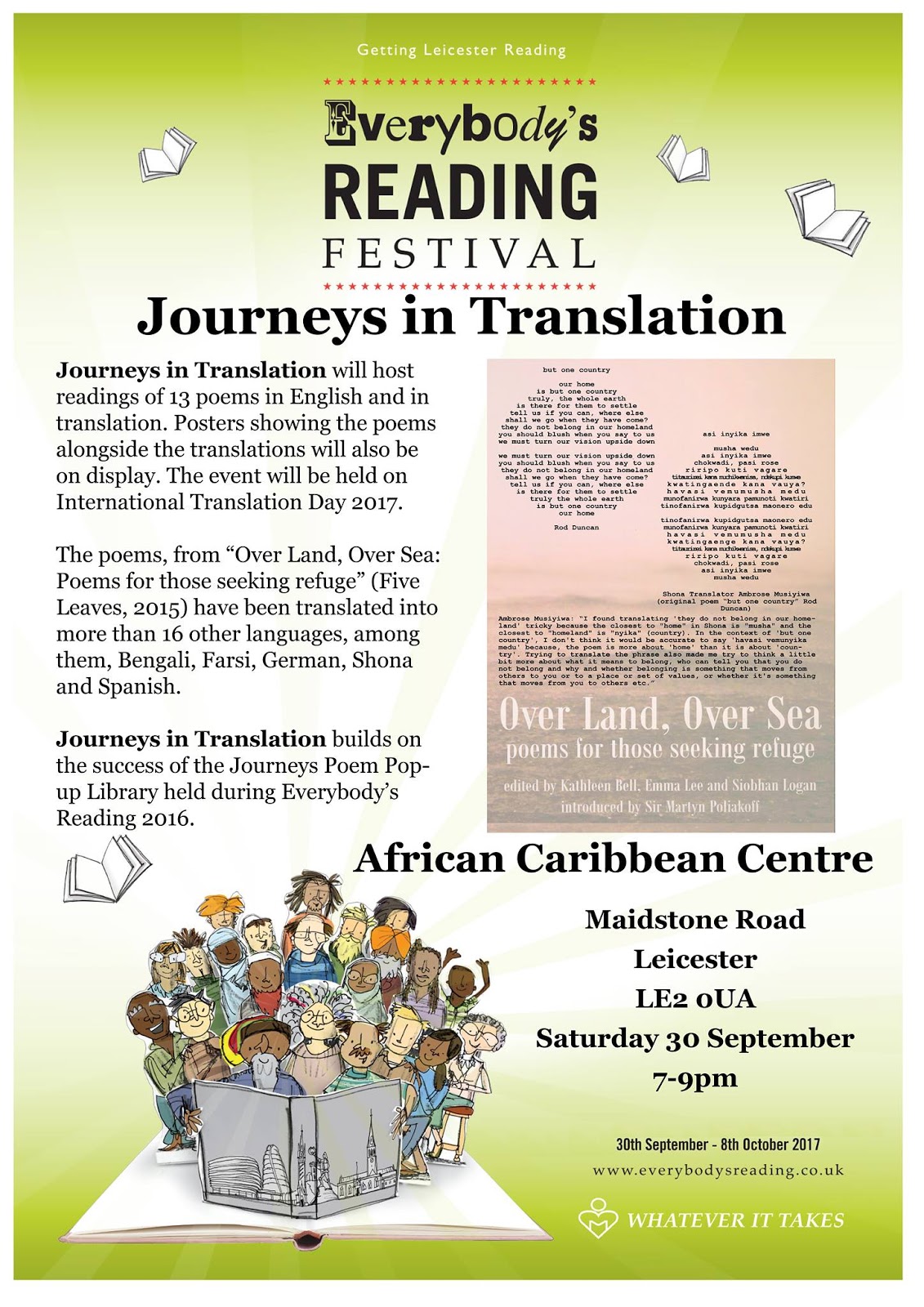
Journeys in Translation — an International Translation Day and Everybody's Reading 2017 celebration

As part of events to mark International Translation Day 2017 and as part of Everybody's Reading, Journeys in Translation will be hosting an event at which 13 poems will be read in English and in translation.

Posters showing the poems alongside the translations will also be on display.

The event will be held at the African Caribbean Centre on International Translation Day which, this year, falls on Saturday, September 30.

The poems, from Over Land, Over Sea: Poems for those seeking refuge (Five Leaves Publications, 2015) have been translated into more than 16 other languages, among them, Arabic, Bengali, Chinese, Farsi, German, Hindi, Italian, Shona and Spanish.

The event is free and open to all.

If you cannot make it to the September 30 event in Leicester, you could:

  1. translate or encourage others to translate as many of the 13 poems as possible,
  2. share the translations and reflections on the translations through blogs, in letters and emails to family and friends and on social media, and/or
  3. organise a related event in your locality at which the 13 poems and translations will be read and discussed and let us know how the event goes.
Over Land, Over Sea: Poems for those seeking refuge was edited by Kathleen Bell, Emma Lee and Siobhan Logan. The anthology is being sold to raise funds for Doctors Without Borders/ Médecins Sans Frontières (MSF), Leicester City of Sanctuary and the Nottingham and Nottinghamshire Refugee Forum.

Copies of the anthology are available from Five Leaves Bookshop (Nottingham).

*See also:

[1] How Over Land, Over Sea came about
[2] Interviews with Journeys in Translation poets and translators
[3] The 13 Journeys in Translation poems:

[a] "but one country", Rod Duncan (Over Land, Over Sea: Poems for those seeking refuge, Five Leaves Publications, 2015) p.123
[b] "Children of War", Malka Al-Haddad (p.119)
[c] "Come In", Lydia Towsey (p.16)
[d] "Framed", Marilyn Ricci (p.114)
[e] "Song for Guests", Carol Leeming (p.92)
[f] "Stories from 'The Jungle'", Emma Lee (p.85)
[g] "The Humans are Coming", Siobhan Logan (p.79)
[h] "The Man Who Ran Through the Tunnel", Ambrose Musiyiwa (p.1)
[i] "Through the Lens", Liz Byfield (p.121)
[j] "Waiting", Kathy Bell (p.62)
[k] "What's in a Name", Penny Jones (p.5)
[l] "Yalla", Trevor Wright (p.94)
[m] "Dislocation", Pam Thompson (p.120)

Sunday, May 21, 2017

Interview _ Grant Denkinson

Grant Denkinson is an Open Access and Research Data Advisor at the University of Leicester's David Wilson Library. He is also a qualified psychotherapist and is one of the contributors to Purple Prose (Thorntree Press LLC, 2016), a new book about bisexuality in Britain.

In this interview, Denkinson talks about writing, sexuality and Purple Prose:

How would you describe Purple Prose?

Purple Prose presents different forms of writing about various aspects of being bisexual, such as being a bi person of faith and so on. Each chapter curates a number of personal experiences, collected thoughts and even tentative advice, together with quotes, cartoons and poems.

The chapter I co-curated with Juliet Kemp covers bisexuality and non-monogamy. The bi community I've been part of has been talking about how you can be bi and happily monogamous, non-monogamous in various ways, or not in relationships at all. Relationships of all kinds we could think of are spoken about in Purple Prose.

We make no argument for one shape of relationship being better than another, just that different ways to love and relate might work better for different people.

How did the book come about?

Kate Harrad decided a book about bisexuality in UK should exist and then made it happen and edited contributions from the UK bisexual community into Purple Prose.

While there has been an active bi movement in UK for many decades, there has not been a UK book by and about bisexuals since Sue George's Women and Bisexuality from 1993.

There have been some excellent academic works and some books from US. However, the UK is a significantly different context and we wanted something for everyone that speaks to personal experience rather than as part of the academic debates.

What are some of the other ways in which Purple Prose is significant?

I'd like this book to be part of making the whole world a better place since bi people are everywhere. We'll only be a small part, but we can play a part.

More specifically, there are a lot of people who, over their lives, have loved, fancied or had some form of sex with several people where those people were not all of the same gender. Many people in UK have had such thoughts or experiences. It seems important to me that there is at least one book out there that says people in this situation are not alone, which acts like a conversational prompt, which mentions aspects of the joys or stresses that they might have, and which comes from a place similar to home rather than from thousands of miles away.

I've met few bisexual people compared to how many there probably are.

Purple Prose is significant because a book can be a private experience. You don't need to be out to anyone to read a book. Books are portable and can be sent and read anywhere. Books last and are preserved in libraries and on bookshelves and can be quoted from and loaned to friends.

Also, many people know others who may be bi and who perhaps they want to understand better without needing to ask intrusive questions or treating one person's experiences as the same as many people's experiences. To gain this understanding, they can read autobiographical journals on-line and articles and news. They can listen to partners, friends and acquaintances. They can pick out films or listen to interviews on the radio or find a podcast. All these things are important but none of them offer the experience that comes from a good book on the subject.

How long did it take to the book together?

The process from conception to launch was a couple of years. Many of the writers met at events and we mainly collaborated online.

A number of UK publishers considered bisexuality too niche a subject despite recent surveys which show that around half of young people do not identify as gay or straight.

It was important to us to have the book properly produced to high quality while keeping the price aimed for the mass market. We therefore crowdfunded to cover the costs of producing the first print run of Purple Prose with Thorntree Press, a small publisher in U.S., who took the chance to expand from their speciality of books about non-monogamy.

Crowdfunding also showed us that there was a reasonably broad interest in the book.

It is wonderful to see the final version, a tangible thing that didn't exist before and can now be out there in the world to fare as it may.

I think we have a good book ... a book that is part of efforts to raise awareness around the complexity and diversity of human sexuality and which lets many voices shine and which does not reduce people to soundbites and simplistic characters.


Purple Prose 
(Thorntree Press LLC, 2016) was written for and by bisexuals in the UK.

Described as, "the first of its kind", Purple Prose: Bisexuality in Britain features interviews, essays, poems and commentary on topics that include definitions of bisexuality, intersections of bisexuality with other identities, stereotypes and biphobia, being bisexual at work, teenage bisexuality, bisexuality through the years, the media's approach to bisexual celebrities, and fictional bisexual characters. 


Which were the most difficult aspects of the work you put into the book?

The bi community I know has been good at accepting and talking about various aspects of complicated, diverse and sometimes fluid human sexuality including how gender or disability intersect with lives, what options for relationship shapes we might consider, and the emotional and physical feelings related to various bodily practices related to BDSM.

We are also catching up on dealing with other parts of bi lives that include race, ethnicity and class.

Making sure we adequately gave voice to those we don't hear from enough because of racism and the like was a challenge. We never wanted to be tokenistic.

Word-of-mouth and the friend-to-friend networks we enjoy can lead us to mainly speak to people like we are personally, in similar positions in society. We wanted a broader approach.

Also, we're all pretty much volunteers on this. We have the whole rest of our lives to live and some of our community are constantly or often having to struggle more in life because of how they are disabled or because they are dealing with the consequences of prejudice.

What are some of the things from your personal experience that influence your writing?

I've been out as bisexual for about half my life and feel most at home as part of the UK and international bi communities. There I feel I can just be myself rather than feel the need to downplay any part of myself or need to keep explaining the basics of my attraction to some people who don't all share the same gender. I've tended to a high level of frustrated energy towards social progress and this has led to me community organising and volunteering often around sex, sexuality and relationships.

I was born in Nottingham in 1971 and have moved around England with work or study as well was living as a kid in Los Angeles because my parents wanted to try the place out.

I've lived in Leicester about a dozen years and love the mix of people and how much of a beacon we can be to show how positive multicultural living can be. I like how much is going on within 15 minutes bicycle ride from my house and that I will meet good people and friends at pretty much anything I go to.

I have never worked out what I want to do when I grow up. I'm into science and techie things and work these days for University of Leicester in the David Wilson Library promoting and supporting open scholarship. I'm also a qualified psychotherapist and support students at De Montfort University and in private practice.

What are your main concerns as a writer? And, how do you deal with these concerns?

In the back of my mind I'm aware of some of the violent backlash or relationship damage that can follow being out and out so publicly. However, I'm in a privileged position with good people around me and I hope any negative reaction I do get will be a sign of possible change and progress and will help others in the future.

I don't think of myself as a writer but cannot deny that I write. There are better crafters of words, better thinkers, people with more experience and knowledge and many other more marginalised voices trying to be heard.

I can amplify and signpost to other writers. I can encourage others to express themselves as they wish and try to lower barriers. I can keep expressing myself despite my inner critics so others may be emboldened to do the same.

If I write and others are inspired to write something better then I have helped offer a step and a goad. Perhaps some people will read and have happier lives or help others to do so. If the only response someone has is critical, that is OK, too ... It shows they are thinking around the the subject.

When did you start writing?

I mainly wrote for myself rather than for others until there were things I wanted to say to a geographically distributed community.

There used to be a magazine in the UK bi community called BiFrost which stopped publication in 1995, just when I was meeting the annual national get-together for bisexuals, friends and allies called BiCon.

Many people wanted a newsletter so Bi Community News was formed and I edited it for a while and still write there.

I've also contributed as a chapter writer or interviewee to a few books and pieces of research work. I wrote a chapter, "SM and Sexual Freedom: A Life History", as an activist, for Safe, Sane and Consensual: Contemporary Perspectives in Sadomasochism by Darren Langdridge and Meg Barker published by Palgrave Macmillan in 2007.

I am currently sharing the findings of a project I conducted recently which collates experiences of bisexual people using emotional support or mental health services and which I hope will lead to better training and professional practice.

And although I am not committing to writing more for books right now, I note that there hasn't been a recent UK book on non-monogamies. I also write snippets and scene settings for fiction as my brain keeps coming up with such narratives and I wonder what would happen if I put them down together on some pages.

Do you write everyday?

I tend to write in bursts of enthusiasm.

I'd like to be better at getting into a writing mood quickly and getting some words down in pockets of dead time throughout the day and be more tolerant of interruptions.

In the writing you are doing, which authors influenced you most?

Writing about sexuality I have much appreciated a number of writers of more ephemeral forms on-line and in zines over the years as well as books such as Pat Califia's Speaking Sex to Power, John Preston's My Life as a Pornographer and Carol Queen's Real Life Nude Girl. These take an unapologetic, brave and clear look at how things could and should be in a better world.

I've also loved bits of recent history including No Bath But Plenty of Bubbles by Lisa Power from the oral history of the Gay Liberation Front; veteran of the campaign for homosexual equality, the late Antony Grey's writings; and Pressing Matters by Christine Burns about the successful Press for Change work around transgender issues.

I can mention books around bisexuality but there are rather a lot of them and an annotated bibliography might be more appropriate!

I feel lucky to have met a number of contemporary bi writers as well as having read their words.

I tend to read speculative fiction, occasionally utopian writers like Iain M. Banks or Ursula K. LeGuin, and dystopian, urban / technical, universe building authors.

I value books above other media and so approach writing for one with care.

Much of my thinking comes from both my own life and the many bi lives I have intersected with. I take the anger, the fear and the hope and joy and try to approach them all as true parts of our stories.
I have felt very open and am operating from a reasonably integrated "me" and am closely connected and moved by some wonderful people when writing.

I am also aware of writing with some horrible experiences in mind because they should not have happened or because people can do better.

And I have spoken to enough people in comic shops and bars to remember that concepts that might have been polished or kicked around in niche communities probably make no sense to the rest of the world ... because of that, I try to be as clear as possible when I write or speak.

Thursday, April 20, 2017

Interview _ Lydia Towsey

Lydia Towsey is a poet and a performer. Her previous commissions include: Freedom Showcase (Literature Network); Spoken Word All Stars Tour (Poet in the City); Beyond Words, U.K. tour of South African poets (Apples and Snakes); and, Three the Hard Way UK tour, alongside Jean ‘Binta' Breeze and Alison Dunne in 2014 and Jean Binta Breeze and Shruti Chauhan in 2015.

Poet, Performer and Spoken Word Artist, Lydia Towsey.
A Decibel commissioned artist, in 2008 Lydia Towsey was one of 50 international artists in residence at Stratford Theatre Royal.

Previously shortlisted for the Bridport Poetry Prize, she has spoken and performed everywhere ... from London’s 100 Club, Roundhouse and the House of Lords, to ... Plymouth University’s Zombie Symposium.

Her work has been featured in publications that include the magazines: The London Magazine, Hearing Voices and Magma Magazine; and the anthologies, Hallelujah for 50ft Women (Raving Beauties, Bloodaxe, 2016), Over Land, Over Sea: Poems for those seeking refuge (Five Leaves Publications, 2015), Welcome to Leicester (Dahlia Publishing, 2016) and within Candlestick Press’ 10 Poems about ... series.

Lydia is currently UK touring the stage show of her collection, The Venus Papers (Burning Eye Books, 2015) produced by Renaissance One, supported by Arts Council England.

In addition to her practice as a poet/performer, Lydia works as a producer, specialising in literature, health, women and excluded communities and works as part-time Arts in Health Coordinator for Leicestershire Partnership NHS Trust. She plays the ukulele, keeps a cat and is the chair/co-ordinator and rotational compere of WORD! - the longest running spoken word night in the Midlands, nominated as ‘Best Regular Spoken Word Night’ in the 2017, national Saboteur Awards.

In this interview, Lydia Towsey talks about the work she is doing.

How would you describe your writing?

My creative writing focuses on poetry and developing work for the page and performance.

I'm particularly interested in narratives surrounding gender, politics, woman and culture - from popular culture to counter culture and the other… to ethnicity and notions of national identity. I enjoy using humour, satire, wordplay, the fantastical and both visual and performance based techniques and approaches to explore these areas.

Who or what has had the most influence on you as a writer?

Who - undoubtedly, Jean Binta Breeze - who I was lucky enough to meet at an early point in my writing career and fall truly, madly, deeply in friendship and fan-girldom with. I was in my mid-20s and experiencing challenging personal circumstances. Jean taught me to look outside of myself and combine the personal with the public. I think of poems of hers like “Ordinary Mawning” pegging out the washing, while America bombs the middle east… now, with new resonance, of course.

Who, also - Scott Bridgwood, my life partner, figurative painter and key creative collaborator. Our work frequently crosses over, and has done so most recently in The Venus Papers. In this, I’ve developed my research in collaboration with Scott, drawing on his knowledge of figurative art and incorporating my work as a life model (within our relationship) to write around these and other experiences/areas of knowledge. He’s always the first person to hear a new poem and the closest thing to a Witch Doctor I’ve found.

Another big influence - around 10 years ago undertaking and completing an MA in Creative Writing at Nottingham Trent University, specialising in poetry and screenwriting. In doing so I was able to develop formal craft, technique and writing processes, which I’ve drawn and built on ever since.

How have your personal experiences influenced your writing?

I began training as a visual artist, initially undertaking a Degree in Critical Fine Art Practice at Brighton University. Though ultimately not a path I pursued, I think I take quite a visual approach to my writing, from the arrangement of text, to style and content. In the case of The Venus Papers, the writing has been at least in part ekphrastic, directly responding to a painting.

Writing about Venus, I’ve also drawn on other backgrounds, specifically the past experience of anorexia, from my late teens through to my early 20s - with this naturally making me interested in such issues as mental health, body image, the media and cultural/societal pressures to conform.

Writing about Venus - as ‘everywoman’ but also ultimate traveller, I’ve also been motivated by my cultural background. Like many people in the UK, I come from a family of immigrants, on my father’s side mostly Hungarian Jewish, though my Great Great Grandfather was Mexican, his wife American - and there are people from/of other places and cultures too, my mother's Welsh. At the same time I'm English and a descendent of the British Empire and therefore implicated in a story of colonialism and post-colonialism. Given all that, a lot of my writing is interested in this question of cultural and national identity, its historical resonance and unfolding contemporary narratives - including Brexit and the current European refugee crisis.

I often write about my own experiences, so everything from being a being a zombie fan (long story), becoming a mother, working part-time for the NHS and keeping a cat - have made it into my work.

I'm currently working on a new collection exploring Englishness and so far, featuring all of the above. Later this year I'll be poet in residence for Literary Leicester and Arriva Buses - thinking about my dad's former occupation as a bus driver, so again working with personal material, but linking it to a broader context.

Lydia Towsey's The Venus Papers (Burning Eye Books, 2015) takes, as it's starting point, Botticelli's 15th Century painting, 'Birth of Venus' where Venus is depicted arriving on a shell at a Cypriot beach, and goes on to imagine Venus transported to the 21st century.

What would you say has been your most significant achievement as a writer so far?

Developing and touring my first full length collection, The Venus Papers, published by Burning Eyes Books (September 2015) and funded by Arts Council England. I first began writing Venus material, six or seven years ago, so the body of work has had a long gestation period and evolved a lot to take in many influences, personal writing breakthroughs, ideas and experiences. Seeing all that come to fruition has been enormously satisfying.

As a whole, The Venus Papers is about how we look - at ourselves, each other and the world - and how others influence the way we do so … from marketing and the media, to representations of women, the (fe)male gaze and the political machine.

The title sequence takes Botticelli’s infamous 15th century painting, "Birth of Venus", depicting Venus, Roman Goddess of love and beauty arriving on a Cypriot beach. It then relocates her to a UK beach in the 21st century and asks what might happen if she were to arrive here, now. So, there are poems like “Venus Walks into a Bar” … “Venus gets a job as a Glamour Model” … “Venus in Primark” … “Venus at Customs” and so on …

Botticelli’s Venus was the first recorded example of a female nude painted and exhibited life size and in many ways the medieval blueprint for every cover girl to come. Against this background and through the eyes and perspective of someone arriving as an outsider, naked and vulnerable, both show and book engage with society, politics, culture and identity ... re-framing familiar contemporary situations to try and look anew.

The tour is produced by Renaissance One and continuing until the end of 2017, with our next dates taking in Wiseword Festival, Canterbury; The Royal Albert Hall and JW3, London; Lancaster Literature Festival, and more.

WORD! - the poetry and spoken word night you chair and compere with fellow committee members, Tim Sayers, Pam Thompson and Richard Byrt - has just been shortlisted in the 2017 Saboteur Awards as the UKs "Best Regular Spoken Word Night".

Tell us about WORD!, its place within the local literature scene and how you feel about the nomination.

WORD! is the longest running spoken word night in the Midlands - est. circa 2001 by Apples & Snakes, and delivered independently by a voluntary committee/organisation since 2008. The night is formed of an open mic, plus booked act(s) and takes place at The Y Theatre, Leicester on the first Tuesday of every month, compered by members of the committee, Pam Thompson, Tim Sayers, Richard Byrt and I.

We take a diverse approach and programme across gender, age, cultural background and style.

Over the last year we’ve presented powerful local voices like Toby Campion, Shruti Chauhan and John Gallas, alongside artists from outside the city - including Mark Pajak, Malika Booker, Jean Binta Breeze MBE and Rosie Garland.

We’ve also programmed exciting local collectives - from a Writing East Midlands literature project, with refugee writers at City of Sanctuary - to a showcase from Project LALU, a group of female ukulele players, writing bilingually and committed to cultural cohesion and wellbeing.

Our open mic is generally busy and attracts both established and emerging voices from near and far. We aim to create a democratic and safe space, where a range of voices can play together, from the acclaimed, to the emerging and/or previously voiceless.

For many years the only spoken word night in Leicester, in more recent years it’s been exciting and energising to see the emergence of many other local literature projects - from our sister nights, Pinnng…K! (particularly open to LGBTQ+ audiences) and Moonshine Wordjam (led by WORD! and Bootleg Jazz and particularly focused on women and diverse artists) - to a range of other initiatives, connected and unconnected to us. In all cases, our work now also involves the voluntary distribution of a regular newsletter, praising, promoting and further supporting such other activity.

WORD! is the longest running spoken word night in the Midlands and has been shortlisted in the 2017 Saboteur Awards as the UKs "Best Regular Spoken Word Night".

What effect would winning the Sabotage Review “Best Regular Spoken Word Event” have on WORD!?

Winning the accolade of ‘Best Regular Spoken Word Event’ in the UK, would of course be a dream. It would really help in our current endeavour to secure public funding - and in doing so substantially grow our work and make it possible for us to reach even more people. If nothing else, being nominated has greatly impressed our cats/mothers/significant others - and provoked us to Instagram!

We find ourselves on a brilliantly inspiring shortlist - so can only hope to follow in our football team’s footsteps, be fearless and ‘do a Leicester’.

If we win, we’ll ask Gary Lineker to present the next WORD! … in his boxer shorts.

If people would like to, they can vote for us, and across other categories, here. Voting closes at midnight on April 30th.

How did you get involved with Journeys in Translation?

I was working on “Three the Hard Way - Part Two” - a show with Jean Binta Breeze and Shruti Chauhan, touring the UK in 2015 and exploring women, our three generations and continents of origin.

In the light of the ongoing and distressing European refugee crisis, we set ourselves and audiences the question “Who’s your neighbour?” - reflecting on such themes as multicultural Britain, globalisation, inter-dependence and migration. In a country built on both transatlantic slavery – and the free movement of Europeans into the New World – how should we define our responsibilities, where should we draw our borders and who should be entitled to what? We invited people from across the country to respond with poems, uploading recordings or links to text, via twitter.

At the same time and in response to the same situation, the call-out came via CivicLeicester for Poems for People, an anthology designed and planned to gather poems and micro-fictions in solidarity with the refugees - then (and still) receiving so little welcome in Europe and specifically of course, the UK.

Jean, Shruti and I were keen to share the call-out alongside our own, raise awareness and contribute to challenging the hostile political and media discourse growing up around the subject.

In addition to sharing the call, we invited project instigator, Ambrose Musiyiwa and co-editor, Kathleen Bell, to share their own poems in solidarity and speak about the book at our first tour date, Upstairs at the Western, in Leicester.

I went on to submit and have two poems placed in Over Land, Over Sea: Poems for those seeking refuge (Five Leaves Publications, 2015) the anthology that came out of the initiative, and have been keenly following the Journeys in Translation stage of the initiative's genesis.

As part of Journeys in Translation, my piece, "Come In" has been translated into six languages so far and I’ve seen it chalked onto the pavements of Leicester as part of one of CivicLeicester’s many activist happenings. I feel very proud to be connected to the project and grateful for its existence.

Lydia Towsey's "Come In" is one of the 13 poems from Over Land, Over Sea: Poems for those seeking refuge (Five Leaves Publications, 2015) that are being translated into other languages as part of Journeys in Translation. So far, the poem has been translated into six languages.

Which were the easiest aspects of the work you put into the project?

Unusually for me, I found it relatively easy to write the poems. I wrote both of those featured in Over Land, Over Sea, around the time our government announced it would shelter only 4,000 of the most severely affected refugees - a minuscule number comparative to need, resources at our disposal and offers made by fellow European countries. My feelings were so strong and the issues so specific that I was able to work quickly.

Post Brexit, the rise of racist attacks, and our government’s new announcement, that it will now take only 350 child refugees - the hardest thing is to not give in to despair and feel powerless. I deal with such fears by continuing to write and speak positively around the subject, donate what I can to charities supporting refugees, engage with activism and exercise my voting rights to effect the change I want to see.

Lydia Towsey's poem, "Come In", on the pavement at the Leicester Against War / Leicester for Peace vigil that, since December 2015, is held every Friday at the Clock Tower in Leicester in solidarity with people from everywhere who are bearing the brunt of war and those who are seeking refuge.

What would you say is the value of initiatives like Journeys in Translation?

Journeys in Translation is exciting and dynamic as both a political and an artistic endeavour. The poems and micro-fictions are in response to migration, a politically resonant and urgent subject - but then the words and poems are themselves migrating across language borders, and then migrating between stage and page - then onto the internet, pavements, placards and beyond. The project has great value in its reach, artistry, innovation and activism.

In translating poems over multiple languages and involving even more people, as translators and audience (in conventional and unconventional settings) it has the ambition and power to bring people together and unite diverse groups and communities - something that is of evident value and importance, and particularly so now.

Editor's Note:

Journeys in Translation aims to facilitate cross- and inter-cultural conversations around the themes of home, belonging and refuge.

The project encourages people who are bilingual or multilingual to have a go at translating 13 of the 101 poems from Over Land: Over Sea: Poems for those seeking refuge (Five Leaves Publications, 2015) from English into other languages and to share the translations, and reflections on the exercise on blogs, in letters and emails to family and friends, and on social media.

So far, the 13 poems that are being used as part of the project have been translated into languages that include Italian, German, Shona, Spanish, Bengali, British Sign Language, Farsi, Finnish, French, Turkish and Welsh. Currently, over 20 people from all over the world are working on the translations. More translations and more languages are on the way.

In Leicester, Journeys in Translation will culminate in an event that is going to be held on September 30 as part of Everybody's Reading 2017. During the event the original poems and translations will be read, discussed and displayed.

Over Land, Over Sea: Poems for Those Seeking Refuge (Five Leaves Publications, 2015) was edited by Kathleen Bell, Emma Lee and Siobhan Logan and is being sold to raise funds for Doctors Without Borders/ Médecins Sans Frontières (MSF)Leicester City of Sanctuary and the Nottingham and Nottinghamshire Refugee Forum.

Copies of the anthology are available from Five Leaves Bookshop (Nottingham).

More information on how Over Land, Over Sea came about is available here.